
Here is the part most meltdown advice skips: the most important moment is not the meltdown itself. By the time a student is screaming, hiding under a table or throwing a chair, the window for teaching has closed. What you do in the quiet hours before, and in the fragile hour after, shapes how often meltdowns come back. Good meltdown support is a cycle, not a reaction.
This guide follows that cycle in three phases, with one infographic for each: 10 prevention strategies, 10 things to avoid during a meltdown, and 10 steps for recovery. It is written for special education teachers and paraprofessionals, with notes for parents and for neurodivergent teens and adults who want to understand their own meltdowns.
What a meltdown actually is (and is not)
A meltdown is an involuntary stress response. The nervous system has taken in more than it can process, whether that is noise, light, demands, emotion, change, hunger or fatigue, and it switches into survival mode. The National Autistic Society describes it as an intense response to overwhelming situations, during which the person temporarily loses control of their behavior. It can be loud (crying, shouting, hitting, running) or quiet (freezing, going mute, withdrawing). The quiet version is often called a shutdown.
A meltdown is not a tantrum. A tantrum usually has a goal and an audience, and it tends to stop once the goal is met or the audience leaves. A meltdown keeps going even when the trigger is removed, because the body needs time to come down. If you want the full comparison, read our guide to meltdown vs tantrum and our breakdown of what a meltdown is not.
Meltdowns are most often discussed in autism, but they also happen with ADHD, PDA profiles, anxiety, sensory processing differences and trauma. Repeated meltdowns are also a warning sign: NHS guidance notes that persistent meltdowns and shutdowns can lead to autistic burnout, a long-term state of exhaustion and lost skills (see autistic burnout in children).
The meltdown cycle: three phases, three jobs
Think of each meltdown as having three parts. Your role changes in each one, and most mistakes happen when adults use the tools of one phase in another, like teaching a lesson in the middle of a crisis.
The Child Mind Institute describes the same logic for autistic meltdowns: once the crisis phase begins, the adult can no longer redirect it and should focus on safety until de-escalation happens. Everything strategic happens before or after.
Before: 10 prevention strategies to reduce meltdowns
Prevention is where you get the biggest return. Every trigger you remove or soften is one less drop in the bucket. Here are the ten strategies we recommend building into daily practice.
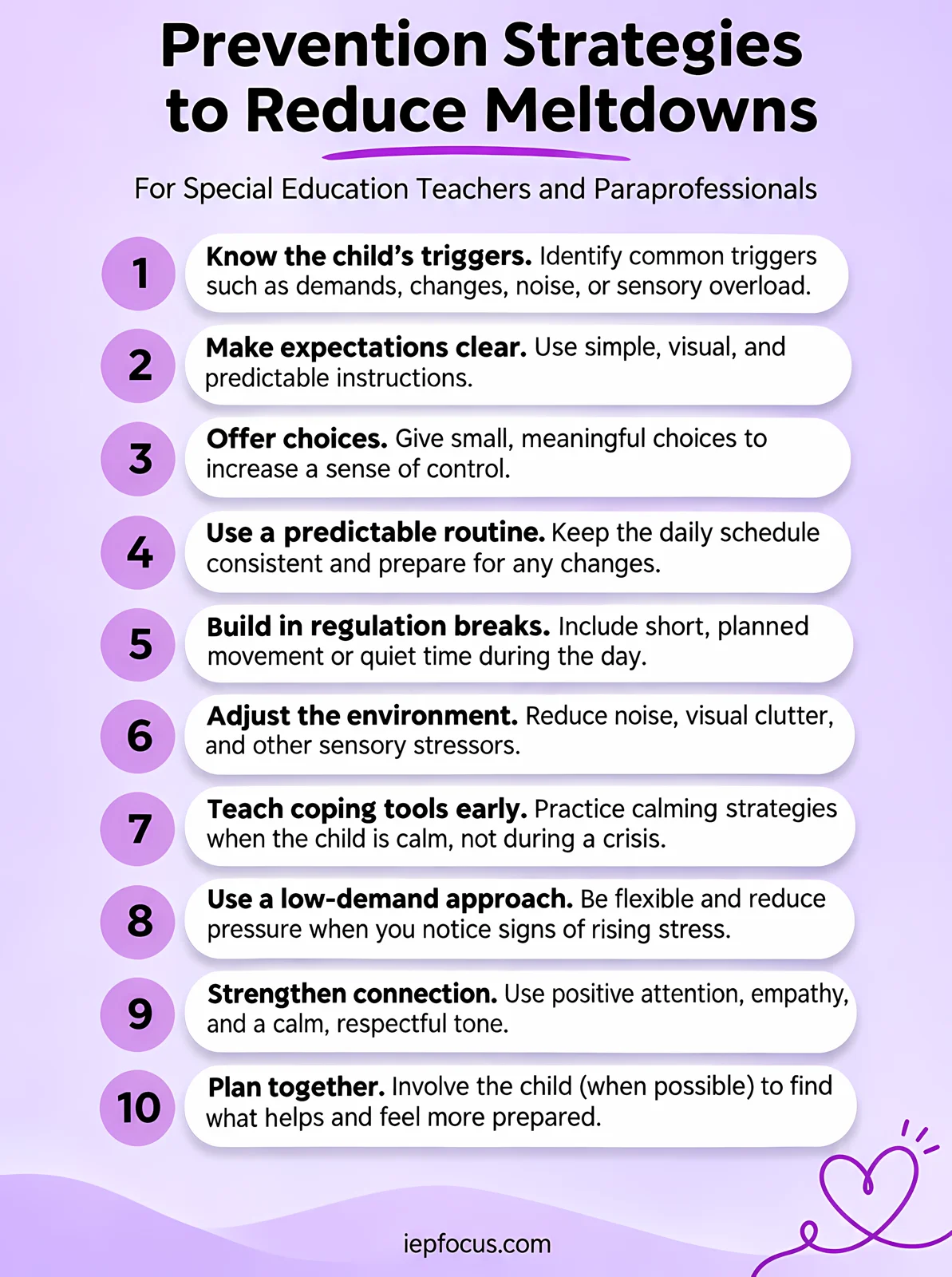
1. Know the child’s triggers
Most meltdowns are not random. Track what happened in the 30 minutes before each one: the activity, the noise level, the time of day, who was present, whether the child had eaten. After four or five entries, patterns appear. A simple log such as our behavior de-escalation log makes this fast.
2. Make expectations clear
Uncertainty is exhausting. Show what is expected with visuals, a model or a short checklist, and say it once in plain words. “Write three sentences, then you can choose a break” is easier to process than “finish your work.”
3. Offer choices
Small, real choices give back a sense of control: which task first, pencil or keyboard, sit at the desk or the beanbag. Two options are enough. Choices are especially powerful for students with a PDA profile, where declarative language also helps.
4. Use a predictable routine
A posted schedule lets the brain stop scanning for surprises. When change is unavoidable, warn early and show it on the schedule. See our guides on visual schedules in the classroom and transitions for autistic children.
5. Build in regulation breaks
Breaks work best when they are planned, not earned. Short movement or quiet breaks every 20 to 40 minutes let pressure out before it builds. Our sensory breaks guide has ideas by sensory profile.
6. Adjust the environment
Dim harsh lights, reduce visual clutter on walls, offer headphones, and give the student a seat away from the door and the pencil sharpener. A well-designed calm corner gives everyone a place to go before things peak.
7. Teach coping tools early
Nobody learns to swim while drowning. Practice breathing, squeezing a fidget, using a break card or pointing to a feelings chart during calm moments, many times, so the tool is automatic when stress rises. Teaching body awareness through interoception helps students notice the early signs themselves.
8. Use a low-demand approach when stress rises
When you notice early signs (pacing, humming, covering ears, short answers, a flushed face), drop or delay demands instead of pushing through. Finishing the worksheet is not worth a 40-minute meltdown and a lost afternoon.
9. Strengthen connection
Students regulate better with adults they trust. A daily two-minute check-in about something the student loves builds the relationship you will lean on during hard moments. This is the foundation of co-regulation.
10. Plan together
When possible, involve the student. Ask: “What makes the classroom too much? What helps you feel better?” Students who help write their own plan are more likely to use it, and it builds self-advocacy skills.
During: 10 things to avoid during a meltdown
Once a meltdown starts, the thinking brain is offline. Language, reasoning and memory are hard to access. That is why the most helpful thing you can do is often to do less. The list below is about what to remove.
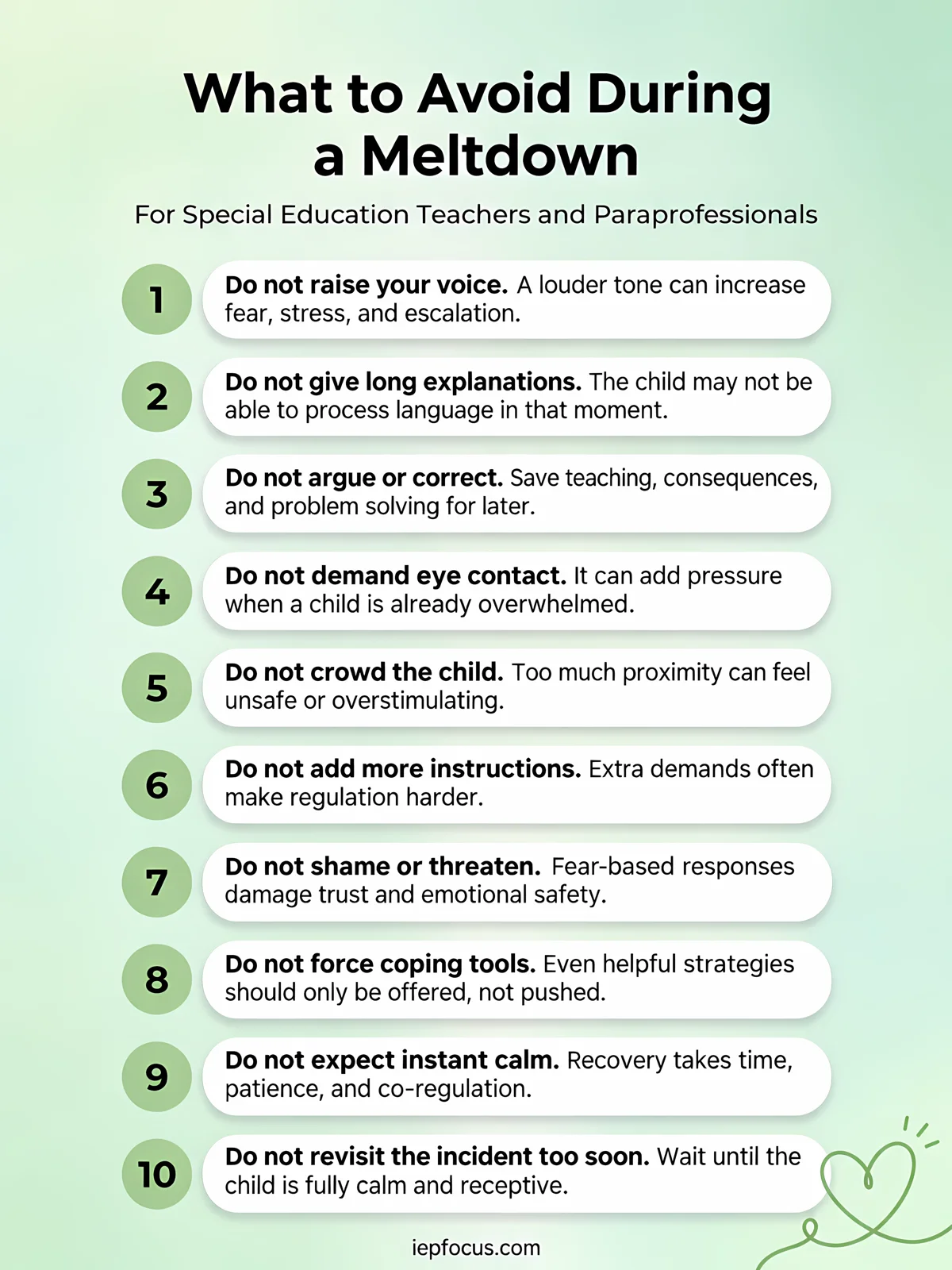
| Avoid | Why it backfires | Try instead |
|---|---|---|
| 1. Raising your voice | Signals danger to an already alarmed nervous system | Lower, slower voice than usual |
| 2. Long explanations | Language processing is limited during overload | Five words or fewer: “You’re safe. I’m here.” |
| 3. Arguing or correcting | Turns distress into a power struggle | Save teaching and problem solving for later |
| 4. Demanding eye contact | Adds sensory and social pressure | Sit or stand side-on, at a lower level |
| 5. Crowding the child | Proximity can feel threatening | Keep a safe distance, stay visible |
| 6. Adding instructions | Every demand is more input to process | Pause all demands until calm returns |
| 7. Shaming or threatening | Damages trust and increases fear | Neutral, warm presence |
| 8. Forcing coping tools | A pushed tool becomes another demand | Place the tool nearby, silently |
| 9. Expecting instant calm | The body needs time to come down | Wait. Breathe slowly yourself |
| 10. Revisiting too soon | Talking about it can restart the meltdown | Wait until the child is fully regulated |
What you can do while you avoid all that
- Make the space safe. Move objects that could hurt, and if needed, calmly move other students out rather than moving the child.
- Regulate yourself first. The Child Mind Institute notes that co-regulation starts with the adult managing their own stress. Slow your breathing, drop your shoulders. Your calm is contagious.
- Use a short, repeated phrase. Pick one and stick with it.
- Get support. Call your para or a trusted colleague using a pre-agreed signal.
“You’re safe.” (pause 20 seconds)
“I’m right here.” (pause)
“Your headphones are on the table.” (place them, step back)
More scripts: de-escalation scripts for teachers.
Physical restraint and seclusion are emergency measures with real risks, and many states restrict them. Know your district policy and read our overview of restraint and seclusion in schools.
After: 10 recovery steps
The recovery phase is often longer than the meltdown itself. Many autistic adults describe meltdowns as physically painful and draining, and children feel the same exhaustion even when they cannot name it. Rushing back to work too soon is one of the most common causes of a second meltdown the same day.
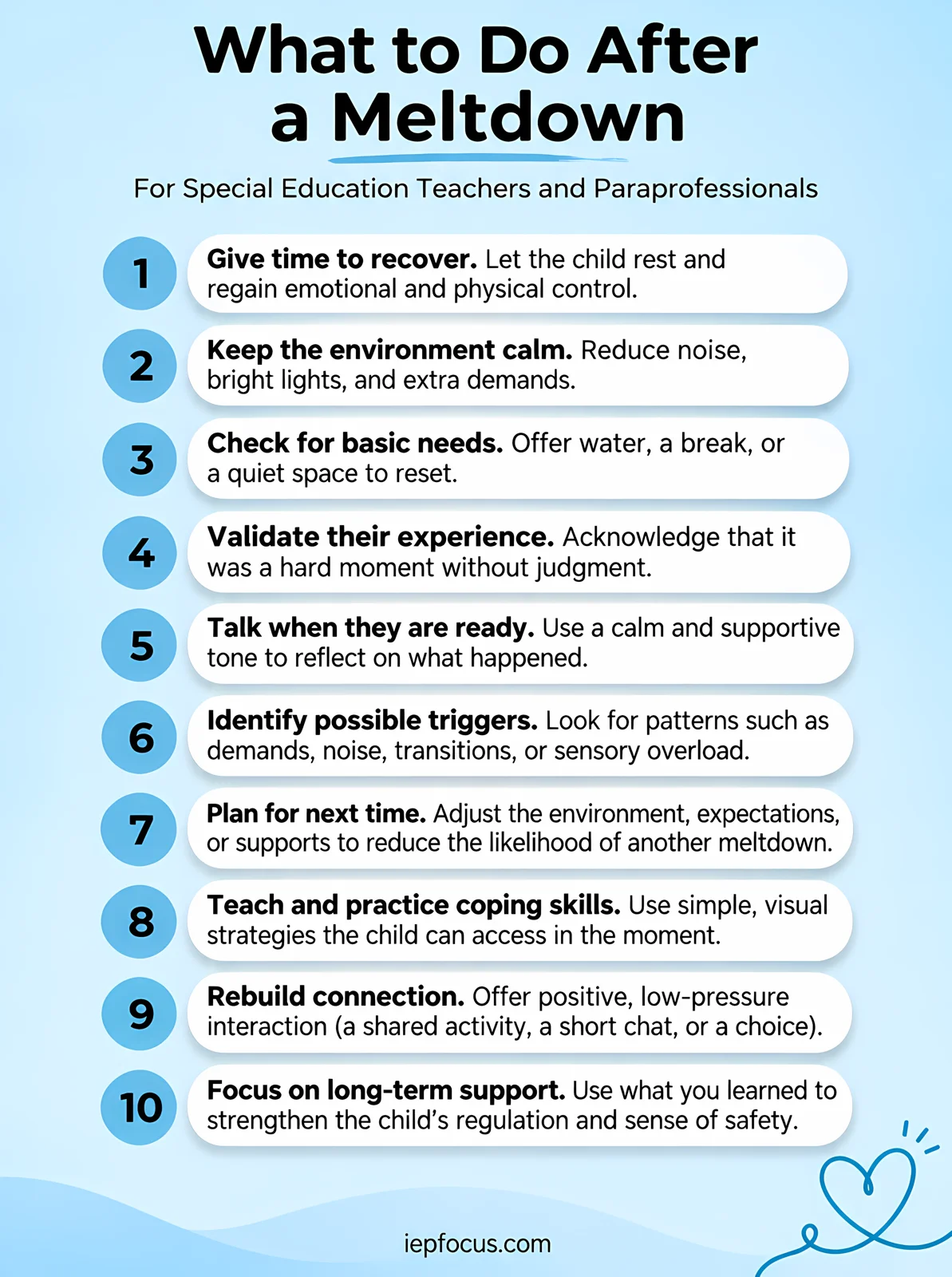
Right after: the first 10 to 30 minutes
- Give time to recover. Let the child rest. Some need 10 minutes, some need an hour.
- Keep the environment calm. Low noise, soft light, no extra demands.
- Check basic needs. Water, a snack, the bathroom, a quiet space. Meltdowns burn a lot of energy.
- Validate the experience. “That was really hard.” No judgment, no “but”.
Later the same day: reflect and repair
- Talk when they are ready. Use a calm tone, and offer other ways to reflect: drawing, a comic strip, a visual feelings scale, or writing.
- Identify possible triggers. Look for patterns such as demands, noise, transitions or sensory overload. Add the episode to your log.
- Rebuild connection. Offer a positive, low-pressure moment: a shared activity, a short chat about a favorite topic, or a choice. This tells the child the relationship is intact.
The following days: plan forward
- Plan for next time. Adjust the environment, expectations or supports based on what you learned.
- Teach and practice coping skills. Use simple, visual strategies the child can reach in the moment.
- Focus on long-term support. Use every episode to strengthen regulation and the child’s sense of safety, not to build a case against them.
At home: a version for parents
The same cycle works at home. Parents often see the biggest meltdowns right after school, because children who mask all day release the pressure in the place they feel safest (see autistic masking).
- Before: plan a decompression time after school with no questions, a snack and a quiet activity. A visual schedule for home helps evenings feel predictable.
- During: protect siblings, lower the lights, and say as little as possible. You do not need to fix it, only to stay nearby and safe.
- After: reconnect before you reflect. A hug, a favorite show together or a drink. Talk the next day if needed.
- With school: share a short note with the teacher about what helped. Families and teachers using the same words and tools is one of the strongest prevention strategies there is.
For PDA profiles, a low-demand parenting approach can cut meltdowns significantly.
Teens and adults: when you are the one melting down
Meltdowns do not stop at childhood. Autistic and ADHD teens and adults experience them too, often after long periods of masking, sensory overload or stress at school or work. If that is you, the same three phases apply.
- Know your early signs. Rising irritability, tunnel vision, noise suddenly feeling painful, words getting harder to find.
- Have an exit plan. Headphones, a quiet room, a card or text you can send (“I need 15 minutes, I’m okay”).
- Allow real recovery. Sleep, comfort food, a special interest, no social demands. Recovery is not laziness.
- Ask for accommodations. At school, college or work, you can request breaks, a quieter space or advance notice of changes.
Shutdowns are the quieter cousin of meltdowns. Learn more in autistic shutdown in adults.
Putting meltdown support in the IEP or BIP
If meltdowns are frequent, they deserve a written plan so every adult responds the same way. A functional behavior assessment can identify triggers and needs, and the IEP can include:
- Accommodations: scheduled sensory breaks, access to a calm space, headphones, advance warning of transitions, reduced workload on hard days.
- Goals: recognizing early signs of stress, requesting a break, using a chosen coping tool. See our bank of self-regulation IEP goals.
- A crisis response plan: who responds, what words they use, where the student goes, and how families are informed.
- A recovery protocol: how long before returning to work, and what the first task looks like.
Remember that behavior is communication. Every meltdown is information about what the student needs.
FAQ
How long does a meltdown last?
It varies from a few minutes to over an hour, and recovery can take longer than the meltdown itself. Removing demands and sensory input usually shortens it.
Should I talk to a child during a meltdown?
Very little. Use a short, calm phrase such as “You’re safe, I’m here” and repeat it if needed. Save explanations and discussion for when the child is fully calm.
Can meltdowns be completely prevented?
Not always. The goal is fewer, shorter and less intense meltdowns, through trigger awareness, predictable routines, planned breaks and coping skills taught in calm moments.
When should we talk about what happened?
Only once the child is fully regulated, which may be later that day or the next day. Use visuals, drawing or a simple feelings scale if talking is hard.
Is a meltdown a sign of autism?
Meltdowns are common in autism but are not a diagnosis on their own. They can also occur with ADHD, anxiety, sensory processing differences and trauma. If you have concerns, speak with a qualified professional.
References
- National Autistic Society. Meltdowns: a guide for all audiences.
- Child Mind Institute. How to De-Escalate an Autistic Meltdown.
- Child Mind Institute. What Is Co-Regulation?
- Autism Society of America (2025). Autistic Meltdowns and Shutdowns: An Inclusive Guide.
- Lewis, L. F. & Stevens, K. (2023). The lived experience of meltdowns for autistic adults. Autism. doi:10.1177/13623613221145783
- The Open University, OpenLearn (2025). Why an autistic meltdown or shutdown is not a ‘tantrum’.
- NHS Scotland Right Decisions. Autistic meltdowns and shutdowns.
- Reframing Autism. All About Autistic Meltdowns: A Guide for Allies.
Was this article helpful?
Tap a star to rate

