
Most behavior documentation forms were designed by administrators, not by the people actually crouching beside a dysregulated student at 10:43 a.m. They are too long, too vague, or so focused on consequences that they skip the most important question: what happened right before?
In 2026, school behavior teams are still losing critical pattern data because the forms teachers fill out after an incident don’t capture what matters. A review of PBIS documentation practices found that over 60% of school behavior logs lack a structured antecedent field, meaning teams are repeatedly responding to crises without ever identifying what triggers them.
This free behavior de-escalation log for special education was built differently. It follows the actual sequence of a behavioral incident, context → escalation signs → triggers → adult strategies → student response → recovery → staff reflection. Read it directly below, then download your copy.
📌 In This Article
Read the free behavior de-escalation log below
You can scroll through the full document directly here. To save your copy, use the download button in the toolbar or the button below the viewer.
📋 Free Behavior De-Escalation Log
Printable PDF · 1 page · Ready to use today · No sign-up required
⬇ Download Free PDFFree for all educators. Print and share with your team.
What is a behavior de-escalation log, and why does it matter more than a standard incident report?
A standard incident report answers one question: what did the student do? A behavior de-escalation log answers the questions that actually change outcomes: What happened first? What did the adult do? How did the student respond? What will we do differently?
This distinction is not semantic. When a student with autism, ADHD, PDA, or another profile experiences a behavioral crisis, the moment itself is rarely the problem, it is the final, visible step in a chain of events that started much earlier. Without structured documentation of that chain, teams are forced to keep reacting to the same crises without ever interrupting the pattern.
A behavior de-escalation log is a proactive, neuroaffirmative data tool. It shifts the team’s lens from “what’s wrong with this student?” to “what does this student need, and what conditions are we failing to provide?”
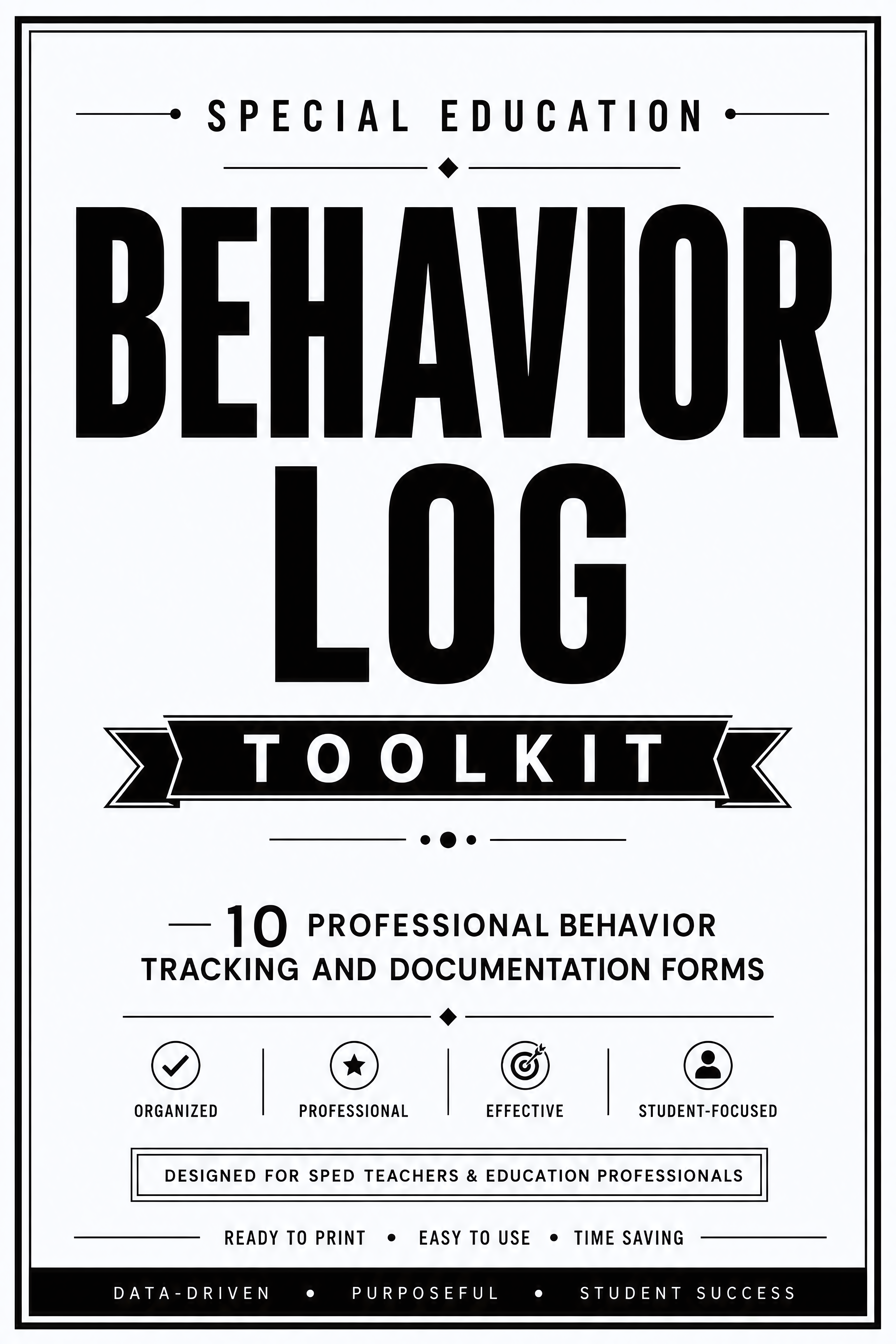
Free resource
Behavior Log Toolkit: 10 Tracking Forms
Professional forms to document behavior, triggers and progress for IEP meetings.
Download free →What does this behavior de-escalation log track? The 7 sections explained
Every section of this log was designed to collect information that is genuinely actionable. Here is what each one captures and why it matters.
① Incident Context
Records the time, the activity or task underway, the antecedent (what happened immediately before the behavior), the environment, and any relevant notes. This is the most underused, and most important, field in any behavior form. Antecedent data is what allows teams to prevent the next incident.
② Escalation Signs Observed
A checkbox list of observable early-warning signals: verbal refusal, withdrawal, raised voice, aggression, property destruction, flight risk, emotional outburst, and an open “Other” field. Checking these consistently trains staff to recognize the escalation before it peaks, the window where de-escalation is still possible.
③ Triggers Identified
Six evidence-based trigger categories: unexpected routine change, direct instruction or demand, peer conflict or pressure, sensory overload, performance pressure, and adult tone or perceived authority. For many neurodivergent learners, especially those with PDA profiles, this last trigger is among the most significant and the most overlooked.
④ De-Escalation Strategies Used by Adult
Documents what the staff member actually did: reduced verbal demands, allowed space and time, rephrased the request or offered choices, provided calming sensory input, used positive reinforcement, or engaged in collaborative problem-solving. This section builds an evidence base of what works for each individual student.
⑤ Student Response During De-Escalation
A five-option checkbox: calmed with support, calmed independently, continued escalation, removed from environment, or other. Tracked over multiple incidents, this single field reveals whether current strategies are working, or whether the team needs to adjust its approach.
⑥ Outcome & Recovery
Captures incident duration, whether the student re-engaged with the task, the level of support needed, and the student’s emotional state post-incident. The “emotional state post-incident” field is particularly valuable for understanding recovery time, critical for scheduling, transitions, and re-entry planning.
⑦ Staff Reflection
Four structured prompts: What worked well? What could be improved next time? What patterns are emerging over time? What are the next steps? This section closes the loop. Without it, even excellent documentation stays inert.
Why this behavior de-escalation log is particularly useful for neurodivergent students
Standardized behavior management systems were designed for neurotypical students in neurotypical classrooms. For many neurodivergent learners, teams need to understand the function of behavior, not just its form. A log that captures antecedents, sensory triggers, and adult-side variables gives teams exactly that understanding.
| Student Profile | Most Relevant Log Sections | Insight It Provides |
|---|---|---|
| Autism / sensory differences | Triggers (sensory overload) + Environment | Identifies sensory conditions that consistently precede escalation |
| PDA profile | Triggers (direct instruction, adult tone) + Strategies (choices offered) | Shows whether autonomy-supporting strategies reduce escalation frequency |
| ADHD | Incident Context (activity/task) + Escalation Signs | Maps which task types or transitions are highest-risk |
| Anxiety / RSD | Triggers (performance pressure, peer conflict) + Recovery (emotional state post-incident) | Tracks recovery duration and patterns around perceived failure |
| AuDHD | All sections, especially Staff Reflection patterns | Builds a longitudinal picture of compounding triggers across the day |
How to use this behavior de-escalation log effectively in your SPED classroom
Complete it within 30 minutes of the incident
Memory degrades fast under stress. The antecedent field, the most important section, is the first to go. Keep a printed stack in your classroom toolkit and complete the log while details are still fresh.
Focus on the adult side, not just the student side
Sections 4 and 7 are about what staff did and what staff can do differently. This is where the real leverage is. A student’s behavior tells you what they need. The staff response tells you whether the team’s approach is meeting that need.
Use it as a team document, not a personal record
Share completed logs at weekly check-ins or BIP review meetings. When multiple staff members complete the log for the same student across different incidents, patterns emerge quickly, and so do inconsistencies in implementation that may be driving escalation.
Pair it with the student’s IEP behavior goals
Cross-reference the log against the student’s current IEP behavioral objectives. If the strategies in Section 4 don’t align with the student’s BIP, that misalignment is itself a data point for the next IEP meeting.
How to use the behavior de-escalation log to identify patterns over time
Step 1: Collect at least 5 incidents before drawing conclusions
Behavioral patterns require a sample size. Five to ten incidents give you enough variation to distinguish genuine triggers from coincidence. Resist the urge to overgeneralize from one or two incidents, especially if they occurred under unusual conditions.
Step 2: Look for recurrence across three fields
When reviewing multiple logs, highlight recurrences in: (1) the Antecedent field, what activity or demand was present, (2) the Triggers Identified checkboxes, which boxes are checked most consistently, and (3) the Student Response field, is a particular strategy consistently associated with calming?
Step 3: Bring patterns to the BIP or IEP team
Documented patterns from a behavior de-escalation log are among the most persuasive evidence a SPED teacher can bring to an IEP meeting. They shift the conversation from anecdote to data, and make it significantly easier to justify specific, individualized accommodations and supports.
📋 Download the Free Behavior De-Escalation Log
PDF · Print-ready · Neuroaffirmative framework · No login required
⬇ Get the Free PDFFree to use, print, and share with your school team.
More Tools to Use With Your Behavior De-Escalation Log
- Behavior de-escalation in the classroom
- De-escalation scripts for teachers
- Free sensory needs guide for kids
- Strategies to manage hyperactivity in the classroom
Trusted outside sources: Child Mind Institute: De-escalating a meltdown and National Autistic Society: Meltdowns.
Frequently asked questions about behavior de-escalation logs
What is the difference between a behavior de-escalation log and a behavior incident report?
A behavior incident report documents what happened and what consequence was applied, it is primarily a compliance tool. A behavior de-escalation log documents the full sequence of an incident, including antecedents, adult responses, and recovery, it is a learning and prevention tool. Both may be required, but the de-escalation log is the one that actually informs better practice.
How often should a behavior de-escalation log be completed?
Complete a log for every incident that requires staff intervention, regardless of severity. Low-level incidents documented consistently often reveal the most important patterns. High-severity incidents documented in isolation tell you very little about prevention.
Can this log be used as part of a student’s Functional Behavior Assessment (FBA)?
Yes. Completed de-escalation logs are valuable source data for an FBA. The antecedent, trigger, and environmental fields directly inform the A-B-C analysis central to any FBA. Teams that maintain consistent logs before beginning an FBA typically complete the assessment faster and with higher-quality hypothesis statements.
Is this behavior log appropriate for students with PDA profiles?
Yes, and it is especially useful. The Triggers section includes “direct instruction/demand” and “adult tone/perceived authority,” among the most common PDA triggers. Section 4 includes “rephrased request/offered choices” and “collaborative problem-solving,” both core PDA-informed strategies. The log helps teams track whether autonomy-supporting approaches are reducing escalation over time.
Can paraprofessionals and classroom aides complete this log?
Absolutely. Paraprofessionals present during incidents often have the most direct observational data. Brief the whole team on how to complete it consistently, particularly the antecedent and strategies sections, and designate who reviews and compiles logs across the team.
5 things to do with this log starting tomorrow
- Print 10 copies and keep them in your classroom, not in a binder, not in the office. At the point of incident.
- Brief your para or co-teacher on Sections 2 and 4 specifically, escalation signs and strategies. Shared language between adults is what makes the log work.
- Complete your first log within 30 minutes of the next incident, even if it feels incomplete. An imperfect log filled out immediately beats a perfect one written from memory the next day.
- After your 5th completed log, tally the Triggers section. Which boxes appear most often? That answer is where your proactive support should start.
- Bring your logs to the next IEP or BIP review meeting: not as anecdotes, but as a data set. Pattern documentation changes the conversation from “this student is difficult” to “here is what this student needs.”
Related reading: