It is 7:42 in the morning. Breakfast is on the table. You have said “shoes on” four times in a calm voice. On the fifth, the chair scrapes back, your child bolts upstairs, and what started as a Tuesday becomes a two-hour standoff that leaves you both exhausted, late, and quietly dreading tomorrow. If this sounds familiar, you are not failing as a parent, you are parenting a child whose nervous system experiences demands very differently from most.
Pathological Demand Avoidance (PDA) is a profile on the autism spectrum characterized by an extreme, anxiety-driven need to resist everyday demands and maintain a sense of autonomy. Traditional parenting strategies, rewards charts, clear consequences, structured routines, often make PDA worse, not better. The more a demand is pressed, the higher the anxiety, and the more intense the response.
Low demand parenting offers a different framework. Developed and refined within the PDA community over the past decade, it is now recognized by leading researchers and clinicians as the most effective approach for creating a PDA-affirming home. This article breaks down exactly what it means, why it works, and what it looks like day to day, from morning routines to meltdown recovery.
What Is Low Demand Parenting?
Low demand parenting is an approach that deliberately reduces the number, frequency, and pressure of demands placed on a child whose nervous system struggles to process them without significant distress. It was articulated most clearly by Amanda Diekman (author of What I Mean When I Say I’m Autistic) and aligns closely with the work of clinical psychologist and author Naomi Fisher, whose book Changing Our Minds reframes demand-avoidance through a trauma-informed, autonomy-supportive lens.
At its core, low demand parenting asks one deceptively simple question before every request: Is this demand actually necessary right now? Many of the demands children encounter daily, getting dressed at a specific time, eating at the table, saying hello to a relative, feel essential to adults but are, in fact, negotiable. When unnecessary demands are removed, the total demand load decreases. When the demand load decreases, the nervous system has more capacity. When the nervous system has more capacity, connection, learning, and flexible behavior become possible again.
It is important to name what low demand parenting is not. It is not permissive parenting, where anything goes and adults abdicate responsibility. It is not child-led anarchy. Safety needs are always maintained. What changes is the delivery of expectations, the frequency of direct commands, and the adult’s willingness to be flexible about how and when non-urgent tasks happen. The goal is a regulated nervous system, not a perfectly obedient child.
For PDA specifically, low demand parenting is the foundation of everything else. Without reducing the demand load, no other strategy, no social story, no visual schedule, no reward chart, has a chance of working. The PDA nervous system cannot access reasoning or compliance when it is in a threat state. Low demand parenting prevents the threat state from being triggered in the first place.
Understanding the PDA Family Experience
Families navigating PDA often describe a particular kind of exhaustion that is hard to convey to people outside it. It is not just the logistical difficulty of getting a child to school or through a meal, it is the chronic hypervigilance, the constant calculation of every word before it is spoken, the grief of watching a child who is clearly intelligent and creative become completely dysregulated by the word “time to go.”
Researcher and parent advocate Steph Curtis, whose work on The Family Experience of PDA has been widely cited in the UK PDA community, documents how the entire family system reorganizes around the PDA child’s demand-avoidance, often at significant cost to parents, siblings, and the couple relationship. Parental burnout is common. Parental guilt is nearly universal. Many parents describe being told by professionals, teachers, and relatives that they are “too permissive,” “inconsistent,” or “enabling bad behavior”, when in fact they have discovered through painful trial and error that conventional strategies simply do not apply.
| What it looks like in the family | What is actually happening neurologically |
|---|---|
| Child refuses to get dressed despite being calm moments before | The demand triggered an autonomic threat response before conscious processing could occur |
| Child agrees, then completely melts down at the last minute | Demand anxiety built silently; compliance was masking, not genuine regulation |
| Child can do something easily in one context but refuses in another | The relational or environmental demand load in that context was higher, capacity was used up |
| Child is explosive at home but reportedly “fine” at school | Masking depletes regulatory resources all day; the safe relationship is where the nervous system finally releases |
| Consequences and rewards make behavior worse | Contingency-based systems increase perceived demand and reduce sense of autonomy, both amplify PDA responses |
Understanding the neurological basis of these patterns is not about lowering expectations, it is about directing your energy toward strategies that actually work, and releasing yourself from approaches that cannot work regardless of how consistently you apply them. For a deeper look at how anxiety drives the PDA profile, see our guide on PDA and anxiety.
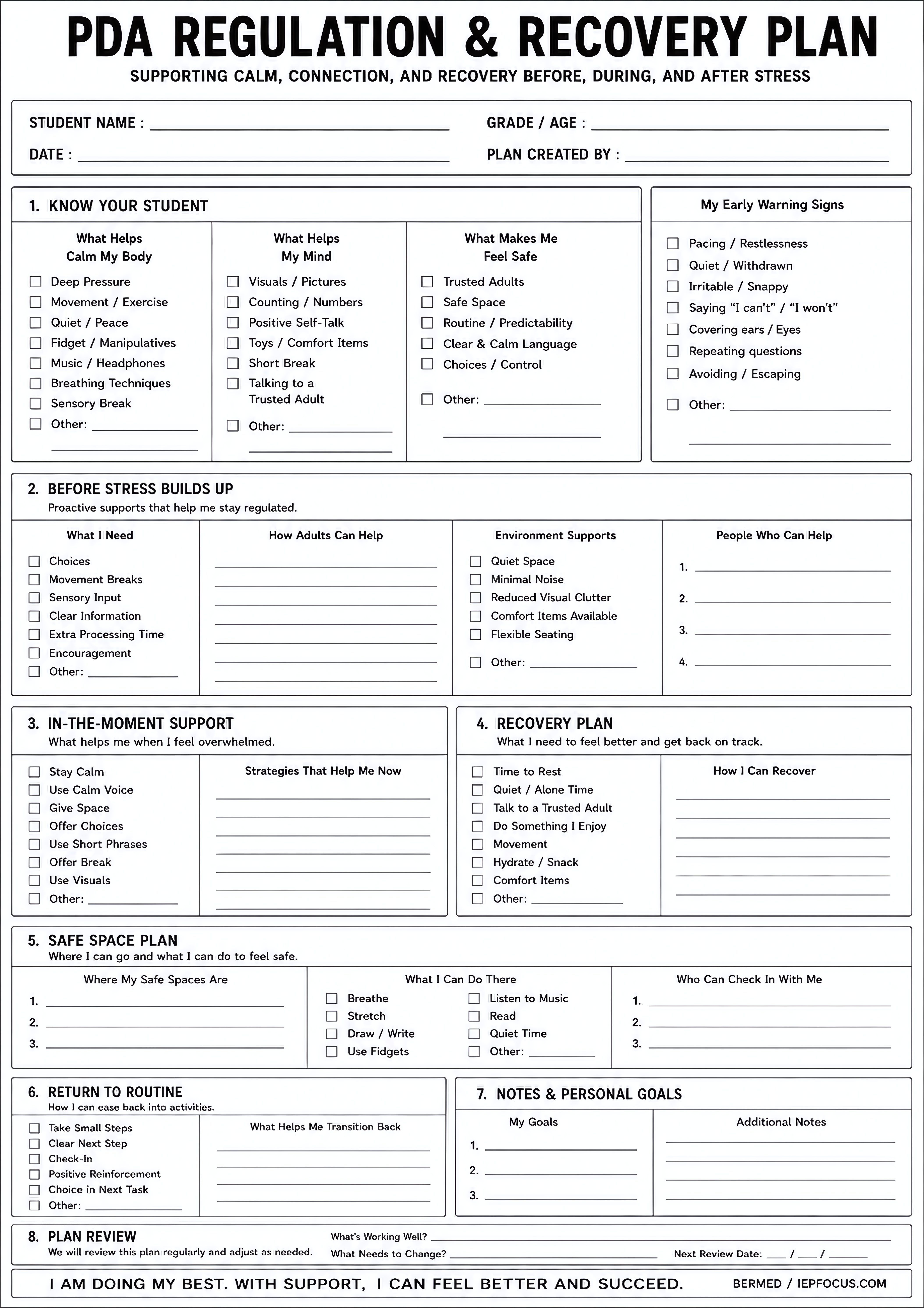
Free resource
PDA Regulation & Recovery Plan
A calm plan for connection, regulation and recovery after hard moments.
Download free →Core Principles of a PDA-Affirming Home
Creating a PDA-affirming home is less about a list of techniques and more about a fundamental reorientation of the parent-child dynamic. These five principles are the foundation everything else builds on.
The 5 Principles of a PDA-Affirming Home
- Reduce the demand load. Audit daily expectations ruthlessly. Identify hidden demands (eye contact, specific greetings, “thank you” on command) and eliminate non-essential ones. Fewer demands = more nervous system capacity.
- Offer perceived control and choice. PDA anxiety is rooted in a need for autonomy. When a child can influence what happens, how it happens, or when it happens, the threat response is less likely to activate. The choice doesn’t need to be large to be meaningful.
- Depersonalize the demand. Direct commands from an adult (“You need to…”) carry the highest demand weight. The same task framed as a shared puzzle, a game, a story, or an external necessity (“The dentist has a rule about…”) reduces the perceived demand significantly.
- Prioritize the relationship over compliance. A regulated, connected child is far more likely to cooperate over time than a child who has learned that interactions are a series of battles. When you protect the relationship, you protect access to influence.
- Repair, don’t punish. After a meltdown or explosion, the most effective intervention is a calm, non-shaming reconnection conversation, not a consequence. Consequences applied during or immediately after a meltdown do not teach; they compound the threat response and damage trust.
15 Practical PDA-Affirming Strategies for Home
The strategies below are organized by the contexts where demand-avoidance most commonly appears at home. They are not scripts to follow rigidly: PDA children are highly attuned to inauthenticity. The goal is to internalize the principle so you can apply it flexibly in the moment. For the school-facing equivalent of these strategies, see our article on PDA strategies for parents and educators.
🏠 Daily Routines & Transitions
- Frame routines as invitations, not rules. Instead of “It’s time to brush your teeth,” try “The toothbrush is ready when you are” or “I’m heading to the bathroom, want to come?” The task stays the same; the autonomy signal is radically different.
- Build choice into every transition. “Do you want to walk to the car or run?” “Coat on before we leave, do you want the zip-up or the hoodie?” The choice is bounded, but it is real. Perceived control reduces demand anxiety even when actual control is limited.
- Use visual schedules with opt-out language. Rather than “Here’s what we’re doing today” (a presented fact that can be resisted), try “Here’s what’s available today.” The same information, framed as opportunity rather than obligation, lands differently.
- Give advance notice without ultimatums. “In about ten minutes we’ll probably need to think about leaving” is much lower demand than “You have ten minutes and then we go.” The former is information; the latter is a countdown, which many PDA children experience as a threat.
- Reduce the demand density of mornings. Morning is often the highest demand period of the day, get dressed, eat, brush teeth, shoes, bag, door. Auditing each step for what can be removed, shifted to the night before, or made more flexible significantly reduces the pressure that creates explosions before 9am.
🗣️ Communication & Language
- Replace commands with “I wonder…” framing. “I wonder if the shoes could magically appear on feet before we leave” removes the direct command entirely and often works because it sidesteps the autonomic threat response. This is not manipulation, it is working with the nervous system, not against it.
- Eliminate “you need to” and “you have to.” These phrases carry an extremely high demand weight for PDA brains. Replace with “it would help if…,” “the plan is…,” or simply remove the frame altogether (“Shoes, car, adventure”).
- Use humor and novelty to deflect demand anxiety. Many PDA children respond beautifully to silliness, surprise, and play. A request made in a silly voice, via a stuffed animal intermediary, or as part of a spontaneous game often succeeds where a direct ask fails. This is not bribery, it is using the child’s strengths (imagination, humor, creativity) to reduce demand pressure.
- Avoid “good job” and evaluative praise. Approval-based praise (“Good boy,” “Well done for…”) can function as a subtle demand, a demand to perform for adult approval. Descriptive observation (“You got your shoes on, we’re ready to go”) is more neutral and less likely to trigger the need to refuse.
- Narrate rather than instruct. Thinking aloud (“I need to grab my bag, where did I put it…”) gives the child information without directing them. Many PDA children will spontaneously follow a narrated action they would refuse if directly requested.
💥 When Things Escalate
- Drop the demand at first signs of escalation. When a PDA child begins to escalate, pressing the demand, even calmly, will almost always intensify the response. Dropping the demand in the moment is not “letting them win.” It is preventing a full dysregulation that will cost hours of recovery time for everyone.
- Use the “demand detox” concept. After a period of high demand (illness, school term, a difficult event), PDA children often need days or even weeks of very low demand to rebuild their regulatory capacity. This is not regression, it is recovery. Honoring it shortens it significantly.
- Stay regulated yourself. The adult’s nervous system is the most powerful co-regulatory tool in the room. A calm, unhurried adult body posture, low voice, slow movements, no urgency, communicates safety more effectively than any words. Your regulation is the intervention.
- Initiate repair conversations at a neutral time. After a meltdown has passed and everyone is calm, a brief, non-shaming conversation: “That was hard this morning. I’m glad we got through it”, rebuilds connection and models emotional processing. Avoid analysis, consequence delivery, or “next time” instructions immediately after dysregulation.
PDA-Affirming vs. Traditional Parenting Approaches
One of the most disorienting experiences for PDA parents is realizing that the parenting tools they were given, firm boundaries, consistent consequences, reward charts, ignoring attention-seeking behavior, actively worsen outcomes for their child. This is not a failure of the parent or the child. It is a mismatch between a neurotypical parenting framework and a neurodivergent nervous system.
| Situation | Traditional approach | PDA-affirming approach |
|---|---|---|
| Child refuses to get dressed | Countdown, consequence if not dressed by X | Offer choice of outfit; narrate own dressing; use novelty (“race the clock” as play, not ultimatum) |
| Child won’t eat at the table | Rule: everyone eats together, no alternatives | Allow eating in a preferred location; reduce table-time demands; offer the connection separately |
| Child has a meltdown | Remove privilege; send to room to calm down | Drop all demands; offer co-regulation; reconnect when calm; no consequence applied |
| Child refuses homework | No screen time until homework is done | Collaborate with school to reduce homework demands; offer choice of when/where; stay alongside |
| Child is rude or uses hurtful language | Immediate consequence for unacceptable behavior | Recognize dysregulation as the cause; address calmly after regulation; build communication skills at neutral times |
| Child won’t say thank you | Prompt repeatedly; correct in the moment | Model gratitude yourself; remove the social demand; allow the child to express appreciation in their own way |
| Child refuses school | Enforce attendance; consequences for avoidance | Treat as a nervous system response; investigate demand load at school; explore flexible attendance options |
| Sibling conflict | Separate and apply equal consequences | Support PDA child’s regulation first; address conflict after calm; adapt expectations for neurodivergent sibling |
| Child won’t follow bedtime routine | Strict schedule, loss of screen time if not followed | Build routine around child’s sensory and autonomy needs; offer flexible timing with non-negotiable end goal (rest) |
| Child refuses to engage with therapy | Require attendance; frame as non-optional | Seek PDA-informed therapist; allow child to shape format; begin with connection before any “work” |
The research literature on PDA consistently indicates that behavior-management approaches, including token economy systems, response cost, and time-out, fail to produce lasting change in PDA profiles and frequently worsen demand avoidance over time (Newson et al., 2003; Christie et al., 2022). The neurological basis for this is clear: strategies that increase perceived demand or reduce perceived autonomy will always intensify the PDA response, regardless of how they are delivered. When PDA co-occurs with ADHD, the complexity increases further, explore our guide on PDA and ADHD combined profiles for targeted strategies.
Supporting Siblings and the Whole Family
One of the most underaddressed dimensions of the PDA family experience is the impact on neurotypical or differently-neurodivergent siblings. When a child’s demand-avoidance shapes the entire household, what routes you take, what restaurants are possible, whether family events happen at all, siblings absorb that impact. Some become hypervigilant, constantly monitoring the PDA sibling’s emotional state. Others feel invisible, as though their own needs have become secondary by default.
Supporting siblings means naming what is happening in age-appropriate language: “Your brother’s brain works differently and some things feel much scarier for him than they would for us. That’s not about you, and it’s not about anyone doing anything wrong.” It also means carving out one-on-one time that belongs entirely to the sibling, time that is not negotiated away when the PDA child escalates.
For extended family members who do not understand why you are “letting your child run the household,” an honest and brief explanation works better than defensiveness: “We’ve learned that fewer demands means fewer crises. This is actually the approach recommended for his profile. It looks different from traditional parenting but it’s working.” You do not owe anyone a lengthy justification for evidence-based parenting.
Parental self-care is not a luxury in the PDA context, it is a clinical necessity. A dysregulated parent cannot co-regulate a dysregulated child. Communities like the PDA Society and the IEPPLANNERS community on Facebook offer parent-to-parent support from people who understand the specific and exhausting nature of PDA parenting without judgment.
When to Seek Professional Support
Low demand parenting and a PDA-affirming home environment are powerful, but they are not always sufficient on their own. There are signs that a family needs external, professional support:
- The child’s physical safety is at risk during escalations
- A parent or sibling is experiencing symptoms of trauma or burnout
- School refusal has become complete and prolonged
- The child is self-harming or expressing suicidal ideation
- The family has reached a point of crisis that feels unsustainable
When seeking professional support, it is essential to find practitioners who are PDA-informed and neuroaffirmative. A therapist who applies behavioral or compliance-based approaches to a PDA child will not produce improvement, and may cause significant harm. Ask directly: Are you familiar with the PDA profile? What is your approach to demand avoidance? Do you work from a neuroaffirmative framework?
Useful professional roles include PDA-informed occupational therapists (especially for sensory regulation), speech-language pathologists with AAC and anxiety expertise, educational psychologists who understand demand avoidance, and family therapists trained in attachment and trauma-informed approaches. If your child has an IEP or you are working toward one, our complete guide to PDA IEP planning covers how to build a document that actually reflects the PDA profile.
Frequently Asked Questions
What is low demand parenting for PDA?
Low demand parenting for PDA is a neuroaffirmative approach that reduces the frequency and pressure of everyday demands on a child with Pathological Demand Avoidance. Because PDA is driven by anxiety and an autonomic threat response to demands, lowering the demand load reduces the nervous system activation that causes refusal and meltdowns. It is not permissive parenting, it is a clinically supported strategy for supporting a child whose brain processes demands as threats.
How do I create a PDA-affirming home?
A PDA-affirming home is built on five core principles: reducing the demand load, offering perceived control and choice, depersonalizing demands through indirect language and humor, prioritizing the relationship over compliance, and repairing connection after difficult moments rather than applying consequences. Practically, this means auditing daily routines to remove unnecessary demands, replacing commands with invitations and “I wonder” framings, and building flexibility into transitions and expectations.
Is low demand parenting the same as permissive parenting?
No. Low demand parenting is not permissive parenting. Permissive parenting involves an absence of boundaries and expectations. Low demand parenting involves a deliberate, thoughtful audit of which expectations are genuinely necessary and how they can be communicated in ways that do not trigger the PDA nervous system’s threat response. Safety boundaries are maintained. What changes is the delivery method and the overall demand density, not the absence of all expectations.
How does PDA affect the whole family?
PDA affects the entire family system. Parents often experience chronic exhaustion, hypervigilance, and guilt from managing demand-avoidance daily. Siblings may feel invisible, anxious, or resentful, particularly if the household routinely reorganizes around the PDA child’s needs. The couple or co-parenting relationship can also be strained by disagreements about approach and the sheer weight of daily caregiving. Naming this impact and seeking community support from other PDA families is an important part of family wellbeing.
What strategies work best for PDA children at home?
The most effective strategies for PDA children at home include: using indirect, collaborative language instead of direct commands; offering genuine choices within bounded options; using humor, novelty, and play to reduce demand pressure; building transitions with advance notice rather than ultimatums; dropping demands at the first sign of escalation rather than pressing through; and prioritizing nervous system recovery (demand detox) after high-demand periods. Reward charts, consequences, and compliance-based systems consistently worsen outcomes for PDA profiles.
PDA Resources for Parents, Teachers & IEP Teams
These BERMED resources are used by thousands of special educators and families navigating the PDA profile. Each one is built on a neuroaffirmative, strengths-based framework, no ABA, no compliance-first language.

PDA at Home: A Practical Guide for Parents
View in the IEPfocus Shop →
PDA: A Comprehensive Guide for Special Education
View in the IEPfocus Shop →
25 Strategy Tables for Teaching Students with PDA
View in the IEPfocus Shop →
PDA IEP Goal Bank: 120 Measurable Goals Across 6 Skill Domains
View in the IEPfocus Shop →
PDA Strategy Bundle: 60 Strategy Tables
View in the IEPfocus Shop →
PDA Bundle: Neuro-Affirming Strategies, Tools & Training for Educators
View in the IEPfocus Shop →Key Takeaways
Low demand parenting for PDA is not a surrender. It is a recognition that a child whose nervous system registers demands as threats cannot be talked, rewarded, or consequence-d into compliance, but can, with patience and the right framework, learn to navigate a world full of demands with a regulated nervous system and an intact sense of self.
The families who report the most progress are not the ones who found the perfect technique. They are the ones who stopped fighting the neurology and started working with it, who learned to read the demand load before it reached crisis point, who rebuilt their language toolkit from the ground up, and who gave themselves permission to parent differently even when the world around them didn’t understand why.
You are not lowering the bar. You are finding the door.
References & Further Reading
- Newson, E., Le Maréchal, K., & David, C. (2003). Pathological demand avoidance syndrome: a necessary distinction within the pervasive developmental disorders. Archives of Disease in Childhood, 88(7), 595–600. adc.bmj.com
- Christie, P., Duncan, M., Fidler, R., & Healy, Z. (2022). Understanding Pathological Demand Avoidance Syndrome in Children (2nd ed.). Jessica Kingsley Publishers.
- Diekman, A. (2022). What I Mean When I Say I’m Autistic. DrawnToWords Press.
- Fisher, N. (2021). Changing Our Minds: How Children Can Take Control of Their Own Learning. Robinson.
- PDA Society UK. (2024). PDA and parenting: A guide for families. pdasociety.org.uk
- Curtis, S. (2022). The Family Experience of PDA. Jessica Kingsley Publishers.
- CHADD. (2023). Demand avoidance and ADHD: Overlapping profiles. chadd.org
Looking for more? Visit our PDA Hub, where every guide on pathological demand avoidance is organized in one place.