
Quick answer: Transitions for autistic children, like leaving the park, turning off a screen, or getting in the car, are hard because they break predictability and interrupt deep focus. Raising Children Network notes that autistic children often like the certainty of routines and rituals. What helps: warnings and visual timers, visual schedules, first-then boards, transition objects, social stories for bigger changes, and building flexibility gradually, starting with pleasant surprises.
In this guide
“Time to go!” For many families, these three words start a meltdown. Your child was deeply absorbed in play, and suddenly they are expected to drop everything. Transitions for autistic children are one of the most common daily challenges, and one of the most fixable.
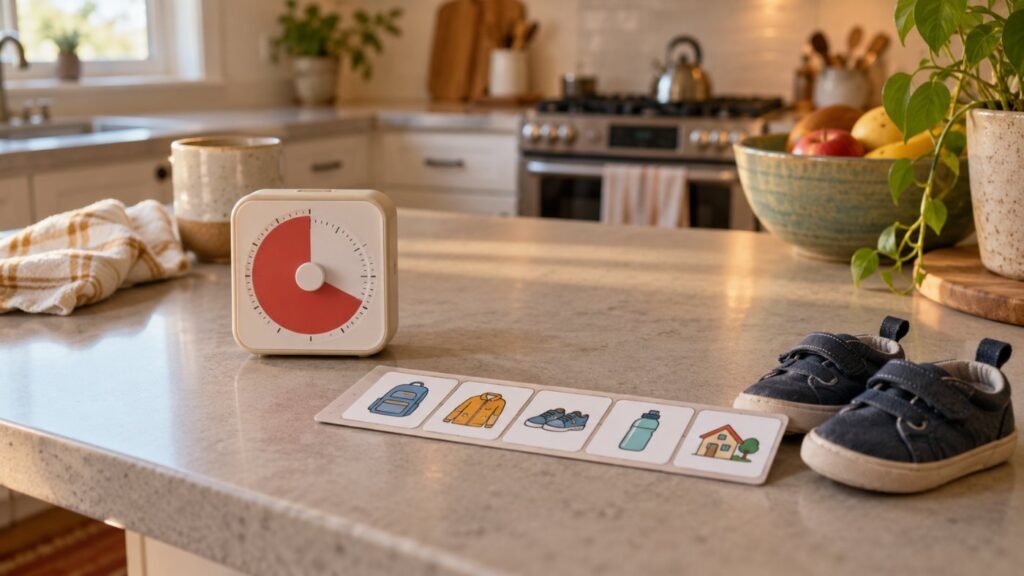
Why Transitions Are Hard for Autistic Children
- Predictability: routines feel safe, and change feels like losing control.
- Monotropism and deep focus: shifting attention away from an absorbing activity is genuinely hard.
- Uncertainty: not knowing what comes next creates anxiety.
- Sensory shifts: moving from quiet to noisy, indoors to outdoors, or warm to cold.
- Demand sensitivity: especially for children with a PDA profile.
Key point: A hard transition is not defiance. It is a brain that needs more time and information to shift gears.
The BERMED Transition Plan
A simple structure for transitions for autistic children.
- B: Before warnings. “Ten minutes, five minutes, two minutes.”
- E: Easy visuals. Timers, first-then boards, and visual schedules.
- R: Rituals. A short goodbye song, a high five, a “see you later” to the toy.
- M: Motivating “next.” Make the next activity clear and, when possible, appealing.
- E: Exit object. A transition object to carry, like a small toy or card.
- D: Declarative language. Comment rather than command to lower pressure.
Everyday Transitions
| Transition | What helps |
|---|---|
| Ending screen time | Visual timer, stop at a natural end, clear next activity |
| Leaving the park | Warnings, “last slide,” a snack in the car |
| Getting dressed | Picture sequence, clothes laid out the night before |
| Bedtime | Same order every night, calm wind-down |
| Getting in the car | Headphones ready, favorite item, tell where you’re going |
Screens are one of the hardest transitions. See autism and screen time. Show daily transitions with visual schedules, which work at home as well as at school.

Use first-then. “First shoes, then car with music.” Two steps are easier to hold than a whole plan.
Comment, don’t command. “I see the timer is almost done. I’m getting my keys.” See declarative language.
Build in buffer time. Rushing makes every transition harder.

Free resource
Going to the School Cafeteria: A Visual Social Story
A calm, ready-to-use social story for one of the hardest parts of the day.
Big Changes
Raising Children Network recommends preparing for expected changes like a new school, a move, or a holiday with social stories, visual timetables, and visits during quiet times. Our guide to social stories shows how to write one, with photos of the real place. Use reference points like “after lunch” if exact times feel stressful.

Unexpected Changes
Raising Children Network describes using a “?” symbol on visual schedules for unknown events, and building tolerance step by step: first pleasant surprises, then neutral changes, then less-preferred ones. Praise flexibility when your child manages a change calmly.
Do
- Give warnings before every transition
- Keep transitions consistent
- Offer a transition object
- Celebrate flexibility
Avoid
- Sudden “we’re leaving now”
- Physically removing your child mid-activity unless unsafe
- Threats to rush transitions
- Expecting instant change
If a transition ends in a meltdown, it is overload, not misbehavior. Read meltdown vs tantrum, and if it turns physical, see aggression in autistic children.
Small wins add up: Every smooth transition builds trust. Over time, many autistic children become more flexible when they feel safe and informed.
Why are transitions hard for autistic children?
Transitions break predictability, interrupt deep focus, create uncertainty, and often involve sensory changes, all of which can raise anxiety.
How can I make transitions easier for my autistic child?
Give warnings, use visual timers and first-then boards, keep rituals consistent, offer a transition object, and make the next activity clear.
What is a transition object?
A transition object is a small item a child carries from one activity or place to the next, such as a toy or card, which gives comfort and continuity.
How do I prepare my autistic child for big changes?
Use social stories with real photos, visual timetables, and visits during quiet times before the change happens.
How can I help my child cope with unexpected changes?
Use a question mark symbol on the schedule for unknowns, start with pleasant surprises, and gradually build tolerance while praising flexibility.
5 Actions to Take This Week
- Pick the hardest daily transition.
- Add a visual timer and warnings.
- Create a first-then card for it.
- Offer a transition object.
- Notice and praise one flexible moment.
Sources

