
Quick answer: Transition IEP goals connect a student’s high school IEP to life after graduation. They include measurable postsecondary goals for education or training, employment and, when appropriate, independent living, plus annual IEP goals that build the skills to reach them. Below are example postsecondary goals and 42 SMART annual transition IEP goals for education, employment, independent living and community participation.
In this goal bank
Graduation can feel like a cliff for students with disabilities and their families. School services end, and adult services work differently. IDEA requires that, beginning no later than the first IEP in effect when a student turns 16, the IEP include appropriate measurable postsecondary goals based on age-appropriate transition assessments, and the transition services needed to reach them. Transition IEP goals make that plan concrete. This page focuses on the goals themselves. For the full process, including assessments and timelines, read our guide to transition planning in the IEP, and see our complete IEP goal bank for other areas.
How to Write Transition IEP Goals
Formula for a postsecondary goal: After high school, [Student] will [enroll in, work as, or live] [specific setting or role]. Use “will,” not “plans to” or “hopes to,” and make it about after graduation.
Formula for an annual transition goal: By [date], given [support], [Student] will [skill that moves toward the postsecondary goal] in [number] of [opportunities] as measured by [data tool].
Present level example: “Sofia, age 16, wants to study early childhood education at a community college and work in a daycare. Transition assessments show strengths in caring for younger children and following routines. She has not visited a college, does not know how to request accommodations, and relies on her parents for transportation.”
Key point: Every annual transition goal should clearly connect to a postsecondary goal. Ask: “Does this skill help the student get where they want to go after high school?”
Postsecondary Goal Examples
- Education: After high school, [Student] will enroll in a certificate program in early childhood education at a community college.
- Education: After high school, [Student] will attend a 4-year university and major in graphic design, using disability services.
- Training: After high school, [Student] will complete a vocational training program in automotive repair.
- Employment: After high school, [Student] will work part-time in a retail store stocking shelves with job coach support as needed.
- Employment: After high school, [Student] will work full-time as an animal care assistant.
- Independent living: After high school, [Student] will live in a supported apartment and manage their own weekly schedule.
- Independent living: After high school, [Student] will use public transportation to get to work and community activities.
Education and Training Goals
- By [date], [Student] will research 3 postsecondary programs that match their career goal, including admission requirements and disability services.
- By [date], [Student] will visit or take a virtual tour of 2 colleges or training programs and complete a comparison chart.
- By [date], [Student] will complete a mock college application with 90% accuracy using a checklist.
- By [date], [Student] will describe how to register with a college disability services office in 3 of 4 opportunities.
- By [date], [Student] will use a planner to manage assignments in 2 high school classes, submitting 90% of work on time over a grading period.
- By [date], [Student] will take notes using a chosen strategy (guided notes, laptop, audio) in 4 of 5 lectures.
- By [date], [Student] will complete a dual enrollment or college readiness course with accommodations.
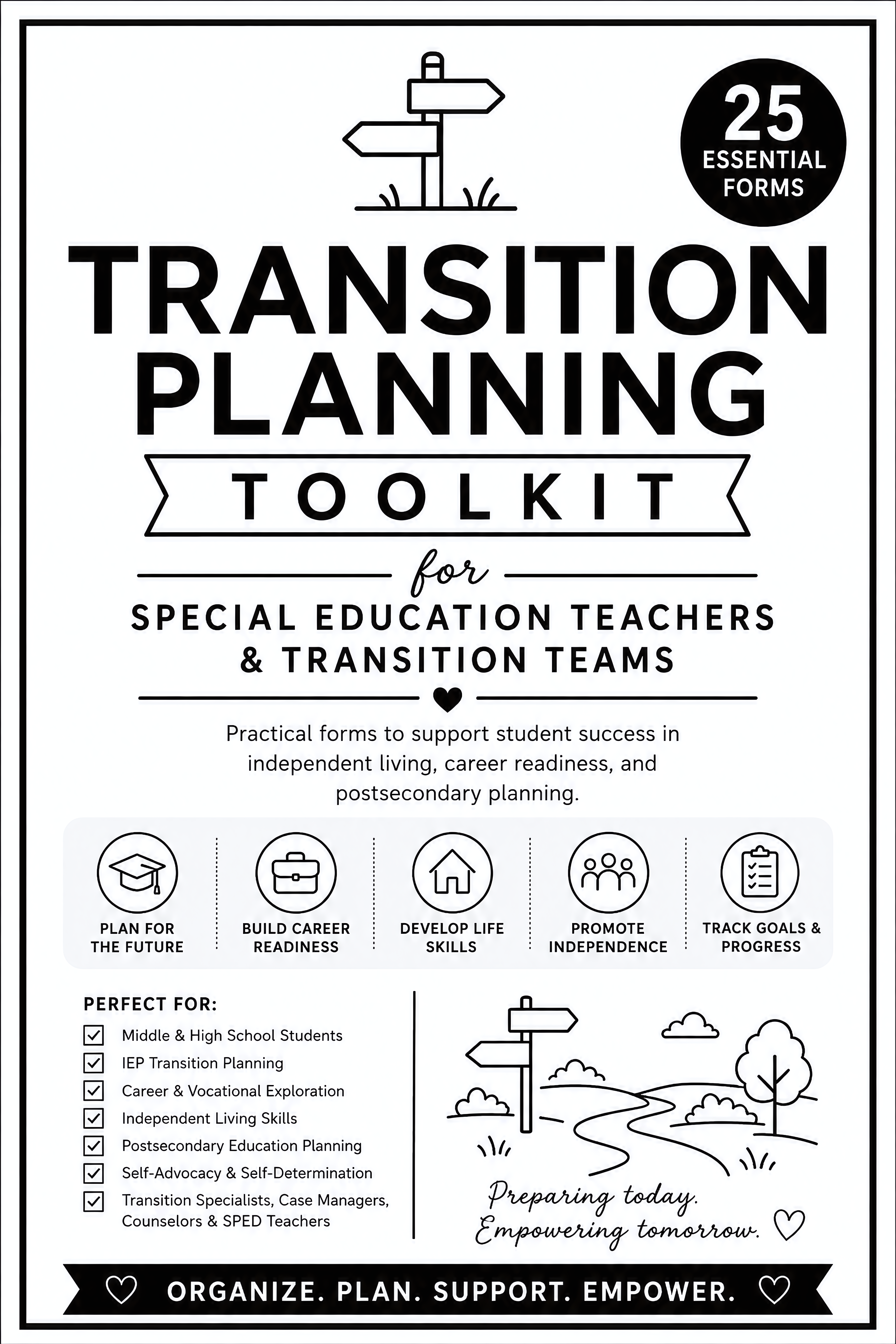
Free resource
Transition Planning Toolkit for Educators
Tools to plan postsecondary goals, services and student-led transition.
Employment Goals
For a deeper bank of job skills, see our vocational IEP goals.
- By [date], [Student] will complete 2 career interest inventories and identify 3 jobs that match their postsecondary employment goal.
- By [date], [Student] will participate in a work-based learning experience for 4 hours per week and meet employer expectations in 80% of sessions.
- By [date], [Student] will create a resume with adult support.
- By [date], [Student] will answer 5 interview questions in a mock interview in 3 of 4 practice sessions.
- By [date], [Student] will arrive on time to a school or community job in 90% of shifts.
- By [date], [Student] will apply for 2 summer or part-time jobs with support.
- By [date], [Student] will meet with a vocational rehabilitation counselor and complete an intake before graduation.

Independent Living Goals
Daily routines matter too. See our daily living skills IEP goals.
- By [date], [Student] will plan and prepare a simple meal using a recipe in 3 of 4 opportunities.
- By [date], [Student] will use a phone calendar to track appointments and events in 4 of 5 weeks.
- By [date], [Student] will complete a weekly cleaning routine using a checklist in 4 of 5 weeks.
- By [date], [Student] will do a load of laundry from start to finish in 3 of 4 opportunities.
- By [date], [Student] will make a grocery list and shop for 5 items within a budget in 3 of 4 community outings.
- By [date], [Student] will wake up with an alarm and complete a morning routine independently in 4 of 5 school days.
- By [date], [Student] will identify what to do in 3 home emergencies (fire, power outage, injury) in 4 of 5 scenarios.
Community and Transportation
- By [date], [Student] will plan a bus or transit route to a familiar destination using an app in 4 of 5 opportunities.
- By [date], [Student] will ride public transportation to a community location with decreasing support in 3 of 4 trips.
- By [date], [Student] will study for and pass a driver’s permit test, if appropriate for their goals.
- By [date], [Student] will participate in one community activity, club or volunteer role of their choice monthly.
- By [date], [Student] will order and pay for food at a restaurant independently in 3 of 4 outings.
- By [date], [Student] will use a map app to find a new location in the community in 3 of 4 opportunities.
- By [date], [Student] will identify safe people to ask for help in the community in 4 of 5 scenarios.
Health, Money and Adult Services
Students also need to understand their rights and supports. Pair these goals with self-advocacy IEP goals.
- By [date], [Student] will schedule a medical or dental appointment by phone or online in 3 of 4 opportunities.
- By [date], [Student] will describe their own health needs and medications to a provider using a health summary card in 3 of 4 opportunities.
- By [date], [Student] will create and follow a simple monthly budget with income and expenses in 3 of 4 months.
- By [date], [Student] will use a debit card or banking app to check a balance in 4 of 5 opportunities.
- By [date], [Student] will explain the transfer of rights at the age of majority and the decision-making supports available.
- By [date], [Student] will identify 2 adult service agencies and what they offer with family support.
- By [date], [Student] will lead the transition section of their IEP meeting by sharing their postsecondary goals.
The BERMED Goal-Writing Check
- B – Baseline: Are goals based on age-appropriate transition assessments and student interviews?
- E – Exact skill: Does each annual goal name one skill that connects to a postsecondary goal?
- R – Realistic: Does the plan reflect the student’s own vision, not only adult expectations?
- M – Measurable: Are postsecondary goals written with “will” and annual goals with clear criteria?
- E – Equitable access: Are community experiences and accommodations available?
- D – Data plan: Who tracks progress, including community and work-based data?
How to Measure Transition IEP Goals
| Area | How to measure | Supports to pair |
|---|---|---|
| Education and training | Completed research, visits, applications | College visits, checklists, dual enrollment |
| Employment | Work-based learning data, resume, interviews | Job coach, career inventories |
| Independent living | Task analysis, routine checklists | Visual routines, phone reminders |
| Community | Trips completed, support level | Travel training, map apps |
| Health and money | Appointments made, budget completion | Health summary card, budget template |
| Adult services | Agency contacts and intakes completed | Transition coordinator, family meetings |
Support planning skills with executive functioning IEP goals and help students understand their options with our guide to IEP vs 504 plans, since many college students use 504-style accommodations.
Neuroaffirming tip: A good transition plan starts with the student’s dreams, strengths and interests. Success can look like college, a job, supported living, creative work or a mix. Avoid choosing a path for the student. Ask, listen and build the plan together.
What are transition IEP goals?
Transition IEP goals include measurable postsecondary goals for education or training, employment and independent living, plus annual IEP goals that build the skills needed to reach them.
When are transition goals required?
IDEA requires transition goals beginning no later than the first IEP in effect when the student turns 16. Many states require them earlier, often at age 14.
What is the difference between a postsecondary goal and an annual goal?
A postsecondary goal describes what the student will do after high school. An annual goal is a measurable skill the student will work on this year to move toward that outcome.
Are independent living goals required?
Education or training and employment goals are required. Independent living goals are included when appropriate, based on the student’s needs and transition assessments.
Who should be involved in transition planning?
The student, family, special and general education teachers, a transition coordinator and, when appropriate, adult agency representatives such as vocational rehabilitation.
5 Actions to Take This Week
- Interview the student about what they want to do after high school.
- Complete one age-appropriate transition assessment or interest inventory.
- Write or review postsecondary goals for education, employment and independent living.
- Choose 2 or 3 annual goals from this bank that connect to those goals.
- Plan one community or work-based experience for this semester.
Continue the Transition to Adulthood guide:
- Transition Assessment: 6 Essential Tools
- Self-Advocacy Skills: From IEP Observer to IEP Leader
- Age of Majority: IEP Rights at 18
- SSI at 18: What Changes
- See the complete Transition to Adulthood guide
Sources

