
Quick answer: Self-advocacy IEP goals teach a student to understand their own strengths and needs, explain their disability in their own words, request accommodations, take part in IEP meetings and speak up when something is not working. These skills matter most in middle school, high school and the move to college or work, when students must ask for support themselves. Below are 42 SMART self-advocacy IEP goals organized by skill, with present level examples and data ideas.
In this goal bank
In school, adults often notice when a student needs help. After graduation, that changes. Colleges and employers usually provide accommodations only when the person asks. The Center for Parent Information and Resources describes self-advocacy as knowing yourself, knowing what you need and knowing how to get it. Self-advocacy IEP goals build those skills step by step, starting with simple requests and growing into leading an IEP meeting. IDEA also requires that students be invited to IEP meetings when transition is discussed, which makes self-advocacy a natural part of transition planning in the IEP. For other areas, see our complete IEP goal bank.

How to Write Self-Advocacy IEP Goals
Formula: By [date], when [situation requiring support], given [script, checklist or fading prompts], [Student] will [identify, explain, request or lead] in [number] of [opportunities] as measured by [teacher log, self-report or observation].
Present level example: “Jade, a 9th grader with ADHD and dyslexia, receives extended time and audiobooks but has never requested them herself. When asked about her IEP, she says ‘I get extra help.’ She attended her last IEP meeting but did not speak. She shares that she wants to study graphic design after high school.”
Key point: Build self-advocacy in layers: first know your needs, then request supports with a script, then request them independently, then lead the meeting.
Knowing My Strengths and Needs
- By [date], [Student] will identify 3 personal strengths and 3 areas of challenge using a self-assessment tool in 4 of 5 opportunities.
- By [date], [Student] will describe their disability or learning difference in their own words in 2 to 3 sentences in 3 of 4 opportunities.
- By [date], [Student] will identify their preferred learning style or conditions (quiet room, visuals, movement) in 4 of 5 opportunities.
- By [date], [Student] will explain how their disability affects one school task (reading, writing, focus) in 3 of 4 opportunities.
- By [date], [Student] will name 3 accommodations in their IEP and explain why each helps in 4 of 5 opportunities.
- By [date], [Student] will create a one-page profile about themselves (strengths, needs, supports) with adult guidance.
- By [date], [Student] will identify situations where they work best and where they struggle using personal data in 3 of 4 reflections.
Requesting Accommodations
Students need to know the difference between supports, so review accommodations vs modifications together.
- By [date], [Student] will request an IEP accommodation (extended time, notes, quiet setting) from a teacher using a script in 4 of 5 opportunities.
- By [date], [Student] will request accommodations independently without adult prompting in 80% of opportunities.
- By [date], [Student] will email a teacher to request an accommodation for an upcoming test in 3 of 4 opportunities.
- By [date], [Student] will choose the right time and place to request support (before class, privately) in 4 of 5 opportunities.
- By [date], [Student] will follow up when an accommodation was not provided by speaking with the teacher or case manager in 3 of 4 situations.
- By [date], [Student] will decline an accommodation they do not need for a specific task and explain why in 3 of 4 opportunities.
- By [date], [Student] will use an accommodation card to request support in a new class in 4 of 5 opportunities.
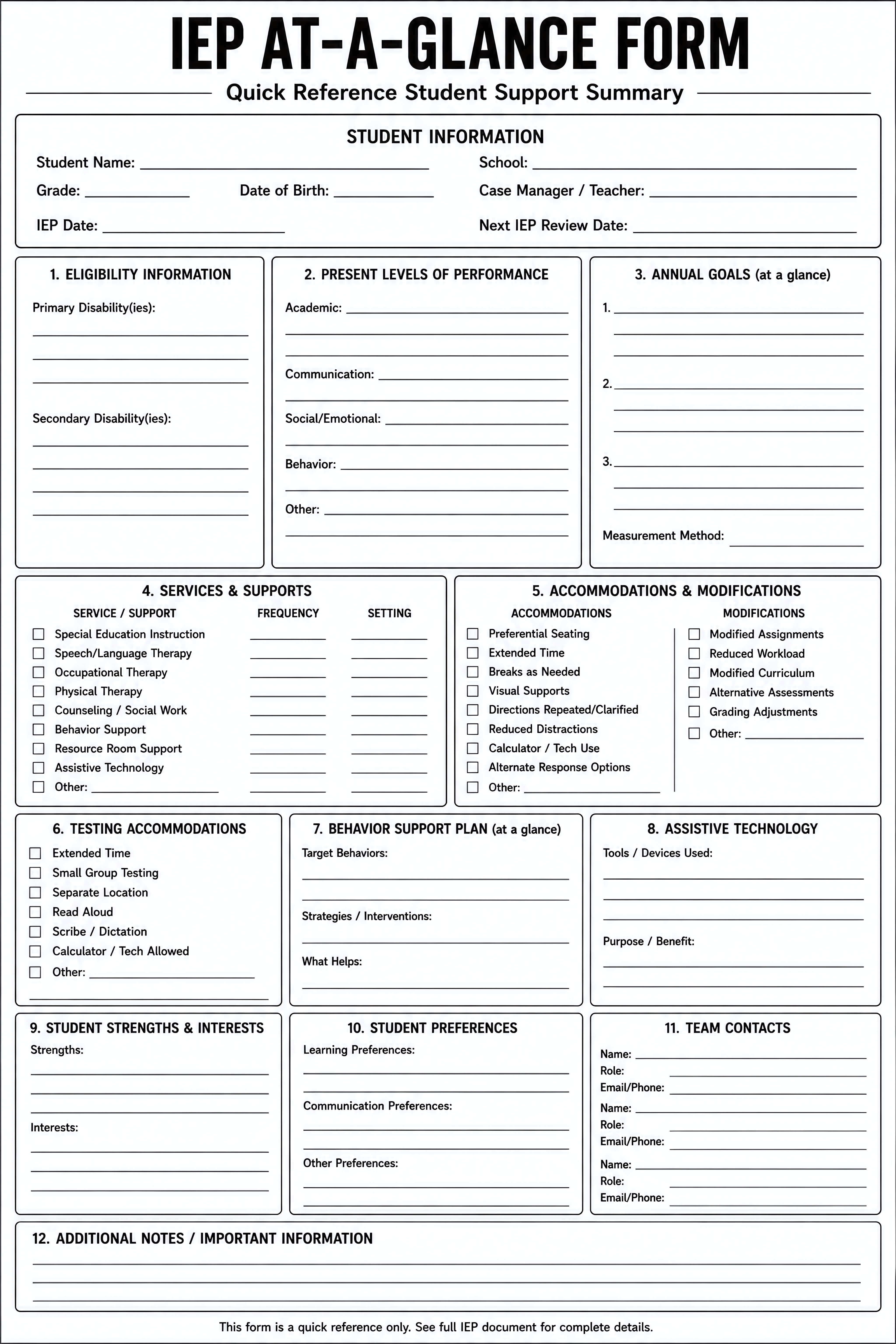
Free resource
IEP At-a-Glance Form
A one-page student support summary every teacher can use.
Participating in the IEP Meeting
- By [date], [Student] will attend their IEP meeting and share one strength and one goal in 1 of 1 annual meeting.
- By [date], [Student] will help prepare for their IEP meeting by completing a student input form 2 weeks before the meeting.
- By [date], [Student] will present a short summary of their progress using slides or a written script during their IEP meeting.
- By [date], [Student] will share their post-school goals and interests during their IEP meeting.
- By [date], [Student] will ask at least one question or suggest one support during their IEP meeting.
- By [date], [Student] will lead part of their IEP meeting (introductions, strengths, goals) with a student-led IEP template.
- By [date], [Student] will review their IEP goals with their case manager each quarter and rate their own progress.

Speaking Up in Class
- By [date], [Student] will ask a clarifying question when they do not understand directions in 4 of 5 opportunities.
- By [date], [Student] will ask for help from a teacher or peer instead of leaving work incomplete in 80% of opportunities.
- By [date], [Student] will let a teacher know when the environment is overwhelming (noise, lights) and request a change in 3 of 4 opportunities.
- By [date], [Student] will express disagreement respectfully using an “I” statement in 3 of 4 opportunities.
- By [date], [Student] will attend teacher office hours or a support period to ask for help in 2 of 3 weekly opportunities.
- By [date], [Student] will tell a teacher when an assignment is too difficult and ask for a different format in 3 of 4 opportunities.
- By [date], [Student] will report bullying or unfair treatment to a trusted adult in 100% of incidents.
Understanding Rights and Supports
Teens should know the difference between an IEP and a 504 plan. Our guide to IEP vs 504 plan differences is a good starting point.
- By [date], [Student] will explain the purpose of an IEP and name who is on their IEP team in 4 of 5 opportunities.
- By [date], [Student] will describe the difference between an IEP and a 504 plan in 3 of 4 opportunities.
- By [date], [Student] will identify the transfer of rights at age of majority and what it means for them before their 17th birthday IEP meeting.
- By [date], [Student] will name one adult at school to contact if their IEP is not being followed in 4 of 5 opportunities.
- By [date], [Student] will explain the difference between disability services in high school and in college or work in 3 of 4 opportunities.
- By [date], [Student] will locate the disability services office information for one college or training program of interest.
- By [date], [Student] will describe how to request workplace accommodations in a role-play in 3 of 4 trials.
Self-Advocacy for Life After School
- By [date], [Student] will practice disclosing their disability and needed supports in a mock college or job interview in 3 of 4 role-plays.
- By [date], [Student] will schedule and keep their own appointments (counselor, tutoring) using a planner or phone in 80% of opportunities.
- By [date], [Student] will gather documentation needed to request college accommodations with adult support before graduation.
- By [date], [Student] will write a short self-advocacy letter describing their strengths and needed accommodations.
- By [date], [Student] will make a phone call or send an email to request information from an agency or program in 3 of 4 opportunities.
- By [date], [Student] will identify 3 people in their support network and when to contact each in 4 of 5 opportunities.
- By [date], [Student] will set a personal goal, make a plan and review progress monthly in 4 of 5 months.
The BERMED Goal-Writing Check
- B – Baseline: Can the student currently describe their needs and supports? Do they request help?
- E – Exact skill: Does the goal name one skill, such as explaining needs or requesting an accommodation?
- R – Realistic: Is the step right for their age and confidence, with scripts that fade over time?
- M – Measurable: Can two adults count it the same way?
- E – Equitable access: Can the student self-advocate in writing, by email, with cards or AAC?
- D – Data plan: Who tracks requests and IEP participation, and how does the student self-monitor?
How to Measure Self-Advocacy IEP Goals
| Skill | How to measure | Accommodations to pair |
|---|---|---|
| Self-knowledge | Accuracy on self-assessment, profile completion | Strengths inventory, one-page profile |
| Requesting accommodations | Frequency of independent requests | Accommodation card, email templates |
| IEP participation | Level of participation (attend, share, lead) | Student-led IEP template, practice |
| Speaking up | Clarifying questions and help requests | Help signal, office hours schedule |
| Rights | Accuracy explaining rights and services | Visual guides, rights checklist |
| Post-school | Role-play ratings, completed tasks | Mock interviews, scripts |

Self-advocacy connects with executive functioning IEP goals for planning, anxiety IEP goals when speaking up feels scary, and advocating for your child, which helps families model the same skills at home.
Neuroaffirming tip: Self-advocacy is not about fixing yourself to fit in. It is about knowing your rights and needs and asking for what helps. Teach students that needing support is normal and that asking for it is a strength.
What are self-advocacy IEP goals?
Self-advocacy IEP goals teach students to understand their strengths and needs, explain their disability, request accommodations, take part in IEP meetings and speak up when supports are not working.
At what age should self-advocacy goals start?
Simple self-advocacy, like asking for help, can start in elementary school. Goals about explaining a disability, requesting accommodations and leading IEP meetings are especially important from middle school on.
How do you measure self-advocacy?
Track independent accommodation requests, clarifying questions, the level of IEP meeting participation, accuracy on self-assessments and role-play ratings.
What is a student-led IEP?
A student-led IEP is a meeting where the student presents parts of their own IEP, such as strengths, progress and goals, often using slides or a script.
Why is self-advocacy important after high school?
In college and at work, accommodations are usually provided only when the person discloses their disability and makes a request. Students need to know how to do this themselves.
5 Actions to Take This Week
- Ask the student to describe their IEP and accommodations in their own words.
- Create an accommodation card or email template together.
- Practice one request with a script in a low-pressure setting.
- Plan a role for the student in their next IEP meeting.
- Choose 2 or 3 goals from this bank and track independent requests.
Sources

