
Quick answer: Anxiety IEP goals help a student recognize worry, use coping tools, ask for help and gradually face feared situations at school, so anxiety stops blocking learning. Good goals are gentle, step by step and paired with accommodations like a quiet space, advance notice and alternative ways to participate. Below are 42 SMART anxiety IEP goals organized by skill, with present level examples, data ideas and supports.
In this goal bank
A student who freezes before a test, hides in the bathroom during group work or asks “What if?” twenty times a day is not being difficult. Anxiety is one of the most common mental health challenges in children, and the CDC notes that anxiety can show up as fears or worries that interfere with school, home or play. Anxiety IEP goals give the team a shared plan: teach coping skills, build tolerance in small steps and measure what changes. If anxiety is new to your team, read our guide to anxiety in the classroom first, and visit our complete IEP goal bank for other areas.

How to Write Anxiety IEP Goals
Formula: By [date], when [anxiety trigger], given [coping tool or support], [Student] will [identify, cope, ask, participate or take a brave step] in [number] of [opportunities] as measured by [data tool].
Present level example: “Sam reports a worry level of 4 or 5 out of 5 before tests and oral presentations. He asks to go to the nurse about 3 times per week and misses an average of 40 minutes of class. With adult prompting, he uses a breathing strategy in 2 of 10 opportunities. He participates in small groups of 2 to 3 peers but not in whole-class discussion.”
Key point: Anxiety goals should build skills and tolerance, not remove the feeling. A goal such as “will use a coping card and stay in class” is realistic. “Will not feel anxious” is not.
Recognizing Anxiety
- By [date], [Student] will identify their worry level on a 1 to 5 visual scale during 3 daily check-ins in 80% of opportunities.
- By [date], [Student] will name two body signs of anxiety (stomach ache, fast heart, shaky hands) when shown a body map in 4 of 5 opportunities.
- By [date], [Student] will identify personal anxiety triggers (tests, noise, unexpected changes) and record them in a worry journal with adult support weekly for 4 consecutive weeks.
- By [date], [Student] will tell the difference between a small worry and a big worry using a visual scale in 4 of 5 scenarios.
- By [date], [Student] will notice and report rising anxiety to an adult before it reaches level 4 in 70% of observed episodes.
- By [date], [Student] will describe what anxiety feels like for them using words, drawings or AAC in 3 of 4 opportunities.
- By [date], [Student] will predict which upcoming activity may feel hard during morning check-in in 80% of days.
Coping Strategies
Teach coping tools while the student is calm, then practice them before hard moments. Pair these goals with self-regulation IEP goals when anxiety leads to dysregulation.
- By [date], [Student] will practice two coping strategies (square breathing, grounding with 5 senses) daily with an adult in 4 of 5 school days.
- By [date], when worry reaches level 3, [Student] will choose a coping strategy from a personal coping card in 80% of opportunities.
- By [date], [Student] will use a worry box or worry time to set aside a worry until a planned check-in in 4 of 5 opportunities.
- By [date], [Student] will use a calming item (fidget, headphones, comfort object) and stay in the learning area in 80% of anxious moments.
- By [date], [Student] will complete a grounding routine and return to the task within 5 minutes in 4 of 5 opportunities.
- By [date], [Student] will rate the helpfulness of each coping strategy after use and identify a top 3 by the end of the grading period.
- By [date], [Student] will independently use a coping strategy without adult prompts in 60% of observed anxious moments.
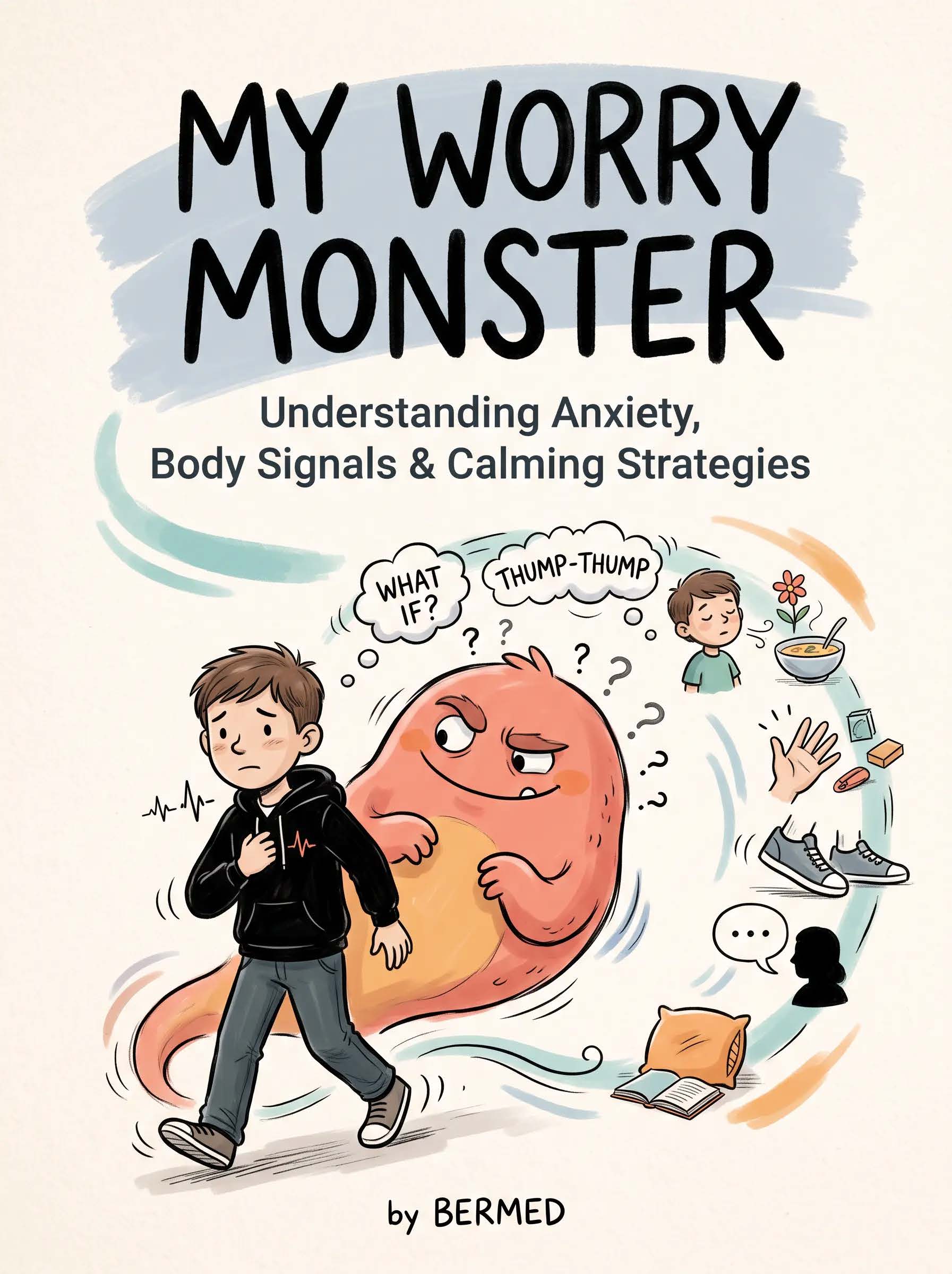
Free resource
My Worry Monster
A child-friendly guide to anxiety, body signals and coping tools.
Asking for Help and Advocating
- By [date], [Student] will ask for help on a confusing task using words, a help card or a written note in 4 of 5 opportunities.
- By [date], [Student] will request an accommodation listed in the IEP (extra time, quiet testing room, preview of questions) in 3 of 4 opportunities.
- By [date], [Student] will use a signal or pass to request a short break in a calm space in 80% of anxious moments, returning within 10 minutes.
- By [date], [Student] will email or message a teacher with a question about an assignment in 3 of 4 opportunities.
- By [date], [Student] will identify two trusted adults at school and contact one when worried in 4 of 5 opportunities.
- By [date], [Student] will explain one accommodation that helps their anxiety to a new teacher with a support script.
- By [date], [Student] will say “I need a minute” or use a card instead of leaving without permission in 80% of opportunities.

Participation and School Attendance
When anxiety keeps a student out of class or school, start small and plan with the family. Our article on school refusal in autistic children covers re-entry plans.
- By [date], [Student] will arrive at school and enter the classroom using a morning arrival routine in 4 of 5 days.
- By [date], [Student] will stay in class for the full period with one planned break in 80% of class periods.
- By [date], [Student] will participate in a small group of 2 to 3 peers by sharing one idea in 4 of 5 group sessions.
- By [date], [Student] will take a test in the general classroom or alternate setting using accommodations and complete it in 4 of 5 tests.
- By [date], [Student] will decrease visits to the nurse for anxiety-related complaints from 3 per week to 1 or fewer per week over 6 weeks.
- By [date], [Student] will participate in a whole-class activity using a preferred mode (written answer, response card, partner sharing) in 3 of 5 opportunities.
- By [date], [Student] will attend school for at least 90% of scheduled days over a grading period with a family and school support plan.
Brave Steps and Gradual Exposure
Exposure should be chosen with the student, broken into small steps and never forced. If a student does not speak in some settings, see our selective mutism IEP goals.
- By [date], [Student] will help build a brave ladder of 5 steps for one feared situation with a trusted adult.
- By [date], [Student] will complete the next step on their brave ladder with support in 3 of 4 weekly practice sessions.
- By [date], [Student] will read aloud to one trusted adult, then to a small group, progressing up their ladder by the annual review.
- By [date], [Student] will try a new or feared activity for 2 minutes with a coping tool in 3 of 4 opportunities, increasing to 10 minutes.
- By [date], [Student] will rate worry before and after a brave step and notice that worry decreased in 4 of 5 practices.
- By [date], [Student] will present to the class using an accommodation (recorded video, slides, partner) in 1 of 2 presentation opportunities.
- By [date], [Student] will celebrate a completed brave step by recording it in a brave journal in 80% of practices.
Helpful Thinking and Self-Talk
- By [date], [Student] will identify a worried thought and replace it with a helpful thought using a thought card in 4 of 5 opportunities.
- By [date], [Student] will use a coping statement (“I can do hard things,” “This feeling will pass”) before a stressful task in 80% of opportunities.
- By [date], [Student] will identify evidence for and against a worry using a 2-column chart with adult support in 3 of 4 opportunities.
- By [date], [Student] will name a realistic outcome for a “what if” worry in 4 of 5 opportunities.
- By [date], [Student] will accept a mistake on classwork using a coping phrase and continue working in 4 of 5 opportunities.
- By [date], [Student] will limit reassurance questions to 2 per activity using a question card in 80% of activities.
- By [date], [Student] will identify one thing that went well each day during check-out in 4 of 5 days.
The BERMED Goal-Writing Check
- B – Baseline: Do you know the triggers, how often anxiety affects learning and which coping tools already help?
- E – Exact skill: Does the goal name one skill (recognize, cope, ask, participate, brave step)?
- R – Realistic: Are brave steps small enough to succeed and chosen with the student?
- M – Measurable: Can two adults count it the same way?
- E – Equitable access: Can the student respond in writing, with cards, gestures or AAC?
- D – Data plan: Who collects worry ratings and participation data, and when does the team review?
How to Measure Anxiety IEP Goals
| Skill | How to measure | Accommodations to pair |
|---|---|---|
| Recognizing anxiety | Worry scale ratings at check-ins | Visual scale, body map, worry journal |
| Coping | Percent of anxious moments with strategy use | Coping card, calm space, fidgets |
| Asking for help | Frequency of help and accommodation requests | Help card, break pass, trusted adult |
| Participation | Minutes in class, attendance, nurse visits | Preview, alternate response modes |
| Brave steps | Ladder steps completed, before/after ratings | Gradual practice, partner support |
| Helpful thinking | Reassurance question counts, thought card use | Thought cards, coping statements |

Pair anxiety goals with a calm corner in the classroom, self-regulation IEP goals and executive functioning IEP goals when worry is tied to planning and deadlines.
Neuroaffirming tip: For many autistic and ADHD students, anxiety comes from an environment that is too loud, too unpredictable or too demanding. Change the environment first, then teach coping skills. Goals should never ask a student to tolerate pain or sensory distress.
What are anxiety IEP goals?
Anxiety IEP goals are measurable goals that help a student recognize worry, use coping strategies, ask for help, participate in class and gradually face feared situations at school.
Can a student with anxiety get an IEP?
Yes, if anxiety adversely affects educational performance and the student needs specialized instruction, they may qualify, often under Emotional Disturbance or Other Health Impairment. Others are supported with a 504 plan.
How do you measure anxiety in an IEP?
Use worry scale ratings, coping strategy use, minutes in class, attendance, nurse visits, completed brave steps and counts of reassurance questions.
Should anxiety goals force a student to face their fears?
No. Exposure should be gradual, planned with the student and paired with coping tools. Forced exposure can increase anxiety and damage trust.
What accommodations help students with anxiety?
Common supports include a break pass, quiet testing space, advance notice of changes, previewing questions, alternate ways to present and a trusted adult check-in.
5 Actions to Take This Week
- Collect worry ratings and note when anxiety affects learning for 5 days.
- Ask the student what situations feel hardest and what already helps.
- Teach one coping strategy while the student is calm.
- Add or review accommodations such as a break pass and alternate test setting.
- Choose 2 or 3 goals from this bank and build a small brave ladder together.
Sources

