
Quick answer: Flexibility IEP goals help a student cope with changes in routine, shift between activities, consider another way to solve a problem and recover when plans fall through. The best goals teach flexible thinking with visuals and practice, not by surprising the student with change. Below are 42 SMART flexibility IEP goals for coping with change, transitions, flexible thinking and problem solving, with present level examples and data ideas.
In this goal bank
The fire drill was not on the schedule. A substitute arrived. Indoor recess replaced outdoor recess. For many autistic, ADHD and anxious students, these moments can turn a good day into a hard one. Understood describes flexible thinking as the ability to shift gears and think about things in a new way, and notes that some kids get stuck seeing things only one way. Flexibility IEP goals teach that skill on purpose, with visuals, scripts and small planned changes. For more goal areas, see our our free IEP goal bank.
How to Write Flexibility IEP Goals
Formula: By [date], when [type of change or unexpected event], given [visual, warning or script], [Student] will [accept, shift, generate an alternative or recover] within [time] in [number] of [opportunities] as measured by [data tool].
Present level example: “When the daily schedule changes, Ava becomes upset, repeats questions about the original plan and needs about 25 minutes to rejoin class. With a change card and a 5-minute warning, she accepts small changes in 3 of 10 opportunities. She can name an alternative activity when given 2 choices.”
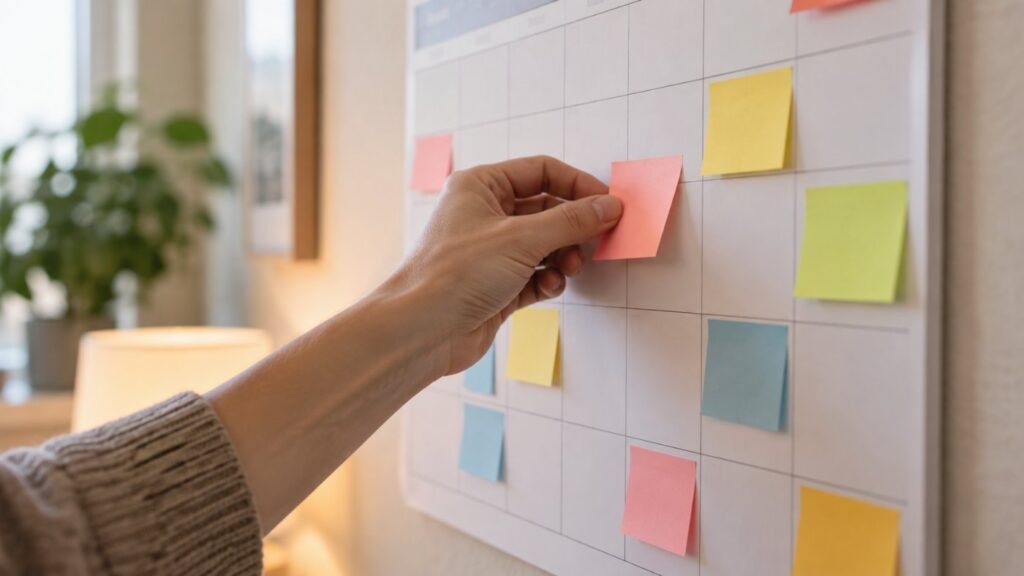
Key point: Flexibility grows with predictability. Use a change card and planned practice so the student learns that change is safe, then fade the warnings slowly.
Coping With Schedule Changes
- By [date], when shown a change card on the visual schedule, [Student] will accept the change and move to the new activity within 3 minutes in 4 of 5 opportunities.
- By [date], [Student] will use a coping strategy (breathing, squeeze ball, scripted phrase) when told about a change in 80% of opportunities.
- By [date], [Student] will participate in 2 planned “surprise” practice changes per week and rate their feelings on a scale in 4 of 5 weeks.
- By [date], [Student] will check the visual schedule independently after a change is announced in 80% of opportunities.
- By [date], [Student] will ask one clarifying question about a change (“When will we have recess?”) instead of repeated questions in 4 of 5 opportunities.
- By [date], [Student] will accept a substitute teacher or new adult using a “new person” social story in 3 of 4 opportunities.
- By [date], [Student] will decrease recovery time after an unexpected change from 25 minutes to 10 minutes or less in 4 of 5 episodes.
Transitions Between Activities
Transitions are small daily changes. Our guides to transitions for autistic children and visual schedules in the classroom explain the supports.
- By [date], given a 5-minute and 1-minute visual timer warning, [Student] will stop a preferred activity and transition in 80% of opportunities.
- By [date], [Student] will use a transition object or “first, then” card to move between locations in 4 of 5 transitions.
- By [date], [Student] will save unfinished work in a “finish later” folder and transition in 4 of 5 opportunities.
- By [date], [Student] will move from a preferred to a non-preferred activity with no more than one prompt in 70% of transitions.
- By [date], [Student] will follow a transition routine (check schedule, gather materials, walk) independently in 80% of transitions.
- By [date], [Student] will transition between school settings (classroom to specials) within 3 minutes in 4 of 5 opportunities.
- By [date], [Student] will use a self-talk script (“It is time to change, I can come back later”) during transitions in 3 of 5 opportunities.
Free resource
Transition Planning Toolkit for Educators
Tools to plan postsecondary goals, services and student-led transition.
Flexible Thinking
- By [date], [Student] will name two different ways to complete a task in 4 of 5 opportunities.
- By [date], [Student] will identify another person’s point of view in a short scenario using a visual in 3 of 4 opportunities.
- By [date], [Student] will sort problems into “rock brain” (stuck) and “flexible brain” (open) examples in 4 of 5 trials.
- By [date], [Student] will accept a different rule for a game played in a new way in 3 of 4 opportunities.
- By [date], [Student] will try a new strategy suggested by an adult after the first strategy fails in 80% of opportunities.
- By [date], [Student] will identify two meanings or uses for the same object or word in 4 of 5 trials.
- By [date], [Student] will use the phrase “Maybe there is another way” before trying again in 3 of 5 opportunities.
Plan B and Problem Solving
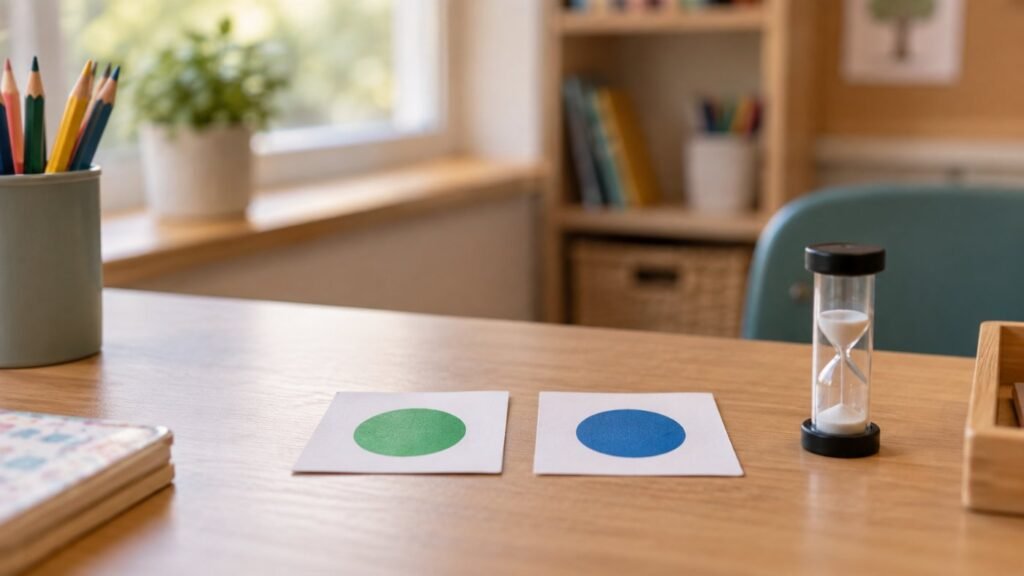
- By [date], when Plan A is not possible, [Student] will choose a Plan B from 2 or 3 visual options in 4 of 5 opportunities.
- By [date], [Student] will generate their own Plan B for a familiar situation in 3 of 4 opportunities.
- By [date], [Student] will identify the size of a problem and match an appropriate reaction in 4 of 5 scenarios.
- By [date], [Student] will use a 3-step problem-solving card (What is the problem? What can I try? How did it go?) in 80% of opportunities.
- By [date], [Student] will accept “not now” with a visual of when the activity will happen in 4 of 5 opportunities.
- By [date], [Student] will compromise by choosing a middle option when two choices conflict in 3 of 4 opportunities.
- By [date], [Student] will ask for help to find a Plan B when stuck in 4 of 5 opportunities.
Flexibility With Peers
- By [date], [Student] will take turns choosing a game or activity with a peer in 4 of 5 opportunities.
- By [date], [Student] will accept a peer’s idea in a group project and add to it in 3 of 4 opportunities.
- By [date], [Student] will play a game using a peer’s rules for at least 5 minutes in 3 of 4 opportunities.
- By [date], [Student] will accept a different seat or partner using a coping strategy in 80% of opportunities.
- By [date], [Student] will respond to a peer’s change of plans using a script (“OK, what should we do instead?”) in 3 of 4 opportunities.
- By [date], [Student] will vote and accept the group decision in 4 of 5 class votes.
- By [date], [Student] will share a preferred item for a set time using a timer in 4 of 5 opportunities.
Mistakes and Unexpected Outcomes
Rigid thinking often shows up around mistakes and losing. These goals connect with self-regulation IEP goals and anxiety IEP goals.
- By [date], [Student] will fix a mistake on classwork using an eraser or a single line and continue working in 4 of 5 opportunities.
- By [date], [Student] will use a coping phrase (“Mistakes help me learn”) after an error in 80% of opportunities.
- By [date], [Student] will lose a game and stay in the activity using a coping strategy in 3 of 4 opportunities.
- By [date], [Student] will accept a grade or feedback that is different from what they expected by identifying one next step in 3 of 4 opportunities.
- By [date], [Student] will adjust when a tool or device does not work by choosing an alternative in 4 of 5 opportunities.
- By [date], [Student] will accept a “good enough” version of a task when time is up in 3 of 4 opportunities.
- By [date], [Student] will describe what they could do differently next time after an unexpected outcome in 4 of 5 reflections.
The BERMED Goal-Writing Check
- B – Baseline: Do you know which changes are hardest and how long recovery takes?
- E – Exact skill: Does the goal name one skill (accept, transition, generate options, recover)?
- R – Realistic: Are changes practiced in small, planned steps first?
- M – Measurable: Can two adults count it the same way?
- E – Equitable access: Can the student use visuals, scripts or AAC to respond?
- D – Data plan: Who tracks transitions and recovery time, and when does the team review?
How to Measure Flexibility IEP Goals
| Skill | How to measure | Accommodations to pair |
|---|---|---|
| Schedule changes | Percent of changes accepted, recovery minutes | Change card, social story, advance notice |
| Transitions | Latency to transition, prompts needed | Visual timer, first-then card |
| Flexible thinking | Number of alternatives generated | Visual examples, modeling |
| Plan B | Percent of opportunities with Plan B used | Plan B cards, problem-solving card |
| Peer flexibility | Turns taken, ideas accepted | Scripts, timers, structured games |
| Mistakes | Percent of errors followed by continued work | Coping phrases, reflection sheet |
Prepare students for change with social stories in the classroom, use declarative language to lower pressure, and pair these goals with behavior IEP goals when rigid moments lead to unsafe behavior.
Neuroaffirming tip: Needing sameness is a real need, not stubbornness. Respect routines that help a student feel safe, and focus flexibility goals on the changes that matter for learning and daily life.
What are flexibility IEP goals?
Flexibility IEP goals are measurable goals that help a student cope with changes, transition between activities, consider other ways to solve a problem and recover from unexpected events.
How do you teach flexible thinking?
Use visuals, change cards, Plan B cards, social stories and planned practice changes. Model flexible language and celebrate small successes.
How do you measure flexibility in an IEP?
Track the percent of changes accepted, recovery time, transition latency, prompts needed and the number of alternatives a student generates.
Are flexibility goals appropriate for autistic students?
Yes, when they respect the need for predictability. Focus on changes that matter for learning and daily life, and keep supports like visual schedules in place.
What is a change card?
A change card is a visual symbol placed on a schedule to show that something will be different. It gives the student advance notice and a predictable way to handle change.
5 Actions to Take This Week
- List the changes and transitions that are hardest for the student.
- Add a change card to the visual schedule and teach what it means.
- Plan 2 small practice changes this week and celebrate coping.
- Create Plan B cards for 3 common situations.
- Choose 2 or 3 goals from this bank and track recovery time.
Related reading:
Sources

