Table of Contents

The fastest way to end a meltdown is to stop trying to end it. That sounds backward, but it is what most experienced special education teachers learn the hard way. Every instruction, warning or question you add during a meltdown is one more input for a brain that is already flooded.
This guide explains what autistic meltdowns in the classroom really are, how to tell them apart from tantrums and shutdowns, and what to do before, during and after one. It is written for SPED teachers, general education teachers, paraprofessionals and anyone who supports autistic students at school.
Why Autistic Meltdowns in the Classroom Are Not a Behavior Problem
Classroom systems are built around choices: follow the rule, earn the reward; break the rule, face the consequence. A meltdown sits outside that system. The student is not weighing options. Their stress response has taken over.
That is why points charts, removing recess or calling home rarely reduce meltdowns. They target motivation, and the problem is capacity. A student can want to stay calm and still melt down when the room is too loud, the schedule changed without warning and a demand arrived at the wrong moment.
If the student also shows a strong need for control and avoids everyday demands, read our guide to the PDA profile in autism, because demand pressure is a frequent trigger for this group.
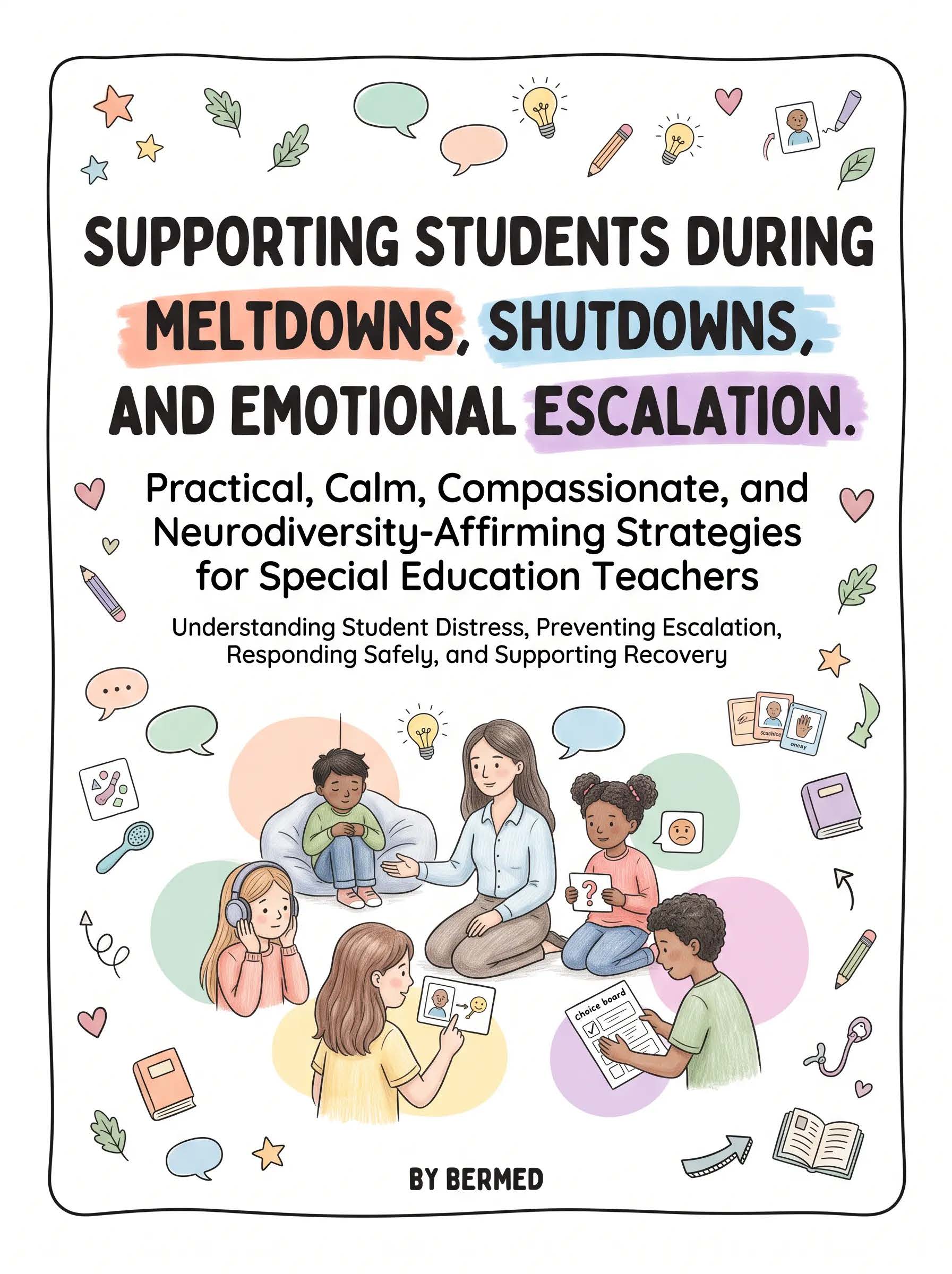
Free resource
Supporting Students During Meltdowns and Shutdowns
A practical guide for calm, safe responses during emotional overload.
Meltdown, Tantrum or Shutdown? How to Tell the Difference
The three can look similar from across the room. The response that helps one can make another worse, so it is worth learning the differences. The Child Mind Institute notes that tantrums are goal-driven and often fade when ignored, while meltdowns are involuntary and need support to settle.
Scroll to see full table
| Feature | Tantrum | Meltdown | Shutdown |
|---|---|---|---|
| Cause | Wanting something or avoiding something | Sensory, emotional or cognitive overload | Same overload, turned inward |
| Control | Some control; checks if adults are watching | Little or none | Little or none |
| Audience | Usually needs one | Happens with or without one | Often goes unnoticed |
| What it looks like | Crying, arguing, negotiating | Screaming, crying, bolting, hitting, dropping to the floor | Silence, stillness, staring, unable to speak |
| Ends when | Goal is met or attention stops | The nervous system calms down | Energy slowly returns |
| Best response | Calm limits and teaching later | Reduce input, keep safe, wait | Quiet, no demands, time |
The Stages of Autistic Meltdowns in the Classroom
Most meltdowns follow a pattern. Knowing the stages tells you where you still have options.
1. Build-up
Stress is stacking: noise, a changed routine, a hard task, hunger, a peer conflict. The student may look fine. This is where most prevention happens.
2. Rumble
Warning signs appear: pacing, rocking, covering ears, repetitive questions, sudden stillness, a louder voice or refusal. The National Autistic Society calls this the rumble stage, and it is often the last point where a calming strategy can still work.
3. Meltdown
Control is gone. Your only jobs are safety and lowering input.
4. Recovery
The student may be exhausted, tearful, embarrassed or unable to talk. Recovery often takes longer than the meltdown itself, and a second meltdown is more likely if demands return too soon.
The BERMED Quiet Response: 5 Steps
The Quiet Response
Five steps for any adult in the room during autistic meltdowns in the classroom. Use them in order. The goal is safety and regulation first, learning later.
Lower Your Own Volume
Slow your breathing, soften your voice and lower your body. Students read your nervous system before they hear your words.
Cut the Input
Dim lights, stop music, pause the lesson, offer ear defenders. Remove every demand you can, including eye contact.
Make Space, Keep Safe
Move furniture or move peers rather than dragging the student out. Follow your school safety plan if anyone is at risk.
Wait Without Pushing
Stay nearby, calm and quiet. Silence is not neglect. It is the most regulating thing you can offer.
Reconnect Before You Return
Offer water, a fidget or a quiet task. Return to class work only when the student signals they are ready.

For more tools, see our full guide to behavior de-escalation in the classroom.
What to Say (and What to Avoid) During a Meltdown
Language processing drops sharply during overload. Fewer words work better. Our list of de-escalation scripts for teachers gives you tested phrases you can memorize now, so you do not have to invent them under pressure.
Do This
- “You are safe.”
- “I am here.”
- “Take your time.”
- Use the same calm phrase each time
- Point to a visual calm card
- Let silence do the work
Avoid This
- “Calm down right now.”
- “Why are you doing this?”
- Counting down or warnings
- Touch without consent
- Lectures about choices
- An audience of peers
After the Meltdown: Repair, Not Punishment

Once the student has fully recovered, the goal is repair and learning. Keep it short, private and blame-free.
- Name it gently: “That was really hard. Your body got overwhelmed.”
- Look for the trigger together: use pictures or a simple scale if words are hard.
- Plan one change: a break card, a seat away from the door, a warning before transitions.
- Write it down: a behavior de-escalation log helps patterns show up within a few weeks.
If meltdowns become frequent or the student seems exhausted for weeks, consider autistic burnout. Our guide to IEP goals for autistic burnout shows how to write supports into the plan.
In Class, At Home and in Life
IN CLASS
Build a calm corner before you need it, teach its use when the student is regulated, and add sensory supports to the IEP. A quick sensory profile, like the one in our sensory needs guide for kids, shows which inputs to reduce first.
AT HOME
Share what you notice with families in neutral language: what happened before, what helped, how long recovery took. Parents often see the same triggers and can share strategies that already work at home.
LIFE
Autistic adults describe meltdowns as frightening and exhausting, not as something they chose. Students who are met with calm support learn that overwhelm is survivable and that they can ask for help early. That lesson lasts far beyond school.
Frequently Asked Questions About Autistic Meltdowns in the Classroom
Are autistic meltdowns in the classroom a form of bad behavior?
No. A meltdown is an involuntary stress response that happens when a student is completely overwhelmed. The student is not choosing it and cannot stop it on request, so consequences and rewards do not change it.
How long does a classroom meltdown last?
It varies from a few minutes to much longer. Recovery often takes longer than the visible meltdown itself, so plan for quiet time afterward before asking the student to return to work.
Should I clear the classroom during a meltdown?
If the student or others may be unsafe, or if the audience is adding stress, moving peers out is often kinder and faster than moving the student. Follow your school safety plan.
What should a teacher say during an autistic meltdown?
Very little. Use short, calm phrases such as “You are safe” or “I am here.” Avoid questions, reasoning, warnings and lectures, because the student cannot process language well during overload.
How can teachers prevent autistic meltdowns in the classroom?
Track what happens before each meltdown, reduce sensory load, give warnings before transitions, offer a calm space the student can use early, and lower demands on hard days.
5 Actions You Can Take This Week
- Write down the last three meltdowns. Note time, place, task and what happened just before.
- Pick one sensory change. Lower one light, one noise or one crowded spot.
- Choose two calm phrases. Share them with every adult who works with the student.
- Set up a calm space. Teach it during a calm moment, not during a crisis.
- Plan the repair talk. Decide how you will reconnect without blame.
Sources
- National Autistic Society. Meltdowns: a guide for all audiences. autism.org.uk
- Child Mind Institute. How to De-Escalate an Autistic Meltdown. childmind.org
- Centers for Disease Control and Prevention. Data and Statistics on Autism Spectrum Disorder. cdc.gov
- Autism Society of America. Autistic Meltdowns and Shutdowns: An Inclusive Guide. autismsociety.org