
Quick answer: Behavior IEP goals should teach a replacement skill that meets the same need as the challenging behavior, such as asking for a break instead of leaving, or using words instead of hitting. The strongest goals come from a functional behavior assessment, describe what the student will do, and are paired with supports in a behavior intervention plan. Below are 42 SMART behavior IEP goals organized by need, with present level examples and data ideas.
In this goal bank
“Will comply with adult directions 100% of the time.” “Will not be disruptive.” These behavior IEP goals show up in IEPs every day, and they rarely change anything. Behavior is communication. A student who runs out of the room may be escaping noise. A student who shouts may need help and not know how to ask. IDEA requires IEP teams to consider positive behavioral interventions and supports when behavior gets in the way of learning. Good behavior IEP goals teach a skill that meets the same need in a safer, more effective way. For the full process, start with our guide to functional behavior assessment and our complete IEP goal bank.
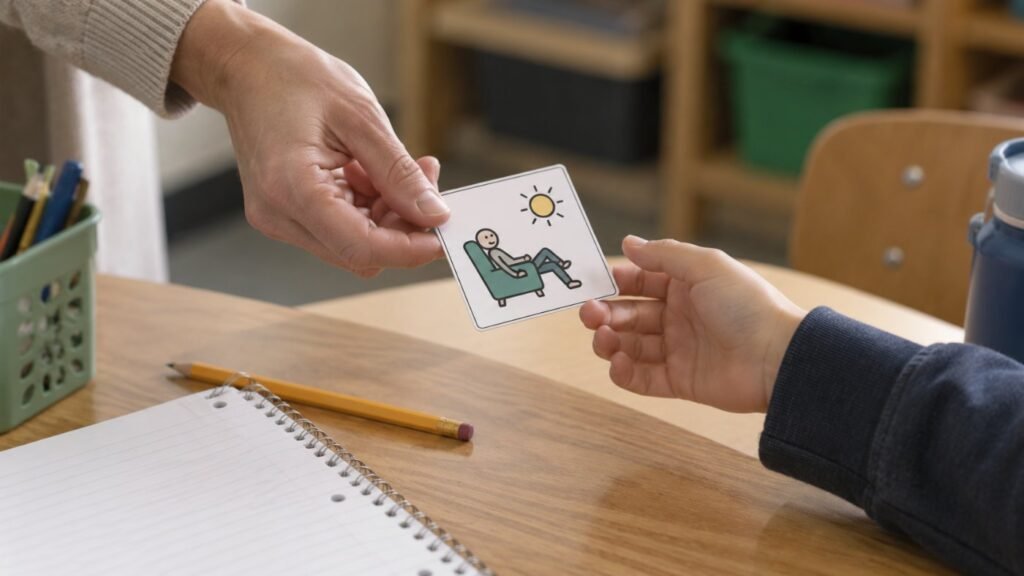
How to Write Behavior IEP Goals
Formula: By [date], when [trigger from the FBA], given [support], [Student] will [replacement behavior that meets the same function] in [number] of [opportunities] as measured by [ABC data, frequency count or interval data].
Present level example: “According to the FBA, Jordan leaves his seat or the classroom about 5 times per day, mostly during independent writing. The behavior appears to serve an escape function. Jordan uses a break card in 1 of 10 opportunities with a verbal prompt. He calms quickly when given a short movement break.”
Key point: The replacement behavior must work as well as the old behavior. If a student leaves to escape hard work, the break card has to actually get them a break, especially at first.
Escape and Avoidance Replacement Goals
When a student avoids work, ask what is hard: the task, the noise, the demand or the uncertainty. Then teach a safe way to ask for less.
- By [date], when presented with a non-preferred task, [Student] will request a break using a break card, AAC or words instead of leaving the area in 8 of 10 opportunities.
- By [date], [Student] will request help (“Can you help me?”) when stuck on a task instead of refusing or tearing materials in 4 of 5 opportunities.
- By [date], given a choice of two ways to complete a task, [Student] will choose one and begin within 2 minutes in 80% of opportunities.
- By [date], [Student] will use a “first, then” board to complete a short non-preferred task before a preferred activity in 4 of 5 opportunities.
- By [date], [Student] will ask to complete a reduced amount of work (“Can I do 5?”) instead of refusing in 3 of 4 opportunities.
- By [date], when overwhelmed by noise, [Student] will request headphones or a quieter space instead of shouting or leaving in 80% of opportunities.
- By [date], [Student] will remain in the designated area for 10 minutes of independent work with one scheduled break, increasing to 20 minutes, in 4 of 5 sessions.
Attention-Seeking Replacement Goals
Needing connection is not bad behavior. Teach clear, effective ways to get it.
- By [date], [Student] will raise a hand, use a help signal or say “Excuse me” to get adult attention instead of calling out in 80% of opportunities.
- By [date], [Student] will wait for adult attention for up to 2 minutes using a visual wait card in 4 of 5 opportunities.
- By [date], [Student] will initiate a positive interaction with a peer (greeting, asking to join, sharing) in 3 of 4 structured opportunities.
- By [date], [Student] will request a check-in with a trusted adult using a check-in card in 4 of 5 days.
- By [date], [Student] will share a comment or idea at an appropriate time during group discussion in 3 of 5 opportunities.
- By [date], [Student] will use a classroom job or helper role to gain positive attention in 4 of 5 scheduled opportunities.
- By [date], [Student] will ask a peer to play or work together using a script or AAC in 3 of 4 opportunities.
Free resource
Behavior Data Tracking Form
Editable observation, frequency and response data sheet for FBAs and BIPs.
Safety and Aggression Replacement Goals
Aggression usually happens when a student is overwhelmed and out of options. Safety comes first, then teaching. See our guides to aggression in autistic children and self-regulation IEP goals.
- By [date], when frustrated, [Student] will use a safe replacement action (squeeze a stress ball, push on the wall, walk away) instead of hitting or kicking in 8 of 10 episodes.
- By [date], [Student] will use words, signs or AAC to say “Stop” or “I am mad” instead of physical aggression in 4 of 5 opportunities.
- By [date], [Student] will move to a designated safe space when upset, with one adult prompt, in 80% of escalating episodes.
- By [date], [Student] will keep hands and feet in their own space during transitions using a visual reminder in 4 of 5 transitions.
- By [date], [Student] will reduce incidents of physical aggression from a baseline of 4 per week to 1 or fewer per week over 6 consecutive weeks, as recorded on ABC data.
- By [date], [Student] will accept a calming offer from an adult (space, water, sensory tool) within 1 minute in 4 of 5 escalating episodes.
- By [date], after an incident, [Student] will take part in a restorative conversation using a visual guide in 3 of 4 opportunities.

Following Routines and Directions
- By [date], given a visual schedule, [Student] will transition between activities within 2 minutes in 80% of transitions.
- By [date], [Student] will follow a 2-step classroom direction with a visual cue within 1 minute in 4 of 5 opportunities.
- By [date], [Student] will follow the arrival routine (hang bag, check schedule, start morning task) using a picture checklist in 4 of 5 days.
- By [date], [Student] will respond to a transition warning (5-minute and 1-minute visual timer) by finishing or saving work in 80% of opportunities.
- By [date], [Student] will line up and walk with the class using a visual route card in 4 of 5 opportunities.
- By [date], [Student] will follow classroom expectations shown on a visual chart during whole-group lessons in 80% of intervals.
- By [date], [Student] will use a “change card” to accept an unexpected schedule change in 3 of 4 opportunities.
Problem Solving and Flexibility
- By [date], when facing a problem, [Student] will identify the size of the problem using a visual scale in 4 of 5 opportunities.
- By [date], [Student] will choose one of three solutions from a problem-solving card (ask for help, take a break, try another way) in 80% of opportunities.
- By [date], when losing a game, [Student] will use a coping phrase (“Maybe next time”) and stay in the activity in 3 of 4 opportunities.
- By [date], [Student] will accept a “no” or “not now” with a visual reminder of when the item will be available in 4 of 5 opportunities.
- By [date], [Student] will negotiate a compromise with a peer using a script in 3 of 4 structured opportunities.
- By [date], [Student] will name a Plan B when Plan A does not work in 4 of 5 practiced scenarios.
- By [date], [Student] will tell an adult what they need (“I need more time”) instead of refusing in 80% of opportunities.
Self-Monitoring Behavior Goals
- By [date], [Student] will rate their own behavior on a daily point sheet and match the teacher rating in 80% of periods.
- By [date], [Student] will use a self-monitoring checklist to track one replacement skill (for example, using a break card) in 4 of 5 days.
- By [date], [Student] will review weekly behavior data with an adult and name one success and one next step in 4 of 5 weeks.
- By [date], [Student] will set a daily behavior goal during morning check-in and reflect on it during afternoon check-out in 80% of days.
- By [date], [Student] will use a vibrating timer cue to self-check whether they are using expected classroom behavior in 80% of intervals.
- By [date], [Student] will identify personal triggers using their own ABC data with adult support and help plan one change.
- By [date], [Student] will share one helpful behavior support during their IEP meeting.
The BERMED Goal-Writing Check
- B – Baseline: Do you have FBA or ABC data showing how often, when and why the behavior happens?
- E – Exact skill: Does the goal name one replacement behavior that meets the same function?
- R – Realistic: Is the replacement easier and faster for the student than the old behavior?
- M – Measurable: Can two adults count it the same way?
- E – Equitable access: Can the student use words, cards, gestures or AAC?
- D – Data plan: Who collects data, which tool, and when does the team review the BIP?
How to Measure Behavior IEP Goals
| Skill | How to measure | Accommodations to pair |
|---|---|---|
| Escape replacement | Frequency of break requests vs leaving | Break card, reduced work, first-then board |
| Attention replacement | Frequency of hand raises vs call-outs | Check-ins, helper role, wait card |
| Safety | ABC data and incident counts | Safe space, sensory tools, crisis plan |
| Routines | Percent of transitions within time | Visual schedule, timers, warnings |
| Problem solving | Percent of opportunities with solution used | Problem-solving card, practice scenarios |
| Self-monitoring | Student vs teacher rating match | Point sheet, check-in/check-out |
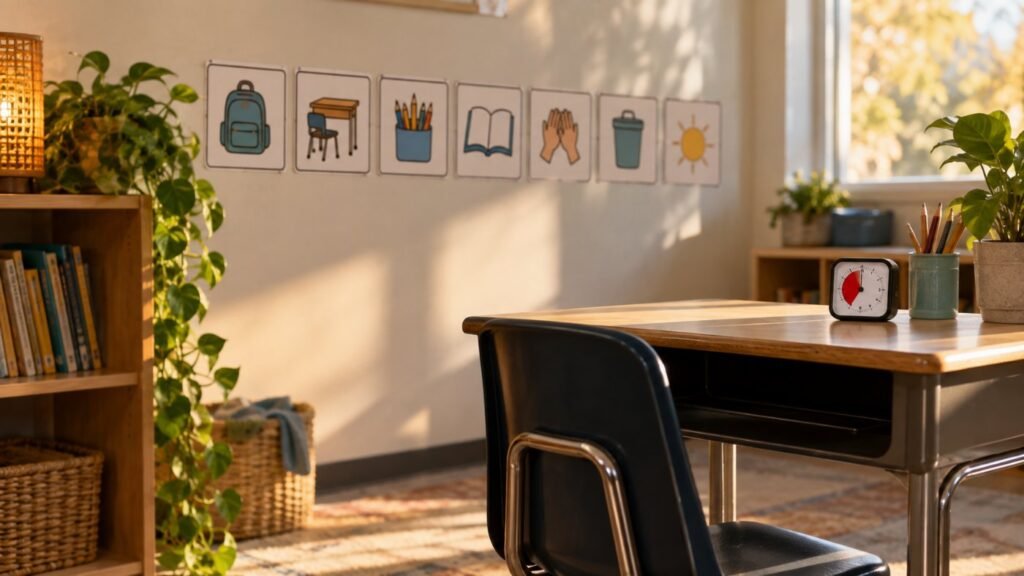
Track these goals with our free behavior de-escalation log, plan calm responses with behavior de-escalation in the classroom, and pair attention goals with ADHD IEP goals.
Neuroaffirming tip: Do not write behavior goals for stimming, avoiding eye contact or needing movement. These are not problems to fix. Focus behavior IEP goals on safety, communication and access to learning.
What are behavior IEP goals?
Behavior IEP goals describe a replacement skill a student will learn, such as asking for a break or using words when upset, that meets the same need as a challenging behavior. They are measurable and usually connected to an FBA and a behavior intervention plan.
What is a replacement behavior?
A replacement behavior is a safer, more effective action that serves the same function as the challenging behavior. If a student hits to escape noise, a replacement could be asking for headphones or a quiet space.
Do behavior IEP goals need an FBA?
An FBA is strongly recommended because it identifies why the behavior happens. Without knowing the function, teams often pick replacement skills that do not meet the student’s real need.
How do you measure behavior IEP goals?
Common tools include ABC data, frequency counts, interval recording, duration data and daily point sheets. Measure the replacement skill as well as the challenging behavior.
Should a behavior goal say 100% compliance?
No. Compliance goals do not teach skills and are rarely realistic. Write goals for communication, coping and participation, at a level the student can reach within a year.
5 Actions to Take This Week
- Collect ABC data for at least 5 days before writing a new behavior goal.
- Name the likely function: escape, attention, sensory or access to items.
- Choose a replacement behavior that is easier than the current behavior.
- Honor every replacement attempt at first so the new skill works.
- Review behavior data with the team every 4 to 6 weeks and adjust the BIP.
Sources

