
Quick answer: ADHD IEP goals should target the skills that ADHD makes harder, not the student’s personality: sustaining attention, starting and finishing work, managing impulses, organizing materials, and using self-management tools. The best goals are positive, observable, and paired with supports like movement breaks, visual timers and check-ins. Below are 44 SMART ADHD IEP goals organized by skill, with present level examples, data ideas and accommodations.
In this goal bank
“Stay focused.” “Stop blurting out.” “Try harder.” Many ADHD IEP goals are written as wishes rather than skills. The CDC notes that children with ADHD can do well in school when families, teachers and administrators work together, using approaches like behavioral classroom management and organizational training. Strong ADHD IEP goals turn that support into measurable progress. This bank is part of our IEP Goal Bank series.
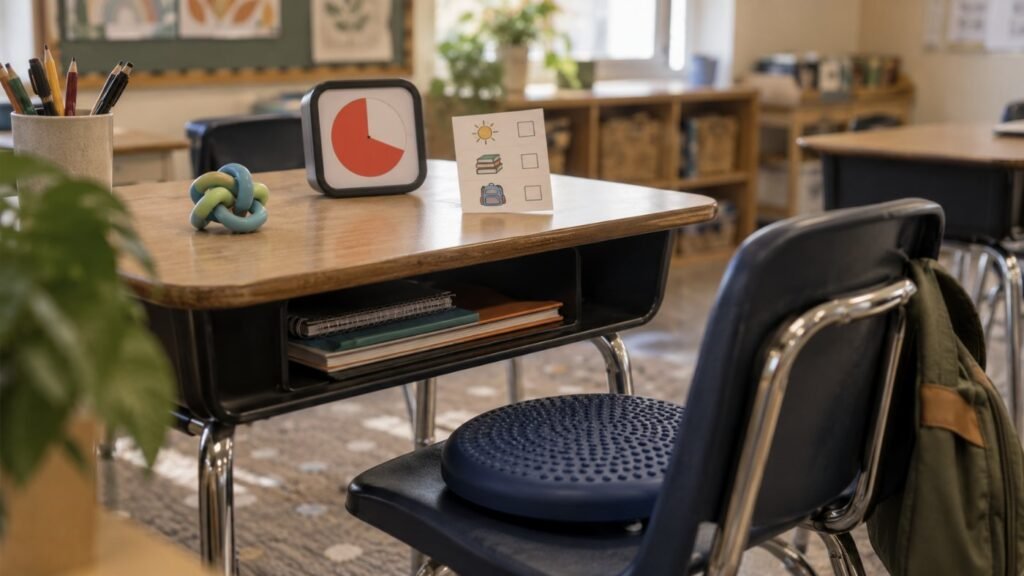
How to Write ADHD IEP Goals
Formula: By [date], given [support or tool], [Student] will [positive observable behavior] during [setting] in [percent of intervals or opportunities] as measured by [data tool].
Present level example: “During 20-minute independent work periods, Leo is on task in 45% of 1-minute intervals. He completes 50% of class assignments and calls out answers about 6 times per lesson. He works best with movement breaks and a visual timer.”
Key point: Write goals for the replacement skill. Instead of “will not call out,” write “will raise a hand or use a response card to share answers in 80% of opportunities.”
Attention and On-Task Goals
- Given a visual timer, [Student] will remain engaged in independent work for 10 minutes in 80% of observed intervals across 3 sessions.
- During whole-group instruction, [Student] will follow along by tracking text or taking guided notes in 4 of 5 lessons.
- Given a self-monitoring checklist, [Student] will be on task in 80% of 1-minute intervals during a 20-minute work period.
- When distracted, [Student] will use a refocus strategy (look at checklist, return to task) within 1 minute in 4 of 5 observed instances.
- Given 2-step directions, [Student] will begin the first step within 1 minute in 4 of 5 opportunities.
- [Student] will increase sustained attention to a preferred learning task from 5 to 15 minutes in 4 of 5 sessions.
- Given a choice of seating or work location, [Student] will choose one that helps them focus and stay engaged in 4 of 5 work periods.
Work Completion Goals
- Given chunked assignments, [Student] will complete 80% of class work within the allotted time across 4 weeks.
- Using a task checklist, [Student] will complete all parts of a multi-step assignment in 4 of 5 assignments.
- [Student] will turn in 80% of homework assignments on time across a grading period.
- Given a work completion chart, [Student] will finish one section before taking a break in 4 of 5 work periods.
- [Student] will check their work for completeness using a “Did I finish?” card in 4 of 5 assignments.
- [Student] will record assignments in a planner and check them off when done in 4 of 5 days.
- Given a long assignment broken into parts, [Student] will meet each mini deadline in 4 of 5 projects.
Free resource
Supporting ADHD Students in the Classroom
Practical, compassionate strategies for focus, organization and behavior, ready to use tomorrow.
Impulse Control Goals
- During discussions, [Student] will raise a hand or use a response card before speaking in 80% of opportunities.
- When waiting, [Student] will use a waiting strategy (fidget, count, breathe) in 4 of 5 opportunities.
- During transitions, [Student] will keep hands and materials to self in 90% of observed transitions.
- Before answering, [Student] will pause and check the question in 4 of 5 opportunities.
- During games or group work, [Student] will wait for their turn in 4 of 5 observed rounds.
- When frustrated, [Student] will request a break instead of leaving the area in 4 of 5 opportunities.
- [Student] will stop and think before acting using a “stop, think, choose” visual in 4 of 5 situations.
Movement and Regulation Goals
- [Student] will request a movement break using an agreed signal in 4 of 5 times they need one.
- [Student] will return from a movement break and resume work within 2 minutes in 4 of 5 breaks.
- [Student] will use a fidget or wobble cushion appropriately during instruction in 80% of observed intervals.
- Given scheduled movement breaks, [Student] will complete the next work period with 80% on-task behavior.
- [Student] will identify when their energy is high or low using a scale and choose a strategy in 4 of 5 opportunities.
- [Student] will use a standing desk or alternative seating appropriately in 4 of 5 lessons.
Movement is a regulation tool for many students with ADHD. See sensory breaks in the classroom and strategies to manage hyperactivity.
Self-Management Goals
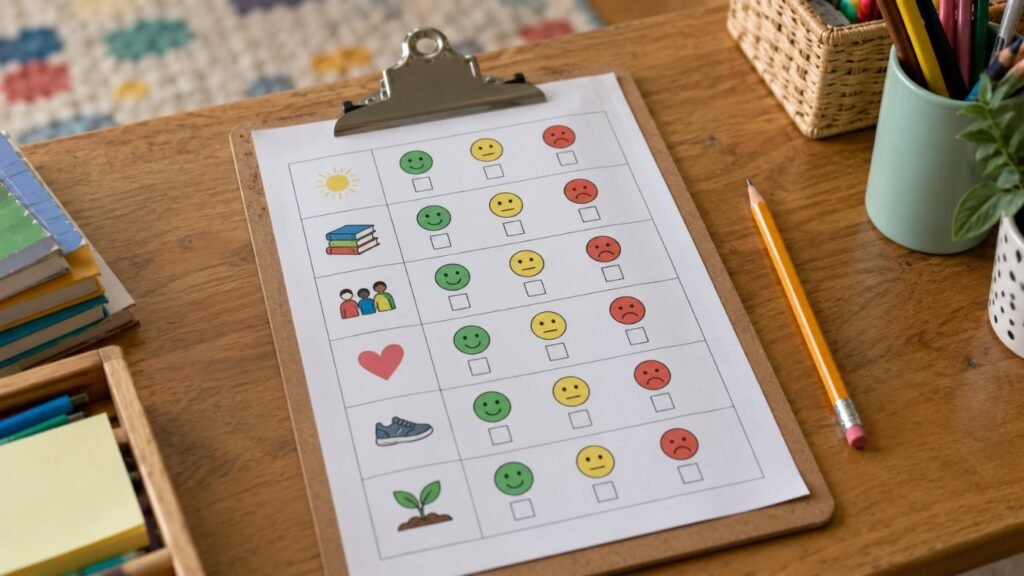
- [Student] will self-monitor work completion on a daily report card and compare with teacher rating with 80% agreement.
- [Student] will set a daily goal for focus or work completion and evaluate it at the end of the day in 4 of 5 days.
- [Student] will identify 3 strategies that help them focus and use one independently in 4 of 5 work periods.
- [Student] will use a digital or paper reminder system to remember materials in 4 of 5 days.
- [Student] will advocate for an accommodation (break, quiet space, extended time) appropriately in 4 of 5 opportunities.
- [Student] will reflect weekly on what helped and what was hard using a short form in 4 of 5 weeks.
- [Student] will use a timer to break work into focus sprints and breaks in 4 of 5 independent tasks.
- [Student] will organize their desk and materials at the end of each class using a checklist in 4 of 5 days.
Social and Classroom Participation Goals
- During group work, [Student] will contribute at least 2 relevant ideas and listen to peers in 4 of 5 sessions.
- [Student] will follow classroom routines (entering, unpacking, starting warm-up) independently in 4 of 5 days.
- [Student] will use a calm voice volume appropriate to the setting in 80% of observed intervals.
- [Student] will repair a conflict with a peer using a script or adult support in 4 of 5 situations.
- [Student] will participate in class discussion by answering at least 1 question per lesson in 4 of 5 lessons.
- [Student] will transition between activities within 2 minutes in 4 of 5 transitions.
- [Student] will accept feedback from a teacher and try a suggested change in 4 of 5 opportunities.
- [Student] will use a quiet signal to request help instead of calling out in 80% of opportunities.
- [Student] will work cooperatively with a partner for 10 minutes in 4 of 5 sessions.
The BERMED Goal-Writing Check
- B: Baseline. Interval data, completion rates, frequency counts.
- E: Exact skill. Attention, completion, impulse control or self-management?
- R: Replacement behavior. What will the student do instead?
- M: Measurable. Percent of intervals or opportunities.
- E: Equitable access. Movement and tools are allowed.
- D: Data plan. Daily report card or weekly observations.
Data Collection and Accommodations
| Skill | How to measure | Accommodations to pair |
|---|---|---|
| On-task behavior | Momentary time sampling | Visual timers, preferential seating |
| Work completion | Percent of tasks completed | Chunked assignments, checklists |
| Impulse control | Frequency counts | Response cards, wait strategies |
| Movement | Break requests and returns | Movement breaks, flexible seating |
| Self-management | Daily report card agreement | Self-monitoring tools |

Pair these goals with 504 accommodations for ADHD and executive functioning IEP goals. For regulation goals, see self-regulation IEP goals. Students who are also autistic may need AuDHD IEP goals. For how ADHD can look different in girls, read ADHD in boys vs ADHD in girls.
Neuroaffirming tip: ADHD brains often thrive with interest, novelty, movement and urgency. Build those into goals and instruction instead of expecting students to sit still and quiet for long periods.
What are good ADHD IEP goals?
Good ADHD IEP goals target specific skills like sustained attention, work completion, impulse control and self-management, written as positive, measurable behaviors.
How do you measure attention in an IEP goal?
Momentary time sampling, where an observer checks if the student is on task at set intervals, is a common and reliable method.
Should ADHD goals say what the student will stop doing?
It is better to name the replacement behavior, such as raising a hand instead of calling out, so the goal teaches a new skill.
What accommodations go with ADHD IEP goals?
Visual timers, chunked assignments, movement breaks, preferential seating, checklists and daily report cards are common supports.
Can students with ADHD have an IEP instead of a 504 plan?
Yes. If ADHD affects learning enough to need specially designed instruction, a student may qualify for an IEP, often under Other Health Impairment.
5 Actions to Take This Week
- Collect on-task and work completion data for 3 days.
- Rewrite any “will not” goal as a positive replacement behavior.
- Choose 2 goals from this bank.
- Start a simple daily report card.
- Add one movement or timer support.

