
Quick answer: Pragmatic language IEP goals target how a student uses language in social situations: starting and keeping a conversation, taking turns, understanding nonliteral language, reading context and repairing misunderstandings. Neuroaffirming pragmatic goals teach tools for clear communication without asking the student to copy neurotypical style. Below are 42 SMART pragmatic language IEP goals organized by skill, with present level examples and data ideas.
In this goal bank
Pragmatic language is language in action: knowing how to join a conversation, when to change the topic and what someone means when they say “Break a leg.” ASHA describes social communication difficulties as persistent challenges with using verbal and nonverbal language for social purposes, which can affect friendships, academics and later employment. Pragmatic language IEP goals give speech-language pathologists and teachers a shared target. Because communication differences go both ways, the best goals give students clear tools and also invite peers and adults to meet them halfway. See our complete IEP goal bank for other areas and our overview of speech-language therapy in the classroom.

How to Write Pragmatic Language IEP Goals
Formula: By [date], during [structured or natural conversation], given [visual, script or model], [Student] will [pragmatic skill] in [number] of [opportunities] across [number] settings as measured by [SLP data or observation].
Present level example: “Liam shares detailed information about trains but rarely asks a partner a question. In 5-minute structured conversations, he maintains a partner’s topic for 1 exchange in 3 of 10 opportunities. He interprets common idioms literally in 8 of 10 trials. He enjoys talking with peers who share his interests.”
Key point: Measure pragmatic skills in more than one setting. A skill shown only in the therapy room is not yet functional. Include the classroom, lunch or recess in the goal.
Initiating and Responding
- By [date], [Student] will initiate a conversation with a peer using a greeting and a question in 3 of 5 opportunities across 2 settings.
- By [date], [Student] will respond to a peer’s greeting or question within 5 seconds in 4 of 5 opportunities.
- By [date], [Student] will request information from an adult (“Where is…?” “When will…?”) in 4 of 5 opportunities.
- By [date], [Student] will use a visual conversation starter card to begin a conversation in 80% of opportunities.
- By [date], [Student] will make a comment about a shared activity (“This is cool!”) in 3 of 5 opportunities.
- By [date], [Student] will answer “wh” questions about a shared experience in 4 of 5 opportunities.
- By [date], [Student] will use a polite request form (“Can I have…?”) in 80% of opportunities.
Topic Maintenance and Turn Taking
- By [date], [Student] will maintain a partner’s topic for 3 conversational turns in 4 of 5 structured conversations.
- By [date], [Student] will ask a follow-up question related to what a partner said in 3 of 5 opportunities.
- By [date], [Student] will use a visual “talk turn” cue to balance turns in a conversation in 80% of opportunities.
- By [date], [Student] will introduce a new topic using a transition phrase (“Can I tell you about something else?”) in 3 of 4 opportunities.
- By [date], [Student] will share talking time about a favorite interest for up to 2 minutes and then invite a partner to share in 4 of 5 opportunities.
- By [date], [Student] will notice a partner’s cue (looking away, short answers) and ask “Do you want to keep talking about this?” in 3 of 5 opportunities.
- By [date], [Student] will close a conversation appropriately (“I have to go, bye”) in 4 of 5 opportunities.
Free resource
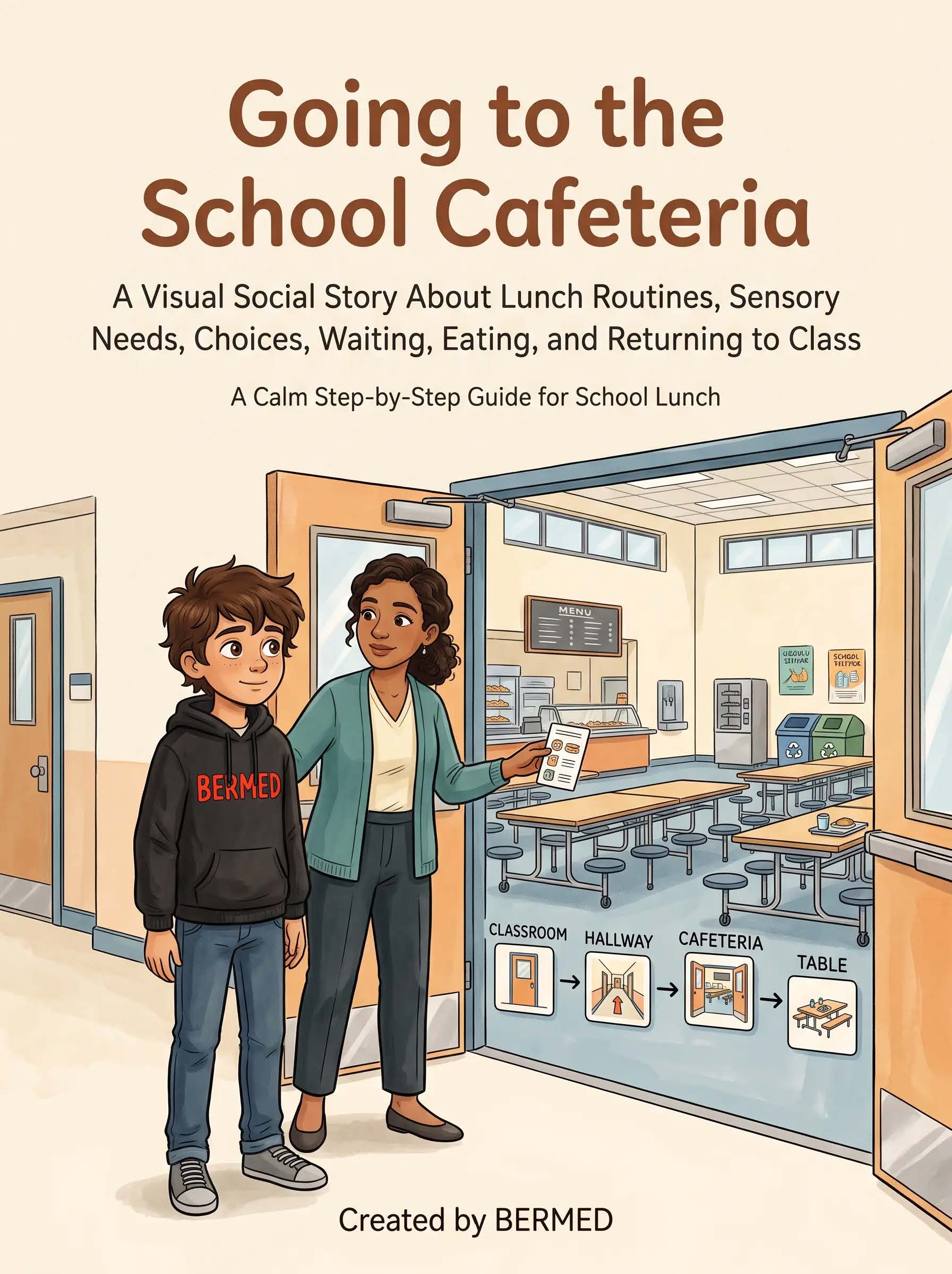
Going to the School Cafeteria: A Visual Social Story
A calm, ready-to-use social story for one of the hardest parts of the day.
Nonliteral Language
- By [date], [Student] will explain the meaning of 20 common idioms using picture support in 8 of 10 trials.
- By [date], [Student] will identify whether a statement is literal or figurative in 4 of 5 trials.
- By [date], [Student] will identify sarcasm in short scenarios using tone and context clues in 3 of 5 trials.
- By [date], [Student] will explain the meaning of a simple joke or pun in 3 of 5 trials.
- By [date], [Student] will use context clues to interpret a figurative phrase in a story in 4 of 5 opportunities.
- By [date], [Student] will ask “Do you mean that literally?” when unsure in 80% of opportunities.
- By [date], [Student] will use 3 idioms correctly in conversation or writing over a grading period.
Reading Context and Perspective
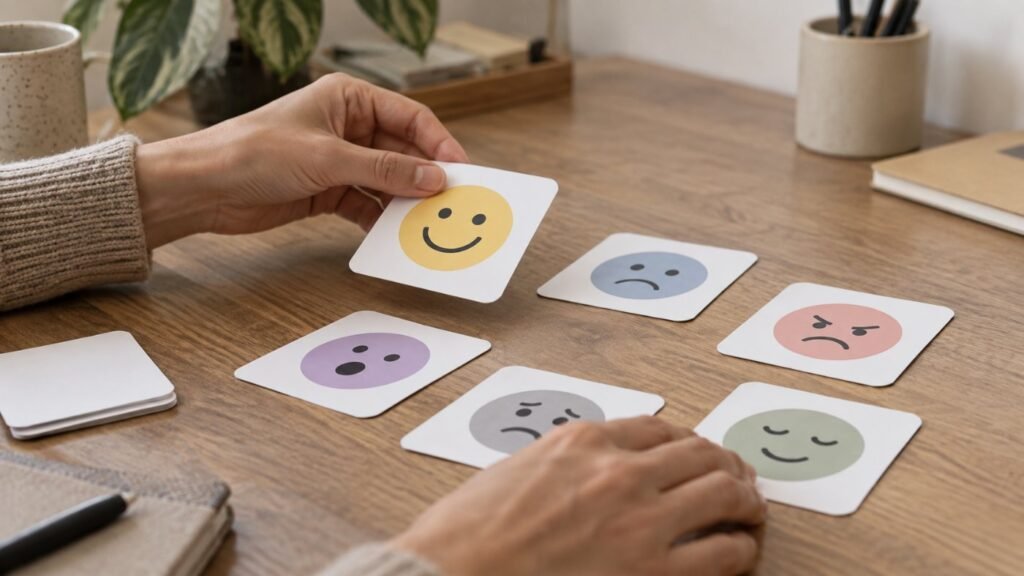
- By [date], [Student] will identify how a character might feel in a short story using text and picture clues in 4 of 5 trials.
- By [date], [Student] will adjust their voice volume to the setting (library, playground, classroom) using a volume scale in 80% of opportunities.
- By [date], [Student] will explain why a person might say something different to a teacher than to a friend in 3 of 4 scenarios.
- By [date], [Student] will identify what another person might know or not know about a topic before explaining it in 3 of 5 opportunities.
- By [date], [Student] will predict what a peer might think in a social scenario in 4 of 5 trials.
- By [date], [Student] will choose a formal or informal greeting based on the listener in 4 of 5 opportunities.
- By [date], [Student] will describe what is happening in a social picture or video clip, including the likely feelings of people, in 4 of 5 trials.
Conversational Repair
- By [date], [Student] will ask for clarification (“What do you mean?”) when a message is unclear in 4 of 5 opportunities.
- By [date], [Student] will rephrase their message when a listener does not understand in 3 of 5 opportunities.
- By [date], [Student] will add missing background information when a listener seems confused in 3 of 4 opportunities.
- By [date], [Student] will repair a misunderstanding with a peer using a script in 3 of 4 opportunities.
- By [date], [Student] will tell a partner “I need a minute to think” when processing time is needed in 80% of opportunities.
- By [date], [Student] will check for understanding by asking “Does that make sense?” in 3 of 5 explanations.
- By [date], [Student] will explain their communication preferences (“I like direct words”) to a new adult in 3 of 4 opportunities.
Narrative and Sharing Experiences
- By [date], [Student] will retell a personal event in sequence using who, what, where and when with a visual organizer in 4 of 5 opportunities.
- By [date], [Student] will share weekend news with a peer and answer one question about it in 4 of 5 opportunities.
- By [date], [Student] will use transition words (first, next, then, last) in an oral retell in 80% of opportunities.
- By [date], [Student] will include a feeling in a personal narrative in 3 of 4 opportunities.
- By [date], [Student] will retell a short story including the problem and solution in 4 of 5 trials.
- By [date], [Student] will listen to a peer’s story and make a related comment in 3 of 5 opportunities.
- By [date], [Student] will give clear directions for a familiar task to a peer in 3 of 4 opportunities.
The BERMED Goal-Writing Check
- B – Baseline: Do you have SLP data and classroom observations of how the student communicates now?
- E – Exact skill: Does the goal name one pragmatic skill, such as topic maintenance or repair?
- R – Realistic: Does it respect the student’s natural communication style?
- M – Measurable: Can two adults count it the same way?
- E – Equitable access: Can the student use speech, writing, signs or AAC?
- D – Data plan: Who collects data in which settings, and how often?
How to Measure Pragmatic Language IEP Goals
| Skill | How to measure | Accommodations to pair |
|---|---|---|
| Initiating | Initiations per session or setting | Starter cards, peer partners |
| Topic maintenance | Number of on-topic turns | Talk turn cue, topic board |
| Nonliteral language | Percent correct on idiom and sarcasm tasks | Picture supports, direct explanations |
| Context | Percent of correct perspective responses | Video modeling, volume scale |
| Repair | Clarification requests and rephrases | Repair scripts, processing time |
| Narrative | Story grammar elements included | Visual story organizer |

Pair these goals with social skills IEP goals, use social stories in the classroom to preview situations, and support device users with AAC in the classroom.
Neuroaffirming tip: Direct communication, info-dumping about a passion and needing processing time are differences, not deficits. Teach students tools to be understood, and teach peers and adults to listen with patience too.
What are pragmatic language IEP goals?
Pragmatic language IEP goals target the social use of language, such as starting conversations, staying on topic, understanding figurative language, reading context and repairing misunderstandings.
Who works on pragmatic language goals?
Speech-language pathologists usually lead pragmatic language goals, but teachers, paraprofessionals and families help practice them in real settings.
How do you measure pragmatic language?
Use SLP session data plus observations in real settings: initiations, on-topic turns, clarification requests, accuracy on figurative language tasks and story grammar elements.
Are pragmatic language goals appropriate for autistic students?
Yes, when they teach useful tools and respect autistic communication. Avoid goals for eye contact or hiding interests, and focus on being understood and understanding others.
What is conversational repair?
Conversational repair is fixing a breakdown in communication, for example asking “What do you mean?” or rephrasing a message so a listener understands.
5 Actions to Take This Week
- Ask the SLP for current pragmatic language data and observation notes.
- Observe the student in one social setting, such as lunch or group work.
- Ask the student which conversations feel easy and which feel hard.
- Create one visual support, such as a conversation starter card.
- Choose 2 or 3 goals and plan practice in at least 2 settings.
Sources

