This speech-language therapy classroom guide shows how to bring SLP strategies into everyday lessons, not only into therapy sessions.
Most educators assume speech-language therapy is about fixing pronunciation, teaching a child to say their R’s correctly. In reality, articulation represents only one of twelve distinct communication domains that speech-language pathologists address in school settings, and it is rarely the domain most connected to academic failure.
According to the American Speech-Language-Hearing Association (ASHA), approximately 1 in 12 children ages 3–17 in the United States has a communication or swallowing disorder, and the majority of those children receive speech-language therapy in classroom-adjacent school settings. What happens, or doesn’t happen, in that collaboration directly shapes IEP outcomes, grade-level participation, and long-term academic trajectories.
This article gives special education teams a working map of all 12 speech-language therapy domains, with clinical descriptions, classroom examples, and the evidence-based recommendations your SLP is most likely drawing from, so you can bridge the gap between pull-out therapy and daily instruction.
Why Most People Misunderstand What SLPs Do in Schools
The word “speech” in speech-language therapy carries a lot of misleading weight. Speech refers to the physical production of sound, articulation, fluency, voice. Language refers to the entire system of understanding and using communication: vocabulary, grammar, narrative structure, pragmatics, and the phonological code that underlies reading. In school-based SLP caseloads, language disorders, not speech disorders, account for the majority of IEP goals.
This distinction matters enormously in IEP planning. A student with an expressive language disorder may be misidentified as oppositional (because they shut down when asked to answer questions) or as having an attention deficit (because they cannot follow multi-step verbal directions). A student with a pragmatic communication disorder may be labeled as socially immature rather than recognized as needing explicit social language instruction. Misattribution delays appropriate services by an average of two to three years, according to research on developmental language disorder identification (Bishop et al., 2017).
What Does Speech-Language Therapy Actually Target in the Classroom?
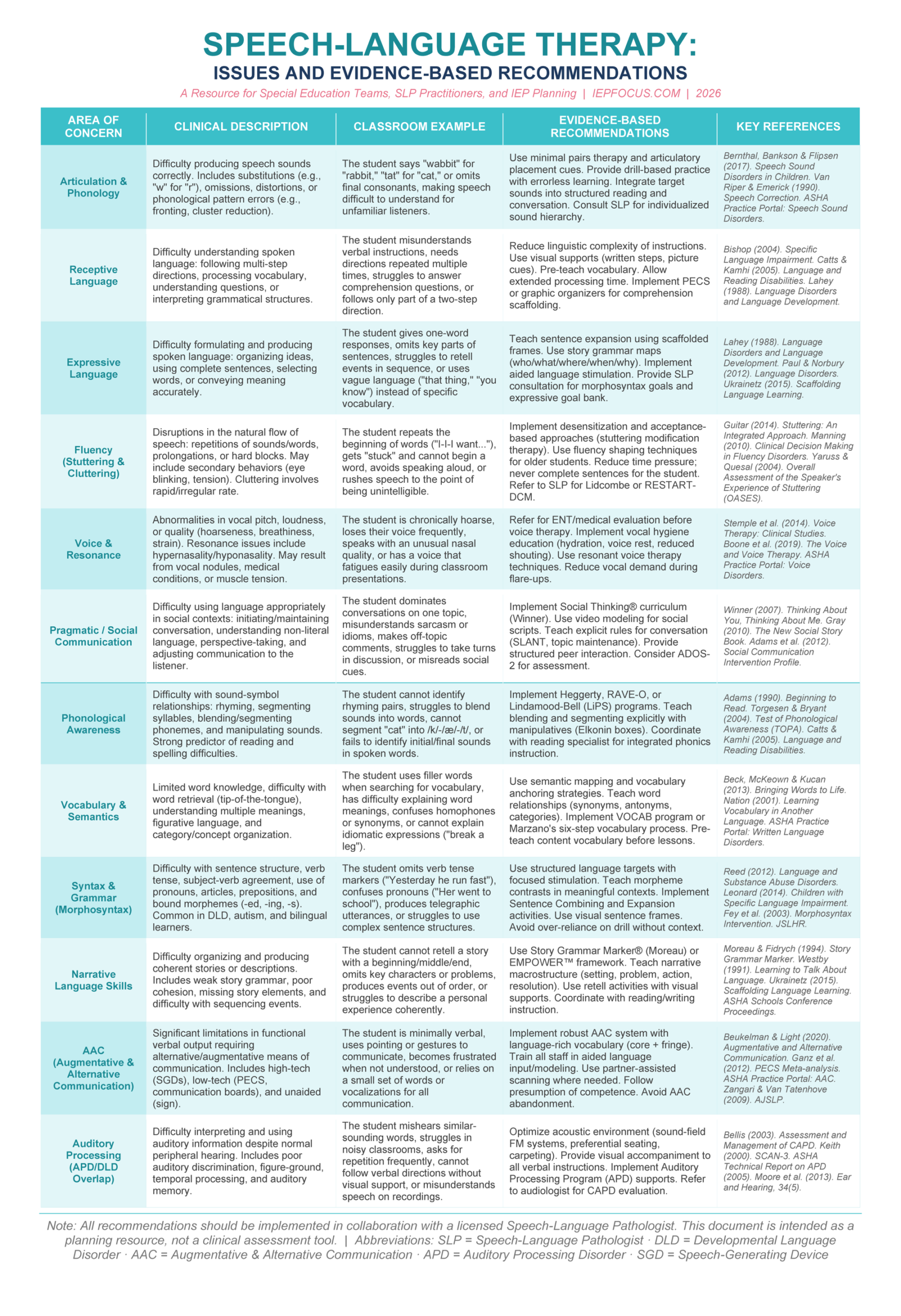
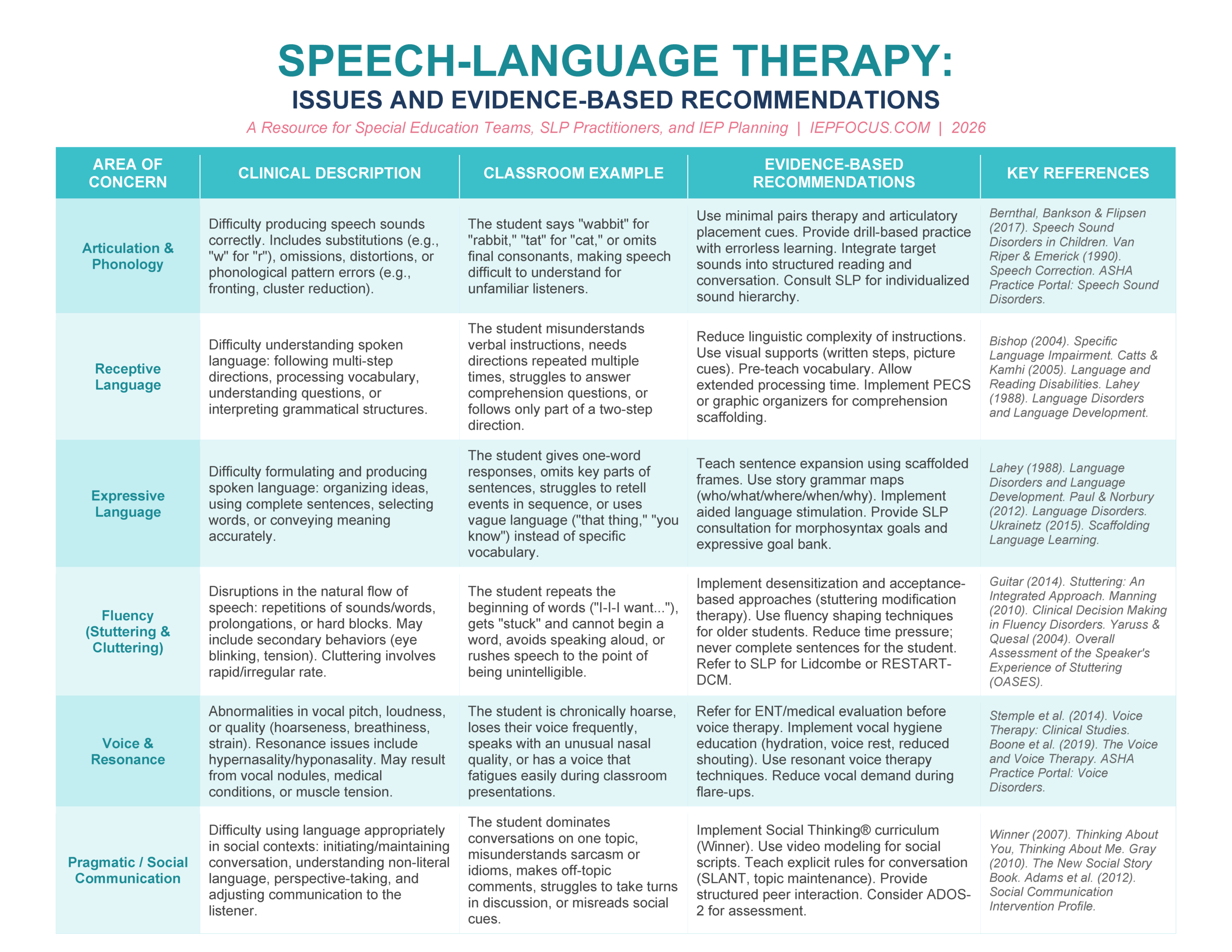
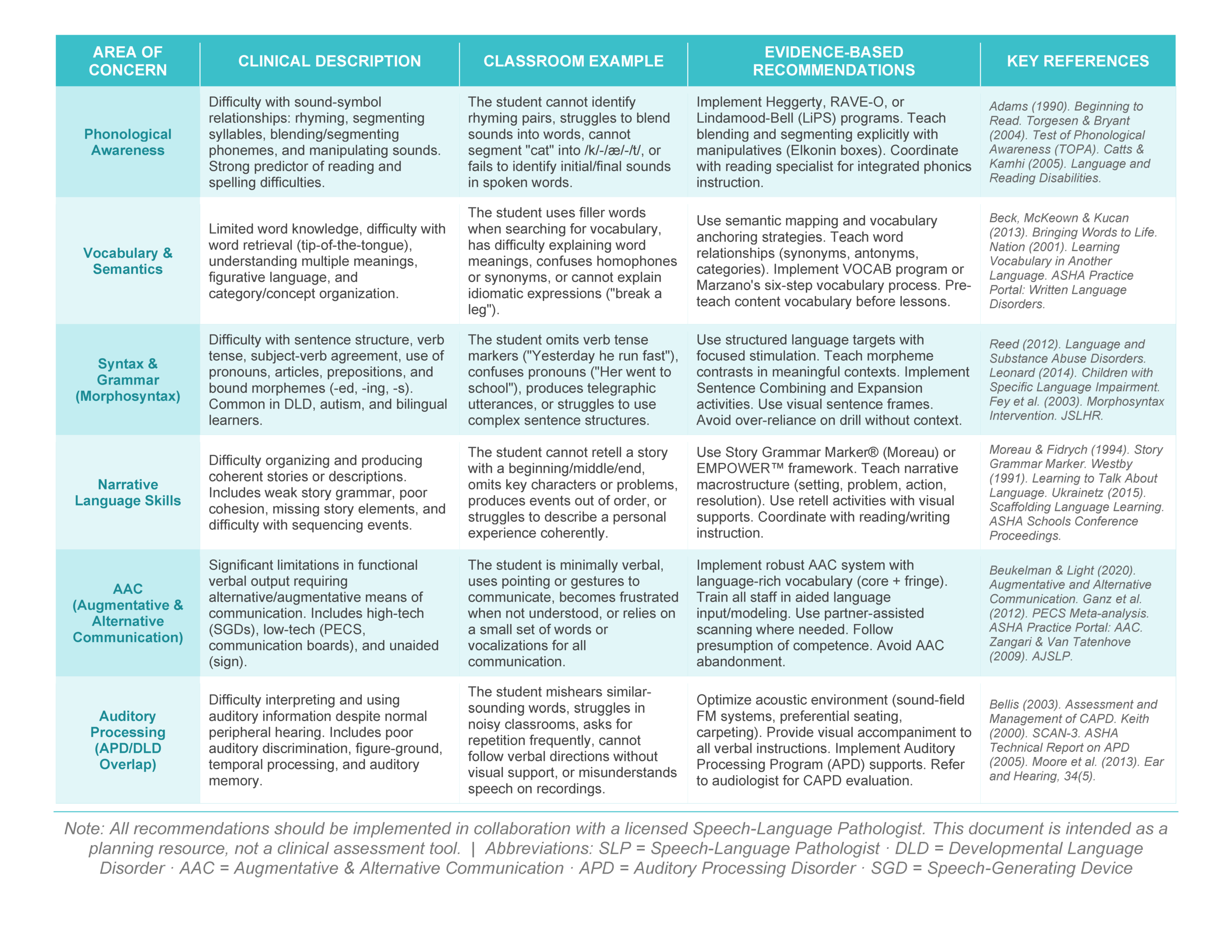
School-based speech-language therapy in the classroom is organized around communication domains, discrete areas of language and speech function, each with its own assessment tools, intervention hierarchy, and connection to academic outcomes. The 12 domains addressed in the IEPFOCUS reference chart below span the full continuum from sound production to complex social communication:
Each domain has a distinct clinical profile, a different classroom presentation, and evidence-based interventions that classroom teachers can actively reinforce, even without SLP training.
Download: Free SLT Reference Chart for IEP Teams
The chart below is a free printable and digital reference guide developed by IEPFOCUS.COM for special education teams, SLP practitioners, and IEP planning meetings. For each of the 12 speech-language therapy domains, it provides a clinical description, a concrete classroom example, evidence-based recommendations, and key professional references.
Use it to prepare for IEP annual reviews, to brief classroom teachers on SLP goals, or as a training reference for paraprofessionals working with students on communication IEP objectives.
📌 Click on either page below to view full size.
Which Speech-Language Therapy Areas Are Most Common in IEPs?
In school-age children, language-based IEP goals dominate SLP caseloads. A 2021 survey of school-based SLPs found that expressive and receptive language goals accounted for over 60% of active IEP objectives, followed by pragmatic/social communication (particularly in students with autism spectrum disorder) and phonological awareness goals tied to literacy.
Articulation, the domain most associated with “speech therapy” in the public imagination, is more prevalent in early childhood (PreK–Grade 2) and typically resolves by age 8 for most phonemes. For middle school students, the more clinically urgent domains are often vocabulary and semantics, narrative language, and morphosyntax, all of which directly impact reading comprehension, written expression, and content-area learning.
Students with neurodivergent profiles, autism, ADHD, dyslexia, and DLD (developmental language disorder), frequently present with overlapping communication needs across multiple domains simultaneously. An autistic student may have strong articulation but significant deficits in pragmatics, narrative language, and auditory processing. For these students, a siloed “articulation only” IEP grossly underserves their communication profile. You can read more about how communication intersects with neurodivergent profiles in our guides on AuDHD in the classroom and autism in girls at school.
How Do SLP Goals Connect to IEP Academic Standards?
One of the most persistent gaps in IEP quality is the disconnect between SLP communication goals and general education curriculum standards. A student can have an IEP goal targeting “5-word utterances in structured sessions” while their classroom teacher is expecting paragraph-length written responses in science. That gap is not the student’s failure, it’s a planning failure.
Best practice requires that SLP goals be mapped to academic demands from the outset. The table below illustrates how each major speech-language therapy domain connects to a classroom skill area:
| SLP Domain | Primary Academic Impact | IEP Connection |
|---|---|---|
| Receptive Language | Reading comprehension, following instructions | ELA, science, all content areas |
| Expressive Language | Written expression, oral presentations | ELA writing goals, class participation |
| Phonological Awareness | Decoding, spelling, early literacy | Reading foundational skills |
| Vocabulary & Semantics | Academic vocabulary, reading comprehension | ELA, social studies, science |
| Syntax & Grammar | Writing mechanics, sentence construction | Writing IEP goals |
| Narrative Language | Story writing, retelling, oral summaries | ELA narrative writing standards |
| Pragmatic Communication | Collaborative work, discussion participation | Social-emotional, behavior goals |
| AAC | Access to curriculum across all areas | Communication/participation goals |
| Auditory Processing | Listening comprehension, dictation | ELA listening standards |
The BERMED SLT–IEP Alignment Framework
At IEPFOCUS.COM, we use the BERMED SLT–IEP Alignment Framework to help special education teams ensure that speech-language therapy goals are connected to, not isolated from, the rest of the IEP. The framework has four steps:
🔗 BERMED SLT–IEP Alignment Framework
- Domain Map First. Before writing SLP goals, identify which of the 12 communication domains are affecting classroom performance using the reference chart above. Prioritize domains that block access to the curriculum, not just those easiest to measure.
- Anchor to Present Levels. Every SLP goal must reference a Present Level of Academic Achievement and Functional Performance (PLAAFP) statement that describes how the communication deficit impacts the student’s educational performance. Generic PLAAFP statements (“student has difficulty with language”) are not sufficient.
- Classroom Generalization Goal. For each SLP pull-out goal, write a parallel generalization target, a specific behavior the classroom teacher will look for in the natural environment. This closes the transfer gap.
- SLP–Teacher Consultation Schedule. Build formal consultation time (minimum monthly) into the IEP service minutes, not as an afterthought, but as a scheduled, measurable service. Document consultation topics.
This framework is particularly effective for students with Rejection Sensitive Dysphoria (RSD) or a PDA profile, whose communication difficulties are often masked by demand avoidance and may not surface in structured SLP assessment environments.
How Should Special Education Teachers Collaborate With SLPs?
Collaboration between special education teachers and speech-language pathologists is federally mandated in the IEP process, but the quality of that collaboration varies enormously. Research consistently shows that students make greater gains when SLP intervention is embedded in classroom contexts rather than delivered exclusively in pull-out settings (Ukrainetz, 2015).
Practical collaboration strategies for special education teachers working with SLPs include:
- Pre-teaching SLP vocabulary targets before the SLP session so students arrive with prior exposure
- Using aided language input (pointing to AAC symbols while speaking) for students who use AAC devices
- Embedding narrative language practice into morning meeting, journaling, and content retell activities
- Reducing linguistic load in written directions for students with receptive language goals
- Providing structured conversation opportunities for students with pragmatic communication goals during peer work time
The reference chart in this article (embedded above) was designed specifically to support this collaboration, giving classroom teachers and paraprofessionals the clinical language to understand what their SLP colleagues are targeting, and why.
Frequently Asked Questions About Speech-Language Therapy in the Classroom
What is the difference between a speech disorder and a language disorder?
A speech disorder affects the physical production of sounds, articulation errors, stuttering, or voice problems. A language disorder affects the understanding or use of the language system itself, vocabulary, grammar, comprehension, and social communication. Many students with IEPs have language disorders, not speech disorders, but receive services under the broad “speech-language” service category.
How many speech-language therapy sessions per week does an IEP student typically receive?
IDEA requires that services be determined by the IEP team based on individual need, there is no standard frequency. Common frequencies range from 1–3 sessions per week (30 minutes each) for direct therapy, plus consultation time. Students with more complex profiles (AAC users, DLD, severe pragmatic deficits) may require higher service frequency.
Can a student have both speech-language therapy and occupational therapy on their IEP?
Yes. Many students, particularly those with autism, AuDHD, or sensory processing differences, have IEPs that include both SLP and OT services. These services should be coordinated: for example, sensory regulation strategies from OT can directly support a student’s ability to participate in SLP sessions that target attention and auditory processing.
What is AAC and who qualifies for it on an IEP?
AAC (Augmentative and Alternative Communication) refers to any method beyond natural speech used to communicate, including high-tech speech-generating devices, communication apps, low-tech picture boards, and sign language. Any student who cannot reliably communicate their needs, participate in instruction, or demonstrate learning through spoken language alone may benefit from AAC. There is no minimum speech requirement; IDEA mandates that AAC be considered for every student with a communication impairment.
How does speech-language therapy support reading skills?
Phonological awareness, the ability to identify and manipulate the sound units of language, is the strongest predictor of early reading success and is a core SLP domain. Beyond phonics, language comprehension (vocabulary, syntax, narrative structure) predicts reading comprehension from Grade 3 onward. Many students identified with dyslexia or reading disabilities have underlying language disorders that require SLP intervention, not reading intervention alone.
What to Do Next: 5 Concrete Actions for IEP Teams
Your next steps after reading this guide:
- Download and print the SLT reference chart (embedded above) and share it with your SLP, classroom teachers, and paraprofessionals before the next IEP meeting.
- Audit your student’s current SLP goals using the 12-domain framework: which domains are being addressed? Which are being overlooked? Is there an academic impact statement for each?
- Request a PLAAFP review with your SLP: if the present levels don’t name a specific domain and a specific classroom impact, they need to be revised before goals can be written with integrity.
- Add a generalization target to each active SLP goal, a behavior the classroom teacher monitors daily, not just the SLP in session.
- Schedule a monthly SLP–teacher consultation as a formal IEP service and document it, this single structural change has the highest evidence base for improving student outcomes in school-based communication intervention.
More Speech-Language Therapy Classroom Resources
Trusted outside sources: ASHA: Speech-language pathologists and AOTA: What is occupational therapy?.