
Quick answer: AAC in the classroom means giving students who cannot rely on speech, or whose speech is limited or unreliable, other ways to communicate: picture boards, core vocabulary boards, tablets with communication apps, or speech-generating devices. ASHA is clear that AAC does not stop speech from developing and can help it. The key to success is modeling: adults use the device themselves, all day, without demanding that the student respond.
In this guide
A student pulls your arm toward the shelf, cries when you guess wrong, and melts down when nobody understands. Communication is a human right, and every student deserves a way to say “stop,” “more,” “I don’t like that,” and “look at this.” AAC in the classroom makes that possible for students who are nonspeaking, minimally speaking, or whose speech disappears under stress.
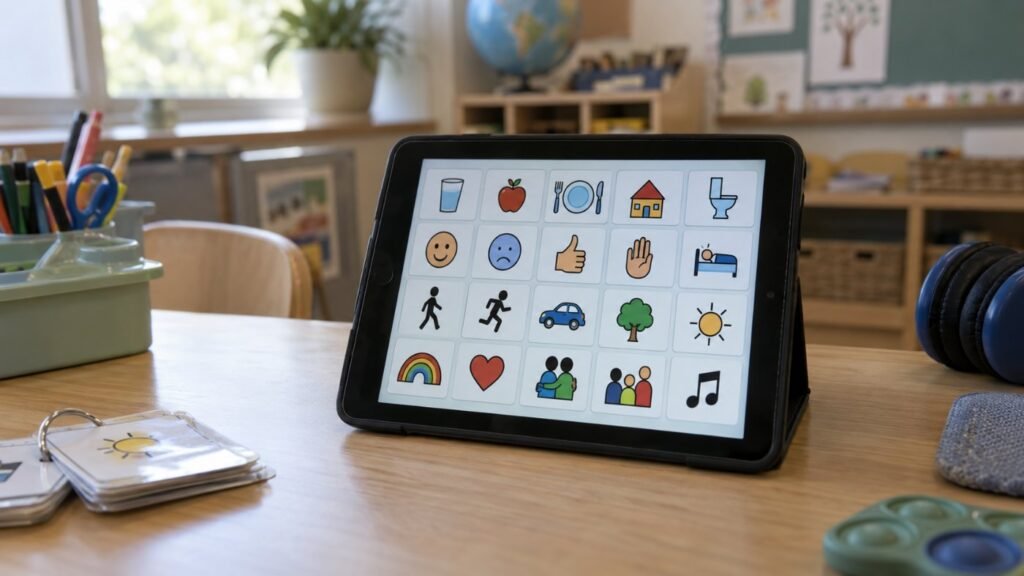
What Is AAC?
The American Speech-Language-Hearing Association (ASHA) defines augmentative and alternative communication as all the ways someone communicates besides talking. It can add to speech (augmentative) or replace it (alternative). Many autistic people use AAC part time, for example when speech becomes hard during overload or shutdown.
Key point: AAC is not a last resort. It is a full communication system, and every student who might benefit should have access to one now, not after they “fail” at speech.
AAC Myths Teachers Hear
| Myth | What ASHA and research say |
|---|---|
| AAC will stop my student from talking | AAC does not hinder speech and can support it |
| They are too young for AAC | AAC helps people of all ages, even under 3 |
| They need certain skills first | There are no prerequisites to start |
| AAC is only for nonspeaking students | Part-time speakers benefit too |
| A device is enough | Without daily modeling, devices go unused |
Types of AAC
- No-tech: gestures, signs, facial expressions, pointing
- Low-tech: picture cards, choice boards, core vocabulary boards, letter boards
- High-tech: tablet apps and speech-generating devices with voice output

Core vocabulary boards hold the small set of words used most often, like “go,” “stop,” “more,” “help,” “like,” and “not.” They work across every activity and are a great first step for whole-class AAC in the classroom.
The BERMED AAC Framework
A simple plan for teachers starting AAC in the classroom.
- B: Begin now. Don’t wait for an evaluation to offer a core board or picture choices.
- E: Everywhere access. The AAC system goes to lunch, recess, specials, and the bus.
- R: Respond to every attempt. Treat button presses as real communication, even if they seem random at first.
- M: Model, model, model. Use the device yourself while you talk.
- E: Expand gently. Add one word to what the student says: “more” becomes “more juice.”
- D: Don’t demand. No “show me” or “say it on your talker” tests.
How to Model AAC
Talk and touch. As you say “Let’s go outside,” tap “go” and “outside” on the device.
Model a little above. If the student uses one word, model two or three.
Use real moments. Snack, play, transitions, and protests are perfect times to model.
Model all functions. Not just requests: comments, questions, jokes, feelings, and “no.”
Wait. Give time after modeling without pressure.
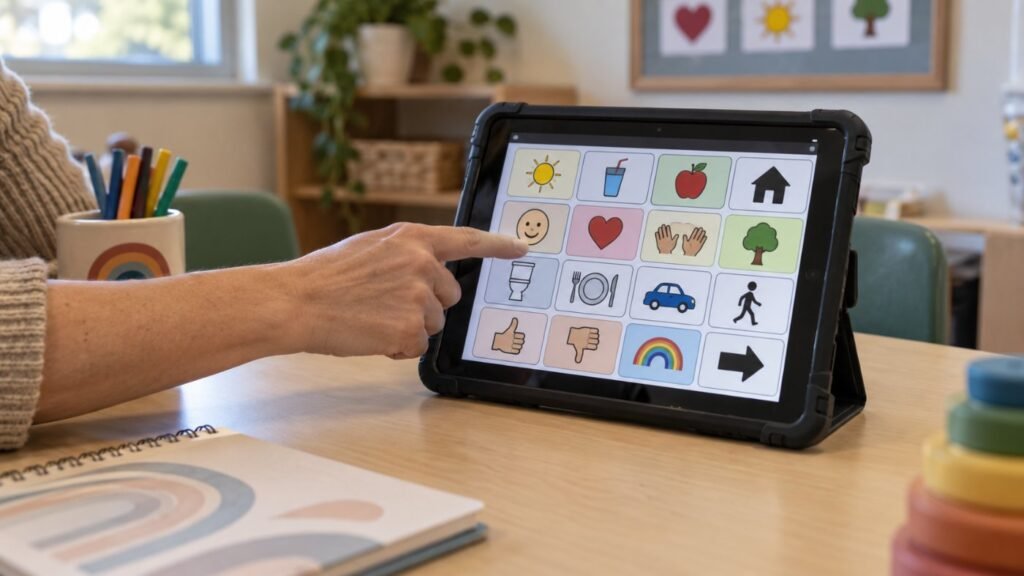
Do
- Keep the device charged and within reach
- Honor “no” and “stop” on the device
- Train all staff to model
- Pair AAC with visuals like schedules
Avoid
- Taking the device away as a consequence
- Using it only for requests
- Moving icons around without warning
- Testing instead of modeling
AAC fits naturally with visual schedules in the classroom and social stories. Students who use echolalia may also benefit from AAC. See autism and echolalia.
AAC in the IEP
Under IDEA, IEP teams must consider whether a student needs assistive technology, which includes AAC. Ask for an AAC evaluation by a speech-language pathologist, and write device access, staff training, and modeling into the plan. Find communication goal examples in our IEP goal bank.
Presume competence: A student who cannot speak may understand far more than they can show. Talk to them, not about them, and give them the tools to answer.
What is AAC in the classroom?
AAC in the classroom gives students other ways to communicate besides speech, such as picture cards, core vocabulary boards, tablet apps, and speech-generating devices.
Does AAC stop children from learning to talk?
No. ASHA states that AAC does not hinder speech development and can actually support it.
Who needs AAC?
Students who are nonspeaking, minimally speaking, have unclear speech, or lose speech under stress can all benefit from AAC.
How do I teach a student to use AAC?
Model it. Use the device yourself while you talk, throughout the day, in real situations, without demanding that the student respond.
Can AAC be included in an IEP?
Yes. IEP teams must consider assistive technology, including AAC, and can write device access, staff training, and modeling into the plan.
5 Actions to Take This Week
- Post a core vocabulary board in your classroom.
- Model five words on it during one daily routine.
- Check that each AAC user’s device goes everywhere.
- Train one more adult to model.
- Request an AAC evaluation if a student needs one.
Sources

