
Quick answer: Math calculation IEP goals target the core number skills students need before they can solve problems: number sense, place value, math fact fluency, and computation with whole numbers, fractions and decimals. Strong goals name the operation, the number range, the tools allowed (manipulatives, number line, calculator), and a measurable criterion such as digits correct per minute or percent accuracy. Below are 42 SMART math calculation IEP goals organized by skill and grade band.
In this goal bank
A student who counts on fingers for every fact, loses track during long division, or cannot tell whether 0.5 or 0.25 is bigger needs goals that target the exact skill gap. Math calculation IEP goals are most effective when they follow the natural sequence of number learning. This bank is part of our IEP Goal Bank series.
How to Write Math Calculation IEP Goals
Understood.org describes dyscalculia as a learning disorder that makes it hard to understand math concepts and work with numbers, affecting up to 7 percent of people. Many other students, including those with ADHD or working memory differences, also struggle with calculation. Start with a skills inventory, then write goals for the lowest missing skill.
Formula: By [date], given [problem type and number range] and [tool], [Student] will [compute or demonstrate] with [accuracy or rate] across [number] probes.
Present level example: “Ava solves single-digit addition with 90% accuracy using a number line, but answers only 8 facts correctly in 2 minutes without tools. She regroups incorrectly in 2-digit subtraction in 4 of 5 problems.”
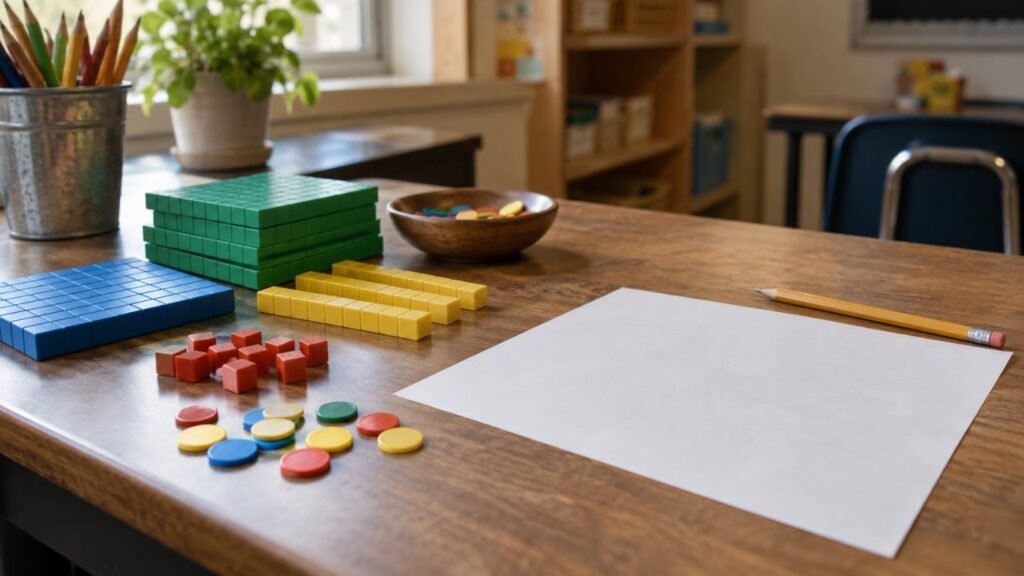
Key point: Follow the CRA sequence: concrete (objects), representational (drawings), then abstract (numbers). Goals can specify which level the student works at.
Number Sense Goals
- Given a set of up to 20 objects, [Student] will count with one-to-one correspondence and state the total with 100% accuracy in 4 of 5 trials.
- Given numbers 0 to 100, [Student] will identify which is greater or less with 90% accuracy.
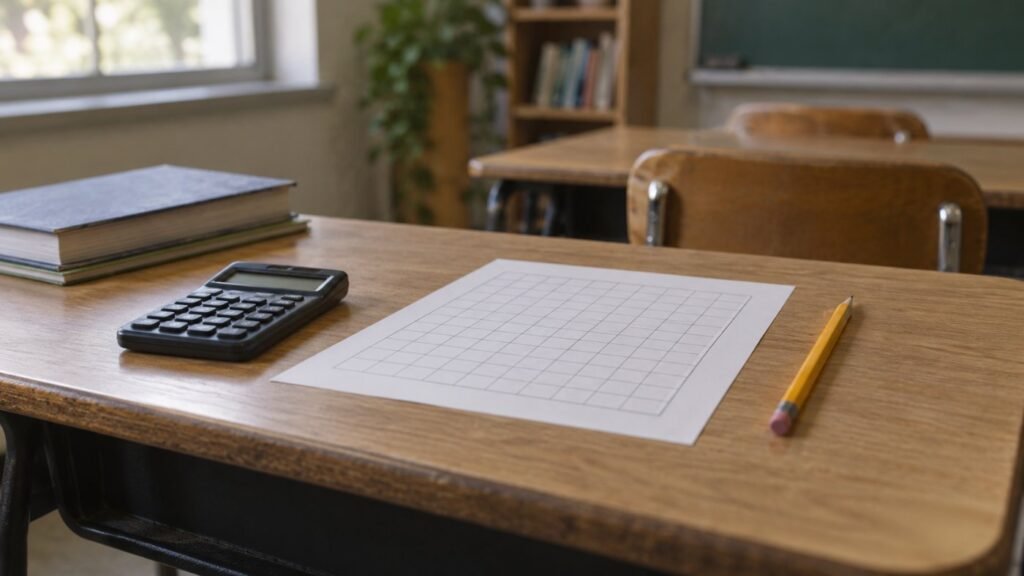
- Given a number line, [Student] will place numbers 0 to 100 within a reasonable range in 4 of 5 trials.
- Given a quantity up to 10 shown on a ten frame, [Student] will subitize (name without counting) with 90% accuracy.
- Given a number, [Student] will state one more, one less, ten more and ten less with 90% accuracy.
- Given a number up to 20, [Student] will decompose it into two parts in at least 3 ways in 4 of 5 trials.
Place Value Goals
- Given a 2-digit number, [Student] will represent it with base ten blocks with 90% accuracy.
- Given a 3-digit number, [Student] will identify the value of each digit with 90% accuracy.
- Given numbers up to 1,000, [Student] will write them in expanded form with 85% accuracy.
- Given a number, [Student] will round to the nearest 10 and 100 with 85% accuracy.
- Given decimals to the hundredths, [Student] will identify place value with 80% accuracy.
Free resource
IEP Goal Data Tracker Template
An editable PDF to track progress on every IEP goal with ease.
Math Fact Fluency Goals
- Given addition facts to 10, [Student] will answer 20 facts correctly in 2 minutes across 3 probes.
- Given subtraction facts within 20, [Student] will answer with 90% accuracy using a strategy (counting on, doubles, make ten).
- Given multiplication facts 0 to 10, [Student] will answer 30 facts correctly in 2 minutes.
- Given division facts related to known multiplication facts, [Student] will answer with 85% accuracy.
- [Student] will use a fact strategy card to solve unknown facts independently in 4 of 5 opportunities.
- [Student] will track their own fact fluency on a graph weekly and set a next goal in 4 of 5 weeks.
Computation Goals
Elementary
- Given 2-digit addition problems without regrouping, [Student] will solve with 90% accuracy.
- Given 2-digit addition and subtraction problems with regrouping, [Student] will solve with 80% accuracy across 3 probes.
- Given 3-digit addition and subtraction problems, [Student] will solve with 80% accuracy using a step checklist.
- Given multiplication of a 2-digit by 1-digit number, [Student] will solve with 80% accuracy.
- Given division problems with a 1-digit divisor, [Student] will solve with 80% accuracy using a visual model or algorithm.
Middle and High School
- Given multi-digit multiplication problems, [Student] will solve with 80% accuracy using the standard algorithm or partial products.
- Given long division with 2-digit divisors, [Student] will solve with 75% accuracy using a step-by-step guide.
- Given integer operations, [Student] will add and subtract positive and negative numbers with 80% accuracy using a number line.
- Given expressions, [Student] will apply the order of operations with 80% accuracy.
- Given computation problems, [Student] will use a calculator accurately to check their work in 4 of 5 tasks.
- Given a mixed computation probe, [Student] will increase digits correct per minute from baseline by 50%.
Fractions, Decimals and Percents Goals
- Given a shape or set, [Student] will identify fractions (halves, thirds, fourths) with 90% accuracy.
- Given two fractions, [Student] will compare them using models or benchmarks with 80% accuracy.
- Given fractions with like denominators, [Student] will add and subtract with 85% accuracy.
- Given fractions with unlike denominators, [Student] will find common denominators and add or subtract with 75% accuracy.
- Given a fraction, [Student] will convert it to a decimal and percent with 80% accuracy.
- Given decimals, [Student] will add and subtract with correct place value alignment with 85% accuracy.
- Given a whole number and a fraction, [Student] will multiply with 75% accuracy using a visual model.
- Given a percent problem, [Student] will find the percent of a number with 75% accuracy.
The BERMED Goal-Writing Check
- B: Baseline. Do you know which skills are solid and which are missing?
- E: Exact skill. One operation and number range per goal.
- R: Realistic. Based on the student’s rate of progress.
- M: Measurable. Accuracy or digits correct per minute.
- E: Equitable access. Tools like number lines and calculators where appropriate.
- D: Data plan. Weekly or biweekly probes, graphed.
Data Collection and Accommodations
| Skill | How to measure | Accommodations to pair |
|---|---|---|
| Number sense | Quick oral or hands-on probes | Manipulatives, ten frames |
| Fact fluency | Timed fact probes | Fact charts, strategy cards |
| Computation | Digits correct per minute, accuracy | Graph paper, step checklists |
| Fractions | Curriculum-based probes | Fraction strips, visual models |
| Access | Task completion | Calculator, reduced number of items |
Math difficulties often overlap with dyscalculia and working memory challenges. Pair these goals with math problem solving IEP goals, and check which supports keep expectations the same in accommodations vs modifications.
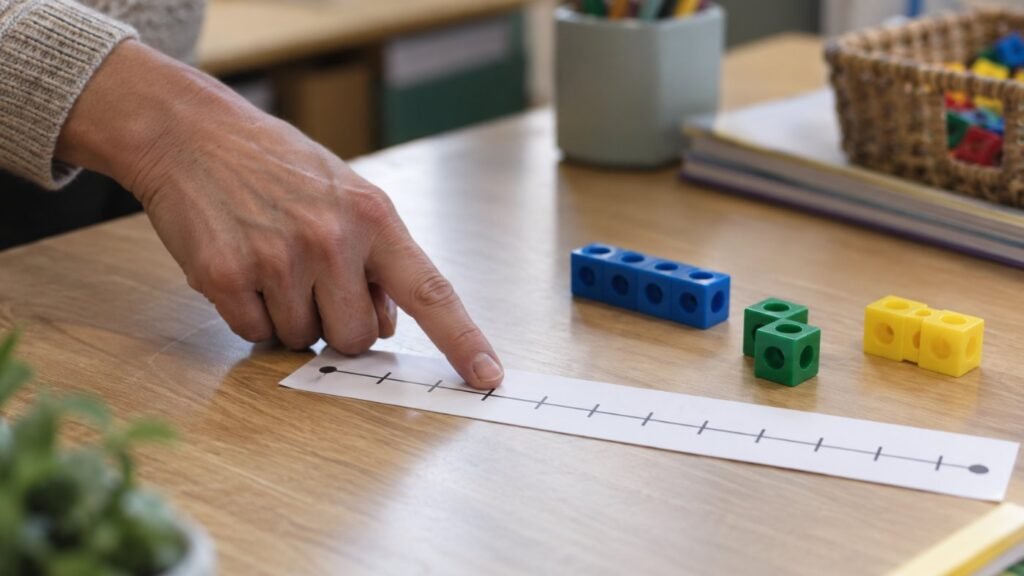
Neuroaffirming tip: Using fingers, number lines or calculators is not cheating. Tools reduce memory load so students can focus on understanding. Build fluency gradually without removing access to grade-level reasoning.
What is a math calculation IEP goal?
A math calculation IEP goal targets a specific number skill, such as adding 2-digit numbers with regrouping, with a clear criterion like 80% accuracy across 3 probes.
How do you measure math calculation goals?
Use short probes measuring accuracy or digits correct per minute, given weekly or every two weeks and graphed.
Should students with IEPs use calculators?
When the goal is reasoning or problem solving, calculators can be an appropriate accommodation. Fact fluency goals can be measured separately.
What is the CRA approach in math?
CRA stands for concrete, representational, abstract. Students learn with objects first, then drawings, then numbers and symbols.
Can a student with dyscalculia have math IEP goals?
Yes. Goals should target the lowest missing skills, use visual and hands-on supports, and allow tools that reduce memory load.
5 Actions to Take This Week
- Give a quick skills inventory from counting to fractions.
- Find the lowest missing skill.
- Choose 2 goals from this bank and adapt them.
- Start a weekly 2-minute probe.
- Decide which tools the student can use.
Sources

