Table of Contents
A student who can tell you everything about volcanoes but still counts on their fingers in fifth grade is not lazy. They may be one of the many students with dyscalculia whose struggles are mistaken for carelessness, anxiety or lack of practice.
This guide explains dyscalculia in the classroom for special education and general education teachers: what it is, the signs to watch for at each age, how it differs from math anxiety, and the strategies, accommodations and IEP goals that actually help.
What Is Dyscalculia?
Dyscalculia is to numbers what dyslexia is to words. Research on basic numerical skills in children with developmental dyscalculia shows that difficulties often start with number sense itself: understanding quantities, comparing amounts and linking symbols to values. That is why more worksheets rarely help. Students need a different route in.
Signs of Dyscalculia in the Classroom by Age
Scroll to see full table
| Age group | Signs to watch for |
|---|---|
| Preschool and kindergarten | Trouble counting in order, recognizing numbers, matching numbers to quantities, sorting and patterns |
| Early elementary | Counting on fingers long after peers, confusing symbols like + and x, difficulty with simple facts, losing track while counting |
| Upper elementary | Struggles with times tables, word problems, place value, telling time and money |
| Middle and high school | Difficulty with fractions, multi-step problems, graphs, estimating, budgeting and schedules |
The Child Mind Institute notes that a clear gap between strong performance in other subjects and weak performance in math is an important clue. Math struggles can also come from dyslexia, ADHD or processing differences, so a full evaluation matters. Our guide to the types of learning disabilities explains how these profiles overlap.
Dyscalculia vs Math Anxiety
- Dyscalculia is a learning disability in number processing. The student struggles even in calm, untimed settings.
- Math anxiety is fear and stress around math. The student may know more than they can show under pressure.
- They often coexist: years of struggling with numbers can create anxiety, and anxiety makes struggling worse.
Reducing time pressure and public performance helps both.
The BERMED Concrete-First Method: 5 Steps
The Concrete-First Method
Five steps for teaching math to students with dyscalculia in the classroom. Move to the next step only when the student is secure.
Touch It
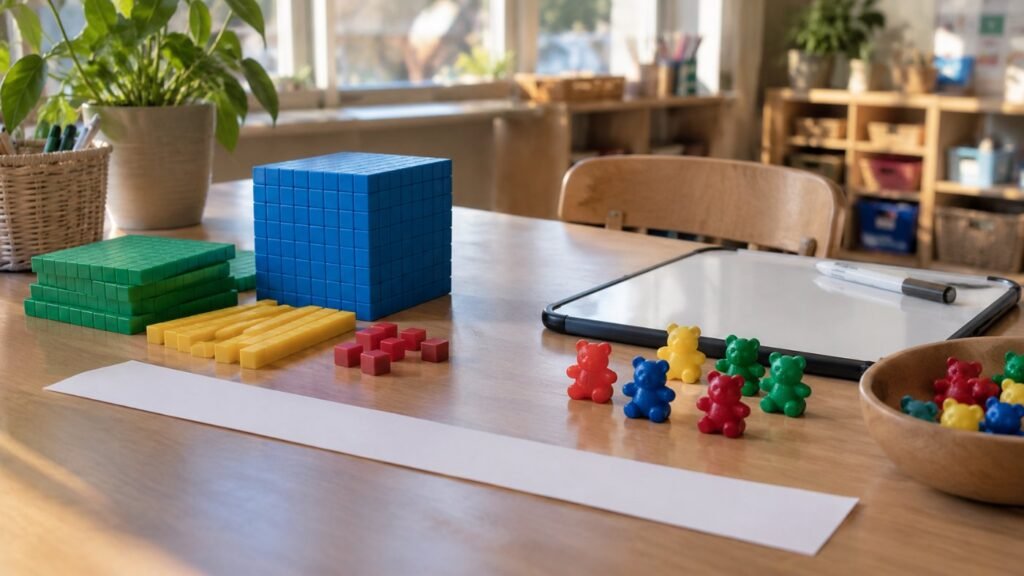
Start with objects: blocks, counters, base-ten rods. Let students build quantities with their hands.
Draw It
Move to pictures: tally marks, dots, number lines, bar models.
Say It
Have students explain what they did in their own words before writing numbers.
Write It
Connect the concrete and visual steps to written symbols and equations.
Practice in Small Doses
Short, frequent, low-stress practice beats long worksheets. Celebrate accuracy before speed.
Classroom Accommodations for Dyscalculia
Do This
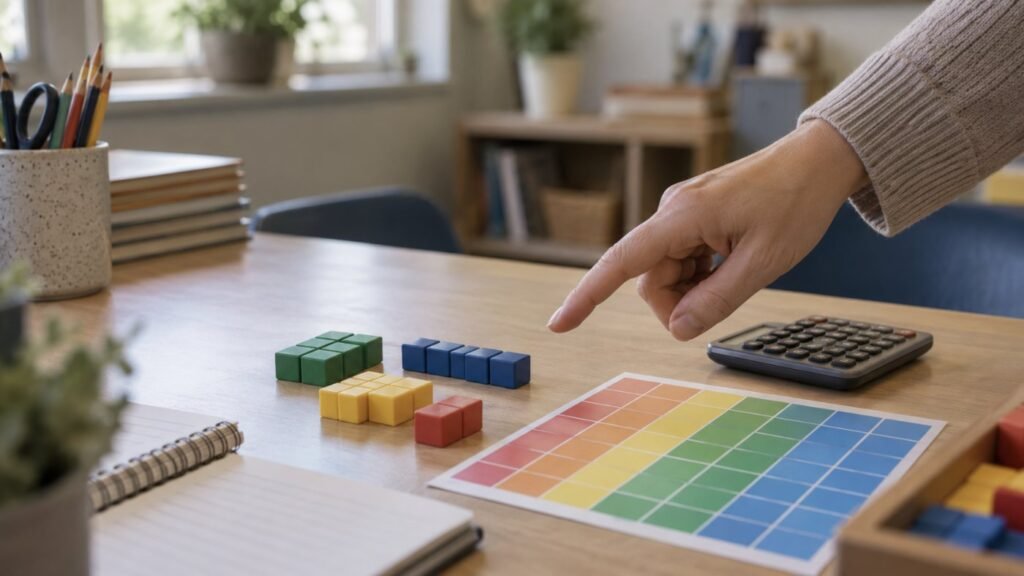
- Allow calculators and number lines
- Provide math fact charts
- Use graph paper to align numbers
- Give extra time on math tasks
- Reduce problems per page
- Read word problems aloud
Avoid This
- Timed fact drills as the main practice
- Calling students to the board unprepared
- Grading neatness of number writing
- Assuming the student “didn’t study”
- Removing visual supports too soon
- Comparing speed with peers

For a full list across subjects, see our accommodation cheat sheet for special education.
Sample IEP Goals for Dyscalculia
Dyscalculia falls under specific learning disability, one of the eligibility categories under IDEA. Students who do not qualify for an IEP may still receive accommodations through a 504 plan, as Understood explains.
- Number sense: Given manipulatives, the student will represent and compare numbers up to 100 with 80% accuracy in 4 of 5 trials.
- Math facts: Using a strategy of their choice, the student will solve single-digit addition and subtraction facts with 90% accuracy across three consecutive probes.
- Word problems: Given a graphic organizer, the student will identify the operation needed in two-step word problems with 80% accuracy.
- Functional math: The student will count money and make change up to $10 with 80% accuracy in real-life scenarios.
Find more examples in our IEP goal bank.
In Class, At Home and in Life
IN CLASS
Use concrete materials, visual models and short practice. Many students with dyscalculia also need support with planning and working memory, which our guide to executive function accommodations covers.
AT HOME
Families can build number sense through everyday math: cooking, shopping, board games and counting steps. Encourage them to keep math playful, not stressful.
LIFE
Adults with dyscalculia often use calculators, budgeting apps and alarms with confidence. Teaching students to use tools early builds independence, not dependence.
Frequently Asked Questions About Dyscalculia in the Classroom
What is dyscalculia?
Dyscalculia is a specific learning disability that affects a student’s ability to understand numbers, learn math facts and perform calculations. It is not caused by low intelligence or poor teaching.
How common is dyscalculia?
The Child Mind Institute estimates that between 5 and 7 percent of elementary school children may have dyscalculia, and it affects boys and girls equally.
What are the signs of dyscalculia in the classroom?
Common signs include trouble recognizing numbers, counting on fingers long after peers stop, difficulty with math facts and word problems, losing track of steps, and problems with time, money and estimating.
Is dyscalculia covered by an IEP?
Yes. Dyscalculia falls under specific learning disability, one of the IDEA eligibility categories. Students may receive specialized math instruction through an IEP or accommodations through a 504 plan.
What accommodations help students with dyscalculia?
Helpful accommodations include extra time, use of a calculator or number line, math fact charts, graph paper to align numbers, fewer problems per page, and reading word problems aloud.
5 Actions You Can Take This Week
- Look for the gap. Compare math performance with other subjects.
- Bring out manipulatives. Teach one concept with objects first.
- Remove one timed drill. Replace it with untimed strategy practice.
- Offer one tool. A number line, fact chart or calculator.
- Talk to the team. Ask about evaluation if concerns persist.
Sources
- Child Mind Institute. How to Spot Dyscalculia. childmind.org
- Delayed development of basic numerical skills in children with developmental dyscalculia. pmc.ncbi.nlm.nih.gov
- U.S. Department of Education. Individuals with Disabilities Education Act (IDEA). sites.ed.gov
- Understood. The difference between IEPs and 504 plans. understood.org