Why Most Executive Function Accommodations Fail Before They Begin
In over a decade of IEP meetings, the same accommodation appears on nearly every plan for students with ADHD and autism: “student will use a planner.” It is also, almost universally, the accommodation least followed through on, by teachers, by students, and by parents. The problem is not willpower or effort. The problem is that a planner requires intact executive function to use, which is precisely what the student lacks.
This is the core error in how schools approach executive function accommodations for IEP students: they hand students the product of executive functioning and call it a support. Real accommodations reduce or bypass the demand itself.
Research from the Harvard Center on the Developing Child confirms that executive function skills, including working memory, cognitive flexibility, and inhibitory control, are not fully developed until the mid-20s, and neurodivergent students show significant delays in this development. A 2021 study published in Child Neuropsychology found that students with ADHD operate with executive function profiles 30–40% below same-age peers, meaning a 14-year-old may functionally operate with the planning capacity of a 9-year-old.
The good news: when executive function accommodations for IEP students are matched to the specific domain of deficit, outcomes improve dramatically. This guide shows you exactly how to do that.
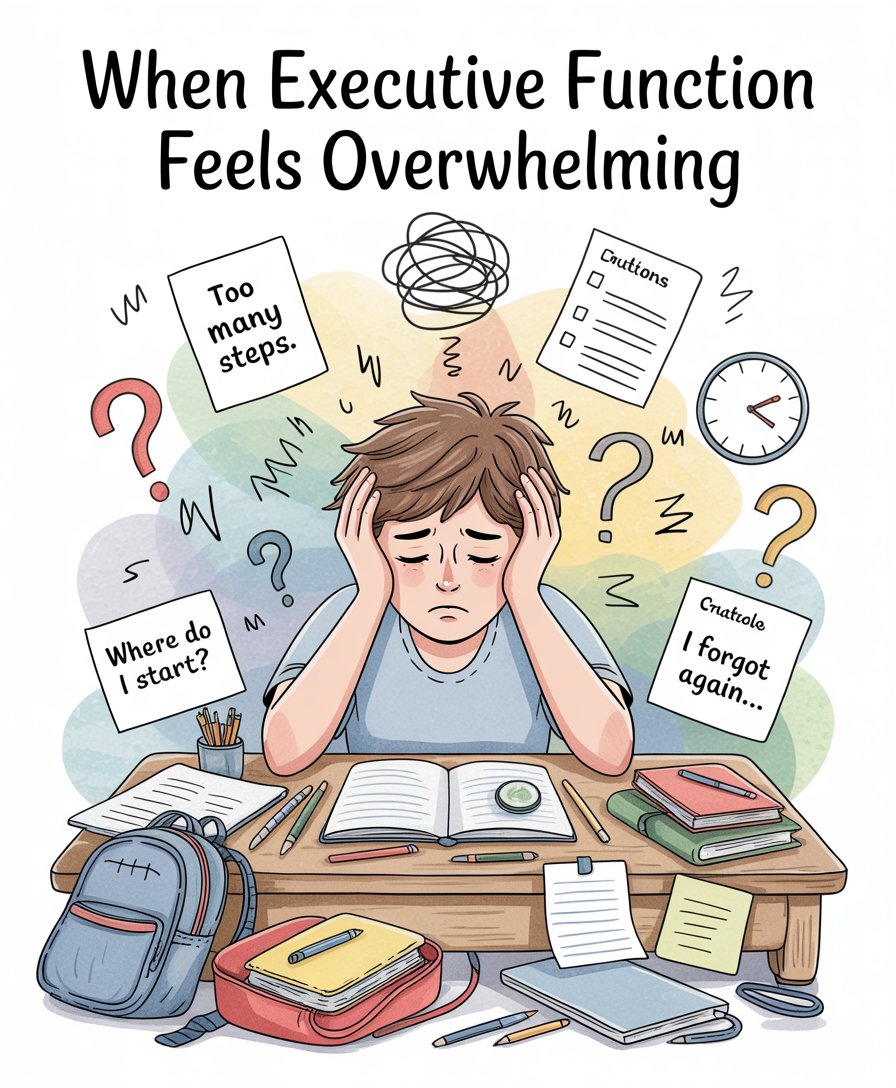
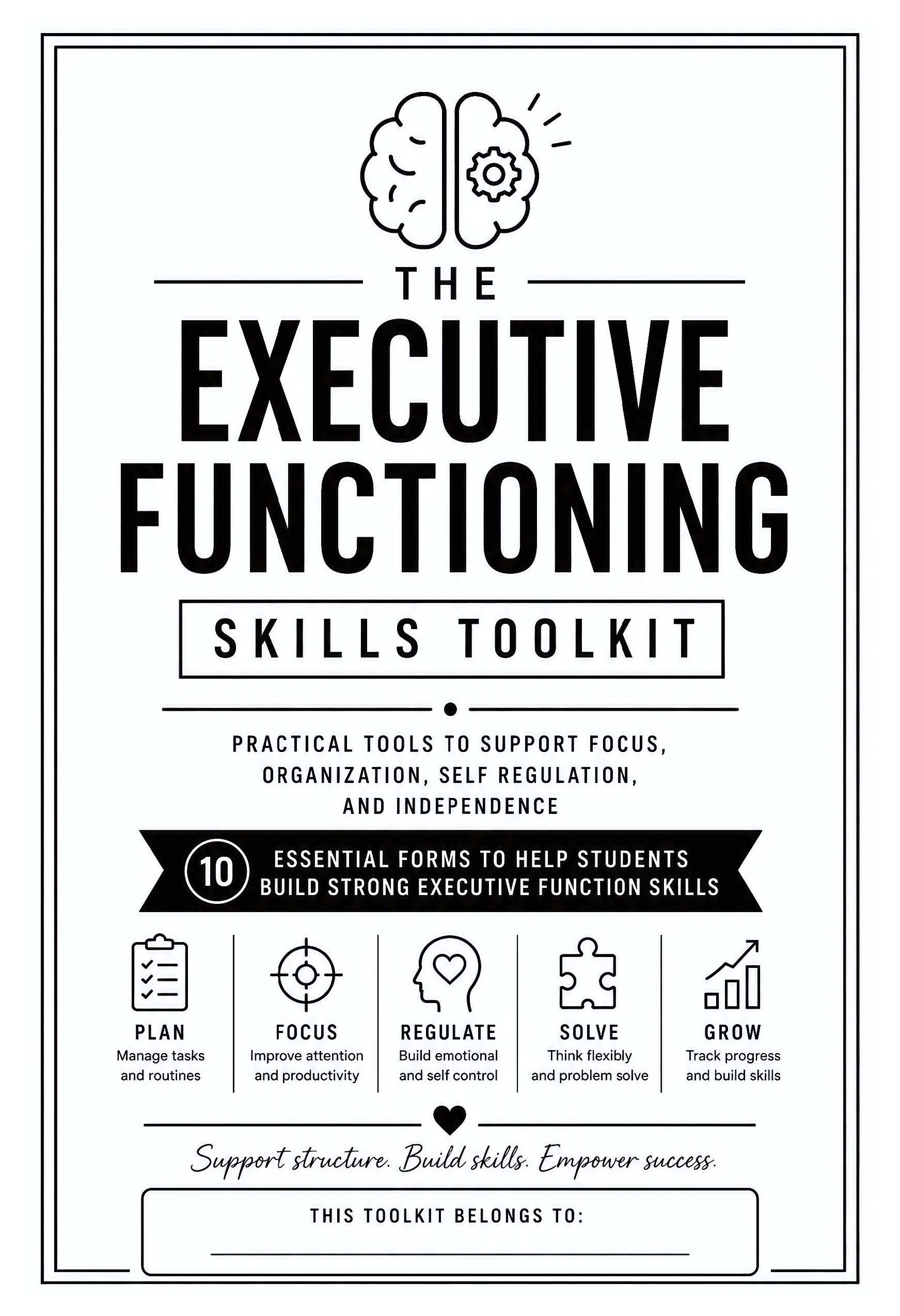
Free resource
Executive Functioning Skills Toolkit
10 printable tools to help students plan, focus, start tasks and stay organized.
Download free →What Is Executive Function, and Why It Matters for IEPs
Executive function (EF) refers to a set of mental skills that act like the brain’s CEO: they manage goal-directed behavior, regulate attention, and coordinate multiple cognitive processes simultaneously. For students on IEPs, executive function deficits are among the most academically debilitating, yet they are often the least specifically targeted in accommodation plans.
Executive function is not a single skill. It is an umbrella term for at least six distinct neurocognitive domains, each with its own profile of difficulty and its own set of evidence-based supports. A student who struggles primarily with working memory needs different accommodations than a student whose primary challenge is task initiation, even if both carry the same diagnosis.
Under IDEA (Individuals with Disabilities Education Act), school teams are required to address executive function deficits when they adversely affect educational performance. Failing to document domain-specific EF accommodations in an IEP may constitute a procedural violation, a point that is increasingly raised in due process hearings.
The 6 Executive Function Domains: What to Target in an IEP
Before writing a single accommodation, every IEP team should identify which EF domains are most impacted for the individual student. The following six domains are derived from the model proposed by Russell Barkley and expanded in current school neuropsychology practice.
| EF Domain | What It Looks Like in the Classroom | Core IEP Accommodation Focus |
|---|---|---|
| Working Memory | Forgets multi-step instructions; loses place in tasks; can’t hold information while writing | External memory aids, chunked instructions, graphic organizers |
| Task Initiation | Appears “lazy”; stares at blank page; needs multiple prompts to begin | First-step scaffolds, body doubling, visual start cues |
| Planning & Organization | Overwhelmed by long-term projects; backpack chaos; can’t break tasks into steps | Project roadmaps, assignment checklists, visual timelines |
| Cognitive Flexibility | Rigidity with schedule changes; meltdowns during transitions; stuck on one approach | Advance warnings, visual schedules, transition scripts |
| Inhibitory Control | Blurts out; acts before thinking; difficulty filtering distractions | Preferential seating, fidgets, cool-down protocols |
| Emotional Regulation | Disproportionate reactions to frustration; meltdowns block task completion | Regulation breaks, sensory supports, co-regulation check-ins |
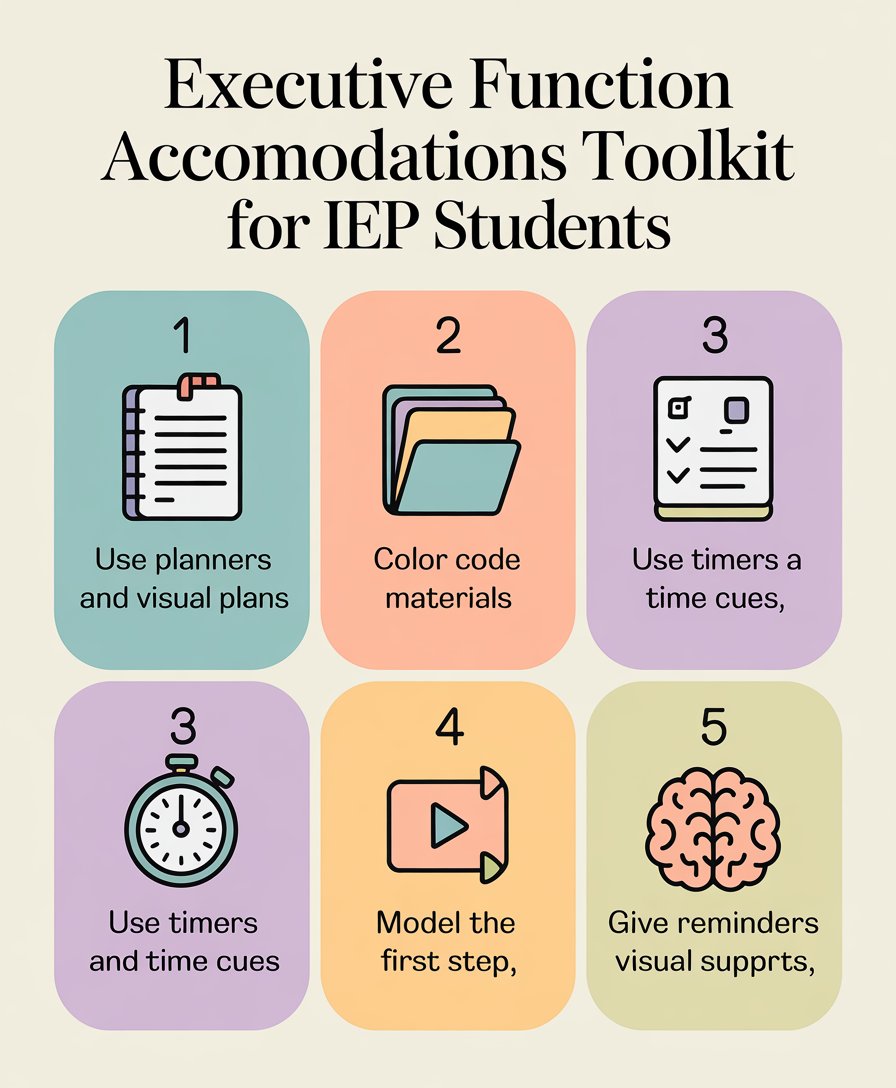
IN CLASS: 30+ Executive Function Accommodations That Work
In ClassThe following classroom accommodations are organized by EF domain and grounded in peer-reviewed research and SPED best practice. They are written in IEP-ready language and can be adapted for students with ADHD, autism spectrum disorder, learning disabilities, and PDA profile.
Working Memory Accommodations
Working memory is often called the “mental sticky note”, and for many IEP students, that sticky note falls off constantly. The solution is not to train students to have better memory. It is to move the information out of their head and into the environment.
| Accommodation | Implementation | Diagnoses Served |
|---|---|---|
| Chunked verbal instructions (max 2 steps) | Deliver one or two instructions at a time; pause; check for comprehension before continuing | ADHD, Autism, LD |
| Written + visual instructions always posted | Use a consistent location (whiteboard corner or printed card on desk) for step-by-step task directions | ADHD, Autism, LD, 2e |
| Graphic organizers for note-taking | Provide pre-structured Cornell notes, concept maps, or Frayer models rather than blank paper | ADHD, LD, Dysgraphia |
| Color-coded subject binders/folders | Assign one consistent color per subject; label every handout; post the color system in the classroom | ADHD, Autism |
| Anchor charts for ongoing reference | Post procedures, vocabulary, and formulas as permanent visual references students can access independently | All IEP students |
| Text-to-speech / read-aloud software | Tools such as NaturalReader or built-in OS accessibility reduce memory load during reading tasks | ADHD, Dyslexia, LD |
Task Initiation Accommodations
Task initiation failure is one of the most misunderstood executive function deficits in schools. Teachers often read it as defiance or apathy when, neurologically, the student’s brain cannot generate the activation signal needed to begin. The key accommodation principle: reduce the perceived size of the starting point.
| Accommodation | Implementation | Diagnoses Served |
|---|---|---|
| “First step only” prompting | Write just the very first action step (“open your notebook to a new page”) on a sticky note on the student’s desk | ADHD, PDA, Autism |
| Countdown start cues | “In 2 minutes we begin, your materials are ___.” Use a visual timer, not verbal reminders | ADHD, Autism |
| Choice of starting point | Allow students to begin with the easiest or most preferred section of an assignment | PDA, ADHD, Anxiety |
| Body doubling (structured proximity) | Place student near a working peer; or sit nearby briefly while they begin a task | ADHD, AuDHD |
| Routine task initiation scripts | Post a visual “start routine” on the desk: “1. Read the directions. 2. Circle what you know. 3. Start #1.” | Autism, ADHD |
Planning and Organization Accommodations
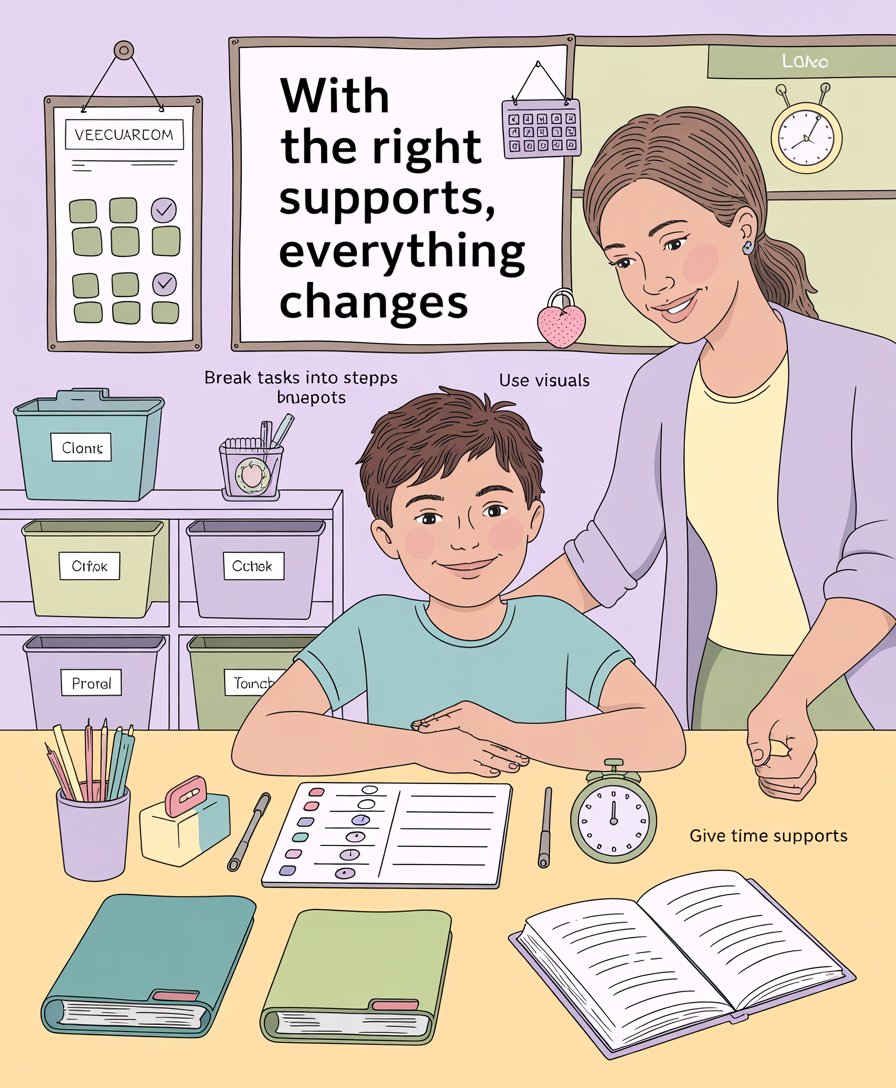
Students with EF-based planning deficits do not fail to plan because they don’t care about the deadline. They fail because they cannot mentally project themselves into future time in the way neurotypical students can. This is not a study skills problem. It is a time-blindness problem, a term coined by Dr. Barkley, and it requires structural scaffolds, not lectures.
| Accommodation | Implementation | Diagnoses Served |
|---|---|---|
| Pre-made assignment checklists | Teacher creates a step-by-step checklist for each major assignment; student checks off as completed | ADHD, LD, Autism |
| Intermediate deadlines for long projects | Break projects into 3–5 graded milestones with explicit due dates for each; never a single final deadline | ADHD, LD, 2e |
| Visual project timeline posted in room | Display a physical calendar or roadmap showing where the project currently is and what comes next | All IEP students |
| Weekly homework preview | Provide a one-page summary of the week’s assignments every Monday; include estimated time per task | ADHD, Autism, LD |
| Daily agenda check at start and end | 5-minute structured routine: student reviews the day’s tasks at arrival and confirms completion/carry-over at dismissal | ADHD, Autism |
| Reduced homework volume (not standards) | Assign 50% of problems/questions when the purpose is practice, not assessment; ensure mastery, not quantity | ADHD, LD, Anxiety |
Cognitive Flexibility Accommodations
Cognitive flexibility deficits are highly prevalent in autistic students and are often the source of the most disruptive classroom moments, not because of behavioral intent, but because unexpected transitions activate a neurological alarm system the student has no tools to manage. Prevention is always more effective than response.
| Accommodation | Implementation | Diagnoses Served |
|---|---|---|
| Visual daily schedule posted and reviewed | Print a daily schedule and review it every morning; mark changes clearly before they happen | Autism, ADHD |
| Advance notice of transitions (5 min + 1 min) | Give two warnings before every transition: a 5-minute cue and a 1-minute cue using a consistent signal | Autism, PDA, ADHD |
| Written change notifications | When class routine changes, provide a written note or visual card, not only verbal announcement | Autism, ADHD |
| Transition objects or rituals | Allow student a brief (1–2 min) closing ritual for activities: drawing a line under their work, tapping the desk, or a specific phrase | Autism, OCD, Anxiety |
Inhibitory Control and Attention Accommodations
| Accommodation | Implementation | Diagnoses Served |
|---|---|---|
| Preferential seating (front, near teacher, low-distraction) | Place student away from high-traffic areas, windows, or peers who are disruptive; proximity to teacher supports refocusing | ADHD, Autism, LD |
| Fidget tools during instruction | Provide approved sensory tools (fidget cube, squeeze ball, resistance band on chair legs); establish clear use protocol | ADHD, Autism, SPD |
| Movement breaks (scheduled) | Build in 2–3 structured movement opportunities per class period; not as reward, but as neurological reset | ADHD, Autism, PDA |
| Noise-reduction headphones | Allow student to wear noise-canceling or loop earplugs during independent work or testing | Autism, ADHD, SPD |
| Visual timer for transitions and timed tasks | Use a Time Timer or digital countdown; reduces anxiety about unknown time limits and supports self-pacing | ADHD, Autism, Anxiety |
| Reduced visual clutter on worksheets | Reformat dense worksheets; increase white space, one question per line, larger font; cover unused portions with paper | ADHD, LD, 2e |
Emotional Regulation Accommodations
Emotional regulation is an executive function, not a behavior problem. When students are dysregulated, the prefrontal cortex (the EF center) goes offline. No amount of instruction reaches a dysregulated student. Accommodations here are not about managing behavior; they are about restoring the neurological capacity to learn.
| Accommodation | Implementation | Diagnoses Served |
|---|---|---|
| Designated calm-down space in classroom | Create a low-stimulation corner with a visual menu of regulation tools (breathing cards, fidgets, visual anchor); use proactively, not only in crisis | Autism, ADHD, Anxiety, PDA |
| Pass system for self-initiated breaks | Student holds 2–3 break passes per class period they can use independently, without asking permission | Autism, PDA, ADHD |
| Check-in / Check-out (CICO) | Structured 2-minute morning/afternoon touchpoint with a trusted adult; review goals, regulate, reconnect | All EF/EBD students |
| Reduced demand during dysregulation | When a student is visibly dysregulated, shift to low-demand or preferred tasks to restore regulation before academic engagement | PDA, Autism, Anxiety |
AT HOME: Supporting Executive Function Beyond School
At HomeExecutive function deficits do not end at the school door. For IEP students, homework completion, bedtime routines, and weekend transitions can be sites of significant family stress, stress that directly affects school performance the next day. Families are not responsible for implementing school accommodations, but SPED teachers can share home-aligned strategies as part of parent training documented in the IEP.
Home Strategies Aligned with IEP EF Goals
Visual homework station setup. Create a fixed, low-distraction homework workspace with all needed materials always present. The goal is to eliminate the EF demand of “getting ready to start”, which is itself a task-initiation barrier.
Homework time chunking. Replace a 60-minute homework block with 20/5/20/5 intervals (20 minutes of work, 5-minute movement break). For students with ADHD, sustained attention in 20-minute blocks matches realistic neurological capacity far better than extended sittings.
External family calendar (analog). A large wall calendar with color-coded events for the week helps students with time-blindness “see” the week concretely. Digital calendars are harder to maintain and provide less passive visual presence.
End-of-day backpack protocol. A 5-minute nightly routine: empty backpack, sort papers (keep/trash/sign), repack needed items, check planner. Parents who are coached on this routine by the SPED teacher see dramatically better homework return rates.
LIFE: Building Executive Function Capacity Long-Term
LifeExecutive function accommodations are not a crutch, they are scaffolding. The long-term goal is not to make students permanently dependent on external supports, but to use those supports to reduce failure cycles while students develop compensatory strategies over time. However, this development requires explicit instruction, not just passive exposure.
Teach metacognition explicitly. Students with EF deficits often cannot identify their own patterns of difficulty. Structured self-monitoring tools, such as a weekly “What got in my way?” reflection sheet, build metacognitive awareness that transfers to adult life.
Transition planning (age 14+). Under IDEA, transition planning must begin at age 16 (and earlier in many states). Executive function is the primary predictor of post-secondary success for neurodivergent young adults. IEP transition goals should directly address EF skills, not just vocational skills in isolation.
Self-advocacy and disclosure. Teach students to identify their EF supports, name them, and request them in new environments (college, employment). A student who knows “I need written instructions and extra time to start tasks” is far better positioned for adult independence than a student who merely received accommodations without understanding why.
The BERMED Accommodation Match Framework
BERMED Framework: Matching Accommodations to EF Profiles
Not every student needs every accommodation. Over-accommodating creates learned helplessness; under-accommodating creates failure cycles. The BERMED Match Framework uses three steps to identify the right accommodation set for each student:
Step 1: Identify the primary EF domain(s). Use psychoeducational evaluation data, teacher observations, and parent input. Is the core barrier working memory, initiation, planning, flexibility, inhibition, or regulation? Most students have 2–3 co-occurring domains.
Step 2: Map accommodations to domains. Use the tables above to select 3–5 high-impact accommodations per domain. More is not better, targeted and consistently implemented supports outperform comprehensive but inconsistently used lists.
Step 3: Define implementation specifics in the IEP. Vague accommodations fail. “Extended time” is better than nothing; “50% additional time on all timed assignments excluding final state assessments” is better still. Every accommodation should include who provides it, how, and in what setting.
How to Write Executive Function Accommodations in an IEP
The quality of an accommodation depends almost entirely on how it is written. Vague language leads to inconsistent implementation. The following examples show how to move from weak to strong IEP accommodation language, a skill every SPED teacher and IEP coordinator should master.
| Weak (Vague) | Strong (Specific, Measurable) |
|---|---|
| “Student will receive extended time.” | “Student will receive 50% extended time (1.5x) on all timed written assessments and in-class assignments. General education teachers will be notified in writing at the start of each grading period.” |
| “Teacher will provide organizational support.” | “Teacher will provide a pre-printed step-by-step checklist for all multi-part assignments before work begins. Checklists will be laminated and kept in student’s binder.” |
| “Student may take breaks as needed.” | “Student may independently use 2 self-initiated break passes per class period to access the designated calm-down corner for up to 5 minutes. No teacher permission required.” |
| “Instructions will be simplified.” | “All multi-step verbal instructions will be limited to 2 steps at a time, followed by a written or visual summary posted on the student’s desk or the classroom board.” |
| “Student will use fidget tools.” | “Student may use approved sensory regulation tools (fidget cube or resistance band) during instruction and independent work. Tools are stored in student’s pencil case and may be used without requesting permission.” |
5 Common Errors SPED Teachers Make with EF Accommodations
Even experienced special education teachers fall into predictable patterns that undermine the effectiveness of executive function supports. Recognizing these errors is the first step to avoiding them.
Error 1: Using accommodations as rewards. Fidget tools, movement breaks, and calm-down spaces should never be withheld as disciplinary consequences. They are medically documented supports, the equivalent of removing a student’s glasses for bad behavior.
Error 2: Writing accommodations without training general education teachers. The majority of IEP accommodations are delivered in general education settings. If the gen-ed teacher does not know the accommodation exists, understand the rationale, or know how to implement it, it does not exist for the student. Annual accommodation training is the minimum; beginning-of-year plus after-each-IEP-meeting is the standard of care.
Error 3: Confusing modifications with accommodations. An accommodation changes how a student accesses learning without changing the standards. A modification changes the standard itself. Reducing assignment length for practice is an accommodation; reducing the grade-level standard is a modification. Both are legal, but they have different implications for diploma track and transition planning.
Error 4: Not reviewing accommodation effectiveness. An accommodation that was necessary at age 8 may no longer be needed at 14, or the reverse. IEP annual reviews should include a data-driven evaluation of which accommodations are being implemented, by whom, and with what result. If a student never uses a support, investigate why before removing it.
Error 5: Over-relying on self-monitoring before independence is established. Many plans include “student will self-monitor task completion” as if the skill exists. For students with significant EF deficits, self-monitoring is a skill that must be explicitly taught and externally scaffolded before independence can be expected.
More Executive Function Accommodations Resources
- What is an IEP in education?
- IEP vs 504 plan
- our free IEP goal bank
- Special education glossary (210 terms)
Frequently Asked Questions
What is the difference between executive function accommodations and modifications in an IEP?
Accommodations change how a student accesses or demonstrates learning without altering the grade-level standard, for example, providing a graphic organizer or extended time. Modifications actually change the standard or content expectation, such as reducing the number of required learning objectives. For most IEP students in inclusive settings, executive function accommodations are preferred because they preserve access to grade-level curriculum and support diploma attainment.
Are executive function accommodations legally required in an IEP?
Under IDEA, IEP teams are required to address any area where a disability adversely affects educational performance, which includes executive function deficits that impact academic tasks. Courts and hearing officers have increasingly found in favor of families when school teams failed to document domain-specific EF accommodations that were clearly indicated by evaluation data. While there is no exhaustive federal list of required accommodations, teams must demonstrate that accommodation decisions are data-driven and individually determined.
Which executive function accommodations are most effective for students with ADHD?
Research consistently supports: chunked instructions (max 2 steps), preferential low-distraction seating, scheduled movement breaks, visual timers, graphic organizers, and reduced homework volume for practice tasks. The most impactful single change in most classrooms is shifting from verbal-only to written-plus-visual instructions, which directly addresses working memory demand, the most pervasive EF deficit in ADHD. For students who qualify under Section 504 rather than IDEA, see the full list of 504 accommodations for ADHD: many overlap with IEP EF supports and can be used as a reference regardless of eligibility category.
How do executive function accommodations differ for autistic students vs. ADHD students?
ADHD profiles most often present with working memory and inhibitory control as primary deficits, requiring external memory aids and attention regulation supports. Autistic students are more likely to present with cognitive flexibility challenges, requiring advance transition notices, visual schedules, and explicit change management protocols. Students with AuDHD (co-occurring autism and ADHD) typically need supports from both profiles. Always assess individual student data rather than applying diagnosis-based assumptions.
Can parents request executive function accommodations even without a formal diagnosis?
Yes. Under both IDEA and Section 504 of the Rehabilitation Act, eligibility for accommodations is based on educational need and functional impact, not solely on a clinical diagnosis. A student with documented teacher observations, standardized assessment data showing EF delays, and evidence of academic impact may qualify for a 504 plan or IEP even without a psychiatrist’s or neuropsychologist’s diagnosis. Parents should submit a written evaluation request to the school’s special education team.
How often should executive function accommodations be reviewed?
At minimum, accommodations must be reviewed at each annual IEP meeting. However, best practice calls for a mid-year check-in, particularly for newly added accommodations, to assess implementation fidelity and effectiveness. When a student transfers to a new school, grade level, or teacher, accommodations should be explicitly re-introduced and reviewed with all relevant staff, not merely passed along in a file.
What to Do Next: 5 Concrete Actions
Executive function accommodations for IEP students work when they are specific, consistently implemented, and matched to the right domain. Here is where to start:
1. Audit your current IEP accommodations. For each existing accommodation, identify which EF domain it targets. If you cannot, it may be too vague to implement meaningfully.
2. Run a domain-mapping exercise at your next IEP meeting. Before discussing accommodations, have the team agree on the student’s primary 1–3 EF deficit domains based on evaluation data. Let the domains drive the accommodation list.
3. Rewrite at least three accommodations in specific, measurable language using the strong examples in the table above. If a colleague cannot implement it without asking you a follow-up question, it is not specific enough. Need a quick-reference tool? The accommodation cheat sheet for special education is a practical one-page resource you can keep in your IEP binder.
4. Schedule a 20-minute accommodation briefing with all general education teachers at the start of the year and after any IEP update. Document this briefing in the student’s service log.
5. Add an implementation review question to your mid-year check-in: “Which accommodations are being used consistently? Which are not being used, and why?” Data on implementation fidelity is as important as data on academic progress.
Sources
- Barkley, R. A. (2012). Executive Functions: What They Are, How They Work, and Why They Evolved. Guilford Press. guilford.com
- Harvard Center on the Developing Child. (2023). Executive Function and Self-Regulation. developingchild.harvard.edu
- Willcutt, E. G., et al. (2021). “Executive function deficits in students with ADHD: A meta-analytic review.” Child Neuropsychology, 27(4), 456–482. tandfonline.com
- CHADD – Children and Adults with ADHD. (2024). Accommodations for Students with ADHD. chadd.org
- Understood.org. (2024). IEP Accommodations: A Complete Guide for Parents and Educators. understood.org
- IDEA – Individuals with Disabilities Education Act. 20 U.S.C. § 1400 et seq. U.S. Department of Education. ed.gov/idea
- Gioia, G. A., Isquith, P. K., Guy, S. C., & Kenworthy, L. (2000). Behavior Rating Inventory of Executive Function (BRIEF). Psychological Assessment Resources.
Related reading: