
Quick answer: A visual schedule for home is a sequence of pictures, symbols or words that shows your child what happens next and in what order. It reduces anxiety, power struggles and repeated questions because the schedule, not the parent, gives the direction. Start with one routine (morning, after school or bedtime), use three to six pictures, teach it when your child is calm, and let your child check off or remove each step when it is done.
In this guide
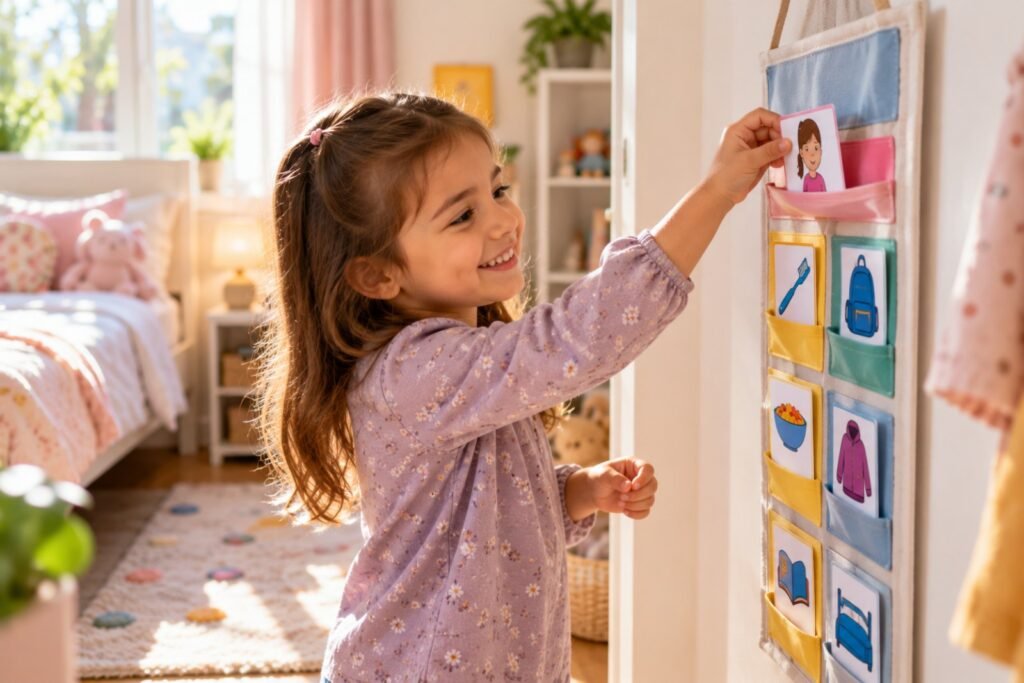
Many children, especially autistic children and kids with ADHD, find spoken instructions hard to hold in mind. Words disappear the moment they are said. Pictures stay. A visual schedule for home turns the day into something your child can see, predict and follow more independently, and it often lowers stress for the whole family.

What Is a Visual Schedule for Home?
A visual schedule shows a series of activities with images, objects or words, arranged from first to last. Visual supports are recognized as an evidence-based practice for autistic children and youth, and they help with transitions, independence and understanding expectations (AFIRM, UNC Frank Porter Graham). A review of research found visual activity schedules meet criteria for evidence-based practice for autistic individuals (Knight, Sartini and Spriggs, 2015).
Key point: Schools use visual schedules every day. Using the same type of schedule at home creates consistency, and our guide to visual schedules in the classroom can help you align with your child’s teacher.
Types of Visual Schedules for Home
| Type | Best for | Example |
|---|---|---|
| Object schedule | Toddlers and children who do not yet use pictures | A toothbrush means bathroom time |
| First-then board | Starting a single task | First shoes, then park |
| Photo schedule | Young children, new routines | Real photos of your child’s bathroom and breakfast |
| Picture symbol strip | Most children ages 3 to 10 | Vertical velcro strip on the fridge |
| Written checklist | Readers and teens | Whiteboard list or phone app with alarms |
| Mini schedule | Multi-step tasks | Steps for handwashing posted by the sink |
How to Make a Visual Schedule for Home in 6 Steps
Six steps to your first home schedule
You do not need special software. Photos from your phone, printed and laminated with packing tape, work very well. Use the same image for the same activity every time so your child learns the meaning quickly.
Ready-to-Copy Routines for a Home Visual Schedule
| Routine | Suggested steps |
|---|---|
| Morning | Toilet, get dressed, breakfast, teeth, shoes, bag. See our morning routine guide. |
| After school | Snack, movement break, homework, free time |
| Bedtime | Bath, pajamas, teeth, story, lights out |
| Weekend | Breakfast, outing, lunch, quiet time, play, dinner |
| Outing | Car, store, choose one item, pay, car, home |
| New event | Car, meet grandma, eat, play, goodbye, home |
For changes, add a “surprise” or “change” card. It teaches that plans sometimes change and gives your child a safe way to prepare for it.
How to Teach Your Child to Use the Schedule
- Introduce it when calm. Walk through the schedule together, touching each picture.
- Guide, then step back. At first, take your child to the schedule at each transition. Fade your help over days or weeks.
- Use a consistent phrase. “Check your schedule” becomes the only reminder you need.
- Let your child move the card. Removing a finished picture gives a sense of control and progress.
- Put something enjoyable last. A preferred activity at the end motivates finishing.
- Praise using the schedule. “You checked your schedule all by yourself!”
Script for introducing the schedule
“This is your morning schedule. It shows what we do first and what comes next. When you finish, you put the picture in the done pocket. Let’s try it together. What’s first? Yes, toilet!”

- One routine at a time, three to six steps.
- Pictures match what your child actually sees at home.
- The schedule is at eye level in the right room.
- There is a clear “done” spot.
- A preferred activity comes last.
- You use one short phrase: “Check your schedule.”
- You update the schedule as your child grows.
Real-Life Example
Case story
Amira, 5, is autistic and cried at almost every transition after school. Her dad made a photo schedule with five steps: snack, trampoline, bath, dinner, tablet. Each photo moved to a “finished” envelope. After two weeks, Amira started checking the schedule on her own, and the crying at transitions dropped to once or twice a week. Her teacher noticed the same pictures helped at school when the family shared them.
Related: Read our guides on transitions for autistic children and social stories.
Visual Schedule for Home: FAQ
At what age can a child use a visual schedule for home?
Children as young as 2 can use object or photo schedules. Older children and teens can use written lists or apps.
Will my child depend on the schedule forever?
Schedules build independence. Many children move to shorter or written versions as routines become automatic.
Should the whole day be on the schedule?
Start with one routine. Add more only when the first one works.
What if my child removes all the pictures?
Show only the next two or three steps, or use a first-then board for a while.
Can visual schedules help kids without autism?
Yes. Children with ADHD, anxiety or language delays often benefit too.
In short: A visual schedule for home makes routines predictable, reduces stress and builds independence. Start with one routine, keep it simple and let your child own the process. Explore more ideas in our At Home section.
Was this article helpful?
Tap a star to rate
Sources
- AFIRM, UNC Frank Porter Graham Child Development Institute. Visual Supports
- Knight, Sartini and Spriggs (2015). Evaluating Visual Activity Schedules as Evidence-Based Practice
- Vanderbilt Kennedy Center TRIAD. First-Then Board Overview
This article is educational and does not replace advice from your child’s therapist or care team.

