
Quick answer: Choosing an AAC device starts with the person, not the device: their communication needs, language level, motor access, vision, hearing and preferences. AAC ranges from no-tech (gestures, signs), to low-tech (picture boards, books), to high-tech (speech-generating devices and AAC apps). A good choice offers a robust vocabulary that can grow, a way to access it the person can use reliably, and support from trained communication partners. No skills or “readiness” are required before starting AAC.
In this guide
Choosing an AAC device can feel overwhelming: dozens of apps, dedicated devices, symbol sets and vocabulary layouts. The right choice can change a child’s life, giving them a voice at school, at home and with friends. The key is a careful, team-based process with real trials.
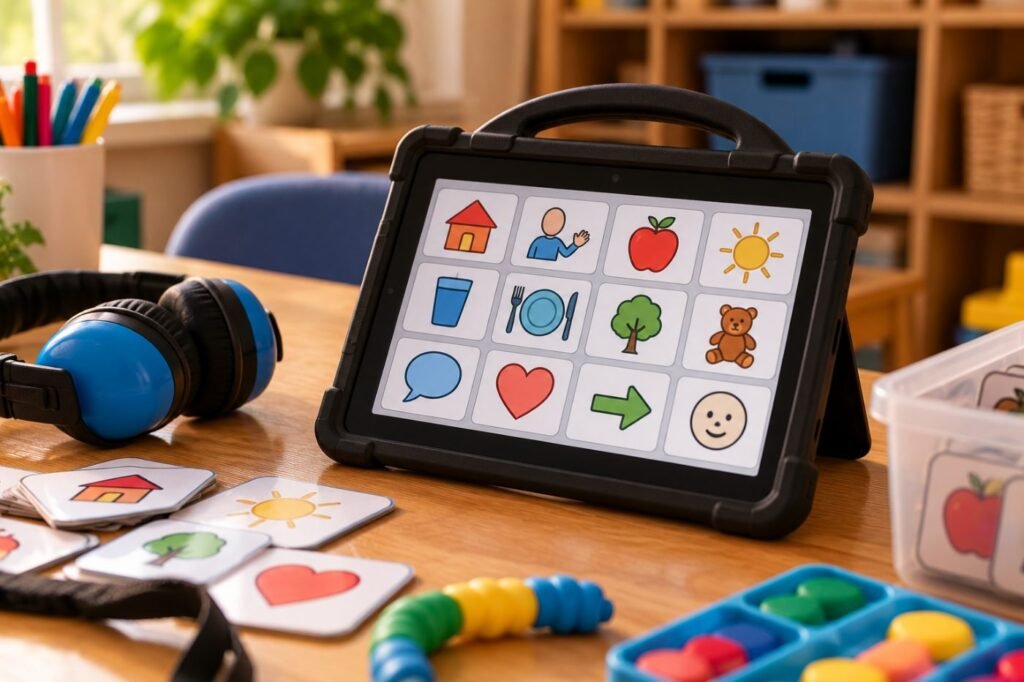
Types of AAC
| Type | Examples | Strengths |
|---|---|---|
| No-tech | Gestures, signs, facial expressions | Always available |
| Low-tech | Picture boards, communication books, alphabet boards | Cheap, durable, quick to use |
| Mid-tech | Single-message or few-message voice buttons | Simple voice output |
| High-tech | Speech-generating devices, AAC apps on tablets | Large vocabulary, voice output, growth over time |
AssistiveWare notes that AAC is a flexible set of tools, and switching between them as needed generally works better than relying on one (AssistiveWare).
Key point: Every AAC user needs a low-tech backup for when the device is charging, broken or not allowed.
Features to Compare When Choosing an AAC Device
- Vocabulary: core words plus personal words, with room to grow.
- Organization: consistent motor patterns help users find words fast.
- Access: touch, keyguard, switch scanning or eye gaze.
- Symbols and text: pictures, words, spelling with prediction.
- Voice: age- and gender-appropriate, clear in noise.
- Durability: rugged case, battery life, portability.
- Support: training, backups, customer service.

Steps to Choose an AAC Device
A team process
State Assistive Technology Act programs offer device demonstration and loan, so families can try before buying (NTAC). Learn about assistive technology funding.
AAC Myths
| Myth | Fact |
|---|---|
| AAC stops speech development | Research indicates AAC generally supports speech |
| A child must be “ready” for AAC | No prerequisite skills are required |
| AAC is only for people with no speech | Many speaking people benefit from AAC |
| One device is enough | Combining tools, including low-tech, works best |

Modeling script for partners
While saying “Let’s go outside,” touch GO and OUTSIDE on the device. Pause and wait. Respond to any attempt as meaningful: “You said GO! Let’s go.”
Real-Life Example
Case story
Amir, 6, is autistic and minimally speaking. His team trialed two AAC apps for four weeks. He found words faster on the app with a stable core vocabulary layout. Teachers and parents modeled daily. Within three months, Amir combined two words, asked for help and told his teacher about his weekend. His spoken words also increased.
Related: See AAC in the classroom and childhood apraxia of speech.
Choosing an AAC Device FAQ
Who should help choose an AAC device?
A speech-language pathologist with AAC experience, plus the family, teachers and therapists.
Is an iPad app as good as a dedicated device?
It can be, depending on access needs, durability and funding rules.
Does AAC prevent talking?
No. Research indicates it generally supports speech.
Who pays for an AAC device?
Schools when in the IEP, and often Medicaid or insurance for personal devices.
How do children learn to use AAC?
Mostly through partners modeling language on the device in daily routines.
In short: Choosing an AAC device is about the person: needs, access and growth. Trial devices, model daily and keep a backup. This article is part of our Assistive Technology series.
Was this article helpful?
Tap a star to rate
Sources
- AssistiveWare. Busting AAC Myths for Good
- ASHA. Funding for Communication Services and Supports
- NTAC. Assistive Technology Act Programs
This article is educational and does not replace professional advice.

