
Quick answer: Preschool IEP goals target the early skills young children need to join classroom routines: communication, play, social interaction, following routines, early self-help, fine and gross motor skills and pre-academic concepts. Good preschool goals are play-based, embedded in daily routines and written in small steps. Below are 42 SMART preschool IEP goals for children ages 3 to 5, organized by skill area, with present level examples and data ideas.
In this goal bank
Preschool is often a child’s first experience with group routines, shared toys and adult directions. For children with disabilities, an IEP can make that experience successful. IDEA requires that preschool IEPs describe how a child’s disability affects participation in appropriate activities, and the CDC’s developmental milestones give families and teams a common language for early skills. Preschool IEP goals should be practical and joyful: requesting a snack, joining circle time, playing next to a friend, washing hands. For other goal areas, see our complete IEP goal bank.
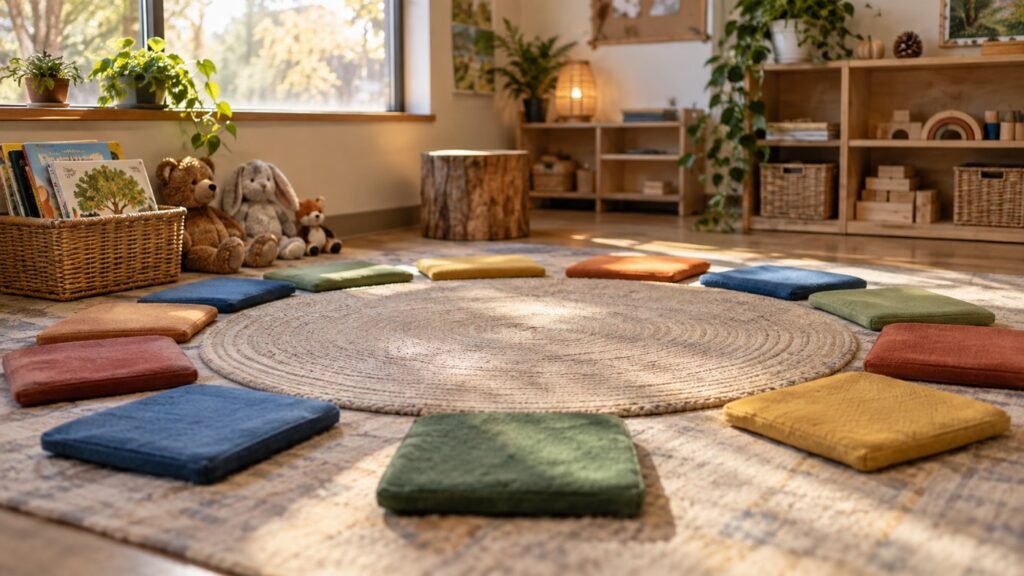
How to Write Preschool IEP Goals
Formula: By [date], during [play or classroom routine], given [visual, model or prompt level], [Child] will [observable early skill] in [number] of [opportunities] across [number] of consecutive sessions as measured by [observation or anecdotal data].
Present level example: “Mila, age 4, communicates with single words and gestures. She joins circle time for about 3 minutes before leaving the rug. She plays alone with blocks and does not yet take turns. She washes her hands with hand-over-hand help and uses a fisted grasp on crayons. She loves music and animals.”
Key point: Embed goals in routines the child already does every day, such as snack, circle, centers and outdoor play. Short, frequent practice in real moments works better than drills.
Communication
For children who use pictures, signs or devices, see our functional communication IEP goals.
- By [date], [Child] will request a preferred item or activity using a word, sign, picture or AAC in 8 of 10 opportunities.
- By [date], [Child] will use 2-word phrases (for example “more juice,” “my turn”) in 4 of 5 opportunities across 3 sessions.
- By [date], [Child] will respond to their name by looking, turning or answering in 80% of opportunities.
- By [date], [Child] will follow a 1-step direction with a gesture during classroom routines in 4 of 5 opportunities.
- By [date], [Child] will answer simple “what” and “where” questions about a picture book in 3 of 5 opportunities.
- By [date], [Child] will name 20 common objects or pictures using any modality in 4 of 5 trials.
- By [date], [Child] will say or show “help,” “stop” and “all done” in 4 of 5 opportunities.
Play and Social Skills
- By [date], [Child] will play next to a peer with similar toys for 5 minutes in 4 of 5 center times.
- By [date], [Child] will take turns with a peer in a simple game with adult support in 3 of 5 opportunities.
- By [date], [Child] will imitate an adult or peer action with a toy (feeding a doll, rolling a car) in 4 of 5 opportunities.
- By [date], [Child] will engage in pretend play for 2 actions in a row in 3 of 4 opportunities.
- By [date], [Child] will greet a peer or adult with a wave, word or sign in 4 of 5 arrivals.
- By [date], [Child] will share materials when a peer asks, with adult support, in 3 of 5 opportunities.
- By [date], [Child] will show or give an item to a peer or adult to share interest in 3 of 5 opportunities.
Free resource
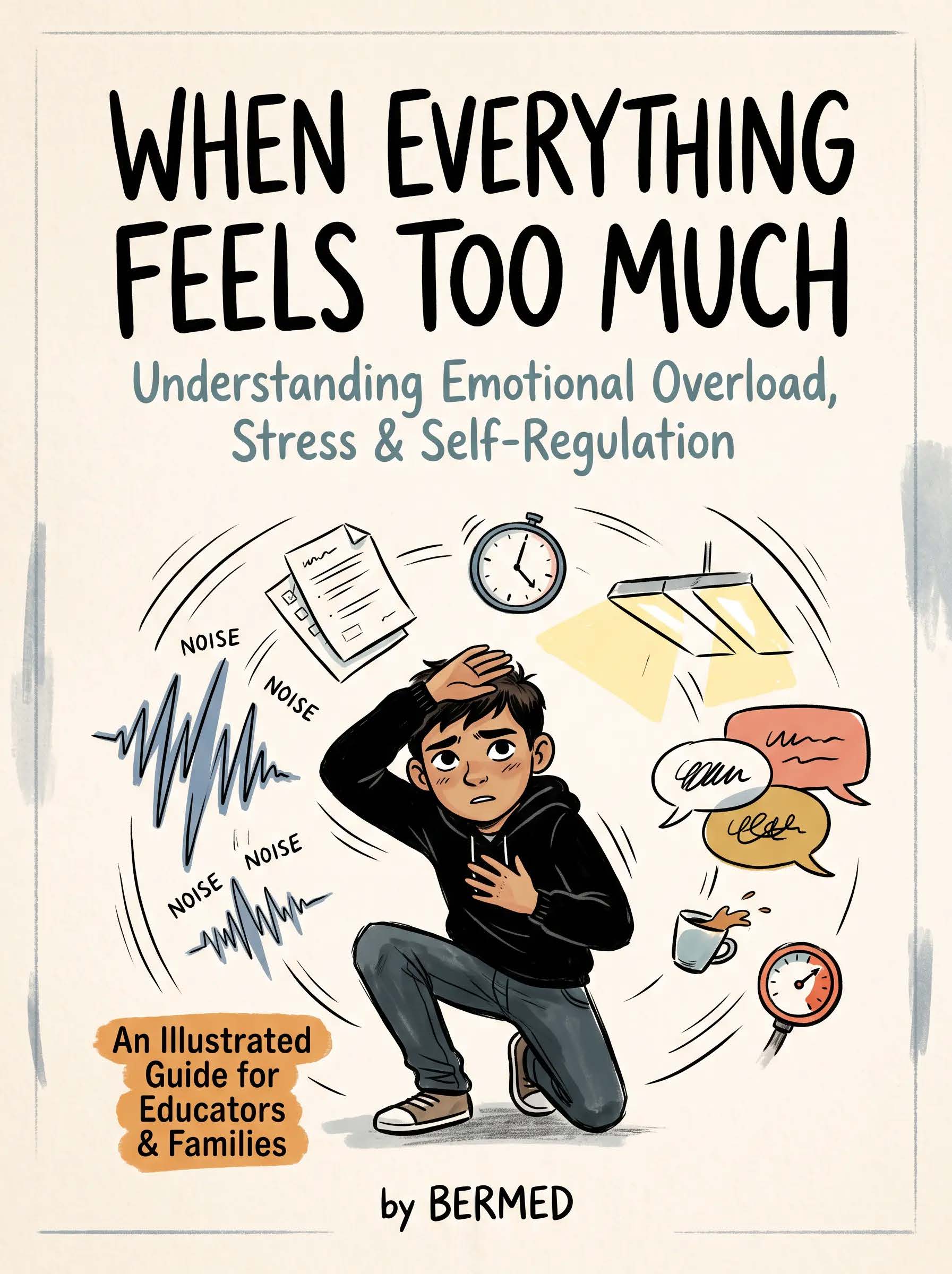
When Everything Feels Too Much
A visual guide that helps children understand emotional overload.
Routines and Transitions
Visual supports help young children predict what comes next. See our guides to visual schedules and transitions for autistic children.
- By [date], [Child] will participate in circle time for 10 minutes with a visual support and a movement break in 4 of 5 days.
- By [date], [Child] will transition between activities using a picture schedule or transition object in 80% of transitions.
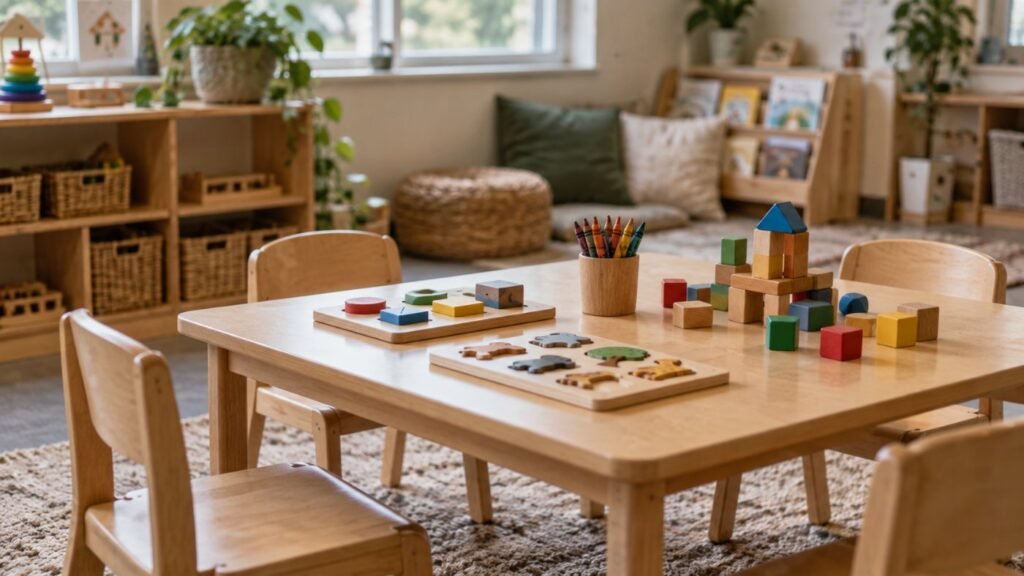
- By [date], [Child] will follow the arrival routine (hang backpack, wash hands, choose activity) with picture cues in 4 of 5 days.
- By [date], [Child] will clean up toys when the clean-up song plays with one prompt in 4 of 5 opportunities.
- By [date], [Child] will line up with the class using a visual spot marker in 4 of 5 opportunities.
- By [date], [Child] will wait for 1 minute using a visual wait card in 3 of 5 opportunities.
- By [date], [Child] will sit at the table for snack until finished in 4 of 5 snack times.
Self-Help
For toileting and dressing details, see daily living skills IEP goals and our guide to potty training an autistic child.
- By [date], [Child] will wash and dry hands following a picture sequence with no more than one prompt in 4 of 5 opportunities.
- By [date], [Child] will feed themselves with a spoon with minimal spills in 80% of snack times.
- By [date], [Child] will drink from an open cup with minimal spills in 4 of 5 opportunities.
- By [date], [Child] will take off and hang up their jacket in 4 of 5 arrivals.
- By [date], [Child] will indicate the need to use the bathroom with a word, sign or picture in 3 of 5 opportunities.
- By [date], [Child] will put on shoes with Velcro straps in 4 of 5 opportunities.
- By [date], [Child] will throw away trash after snack in 4 of 5 opportunities.
Fine and Gross Motor
For older students, see our fine motor IEP goals.
- By [date], [Child] will stack 6 blocks in a tower in 4 of 5 trials.
- By [date], [Child] will use a crayon with a functional grasp to imitate a vertical line, horizontal line and circle in 4 of 5 trials.
- By [date], [Child] will snip paper with child-safe scissors in 3 of 5 trials.
- By [date], [Child] will string 5 large beads in 4 of 5 trials.
- By [date], [Child] will jump with both feet off the ground 3 times in a row in 4 of 5 trials.
- By [date], [Child] will climb up and slide down playground equipment safely with supervision in 4 of 5 outdoor times.
- By [date], [Child] will catch a large ball tossed from 3 feet in 3 of 5 trials.
Pre-Academic Skills
- By [date], [Child] will match 8 basic colors in 4 of 5 trials.
- By [date], [Child] will identify 4 basic shapes by pointing or naming in 4 of 5 trials.
- By [date], [Child] will count objects 1 to 5 with one-to-one correspondence in 4 of 5 trials.
- By [date], [Child] will identify the first letter of their name in 4 of 5 trials.
- By [date], [Child] will sort objects by one attribute (color, size) in 4 of 5 trials.
- By [date], [Child] will point to pictures in a book when named by an adult in 4 of 5 opportunities.
- By [date], [Child] will complete a 4-piece inset puzzle in 4 of 5 trials.
The BERMED Goal-Writing Check
- B – Baseline: Do you have observation data from play and routines, plus family input?
- E – Exact skill: Does the goal name one early skill the child can practice daily?
- R – Realistic: Does it match the child’s developmental level, not just their age?
- M – Measurable: Can two adults count it the same way?
- E – Equitable access: Can the child respond with words, signs, pictures or AAC?
- D – Data plan: Who collects data in which routines, and how is it shared with the family?
How to Measure Preschool IEP Goals
| Skill | How to measure | Accommodations to pair |
|---|---|---|
| Communication | Frequency of requests and words used | Picture choices, AAC, modeling |
| Play and social | Minutes of play, turns taken | Structured games, peer models |
| Routines | Minutes in circle, transitions completed | Visual schedule, timers, movement breaks |
| Self-help | Steps completed independently | Picture sequences, adaptive tools |
| Motor | Trials completed correctly | Adapted crayons, large materials |
| Pre-academic | Percent correct in play-based trials | Hands-on materials, songs |
As children grow, pair these goals with social skills IEP goals and self-regulation IEP goals.
Neuroaffirming tip: Young children learn through play and connection. Follow the child’s interests, accept every form of communication, and avoid goals that ask a preschooler to sit still or stop stimming. Joy is a sign that learning is working.
What are preschool IEP goals?
Preschool IEP goals are measurable goals for children ages 3 to 5 that target early communication, play, social skills, routines, self-help, motor and pre-academic skills.
Who qualifies for a preschool IEP?
Under IDEA Part B, children ages 3 to 5 with a qualifying disability or developmental delay who need special education can receive preschool services through their school district.
How do you measure preschool IEP goals?
Use observation during play and routines, frequency counts, minutes of participation, steps completed in self-help tasks and simple play-based trials.
Should preschool goals be academic?
Most preschool goals focus on communication, play, routines and self-help. Simple pre-academic goals like colors, shapes and counting can be included through play.
How can families help with preschool IEP goals?
Families can practice the same skills during home routines like meals, dressing and play, using the same words, signs or picture supports as school.
5 Actions to Take This Week
- Ask the family about the child’s favorite activities and daily routines at home.
- Observe the child during circle, centers, snack and outdoor play.
- Choose one routine and add a simple picture support.
- Model one new word or sign many times during play.
- Choose 2 or 3 goals from this bank and track them during real routines.
Sources

