
Quick answer: Daily living skills IEP goals build independence in everyday routines: hygiene, toileting, dressing, eating, simple meal prep, household tasks, money and safety. The best goals break each routine into small steps, use visual supports and are practiced where the skill really happens, at school and at home. Below are 42 SMART daily living skills IEP goals organized by routine, with present level examples and data ideas.
In this goal bank
A student may read above grade level and still need help brushing teeth, zipping a coat or making a snack. Daily living skills, sometimes called adaptive or self-help skills, are a strong predictor of independence in adulthood. Resources from the UNC Center on Secondary Education for Students with Autism recommend teaching these skills directly, using visual supports and task analysis, and practicing them in real settings. Daily living skills IEP goals turn that into a clear plan for school and home. If toileting is the main focus, also read our guide to potty training an autistic child, and see our complete IEP goal bank for other areas.
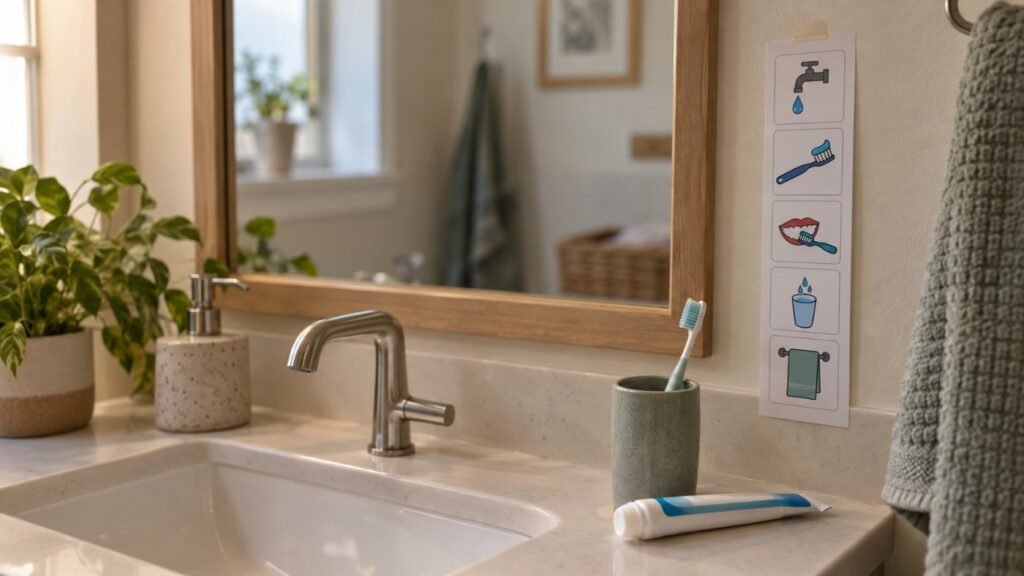
How to Write Daily Living Skills IEP Goals
Formula: By [date], during [routine], given [visual task analysis or prompt level], [Student] will complete [number] of [total] steps of [skill] independently in [number] of [opportunities] as measured by [task analysis data sheet].
Present level example: “Leo, age 9, completes 4 of 10 steps of handwashing independently and needs physical prompts to turn off the water and dry his hands. He can put on his jacket but needs help with the zipper. At lunch, he opens 2 of 4 containers. His family wants him to dress independently for school.”
Key point: Use a task analysis. Measuring “steps completed independently” shows real progress even before the full routine is mastered.
Hygiene and Grooming
Sensory sensitivities can make hygiene hard. Pair these goals with sensory processing IEP goals and our dentist tips for autistic children.
- By [date], [Student] will complete all 8 steps of handwashing using a visual sequence independently in 4 of 5 opportunities.
- By [date], [Student] will brush teeth for 2 minutes using a timer and a picture sequence with no more than one prompt in 4 of 5 opportunities.
- By [date], [Student] will wipe their nose with a tissue and throw it away in 80% of opportunities.
- By [date], [Student] will brush their hair using a mirror and checklist in 4 of 5 opportunities.
- By [date], [Student] will apply deodorant as part of a morning routine checklist in 4 of 5 days.
- By [date], [Student] will wash their face using a washcloth and soap following a visual routine in 4 of 5 opportunities.
- By [date], [Student] will choose clean clothes and identify when clothes need washing in 3 of 4 opportunities.
Toileting
- By [date], [Student] will request the bathroom using words, a picture or AAC in 80% of opportunities.
- By [date], [Student] will follow a scheduled bathroom routine every 90 minutes with a visual timer in 4 of 5 days.
- By [date], [Student] will complete 6 of 8 steps of the toileting routine (pants down, sit, wipe, flush, pants up, wash hands) independently in 4 of 5 opportunities.
- By [date], [Student] will stay dry between scheduled bathroom breaks in 4 of 5 school days.
- By [date], [Student] will use toilet paper appropriately and flush in 80% of opportunities.
- By [date], [Student] will use a public or unfamiliar school bathroom with a visual guide in 3 of 4 opportunities.
- By [date], [Student] will tell an adult when they need help or a change of clothes in 4 of 5 opportunities.
Free resource
Transition Planning Toolkit for Educators
Tools to plan postsecondary goals, services and student-led transition.
Dressing
Many dressing tasks depend on hand skills. Pair these goals with fine motor IEP goals.
- By [date], [Student] will put on a jacket using the “flip” method independently in 4 of 5 opportunities.
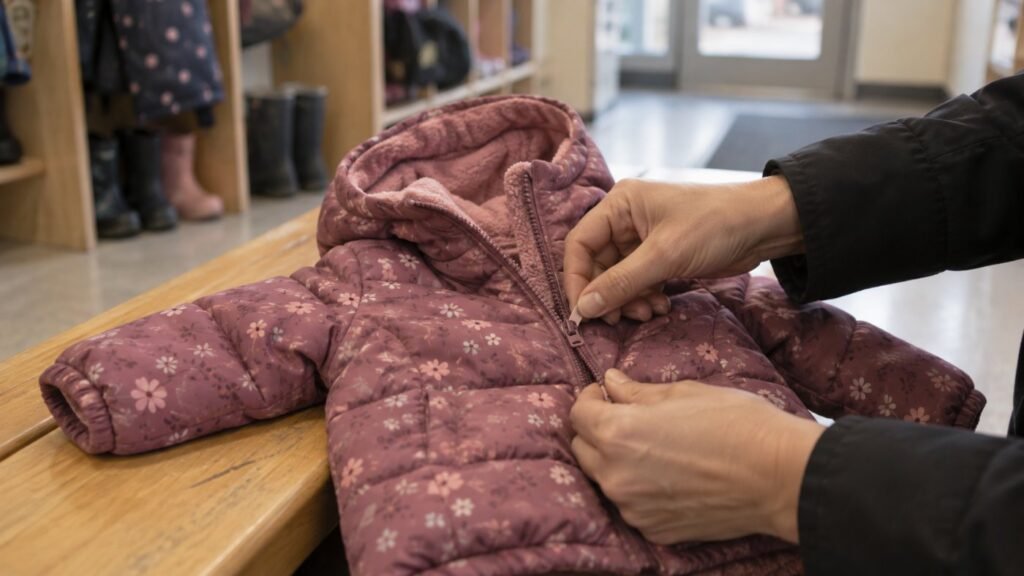
- By [date], [Student] will zip a jacket after an adult starts the zipper, progressing to starting it independently, in 4 of 5 opportunities.
- By [date], [Student] will put on and take off shoes with Velcro straps independently in 4 of 5 opportunities.
- By [date], [Student] will put on a hat, gloves and backpack before recess or dismissal using a visual checklist in 80% of opportunities.
- By [date], [Student] will button 3 buttons on a shirt or smock in 4 of 5 opportunities.
- By [date], [Student] will choose weather-appropriate clothing from 2 choices in 4 of 5 opportunities.
- By [date], [Student] will change into and out of PE clothes within 7 minutes using a picture sequence in 4 of 5 opportunities.
Eating and Meal Prep
For students with food sensitivities, see our guide to picky eating in autistic children.
- By [date], [Student] will open lunch containers, bags and cartons independently in 4 of 5 lunch periods.
- By [date], [Student] will use a spoon and fork to eat with minimal spills in 80% of meals.
- By [date], [Student] will clean up their lunch area (throw away trash, wipe table) in 4 of 5 lunch periods.
- By [date], [Student] will pour a drink from a small pitcher without spilling in 4 of 5 trials.
- By [date], [Student] will prepare a simple snack (spread butter on bread, make a sandwich) using a picture recipe in 4 of 5 opportunities.
- By [date], [Student] will use a microwave to heat food for a set time following a visual guide in 3 of 4 opportunities.
- By [date], [Student] will follow a 5-step picture recipe to prepare a cold snack in 3 of 4 opportunities.
Household and Organization
- By [date], [Student] will unpack their backpack and put materials in the correct places using a checklist in 4 of 5 mornings.
- By [date], [Student] will complete a classroom job (wiping tables, sorting supplies) with a visual task card in 4 of 5 opportunities.
- By [date], [Student] will put away belongings in their cubby or locker in 80% of opportunities.
- By [date], [Student] will fold a towel or shirt following a picture sequence in 4 of 5 trials.
- By [date], [Student] will sort laundry by color in a practice activity in 4 of 5 trials.
- By [date], [Student] will set a table for 4 people using a placemat guide in 3 of 4 opportunities.
- By [date], [Student] will follow a visual schedule to complete a 3-task cleaning routine in 4 of 5 opportunities.
Money, Safety and Community
For older students, connect these goals with transition planning in the IEP.
- By [date], [Student] will identify coins and bills and their values in 4 of 5 trials.
- By [date], [Student] will use the “next dollar” strategy to pay for an item in a classroom store in 4 of 5 trials.
- By [date], [Student] will state their full name, address and a caregiver phone number or show an ID card in 4 of 5 opportunities.
- By [date], [Student] will identify safe and unsafe situations (stranger, crossing the street) in 4 of 5 scenarios.
- By [date], [Student] will follow safety rules in a parking lot or crosswalk with adult supervision in 100% of community outings.
- By [date], [Student] will order food at a counter using a script or AAC in 3 of 4 community outings.
- By [date], [Student] will read common safety signs (exit, stop, restroom) in 4 of 5 trials.
The BERMED Goal-Writing Check
- B – Baseline: Do you have task analysis data showing which steps the student completes now?
- E – Exact skill: Does the goal name one routine, such as handwashing or zipping?
- R – Realistic: Does it fit the student’s age, motor skills, sensory needs and family priorities?
- M – Measurable: Can two adults score the steps the same way?
- E – Equitable access: Are visual sequences and adaptive tools available?
- D – Data plan: Who records task analysis data at school and at home, and how often?
How to Measure Daily Living Skills IEP Goals
| Skill | How to measure | Accommodations to pair |
|---|---|---|
| Hygiene | Steps completed independently | Picture sequence, timer, sensory-friendly tools |
| Toileting | Dry intervals, requests, routine steps | Schedule, visual guide, change of clothes |
| Dressing | Steps completed, time to complete | Adaptive clothing, Velcro, zipper pulls |
| Eating and meal prep | Containers opened, recipe steps | Picture recipes, adapted utensils |
| Household | Checklist completion | Visual task cards, labeled storage |
| Money and safety | Percent correct in trials and outings | ID card, scripts, practice store |
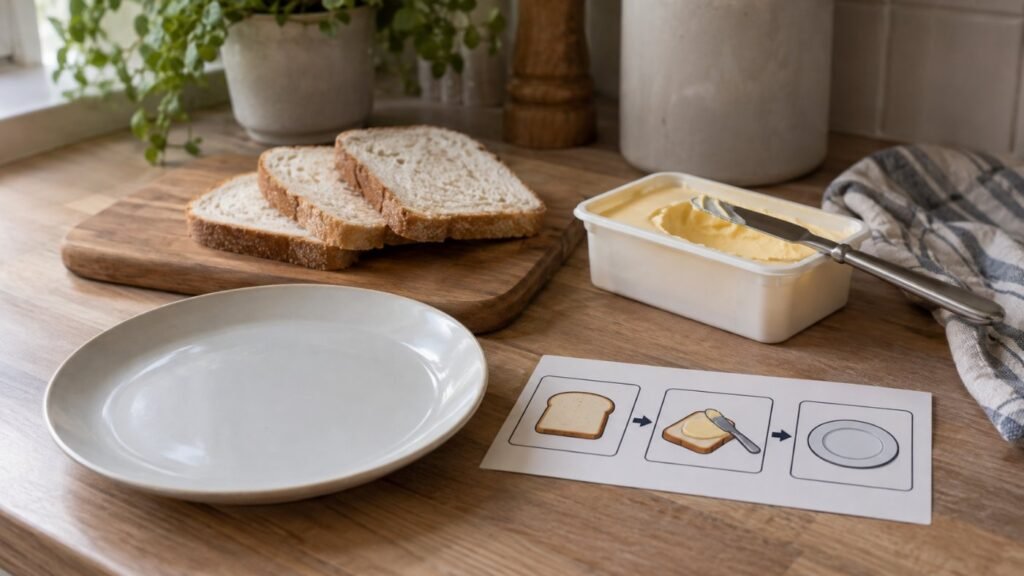
Support these goals with visual schedules, coordinate practice at home, and pair them with functional communication IEP goals so students can ask for help during routines.
Neuroaffirming tip: Independence does not mean doing everything alone. Using a visual checklist, adaptive clothing or an alarm reminder is real independence. Respect sensory needs, such as a soft toothbrush or tagless clothing, and celebrate every step.
What are daily living skills IEP goals?
Daily living skills IEP goals target everyday independence, such as hygiene, toileting, dressing, eating, simple meal preparation, household tasks, money and safety.
Can daily living skills be included in an IEP?
Yes. IEPs address functional needs as well as academic needs. If a student needs instruction in daily living skills to access education and prepare for adult life, they belong in the IEP.
What is a task analysis?
A task analysis breaks a routine into small, ordered steps. Teams track how many steps the student completes independently, which shows progress over time.
How do you measure daily living skills?
Use task analysis data sheets, prompt levels, time to complete a routine and checklists, collected during the natural routine at school and home.
Should families be involved in daily living goals?
Yes. Families know which routines matter most and can practice them at home, which helps skills generalize.
5 Actions to Take This Week
- Ask the family which daily routine matters most at home right now.
- Write a task analysis for that routine and collect baseline data.
- Create a picture sequence and post it where the routine happens.
- Practice the routine at the natural time, not as an isolated drill.
- Choose 2 or 3 goals from this bank and share the data sheet with the family.
Related teaching strategies:
- Task Analysis: Teach Any Skill Step by Step
Sources

