
Quick answer: Self-regulation IEP goals help a student notice body signals, name feelings, choose a calming strategy, ask for a break and return to learning. Good goals move gradually from co-regulation (an adult helps) to self-regulation (the student leads), and they never punish a student for having big feelings. Below are 42 SMART self-regulation IEP goals organized by skill, with present level examples, data ideas and accommodations.
In this goal bank
“Will remain calm.” “Will not have outbursts.” These are some of the most common self-regulation IEP goals, and some of the least useful. Calm is not a skill a student can practice on command. Noticing a racing heart, picking a strategy and asking for space are skills. The Child Mind Institute explains that children learn to manage their emotions through co-regulation, when a calm adult helps them settle again and again until they can do it more on their own. Strong self-regulation IEP goals build on that idea. If you are new to goal writing, start with our complete IEP goal bank, then use this page for regulation-specific goals.
How to Write Self-Regulation IEP Goals
Formula: By [date], when [trigger or early sign], given [visual, tool or adult prompt level], [Student] will [identify, choose, request or use a regulation skill] in [number] of [opportunities] as measured by [data tool].
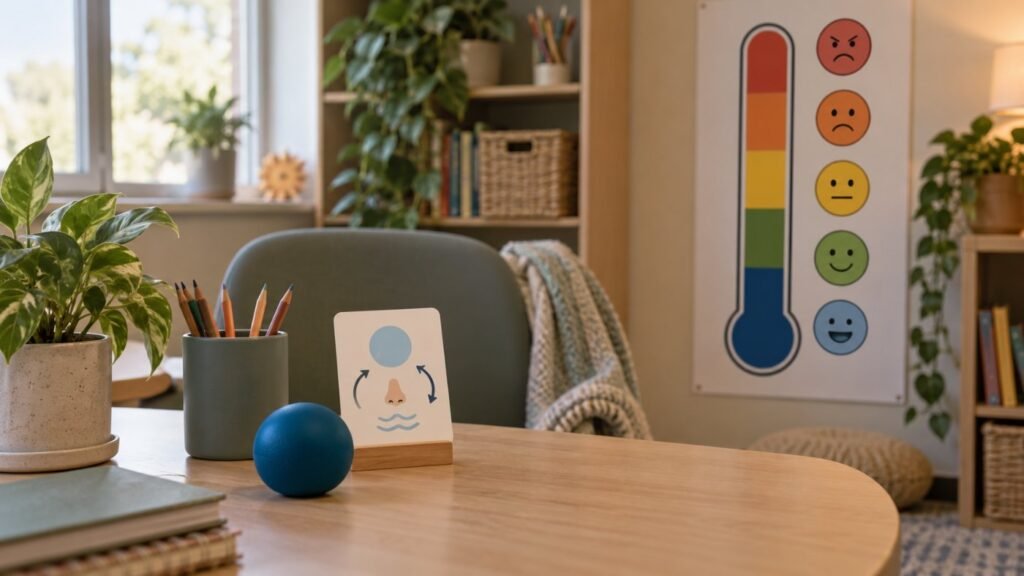
Present level example: “Maya becomes dysregulated about 4 times per day, most often during transitions and loud group work. She currently identifies her feelings with a visual scale in 2 of 10 opportunities with an adult prompt. When an adult offers two calming choices, she uses one in about 40% of episodes and returns to class work within 20 minutes.”
Key point: Measure the tool, not the feeling. “Will use a break card or calming strategy when her scale reaches 3” is teachable and measurable. “Will not get upset” is neither.
Noticing Body Signals and Feelings
Many students, especially autistic and ADHD students, have a hard time noticing internal signals until they are already overwhelmed. Our guide to interoception and emotional regulation explains why this skill comes first.
- By [date], when shown a visual of body signals, [Student] will point to or name one body signal (hot face, tight fists, fast heart) during a check-in in 8 of 10 opportunities.
- By [date], using a 5-point feelings scale, [Student] will identify their current level at 3 scheduled check-ins per day in 80% of opportunities.
- By [date], [Student] will name at least 6 feeling words (calm, worried, frustrated, excited, tired, overwhelmed) using pictures or words in 4 of 5 trials.
- By [date], after a classroom event, [Student] will match a feeling to its likely cause (“I felt frustrated because the work was hard”) with no more than one prompt in 4 of 5 opportunities.
- By [date], [Student] will identify two personal early warning signs of dysregulation with adult support and record them on a personal regulation profile.
- By [date], when an adult says “Check your engine,” [Student] will rate their energy level (low, just right, high) in 8 of 10 opportunities.
- By [date], [Student] will distinguish between small, medium and big problems using a visual problem scale in 4 of 5 scenarios.
Using Calming Strategies
Strategies only work if the student chose them and practiced them while calm. Build a menu together, then write goals for using it.
- By [date], while calm, [Student] will practice two calming strategies (breathing, pushing on the wall, squeezing a fidget) daily with an adult in 4 of 5 school days.
- By [date], when at level 3 or higher on the feelings scale, [Student] will select a strategy from a visual menu of 3 choices with one prompt in 70% of opportunities.
- By [date], [Student] will complete a 3-step breathing routine (smell the flower, blow the candle, repeat 3 times) with a visual cue in 8 of 10 practice trials.
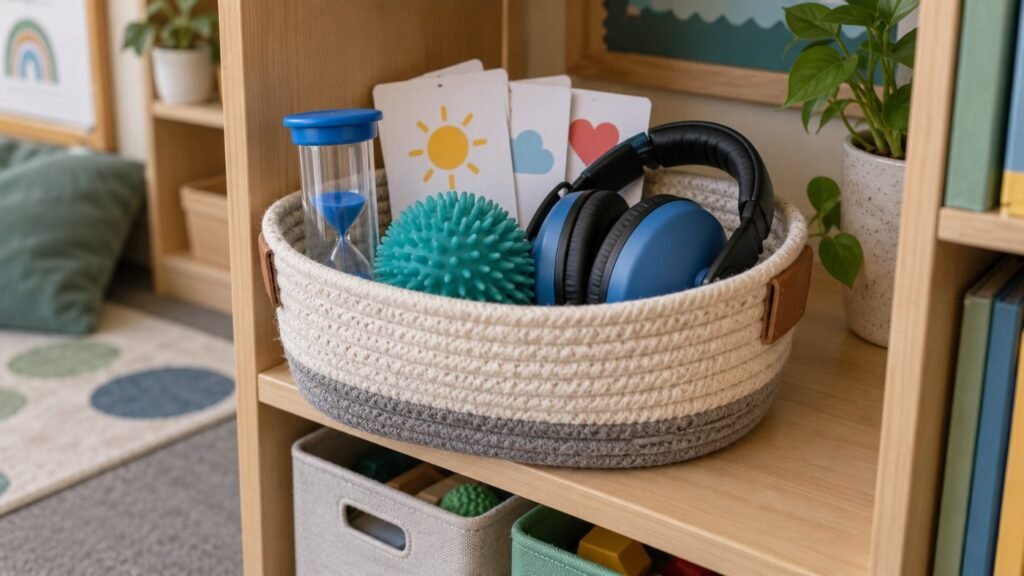
- By [date], [Student] will use a sensory tool from a calm kit for 2 to 5 minutes and then return to the task in 4 of 5 opportunities.
- By [date], [Student] will identify which calming strategies helped most by rating them after use on a simple chart in 80% of episodes.
- By [date], when frustrated by a task, [Student] will use a coping statement (“I can take a break and try again”) aloud or on a card in 3 of 5 opportunities.
- By [date], [Student] will independently use a preferred calming strategy without adult prompts in 60% of observed early warning moments.
Free resource
Emotional Regulation Scripts for Teachers
25 situational scripts for calm, consistent responses in tough moments.
Requesting and Using Breaks
A break request is a powerful replacement for leaving, shutting down or melting down. Pair these goals with sensory breaks in the classroom and a calm corner.
- By [date], [Student] will request a break using a break card, gesture, AAC or words in 8 of 10 opportunities when showing early signs of dysregulation.
- By [date], [Student] will use a timer to take a break of 3 to 5 minutes in the designated calm space and return to the group in 4 of 5 breaks.
- By [date], given a visual break schedule, [Student] will take planned movement breaks at scheduled times with no more than one prompt in 80% of opportunities.
- By [date], [Student] will choose between two break options (walk, calm corner, water) using a choice board in 9 of 10 opportunities.
- By [date], after a break, [Student] will use a re-entry routine (check scale, get materials, start the first step) within 2 minutes in 4 of 5 opportunities.
- By [date], [Student] will decrease adult-prompted breaks and increase self-initiated breaks to at least 50% of all breaks over 4 consecutive weeks.
- By [date], during group or noisy activities, [Student] will request a quieter work space or headphones in 3 of 4 opportunities.
From Co-Regulation to Self-Regulation
Co-regulation is not a crutch. It is the bridge. Write goals that fade support slowly and plan the adult role with our co-regulation strategies for SPED teachers.
- By [date], when an adult models slow breathing and a calm voice, [Student] will join the breathing or calming activity within 1 minute in 4 of 5 episodes.
- By [date], [Student] will accept a co-regulation offer (sitting nearby, a hand signal, quiet counting) from a trusted adult in 80% of escalating moments.
- By [date], with the adult prompt faded from verbal to visual only, [Student] will begin a calming strategy in 3 of 5 opportunities.
- By [date], [Student] will identify two trusted adults at school and use a signal to request their support in 4 of 5 opportunities.
- By [date], [Student] will complete a morning regulation check-in with decreasing adult support, moving from full support to independent in 4 of 5 days.
- By [date], [Student] will follow a personal regulation plan with only one adult reminder in 70% of observed episodes.
- By [date], [Student] will tell an adult what helps them calm down (“I need space” or “Sit with me”) in 4 of 5 opportunities.
Recovery and Repair
Recovery is part of regulation. After a hard moment, the goal is safety and reconnection, not a lecture. Our guide to big emotions in children covers the at-home side.
- By [date], after a period of dysregulation, [Student] will return to a learning activity within 15 minutes in 4 of 5 episodes, decreasing to 10 minutes by the annual review.
- By [date], once calm, [Student] will review what happened using a visual reflection sheet (what I felt, what I did, what I can try) with adult support in 4 of 5 episodes.
- By [date], [Student] will identify one strategy to try next time after a hard moment in 80% of reflection conversations.
- By [date], [Student] will choose a repair action (help clean up, write or draw a note, say sorry when ready) in 3 of 4 situations that affected others.
- By [date], [Student] will rejoin peers using a re-entry phrase or card (“I am ready to come back”) in 4 of 5 opportunities.
- By [date], [Student] will rest, drink water or eat a snack as part of a recovery routine before returning to demands in 80% of episodes.
- By [date], [Student] will accept a reduced task after recovery and complete it in 4 of 5 opportunities.
Self-Monitoring Goals
- By [date], [Student] will rate their regulation level on a self-monitoring card at the end of each class period and match the teacher rating within one point in 80% of periods.
- By [date], [Student] will graph their daily calm-strategy use with adult support and review it weekly in 4 of 5 weeks.
- By [date], [Student] will identify their most challenging time of day using their own data and help plan one support with the team.
- By [date], [Student] will set a weekly regulation goal (for example, “use my break card 3 times”) and self-evaluate on Friday in 4 of 5 weeks.
- By [date], [Student] will use a phone, watch or visual timer reminder to complete self-check-ins in 80% of scheduled times.
- By [date], [Student] will describe their regulation plan to a new adult (substitute, specialist) with visual support in 3 of 4 opportunities.
- By [date], [Student] will participate in their IEP meeting by sharing one regulation strategy that works for them.
The BERMED Goal-Writing Check
- B – Baseline: Do you know how often dysregulation happens, when, and which strategies the student already uses?
- E – Exact skill: Does the goal name one skill (noticing, choosing, requesting, recovering) instead of “will stay calm”?
- R – Realistic: Does the goal fit the student’s nervous system, sensory profile and current support level?
- M – Measurable: Can two adults count it the same way?
- E – Equitable access: Can the student respond with words, cards, gestures or AAC?
- D – Data plan: Who collects data, how often, and when does the team review it?
How to Measure Self-Regulation Progress
| Skill | How to measure | Accommodations to pair |
|---|---|---|
| Noticing feelings | Check-in accuracy on a feelings scale | Visual scale on desk, body signal chart |
| Calming strategies | Percent of episodes with strategy use | Calm kit, strategy menu, practice while calm |
| Break requests | Frequency of self-initiated vs prompted breaks | Break card, calm corner, timer |
| Co-regulation | Prompt level data (full, partial, visual, independent) | Trusted adult, signal system |
| Recovery | Minutes to return to learning | Re-entry routine, reduced task |
| Self-monitoring | Student vs teacher rating match | Self-monitoring card, weekly graph |

Pair these goals with ADHD IEP goals for attention and impulse skills, executive functioning IEP goals for planning and task initiation, and our autistic burnout guide if a student is exhausted rather than dysregulated.
Neuroaffirming tip: Stimming, pacing, hiding under a hood or leaving a loud room can be healthy regulation. Do not write goals to remove these behaviors. Write goals that help the student use them safely and ask for what they need.
What are self-regulation IEP goals?
Self-regulation IEP goals teach a student to notice body signals and feelings, choose a calming strategy, request a break and recover after a hard moment. They focus on teachable skills rather than simply staying calm.
How do you measure self-regulation in an IEP?
Use feelings-scale check-in accuracy, the percent of episodes where a strategy was used, self-initiated versus prompted breaks, prompt level data and the minutes it takes to return to learning.
What is the difference between co-regulation and self-regulation?
Co-regulation is when a calm adult helps a student settle. Self-regulation is when the student does it more independently. Most students need many experiences of co-regulation before self-regulation is possible.
Should a self-regulation goal say the student will not have meltdowns?
No. Meltdowns are a stress response, not a choice. Write goals for early warning skills, break requests and recovery, and reduce triggers through accommodations.
Can self-regulation goals be used for ADHD and autism?
Yes. Self-regulation goals fit many profiles, including ADHD, autism, anxiety and trauma. Personalize the triggers, sensory needs and communication method for each student.
5 Actions to Take This Week
- Collect 5 days of baseline data on when dysregulation happens and what helps.
- Build a calming strategy menu with the student while they are calm.
- Teach one break request method and honor every request at first.
- Choose 2 or 3 goals from this bank and personalize the triggers and supports.
- Plan the adult role: who co-regulates, and how prompts will fade over the year.
Related teaching strategies:
- Self-Monitoring Strategies: 6 Steps
- PBIS in Schools: A Neuroaffirming Guide
Sources

