
Quick answer: Written expression IEP goals target the skills students need to get ideas onto the page: sentence writing, paragraph structure, planning, revising, editing, spelling and handwriting or typing. Good goals separate idea generation from transcription, allow tools like speech to text or graphic organizers, and use a clear rubric or count as the measure. This bank gives you 43 SMART written expression IEP goals by skill and grade, plus present level examples and data tips.
In this goal bank
Writing is one of the most demanding tasks in school. A student has to generate ideas, organize them, choose words, form letters or type, spell, punctuate and review, all at once. When written expression IEP goals target the right part of that process, students make real progress. This bank is part of our IEP Goal Bank series.

How to Write Written Expression IEP Goals
Start by finding where writing breaks down. Is it generating ideas, organizing them, or getting them onto paper? The International Dyslexia Association notes that dysgraphia affects handwriting and spelling, while Understood.org explains that it is about transcription rather than organizing ideas. Read more in dysgraphia in the classroom.
Formula: By [date], given [prompt type] and [support], [Student] will [writing skill] scoring [criterion] on [rubric or count] in [number] of [number] samples.
Present level example: “Given a picture prompt and oral discussion, Sam dictates detailed ideas but independently writes 2 simple sentences with missing capitals and end marks. Handwriting fatigues after 5 minutes.”
Key point: If transcription is the barrier, allow speech to text or typing for composition goals and write a separate goal for handwriting, keyboarding or spelling.
Sentence Writing Goals
- Given a picture prompt, [Student] will write or dictate a complete sentence with a subject and predicate in 4 of 5 trials.
- Given a sentence frame, [Student] will complete 3 sentences with relevant ideas in 4 of 5 trials.
- [Student] will write sentences that begin with a capital letter and end with correct punctuation with 80% accuracy.
- Given two simple sentences, [Student] will combine them using a conjunction (and, but, because, so) in 4 of 5 trials.
- [Student] will expand a simple sentence by adding who, what, when, where or why details in 4 of 5 trials.
- [Student] will use varied sentence beginnings in a 5-sentence piece in 4 of 5 samples.
- Given a topic, [Student] will write a compound or complex sentence with correct punctuation in 4 of 5 trials.
Paragraph and Essay Goals
Elementary
- Given a familiar topic and organizer, [Student] will write a paragraph with a topic sentence, 3 details and a closing sentence in 4 of 5 samples.
- Given a personal narrative prompt, [Student] will write events in sequence using transition words (first, next, then, finally) in 4 of 5 samples.
- Given an opinion prompt, [Student] will state an opinion and give 2 reasons in 4 of 5 samples.
- Given a how-to prompt, [Student] will write 4 ordered steps using clear language in 4 of 5 trials.
Middle and High School
- Given an informational prompt, [Student] will write a multi-paragraph response with an introduction, body paragraphs and conclusion, scoring 3 of 4 on a writing rubric.
- Given a text, [Student] will write an argument with a claim, 2 reasons, evidence and a counterclaim, scoring 3 of 4 on a rubric.
- Given a source, [Student] will paraphrase and cite evidence correctly in 4 of 5 responses.
- Given a constructed response question, [Student] will use the RACE strategy (restate, answer, cite, explain) in 4 of 5 responses.
- Given a narrative prompt, [Student] will include dialogue, description and a clear ending, scoring 3 of 4 on a rubric.
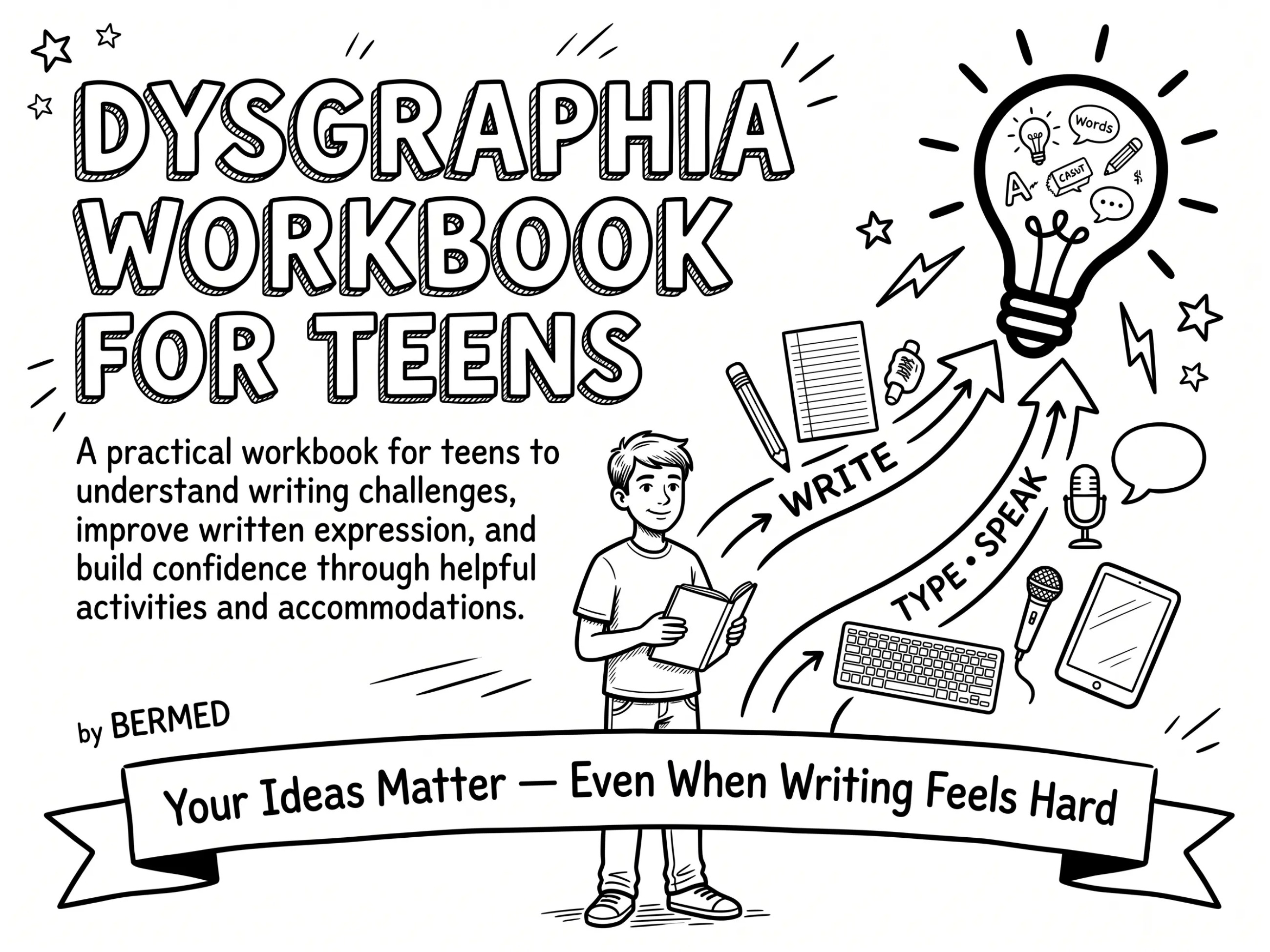
Free resource
Dysgraphia Workbook for Teens
Understand writing challenges and practice strategies that make writing easier.
Planning and Organization Goals
- Given a writing prompt, [Student] will brainstorm at least 3 ideas using a web or list before writing in 4 of 5 tasks.
- [Student] will complete a graphic organizer with a main idea and 3 supporting details before drafting in 4 of 5 tasks.
- Given a writing checklist, [Student] will follow the planning, drafting and revising steps independently in 4 of 5 assignments.
- [Student] will break a writing assignment into steps with due dates using a planner in 4 of 5 assignments.
- [Student] will use an outline to organize a multi-paragraph essay in 4 of 5 assignments.
- [Student] will choose and use a planning tool (organizer, voice notes, mind map) that works for them in 4 of 5 tasks.

Revising and Editing Goals
- Using a COPS or CUPS checklist, [Student] will edit capitalization, organization, punctuation and spelling, correcting 80% of errors.
- [Student] will revise a draft by adding at least 2 descriptive details in 4 of 5 samples.
- [Student] will reread their writing aloud or with text-to-speech to find and fix errors in 4 of 5 samples.
- Given teacher feedback, [Student] will make at least 2 meaningful revisions in 4 of 5 assignments.
- [Student] will replace overused words with more precise vocabulary using a word bank in 4 of 5 samples.
- [Student] will use spell check and grammar check tools appropriately in 4 of 5 typed assignments.
Spelling and Transcription Goals
- Given dictated words with taught spelling patterns, [Student] will spell them with 80% accuracy.
- [Student] will spell 50 high-frequency words correctly in written work with 90% accuracy.
- [Student] will form letters legibly with correct sizing and spacing in 4 of 5 writing samples.
- [Student] will type 15 words per minute with 90% accuracy using correct finger placement.
- [Student] will use speech to text to dictate a paragraph and correct errors in 4 of 5 tasks.
- [Student] will copy a 3-sentence passage with 90% legible letters in 4 of 5 trials.
- Given a word with a known spelling rule, [Student] will apply the rule correctly in 4 of 5 trials.
- [Student] will increase writing stamina from 5 to 15 minutes of sustained writing or typing in 4 of 5 sessions.
The BERMED Goal-Writing Check
- B: Baseline. Do you have a recent writing sample and rubric score?
- E: Exact skill. Ideas, organization, conventions or transcription?
- R: Realistic. Is the target reachable in a year with instruction?
- M: Measurable. Rubric, word count or accuracy percentage?
- E: Equitable access. Are typing and speech to text allowed when appropriate?
- D: Data plan. Monthly writing samples scored with the same rubric.
Data Collection and Accommodations
| Skill | How to measure | Accommodations to pair |
|---|---|---|
| Sentences | Count of complete sentences | Sentence frames, word banks |
| Paragraphs and essays | Writing rubric | Graphic organizers, models |
| Planning | Checklist completion | Planning templates, voice notes |
| Editing | Percent of errors corrected | Editing checklist, text-to-speech |
| Transcription | Legibility, WPM, spelling accuracy | Typing, speech to text, extra time |

Writing relies heavily on planning and memory. See working memory strategies and executive function accommodations. Pair these goals with reading comprehension IEP goals and reading fluency and decoding IEP goals, and check the difference in accommodations vs modifications.
Neuroaffirming tip: Messy handwriting does not mean messy thinking. Let students show their ideas through the tool that works for them, and build transcription skills separately.
What are written expression IEP goals?
They are measurable goals for writing skills such as sentences, paragraphs, planning, revising, editing, spelling and handwriting or typing.
How do you measure written expression IEP goals?
Use a consistent writing rubric, counts of complete sentences or details, percent of errors corrected, or words per minute for typing.
Should students with dysgraphia use speech to text?
Often yes. Speech to text lets students show their ideas while handwriting or typing skills are built through separate goals.
What is a good paragraph writing IEP goal?
Given an organizer, the student will write a paragraph with a topic sentence, 3 details and a closing sentence in 4 of 5 samples.
How many writing goals should an IEP include?
Usually 1 to 3 focused goals, for example one composition goal and one transcription goal, work better than many small goals.
5 Actions to Take This Week
- Collect a writing sample and an oral version of the same idea.
- Score both with the same rubric.
- Decide if the barrier is ideas, organization or transcription.
- Pick 2 goals from this bank and adapt them.
- Allow one access tool like speech to text.
Sources

