Quick answer: Stimming in autistic children means repetitive movements or sounds like hand flapping, rocking, spinning, or humming. It helps children regulate strong emotions and manage sensory input. Most stimming is harmless and should be accepted. Step in only when it causes injury, blocks learning, or leads to bullying, and then offer a safer stim that meets the same need rather than trying to stop it.
In this guide
Your child flaps their hands when their favorite show starts. They rock when the supermarket gets loud. They hum through homework. Maybe a relative has told you to “make them stop.” Before you do, it helps to understand what stimming in autistic children actually does, and why stopping it can backfire.
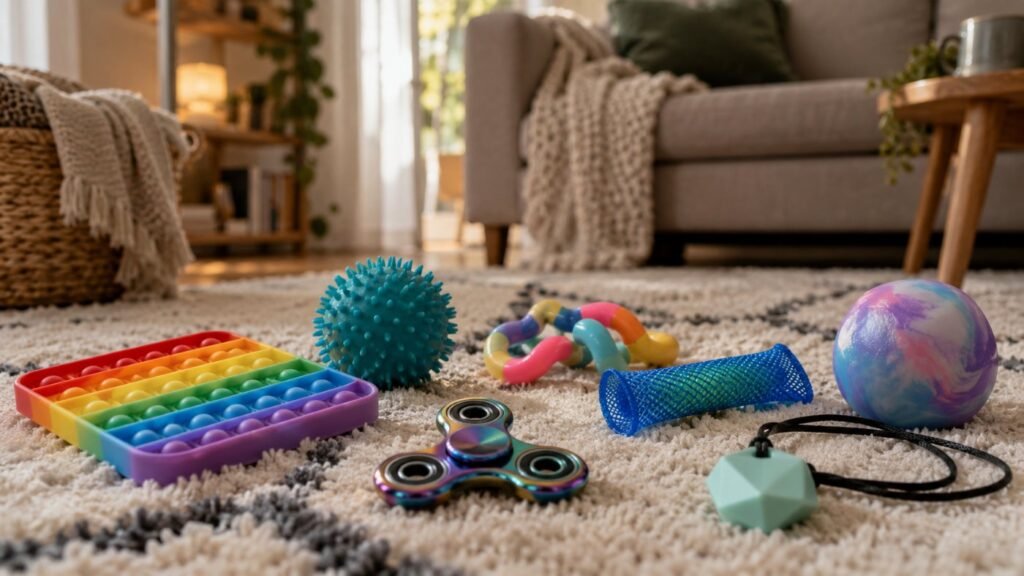
What Is Stimming in Autistic Children?
Stimming, short for self-stimulatory behavior, means repetitive body movements or noises. Raising Children Network, an Australian parenting resource, lists examples like hand flapping, rocking, spinning objects, humming, and repeatedly opening doors. Everyone stims a little, like tapping a pen or bouncing a leg. Autistic children often stim more, and more visibly.
- Movement: flapping, rocking, spinning, jumping, pacing
- Sound: humming, repeating words or sounds. See autism and echolalia.
- Visual: watching spinning objects, lining things up, flicking fingers near eyes
- Touch: rubbing fabrics, tapping, chewing
Why Autistic Children Stim
Stimming has two main jobs:
- Emotional regulation: It helps children cope with anxiety, anger, fear, and excitement. Happy flapping is real.
- Sensory management: A child who is overwhelmed can focus on one steady input. A child who is under-stimulated can get the input they need. Our sensory needs guide explains seeking and avoiding.
Key point: Stimming is a tool, not a symptom to erase. Raising Children Network notes that stopping autistic children from stimming may make them more anxious.
Children who are told to hide stims often learn to mask, which is exhausting over time. Read more in autistic masking.
Common Types of Stimming in Autistic Children
Stimming in autistic children looks different for every child. Some children stim mostly with their hands, others with their voice or whole body. Noticing which type of stimming in autistic children appears in calm moments, and which appears under stress, helps you understand what your child needs. A child who flaps with joy and paces when worried is telling you two different things. If big emotions often end in tears or explosions, our guide to meltdown vs tantrum explains how to tell them apart.
Common Types of Stimming in Autistic Children
Stimming in autistic children looks different for every child. Some children stim mostly with their hands, others with their voice or whole body. Noticing which type of stimming in autistic children appears in calm moments, and which appears under stress, helps you understand what your child needs. A child who flaps with joy and paces when worried is telling you two different things. If big emotions often end in tears or explosions, our guide to meltdown vs tantrum explains how to tell them apart.
When to Step In
| Situation | Example | Response |
|---|---|---|
| Harmless | Flapping, rocking, humming | Accept it. No action needed. |
| Causes injury | Hand biting, head banging | Offer a safe replacement, check for pain or distress, involve OT |
| Blocks learning | Stim takes all attention during a lesson | Adjust the environment, schedule movement breaks |
| Leads to bullying | Peers mock the stim | Address the bullying first, teach acceptance |
A sudden increase in stimming is information. It often means anxiety, sensory overload, illness, or exhaustion is rising. It can be an early sign of a meltdown or autistic burnout.
The BERMED Stim Support Framework
Use this when a stim worries you.
- B: Behavior detective. When does it happen? What came just before?
- E: Emotion or environment. Is it joy, anxiety, noise, boredom?
- R: Respect harmless stims. If no one is hurt, let it be.
- M: Match the need. For a harmful stim, find a safe option with the same sensation.
- E: Environment changes. Reduce noise, add movement, offer a quiet space.
- D: Discuss with your team. An occupational therapist can build a sensory plan.
At Home: Supporting Healthy Stimming
Create a stim-friendly space. A swing, cushions, a trampoline, or a corner with sensory toys gives stims a home.
Offer replacements for harmful stims. Chewy necklaces for biting, a crash pad for head banging, squeeze balls for skin picking.
Watch for patterns. More stimming before school or after parties tells you where support is needed.
Talk about it positively. “Your hands are happy” helps children feel accepted, not broken.

Do
- Accept harmless stims at home and in public
- Notice what stimming tells you about stress
- Offer safe tools for harmful stims
- Teach siblings and relatives about stimming
Avoid
- Saying “quiet hands” or holding hands down
- Punishing or shaming stims
- Removing a stim without replacing its function
- Treating every stim as a problem

In Class: Stimming at School
- Allow fidgets, wobble seats, and movement breaks.
- Teach classmates that stimming is normal and helpful.
- Write sensory supports into the IEP so all staff respond the same way.
- Pair stim supports with a calm corner for overwhelming moments.
A neuroaffirmative view: Many autistic adults say stimming was one of the most helpful tools they had as children, and that being made to stop it was one of the most harmful experiences. Listen to autistic voices when you decide.
What is stimming in autistic children?
Stimming is repetitive movement or sound, such as hand flapping, rocking, spinning, or humming, that autistic children use to regulate emotions and manage sensory input.
Should I stop my autistic child from stimming?
Usually no. Harmless stimming should be accepted. Stopping it can increase anxiety. Step in only if it causes injury, blocks learning, or leads to bullying.
Why does my child stim more sometimes?
More stimming often signals rising anxiety, excitement, sensory overload, illness, or tiredness. It is useful information about how your child is feeling.
What can replace harmful stimming?
Choose a safe option that gives the same sensation, like a chewy necklace for biting, a crash pad for head banging, or a squeeze ball for picking.
Do non-autistic people stim?
Yes. Tapping a pen, bouncing a leg, or twirling hair are all forms of stimming. Autistic people often stim more often and more visibly.
5 Actions to Take This Week
- Write down your child’s stims and when they happen.
- Mark each as harmless or harmful.
- Add one sensory tool or space at home.
- Find one safe replacement for any harmful stim.
- Share your plan with school staff.
Sources