
Quick answer: Lesson planning for special education with mixed-ability groups starts from one shared objective, then plans tiered tasks, supports and IEP goal practice inside the same lesson. Use explicit instruction (I do, we do, you do), group students by need, prepare materials at two or three levels, embed IEP goals into activities and plan quick checks for understanding. A simple weekly template saves hours and keeps instruction aligned with each student’s IEP.
In this guide
In one special education class, you may have a student reading at kindergarten level next to another reading at grade four. Lesson planning for special education must meet all of them without writing ten separate lessons.
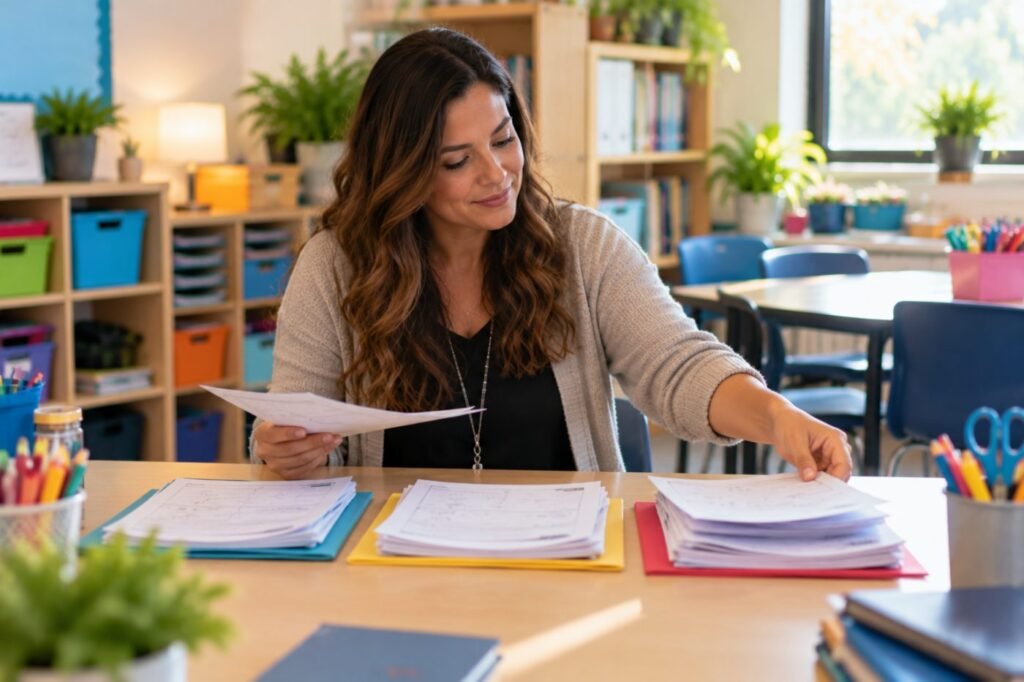
A Lesson Planning Template
| Section | What to write |
|---|---|
| Objective | One student-friendly goal for the group |
| IEP goals addressed | Student initials and goal focus |
| Warm-up | Review of a previous skill, 5 minutes |
| I do | Model with think-aloud |
| We do | Guided practice with prompts |
| You do | Tiered independent practice |
| Check | Exit task or quick probe |
| Data | Which goals to record today |
This follows explicit instruction, a core instructional high-leverage practice (IRIS Center).
Key point: Keep one objective and vary the path: materials, support level and response mode.
Tiering One Lesson
Objective: identify the main idea

Embedding IEP Goals
| IEP goal | Embedded during |
|---|---|
| Request help using a card | Independent practice |
| Write a complete sentence | Exit task |
| Answer wh- questions | Read-aloud discussion |
| Stay on task for 10 minutes | You do section with a timer |
Break complex tasks into steps with task analysis, and remember the difference between accommodations vs modifications.
Saving Planning Time
- Use the same lesson structure every day.
- Plan weekly by skill, not daily from scratch.
- Adapt existing curricula instead of creating everything.
- Create reusable task boxes for independent work.
- Share planning with co-teachers and paras.
Planning note to a para
“This week in math, your station practices counting by 5s with the tier 2 cards. Mark correct answers for Ava and Jon on the data sheet.”

Real-Life Example
Case story
Ms. Ford spent every evening writing separate plans for eight students. She switched to one weekly template with three tiers per objective and a column for IEP goals. Her planning time dropped from 8 hours a week to 3, and her data showed more goal practice than before.
Related: See special education classroom schedule and collaborating with general education teachers.
Lesson Planning for Special Education FAQ
How do I plan for very different levels?
Keep one objective and tier materials, supports and responses.
Do I need to write formal lesson plans?
Follow district rules; a simple weekly template is often enough.
How do I include IEP goals?
List them on the plan and embed practice in activities.
Should I use the general curriculum?
Yes, adapted to students’ levels, to support access to grade-level content.
How long should lessons be?
Short segments of 10 to 20 minutes work well for many students.
In short: Lesson planning for special education works with one objective, tiered tasks and embedded IEP goals. This article is part of our New Special Education Teacher series.
Was this article helpful?
Tap a star to rate
Sources
- IRIS Center. High-Leverage Practices
- 34 CFR 300.320. Definition of Individualized Education Program
- IRIS Center. Classroom Behavior Management (Part 1)
This article is educational and does not replace district guidance.

