
Quick answer: Classroom management in special education rests on proactive structure: predictable routines, a few clear rules taught like academic skills, visual supports, high rates of behavior-specific praise (about 4 positive statements for every correction), meaningful reinforcement and calm, consistent responses to problem behavior. When behavior persists, use data and a functional behavior assessment to understand its purpose and teach a replacement skill.
In this guide
Classroom management in special education is not about control. It is about creating a space where students feel safe, know what to expect and have the skills to succeed. Most behavior challenges shrink when structure, relationships and teaching come first.

Proactive Foundations
| Strategy | What it looks like |
|---|---|
| Routines | Taught step by step and practiced daily |
| Rules | 3 to 5 positive rules with pictures |
| Visual schedules | Class and individual |
| Choice making | “Pencil or marker?” to build cooperation |
| Precorrection | Reminding the expected behavior before transitions |
| Active supervision | Moving, scanning, interacting |
IRIS Center lists behavior-specific praise, criterion-specific rewards, choice making, rules, contingent instructions and group contingencies as proactive strategies (IRIS Center).
Key point: Teach expected behavior like any other skill: model, practice, give feedback and review often.
Praise and Reinforcement
Behavior-specific praise names exactly what the student did well. A general guideline is 4 praise statements for every reprimand (Vanderbilt Kennedy Center).
| Vague | Behavior-specific |
|---|---|
| “Good job!” | “You started your work right away, Lila.” |
| “Nice.” | “Thanks for using your break card, Omar.” |
| “Be good.” | “Walk with hands at your sides, like this.” |
For a structured system, see token economy in special education.

Responding to Behavior
Calm response ladder
Contingent instruction example
“Sam, stop tapping the desk and put your hands in your lap. Thank you. Now let’s finish number three together.”
For escalated situations, use de-escalation scripts for teachers.
When More Is Needed
- Collect ABC data for two weeks.
- Look for patterns: time, task, people, setting.
- Request a functional behavior assessment.
- Teach a replacement behavior that meets the same need.
- Write or update behavior goals in the IEP.
Real-Life Example
Case story
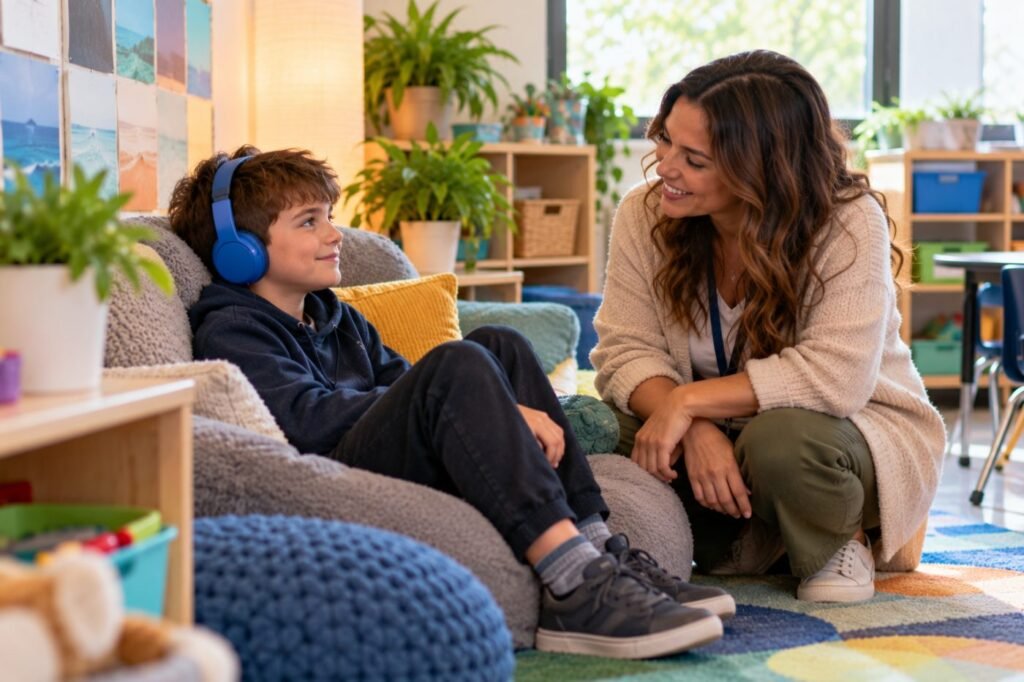
Ms. Ward’s class had frequent outbursts during math. She tracked her praise and found she gave one praise for every three corrections. She set a goal of 4 to 1, added choice of materials and taught a break routine. Within three weeks, outbursts fell from daily to once a week.
Related: Read special education classroom setup and behavior IEP goals.
Classroom Management in Special Education FAQ
What is the best classroom management strategy in special education?
Predictable routines combined with high rates of specific praise and reinforcement.
Are behavior charts effective?
Public color charts can shame students; private, positive systems work better.
How many rules should I have?
Three to five, stated positively.
What if nothing works?
Collect data and request an FBA to understand the behavior’s function.
How do I stay calm?
Use scripts, breathe and remember behavior is communication.
In short: Classroom management in special education is proactive, positive and data-driven. This article is part of our New Special Education Teacher series.
Was this article helpful?
Tap a star to rate
Sources
- IRIS Center. Encouraging Appropriate Behavior
- Vanderbilt Kennedy Center. Behavior-Specific Praise
- IRIS Center. Classroom Behavior Management (Part 1)
This article is educational and does not replace district guidance.

