
In This Article
- What Is Executive Function, Exactly?
- Why Executive Function Matters So Much for Neurodivergent Kids and Adults
- The Core Executive Function Skills, Explained Simply
- What Executive Dysfunction Actually Looks Like
- Is Executive Function the Same as Intelligence?
- Quick Glossary
- Frequently Asked Questions
- What to Do Next
A third-grade teacher hands out a two-step worksheet: color the shapes, then cut them out. Within ninety seconds, half the class is cutting. One student is still staring at the crayon box, not because she does not understand the instructions, but because her brain cannot hold both steps at once while also filtering out the pencil sharpener noise across the room. The common mistake is assuming this student is not trying hard enough. What is actually happening has a name, and it has nothing to do with effort: executive function.
Most parents and even many teachers first hear the term “executive function” attached to a diagnosis, usually ADHD, and assume it only applies there. That assumption causes real harm, because autistic students, students with dyslexia, students with anxiety, and plenty of neurotypical students with no diagnosis at all can also have significant executive function gaps. This guide breaks down what executive function actually is, why it matters so much across school, home, and adult life, and what to do about it starting today.
What Is Executive Function, Exactly?
Executive function refers to the set of mental processes housed largely in the brain’s frontal lobe that let a person hold a goal in mind, plan the steps to reach it, resist distractions along the way, and adjust course when something changes. Harvard’s Center on the Developing Child compares it to an air traffic control system: dozens of planes (thoughts, tasks, distractions) arriving and departing at once, and something has to manage the runway.
Two researchers shaped how the field talks about this today. Psychologist Russell Barkley groups executive function into a small set of self-regulation skills built around response inhibition. Psychologist Thomas Brown describes it instead as six interacting clusters, from activation and focus to emotional regulation and memory. Both models agree on the core point: executive function is what activates, organizes, integrates, and manages every other brain function, and when it is weak, everything downstream gets harder, even when the underlying skill or knowledge is fully there.
Executive function is also developmental, not fixed. Research on adolescent brain development shows the prefrontal cortex, the region most responsible for planning and impulse control, is the last part of the brain to mature, typically continuing to develop into the mid-twenties. That single fact reframes a lot of classroom and household conflict: the twelve-year-old forgetting his lunch for the third week in a row is not choosing carelessness. His control tower is still under construction.
Why Executive Function Matters So Much for Neurodivergent Kids and Adults
Executive function is the connective tissue between what a person knows and what a person does. A student can know how to write a five-paragraph essay and still be unable to start one, because starting requires task initiation, an executive skill, not a writing skill. An adult can know exactly how important a bill deadline is and still miss it, because holding a future date in mind while managing the present is a working-memory task, not a values problem.
For neurodivergent people, this gap between knowing and doing is frequently the single biggest source of conflict at school, at home, and at work, more than the core traits of the diagnosis itself. It is also where the most damage happens to self-esteem, because executive dysfunction looks, from the outside, exactly like not caring.
Free resource
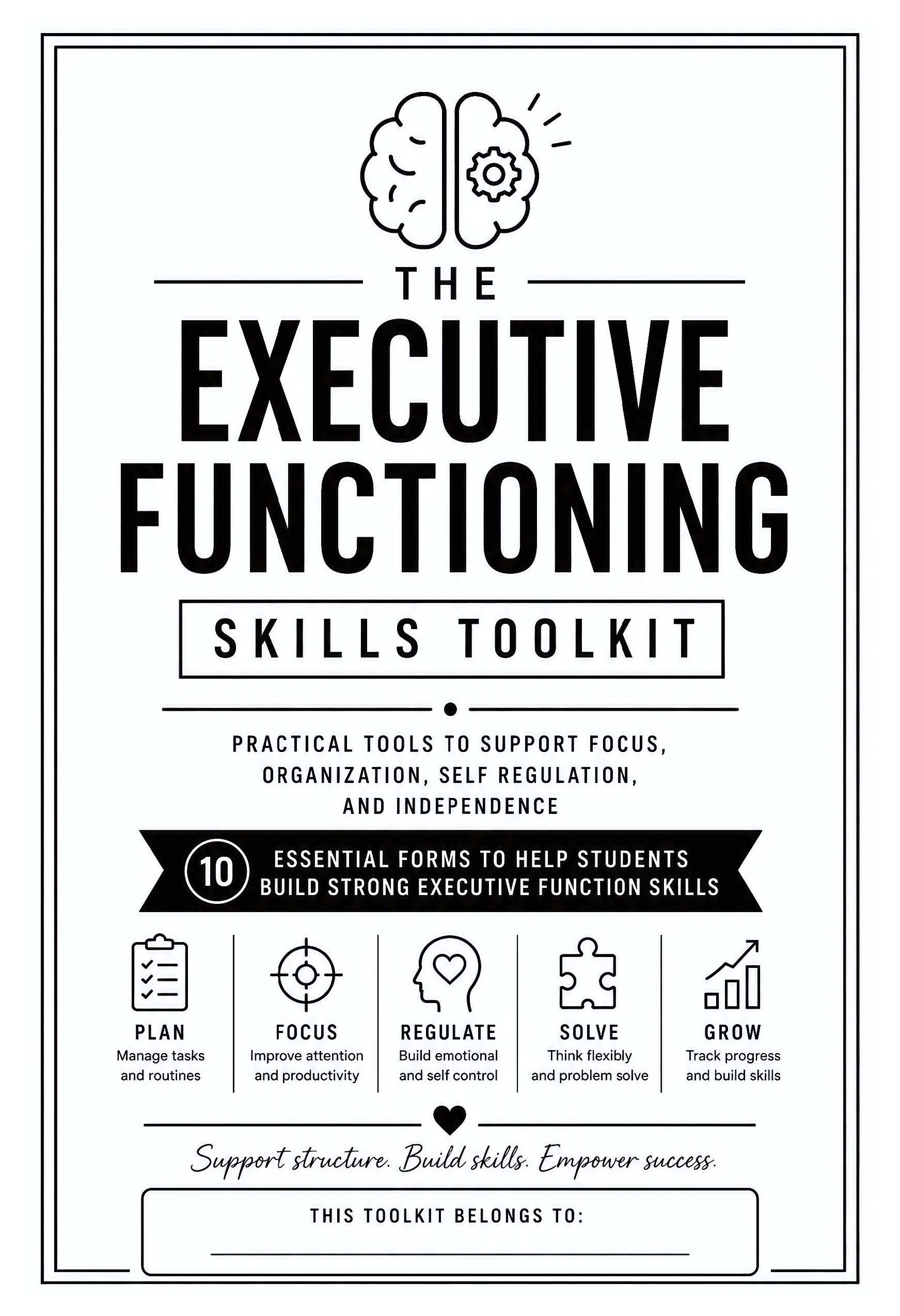
Executive Functioning Skills Toolkit
10 printable tools to help students plan, focus, start tasks and stay organized.
Download free →The Core Executive Function Skills, Explained Simply
Rather than treating executive function as one vague thing, it helps to name the individual skills so a teacher, parent, or clinician can pinpoint exactly where the breakdown happens. The BERMED EF Support Map below organizes the most commonly cited skills alongside what a breakdown in each one actually looks like day to day, plus one starting support for each.
| Executive Skill | What It Does | What a Gap Looks Like | One Starting Support |
|---|---|---|---|
| Task Initiation | Starting a task without excessive delay | Freezing, procrastinating, needing repeated prompts to begin | A visible “first step only” card, not the whole task list |
| Working Memory | Holding information in mind while using it | Forgetting the second half of instructions, losing the thread mid-task | Written or visual instructions, never oral-only |
| Inhibitory Control | Pausing before reacting or blurting | Impulsive answers, interrupting, difficulty waiting a turn | A pre-agreed nonverbal signal instead of a verbal correction |
| Cognitive Flexibility | Shifting between tasks or ideas | Meltdowns at transitions, rigid insistence on one approach | A 5-minute and 1-minute warning before every transition |
| Planning & Organization | Sequencing steps toward a goal | Losing materials, missing deadlines, not knowing where to start a project | A externalized checklist the student checks off, not one held in memory |
| Emotional Regulation | Managing the size of a reaction to a trigger | Reactions that seem disproportionate to the trigger | A named “reset” routine practiced when calm, not mid-crisis |
Notice what is missing from every row above: intelligence. A student can be gifted in every one of these skills except one, and that single gap can be enough to derail an entire school day. This is also why executive function accommodations are almost never about making work easier academically. If you support a student with these gaps directly, our complete classroom guide to executive function accommodations for IEP students lays out more than thirty ready-to-use strategies mapped to each skill above.
What Executive Dysfunction Actually Looks Like
Executive function gaps do not stay inside the classroom walls. They follow a person into the bedroom, the car, and eventually the workplace, just wearing different clothes.
In Class
A teacher sees a student who cannot get started on independent work, loses handouts within minutes of receiving them, or seems to “space out” during multi-step directions. This is frequently misread as inattention or defiance rather than an executive function gap. Chunking assignments, posting visual schedules, and building in checkpoints are among the highest-impact, lowest-cost supports a classroom can offer, and they belong in every 504 or IEP addressing this area. For the full accommodation list organized by category, see the complete 504 accommodations list for ADHD, most of which target executive skills directly.
At Home
Morning and evening routines are where executive dysfunction shows up most visibly at home. A child who can recite the bedtime routine perfectly may still be unable to execute it without support, because reciting a sequence and performing it under real-world distraction are two different executive demands. Families managing this daily can find structured, printable systems in our 504 accommodation bank for ADHD, built around the same domains covered above.
Life (Teens and Adults)
Executive function gaps do not disappear at graduation. They resurface as missed work deadlines, chronic lateness, difficulty managing a household budget, or burnout from constantly compensating for a system that was never built to support this brain. Adults who suspect undiagnosed executive dysfunction, especially those managing ADHD or AuDHD traits into adulthood, often benefit from structured external systems rather than willpower-based fixes. Our adult ADHD daily systems guide offers 30 printable routines built specifically around this reality.
Is Executive Function the Same as Intelligence?
No, and this is the misconception that causes the most harm. Executive function and intelligence are measured differently, develop somewhat independently, and can be mismatched in either direction. A student can test in the gifted range and still have a significant executive function deficit; another student with average or below-average testing scores can have excellent executive function and compensate well. CHADD describes executive function and ADHD as “close cousins, not twins”, and the same logic applies to intelligence: related, frequently confused, but not the same construct. Treating an executive function gap as a motivation or intelligence problem is one of the most frequent errors families and educators make, and it is usually the fastest way to damage a student’s confidence without solving anything.
Frequent error to avoid: Do not respond to an executive function gap with more consequences alone. Consequences assume the student is choosing not to comply. If the actual barrier is task initiation or working memory, punishment removes the emotional safety needed to build the missing skill, without ever teaching the skill itself.
Quick Glossary
- Executive function
- The set of brain-based skills that manage attention, planning, working memory, and self-control in service of a goal.
- Executive dysfunction
- A noticeable, persistent gap in one or more executive skills that interferes with daily functioning.
- Task initiation
- The executive skill responsible for starting a task without excessive delay or avoidance.
- Working memory
- The ability to hold information in mind and actively use it, distinct from long-term memory storage.
- Cognitive flexibility
- The capacity to shift attention or strategy when a task, rule, or situation changes.
Frequently Asked Questions
Can executive function improve over time?
Yes. Executive function skills can be taught and strengthened at any age through explicit, repeated practice paired with external supports, though the pace and ceiling vary by individual and by how much scaffolding is removed too early.
Is weak executive function always a sign of ADHD?
No. Executive function gaps appear across ADHD, autism, AuDHD, anxiety, learning disabilities, and in some people with no diagnosis at all. A gap in this area is a signal to investigate further, not a diagnosis by itself.
What is the difference between executive function and self-regulation?
Self-regulation, particularly emotional regulation, is generally considered one component within the broader executive function system, alongside working memory, planning, and cognitive flexibility, rather than a separate, unrelated skill.
Can an IEP or 504 plan address executive function specifically?
Yes. Executive functioning is a recognized service and accommodation category under IDEA and Section 504, and goals or accommodations can target skills like task initiation, organization, and working memory directly rather than only academic content.
What to Do Next
Understanding executive function is only useful if it changes what happens tomorrow morning. Here is where to start.
- Today: Pick one task that consistently causes conflict, and identify which single executive skill from the table above is actually the barrier, not the surface behavior.
- Today: Replace one oral, multi-step instruction with a written or visual one, and watch whether compliance changes without any consequence involved.
- This week: If you are a teacher, review whether current accommodations target the academic content or the executive skill, using the executive function accommodations guide as a checklist.
- This week: If ADHD traits are also present, consider the free ADHD screening quiz to get a clearer picture of which subscale is driving the pattern.
- Long term: Build external systems, not willpower, into every routine that repeatedly fails, and revisit IEP or 504 goals to make sure at least one targets executive function directly rather than academic output alone.
Sources
- CHADD. “Executive Function Skills.” chadd.org, 2026.
- CHADD. “Executive Function Issues and ADHD: Twins or Cousins?” chadd.org, 2022.
- Center on the Developing Child, Harvard University. “Building the Brain’s ‘Air Traffic Control’ System: How Early Experiences Shape the Development of Executive Function.” Working Paper 11, developingchild.harvard.edu, 2011.
- National Center for Biotechnology Information. “Adolescent Brain Development in Normality and Psychopathology.” PMC, National Institutes of Health.
Continue with the full series: read our complete Executive Function guide, a step-by-step series of in-depth articles, or browse all IEPfocus guides.