Ask a special education teacher what actually exhausts them by November, and it is rarely the meetings themselves. It is rewriting the same accommodation list for the third time this month. It is scrolling through old emails to remember what was promised to a parent in September. It is opening four different documents to prepare for one thirty-minute IEP meeting.
The common mistake is treating this as a time-management problem that willpower will eventually fix. It is not. It is a systems problem. Research on special educator burnout consistently points to administrative workload and role stress, not classroom instruction itself, as the strongest predictors of exhaustion. A planner will not remove a single legal requirement from your caseload. What it can do is stop you from doing the same organizational work over and over, which is where most of the wasted hours actually live.
Why Paperwork, Not Teaching, Is the Real Workload Problem
General classroom teachers plan lessons and manage a shared calendar. Special education case managers do that too, and on top of it, they carry legal responsibility for every IEP on their caseload: annual reviews, re-evaluations, goal progress, accommodation implementation, and a documented paper trail of parent communication for every single student. None of that disappears because a teacher is tired. It just gets shuffled between whatever notebook, spreadsheet, or sticky note is closest at hand, which is exactly what turns a manageable caseload into a constant, low-grade sense of falling behind.
For the legal side of what these responsibilities actually require, see our companion guide on what an IEP is and how it functions in schools.
How the IEP Planner 2026-2027 Is Built to Cut the Busywork
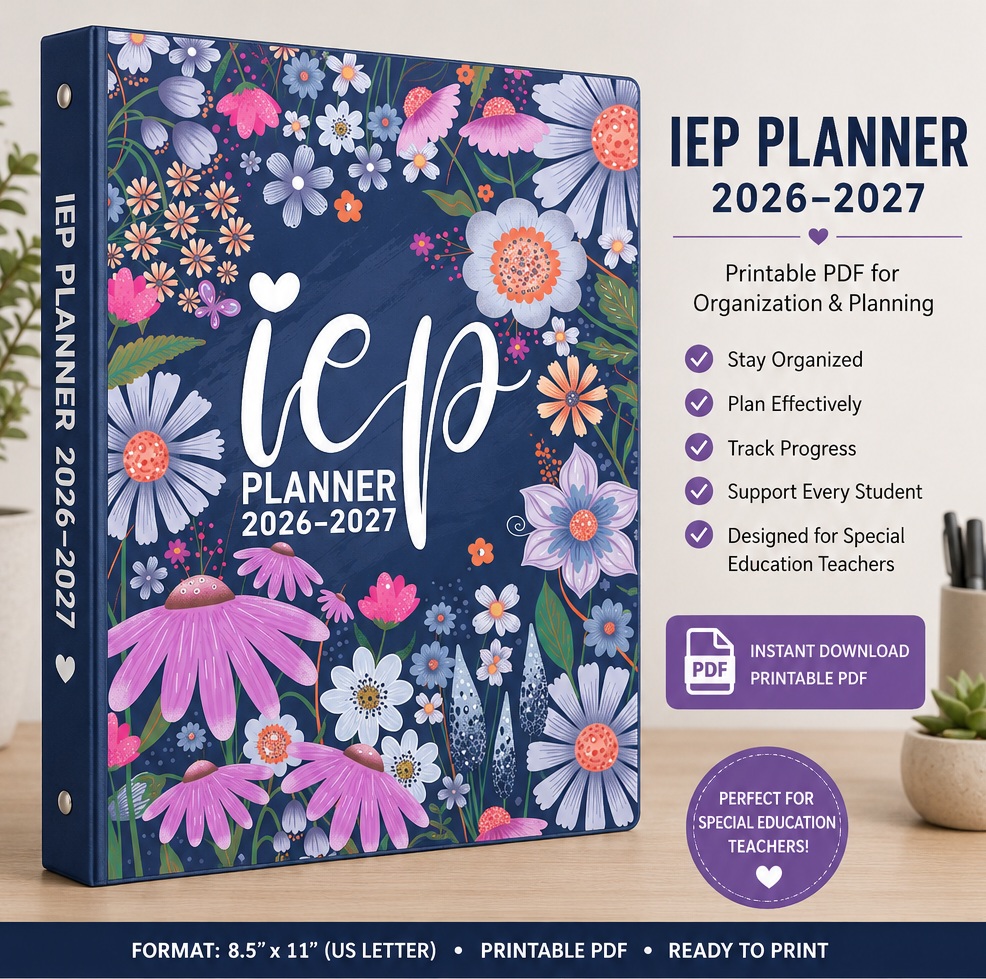
The IEP Planner 2026-2027 is a 251-page PDF designed around one idea: every piece of information a case manager needs during the school year should live in a predictable, dedicated place, not scattered across separate systems that all need updating separately.
For goal-writing support that pairs directly with the IEP Goals Tracker, see our IEP Goal Bank guide, covering measurable, neuroaffirming goal language across disability categories.
In the Classroom, Concretely
It is Tuesday morning and a parent stops a case manager in the hallway to ask about her son’s reading accommodations. Without a system, that means promising to “check and get back to her,” then spending part of lunch searching a shared drive for the right document.
With the IEP Snapshot and Assignment and Accommodation Tracker in one planner, the answer is on a single page: current accommodations, last progress note, and the date they were last discussed with the family. The conversation happens in the hallway, in under two minutes, and nothing gets added to the evening to-do list.
When to Set This Up
If you are already re-explaining the same case to yourself every week, the time you lose searching for information is costing you more than the time it takes to set up a system.
Before your next round of fall IEP meetings, fill in all 30 student sections so every accommodation and deadline is visible from the start.
Log parent contact and goal progress weekly, not just before a meeting. The workload reduction only holds if the habit does.
Stop rebuilding your caseload tracking from memory every week. See the full IEP Planner 2026-2027.
View the IEP Planner in the IEPfocus Shop →Frequently Asked Questions
What to Do Next
- Open the product preview in the IEPfocus Shop and check the table of contents before deciding if it fits your caseload.
- If it fits, get the IEP Planner 2026-2027 and fill in your 30 student sections before your first fall meeting.
- Log your very next parent conversation directly into the Parent Engagement Log, to build the habit early instead of retrofitting it in October.
- Mark your closest annual review and re-evaluation dates first, since those carry the hardest compliance consequences.
- Set a five-minute weekly check-in with the IEP Goals Tracker, so progress data never has to be reconstructed from memory before a meeting.
Sources
RAND Corporation. “State of the American Teacher Survey, 2025.” rand.org, 2025.
Brunsting, N. C., Morin, L. E., Gómez, L. R., Jones, B., Bettini, E., Cumming, M. M., Garwood, J. D., & Ruble, L. A. “Burnout and Occupational Wellbeing of Special Education Teachers: Recent Research Synthesized.” Review of Educational Research, 2026.
U.S. Department of Education, Office of Special Education Programs. “About IDEA.” sites.ed.gov/idea/about-idea, 2026.