This ADHD test adapts to who is taking it: a teacher screening a student, a parent screening a child, or an adult screening themselves. Instead of a single score, it separates inattentive traits from hyperactive-impulsive traits, the same way clinicians categorize ADHD presentations, so your result names an actual pattern instead of just a number. Pick your track below to start.
The Mistake Every Flat-Score ADHD Test Makes
Most online ADHD tests add up your answers into one number, then hand you a single verdict: low, medium, or high risk. That approach throws away the most useful information the test collected.
ADHD is not one pattern, it is at least two that can show up together or apart. Clinicians describe three presentations: predominantly inattentive, predominantly hyperactive-impulsive, and combined. A student who never leaves her seat but cannot retain instructions has a completely different profile than the student climbing the bookshelf, yet a flat-score test would file them under the same “moderate” result. That is exactly how the quiet, inattentive presentation, more common in girls according to CDC data, keeps getting missed for years.
The test below fixes that by scoring two dimensions separately and naming the pattern that actually matches your answers.
Take the Test: Choose Your Track
Answer based on the last six months, comparing to same-age peers rather than an idealized standard. Each track has 12 core questions plus 3 short context questions that sharpen the result, and takes about three minutes. This is a screening tool, not a diagnosis.
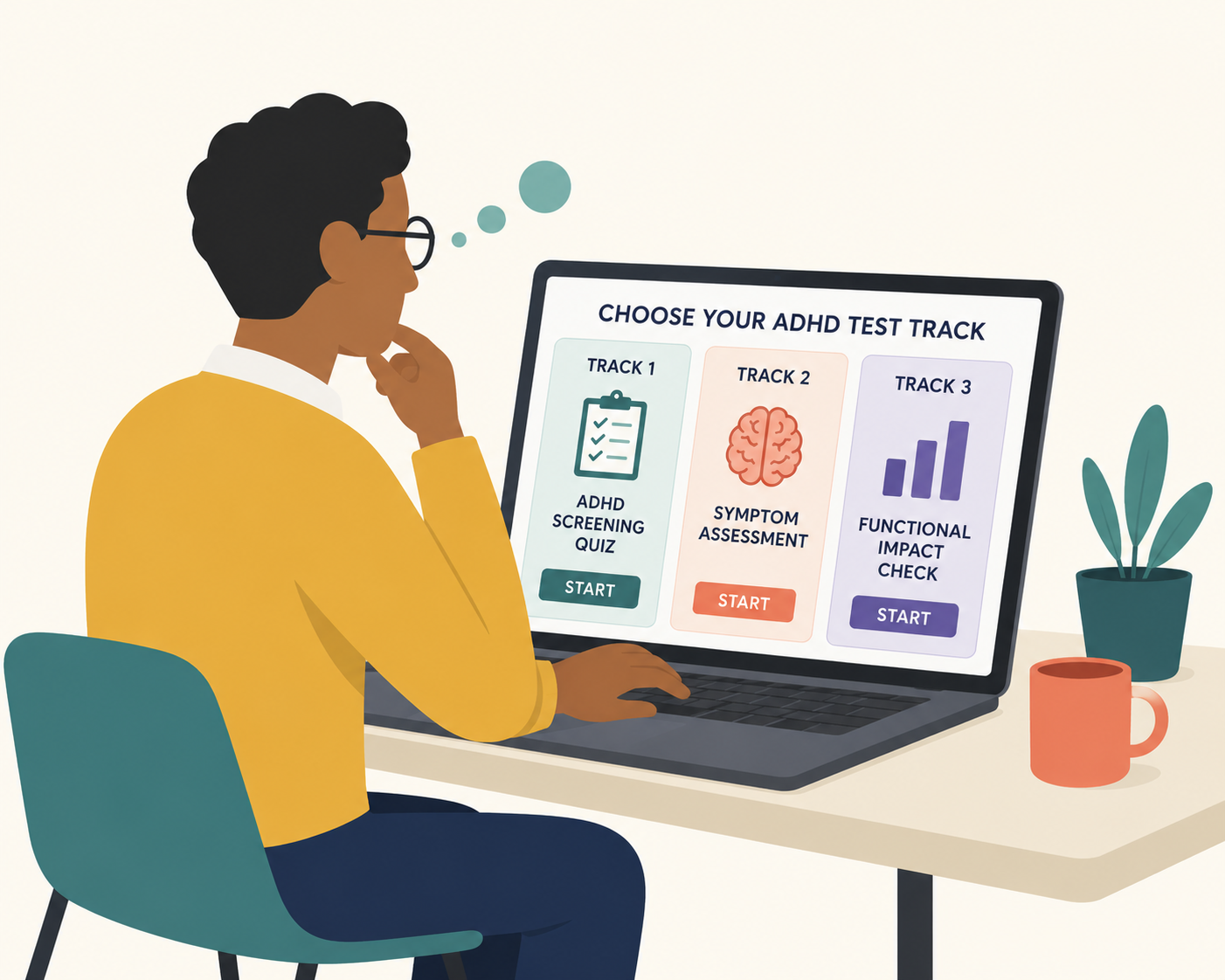
Answer based on the last six months. Choose your track, then answer 12 core questions plus 3 short context questions. It takes about three minutes. Your result names a real pattern and a priority level. This is a screening tool, not a diagnosis.
Free resource
ADHD School Success Workbook
Hands-on activities that build focus, organization and self-confidence at school.
Download free →How to Read Your Result
The test scores two dimensions separately, each out of 18: inattentive traits (difficulty sustaining focus, organizing, remembering) and hyperactive-impulsive traits (restlessness, interrupting, acting before thinking). That gives you a base pattern, the same logic clinicians use to categorize ADHD presentations.
The test then checks three context factors that any real clinical screening also weighs, because symptom count alone is not enough to judge a pattern: duration (has this been going on 6 months or more, not just a rough patch), setting (does it show up in more than one context, not just one classroom or one relationship), and impairment (how much it actually gets in the way day to day). Two people can score the same symptom pattern and still need different next steps once duration, setting, and impairment are factored in, which is exactly why your result includes all three.
The Four Patterns Explained
| Pattern | What it means | Suggested action |
|---|---|---|
| Few traits | Both dimensions score low | No action needed, revisit if things change |
| Predominantly inattentive | Inattentive score elevated, hyperactive-impulsive low | Easy to overlook, document specific examples over 2–3 weeks |
| Predominantly hyperactive-impulsive | Hyperactive-impulsive score elevated, inattentive low | Usually noticed fast, document across settings before acting |
| Combined | Both dimensions elevated | Document both patterns and begin a referral or evaluation conversation |
What Each Pattern Looks Like in Real Life
In class: A sixth-grader turns in half her assignments, always apologetic, never disruptive. Her teacher almost misses her because she scores high on inattentive items and near zero on hyperactive-impulsive ones, the exact profile a flat-score checklist tends to bury in the “moderate” middle.
At home: A nine-year-old builds Lego sets for an hour but cannot get through a five-step morning routine without meltdowns. He scores high on both dimensions, a combined pattern, which is also the profile most likely to get mistaken for defiance instead of a regulation difficulty.
In life: A marketing manager has never missed a deadline, but only because of an exhausting private system of alarms and last-minute all-nighters. She scores high on inattentive traits alone, decades after the same pattern went unnoticed in her report cards, a common story for women according to research on ADHD and hormones.
What To Do Next, By Urgency
Today: Save your result and write down two or three specific recent examples tied to your highest-scoring items, whichever dimension they fall under.
This week: Compare notes across settings. Teachers should check with a co-teacher or paraprofessional; parents should ask the classroom teacher; adults should ask a parent or old friend about childhood patterns, since a diagnosis requires evidence the traits were present before age twelve.
Long term: If the pattern holds and is elevated in either or both dimensions, start a referral conversation. For students, that means your school’s support team; for children, your pediatrician; for adults, a primary care doctor or psychiatrist who can refer you for a full evaluation. If demand-triggered meltdowns are the bigger concern rather than attention itself, see our guide on PDA and ADHD overlap before pursuing an ADHD-specific evaluation. For classroom strategies you can use while that process unfolds, see managing hyperactivity in the classroom. If ADHD doesn’t feel like the right area to be screening at all, our broader neurodivergence quiz for children also covers autism and AuDHD traits.
Frequently Asked Questions
How does the ADHD test work?
Choose your track, teacher, parent, or adult, then answer 12 core questions as never, sometimes, often, or very often, followed by 3 short context questions about duration, setting, and impact. The test scores inattentive and hyperactive-impulsive traits separately, then factors in those three context answers the way a real clinical screening would, before naming your pattern and a priority level. No email or sign-up required.
What do I do with my results?
Save your two subscale scores, the pattern that was named, and the priority level shown. Read any context notes under your result, they explain exactly why the priority was set that way. Then write down two or three specific recent examples tied to your highest-scoring items and use the “What To Do Next, By Urgency” section above.
How long does the ADHD test take?
About three minutes. Each track has 12 core questions plus 3 context questions, and your full result, including the priority level, appears immediately after the last question.
Is this test suitable for children?
Children should not take it themselves. Use the parent track and answer based on what you observe, since young children generally cannot self-report attention and impulsivity accurately.
Can this test diagnose ADHD?
No. Only a licensed physician, psychiatrist, or psychologist can diagnose ADHD, using standardized instruments and a full clinical interview. This test is a starting point for that conversation, not a substitute for it.
Why does the result separate two scores instead of giving one number?
Because a single number hides which presentation you’re dealing with. Two people can land on the same total score for completely different reasons, one from inattention, one from hyperactivity-impulsivity, and they need different next steps.
What if I score high on one dimension but low on the other?
That is a predominantly inattentive or predominantly hyperactive-impulsive pattern, both valid ADHD presentations. The inattentive pattern is the one most often missed, since it rarely disrupts a classroom or a household the way hyperactivity does.
Does the same 12-question structure work for a child and an adult?
The two underlying dimensions, inattention and hyperactivity-impulsivity, stay the same across ages, but how they look changes. That’s why each track uses different, age-appropriate wording for the same core traits rather than reusing one generic question set.
What does the priority label (Low priority, Monitor, Act soon) actually mean?
It combines your symptom pattern with three context factors: whether the traits have lasted 6 months or more, whether they show up in more than one setting, and how much they actually interfere with daily life. The same symptom count gets a more cautious label when it’s recent and setting-specific than when it’s confirmed across settings and time, because that’s closer to how a real evaluation weighs the evidence.
Your Next Steps
- Choose your track and take the two-minute test.
- Save your subscale result, not just the total, and note which pattern it named.
- Write down two or three specific examples tied to your highest-scoring items.
- Cross-check with another setting or another adult who knows the person well.
- If the pattern is elevated and consistent, start the referral conversation that matches your track.
Sources
- Centers for Disease Control and Prevention, Data and Statistics on ADHD, 2024.
- National Institute of Mental Health, Attention-Deficit/Hyperactivity Disorder statistics.
- CHADD, ADHD overview and resources.
This test is an educational screening tool and does not diagnose ADHD or any other condition. If you have concerns, consult a licensed physician or mental health professional.