
Quick answer: Assistive technology in the IEP must be considered for every student: IDEA lists it as one of the special factors the IEP team reviews at each meeting. When the team decides a student needs assistive technology, the IEP should name the type of tool, where and when it is used, the services and training needed, and whether the device goes home. Assistive technology can appear in accommodations, goals, related services and supplementary aids, and it is provided at no cost to the family.
In this guide
Many IEPs include a single checkbox: “Assistive technology considered: no.” That box often hides a missed opportunity. Writing assistive technology in the IEP clearly makes sure the tool is actually available, used and supported every day.

The Consideration Step
IDEA requires the IEP team to consider whether the child needs assistive technology devices and services as one of the special factors (CPIR). The 2024 federal guidance repeats that teams must consider AT for every child (OSEP Dear Colleague letter, 2024).
Four possible outcomes of AT consideration
Key point: “Considered” should mean a real discussion with data, not a checkbox.
Where Assistive Technology Goes in the IEP
| IEP section | Example |
|---|---|
| Special factors | “Student requires AT for reading and writing.” |
| Accommodations | Text-to-speech for all classwork and tests except decoding assessments |
| Annual goals | “Will use speech-to-text to write a 5-sentence paragraph with 80% accuracy.” |
| Related services | AT consultation, 30 minutes monthly |
| Supplementary aids | Tablet with communication app in all settings |
| Supports for staff | Training for teachers on the device |

How to Write Assistive Technology in the IEP Clearly
- Name the function, not just a brand: “text-to-speech software” rather than one app only.
- State where: all classes, tests, homework, home.
- State when: daily, for assignments over one page, for all tests.
- Include training for the student, staff and family.
- Add a goal for learning to use the tool independently.
- Plan how progress and use will be measured.
Sample IEP wording
“Student will have access to text-to-speech software on a school-provided device for all reading tasks over one paragraph in all classes, on assignments and assessments, except when decoding is being measured. Staff will receive 1 hour of training by October 15.”
Assistive Technology at Home
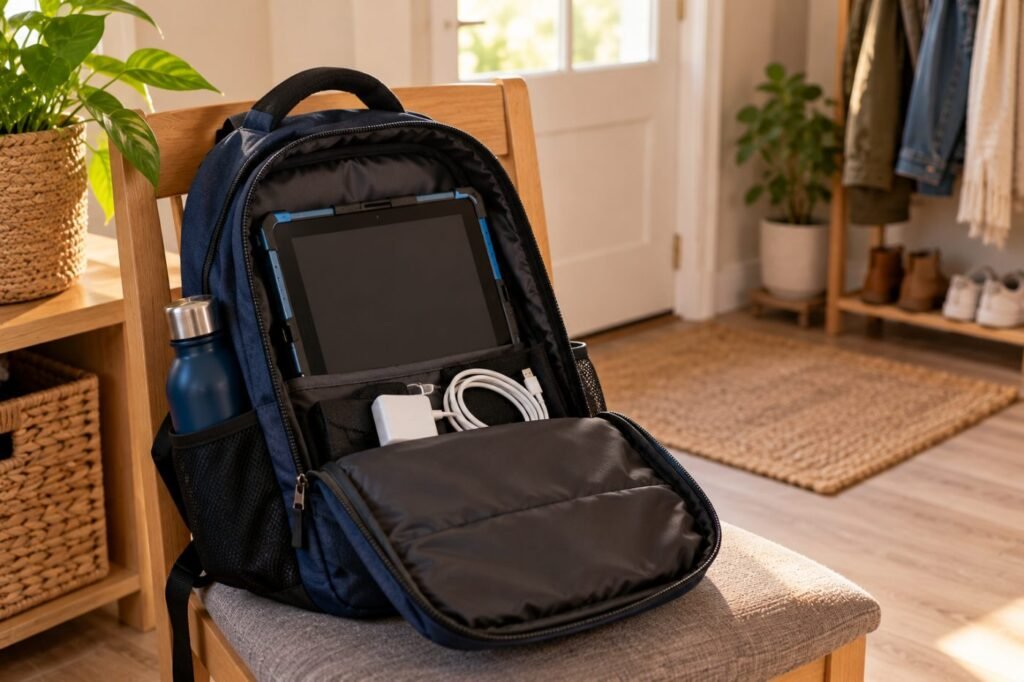
IDEA requires schools to allow use of school-purchased devices at home, on a case-by-case basis, when the IEP team decides the child needs it to receive a free appropriate public education (34 CFR 300.105(b)). Wrightslaw recommends requesting this in writing and making sure the decision is recorded in the IEP (Wrightslaw). Learn more in assistive technology at home.
Real-Life Example
Case story
Zoe, 9, uses an AAC app at school, but her IEP only said “AAC device available.” The tablet stayed in the resource room, and Zoe could not communicate at lunch or at home. Her parents asked for clearer wording. The new IEP stated that the device goes with Zoe to all settings including home, that staff model on it daily, and that the family receives training. Zoe began asking for snacks and greeting friends with her device within weeks.
Tip: Assistive technology often works best as an accommodation that is also taught as a skill. See accommodations vs modifications.
Assistive Technology in the IEP FAQ
Must the IEP team consider assistive technology?
Yes. It is a required special factor for every student with an IEP.
Should the IEP name a specific app?
It is usually better to describe the features needed, so the tool can be updated without a new IEP.
Can the device go home?
Yes, if the IEP team decides it is needed for FAPE.
Who trains staff and families?
Training is an AT service and should be listed in the IEP.
What if the school says AT is too expensive?
Cost cannot be the reason to deny needed AT when it is required for FAPE.
In short: Assistive technology in the IEP must be considered every year and written clearly: what, where, when, who trains and how it is measured. This article is part of our Assistive Technology series.
Was this article helpful?
Tap a star to rate
Sources
- Center for Parent Information and Resources. Special Factors in IEP Development
- OSEP and OET (2024). Dear Colleague Letter on Assistive Technology
- IDEA Regulations, 34 CFR 300.105
- Wrightslaw. Can We Bring My Daughter’s AT Device Home?
This article is educational and does not replace legal advice.

