
Quick answer: Fine motor IEP goals build the small hand movements a student needs for school: grasping a pencil, forming letters, cutting, managing fasteners, using classroom tools and typing. Strong goals target function, like legible writing or opening a lunch container, and are paired with accommodations such as pencil grips, slant boards and keyboarding. Below are 42 SMART fine motor and handwriting IEP goals organized by skill, with present level examples and data ideas.
In this goal bank
A student who presses so hard the pencil breaks, avoids writing, or takes twice as long to copy from the board may be working against weak fine motor skills. Understood explains that fine motor skills involve the small muscles of the hands and wrists and affect tasks like writing, buttoning and using scissors. Fine motor IEP goals help occupational therapists and teachers target the exact skills a student needs, while accommodations reduce the load in the meantime. If handwriting is the main barrier, also read our guide to dysgraphia in the classroom and see our complete IEP goal bank.
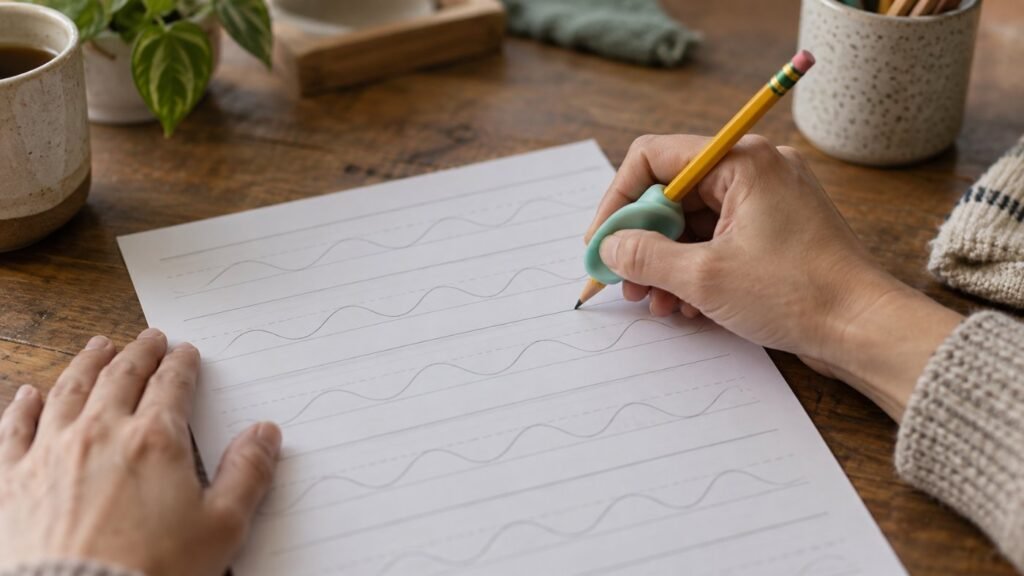
How to Write Fine Motor IEP Goals
Formula: By [date], during [classroom task], given [tool or accommodation], [Student] will [fine motor skill] with [accuracy, legibility or speed criterion] in [number] of [trials] as measured by [OT data, work samples or checklist].
Present level example: “Ethan, a 2nd grader, uses a fisted grasp and tires after 3 minutes of writing. He forms 14 of 26 lowercase letters correctly from memory. When copying a sentence, 50% of his words are readable to an unfamiliar reader. He cuts within 1 inch of a straight line and needs help opening his lunch containers.”
Key point: Aim for functional legibility, meaning another person can read it, rather than perfect letters. Pair handwriting goals with keyboarding or speech-to-text so writing never blocks learning.
Grasp and Hand Strength
- By [date], [Student] will hold a pencil using a functional grasp (tripod or quadrupod) with a pencil grip for 5 minutes of writing in 4 of 5 observations.
- By [date], [Student] will complete a 3-minute hand warm-up (putty, finger exercises) before writing in 4 of 5 sessions.
- By [date], [Student] will use appropriate pencil pressure, without tearing paper or making marks too light to read, in 80% of writing tasks.
- By [date], [Student] will pick up and place 10 small objects (beads, pegs) using a pincer grasp within 1 minute in 4 of 5 trials.
- By [date], [Student] will use clothespins or tongs to transfer 10 items with each hand in 4 of 5 trials.
- By [date], [Student] will stabilize paper with the non-dominant hand while writing in 80% of observations.
- By [date], [Student] will increase writing endurance from 3 to 10 minutes with one movement break in 4 of 5 opportunities.
Letter Formation and Legibility
- By [date], [Student] will correctly form 24 of 26 lowercase letters from memory with correct starting points in 4 of 5 trials.
- By [date], [Student] will correctly form all 26 uppercase letters when dictated in 4 of 5 trials.
- By [date], [Student] will write their first and last name legibly on assignments in 90% of opportunities.
- By [date], [Student] will write a sentence that is 80% legible to an unfamiliar reader in 4 of 5 work samples.
- By [date], [Student] will form numbers 0 to 9 correctly with no reversals in 4 of 5 trials.
- By [date], [Student] will use a self-check list (starting point, size, spacing) to correct letter errors in 3 of 4 writing tasks.
- By [date], [Student] will write 5 cursive letters connected correctly in 4 of 5 trials.
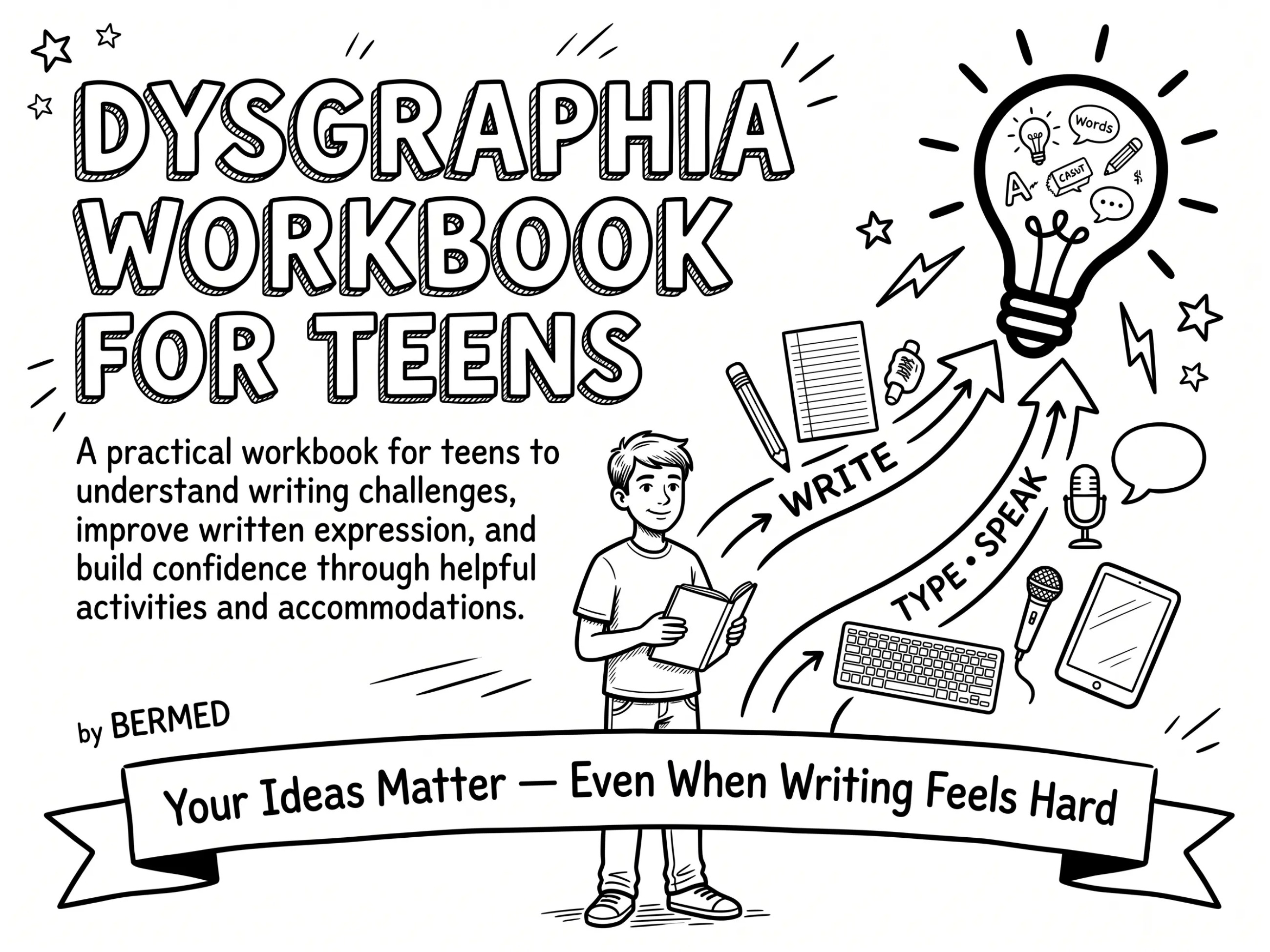
Free resource
Dysgraphia Workbook for Teens
Understand writing challenges and practice strategies that make writing easier.
Spacing, Sizing and Copying
- By [date], [Student] will use a spacing tool or finger space between words in 80% of words in a written sentence.
- By [date], [Student] will write letters that stay within the lines of adapted paper in 80% of letters across 3 work samples.
- By [date], [Student] will size tall, short and tail letters correctly on highlighted paper in 4 of 5 trials.
- By [date], [Student] will copy a 2-sentence passage from a near-point model with 90% accuracy in 4 of 5 trials.
- By [date], [Student] will copy information from the board with 80% accuracy using a printed copy as backup in 4 of 5 opportunities.
- By [date], [Student] will align numbers in columns for math problems using graph paper in 80% of problems.
- By [date], [Student] will complete a writing task on a slant board with improved legibility in 4 of 5 sessions.
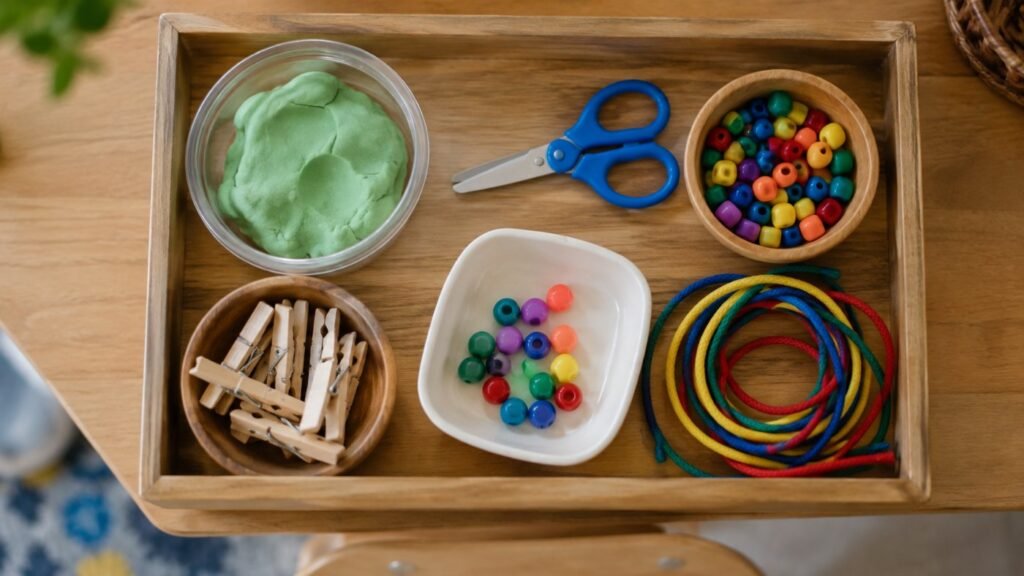
Cutting and Classroom Tools
- By [date], [Student] will cut along a straight 6-inch line within 1/4 inch in 4 of 5 trials.
- By [date], [Student] will cut out a simple shape (circle, square) within 1/4 inch of the line in 4 of 5 trials.
- By [date], [Student] will use a glue stick to apply glue and attach paper neatly in 4 of 5 craft tasks.
- By [date], [Student] will use a ruler to draw a straight line in 4 of 5 trials.
- By [date], [Student] will color within the lines of a simple picture with 80% accuracy in 4 of 5 trials.
- By [date], [Student] will open and close classroom materials (marker caps, folders, binder rings) independently in 80% of opportunities.
- By [date], [Student] will fold a paper in half with edges aligned in 4 of 5 trials.
Functional Fine Motor Tasks
- By [date], [Student] will open lunch containers, milk cartons and snack bags independently in 4 of 5 lunch periods.
- By [date], [Student] will zip a jacket independently in 4 of 5 opportunities.
- By [date], [Student] will button 3 medium buttons within 1 minute in 4 of 5 trials.
- By [date], [Student] will tie shoelaces using a visual sequence in 3 of 4 trials.
- By [date], [Student] will manage a backpack zipper and organize materials inside in 4 of 5 opportunities.
- By [date], [Student] will use a fork and spoon to eat lunch with minimal spills in 80% of observations.
- By [date], [Student] will turn individual book pages without tearing in 4 of 5 opportunities.
Keyboarding and Assistive Technology
- By [date], [Student] will type 15 words per minute with 90% accuracy using home row keys in 4 of 5 timed trials.
- By [date], [Student] will use speech-to-text to compose a paragraph of 5 sentences in 3 of 4 opportunities.
- By [date], [Student] will use word prediction software to complete writing assignments in 80% of opportunities.
- By [date], [Student] will log in and open a word processing document independently in 4 of 5 opportunities.
- By [date], [Student] will use a tablet stylus or finger to complete digital worksheets in 4 of 5 opportunities.
- By [date], [Student] will choose between handwriting, typing or speech-to-text based on the task in 3 of 4 opportunities.
- By [date], [Student] will use keyboard shortcuts (copy, paste, undo) in 4 of 5 opportunities.
The BERMED Goal-Writing Check
- B – Baseline: Do you have OT data and work samples showing grasp, legibility and speed?
- E – Exact skill: Does the goal name one skill, such as letter formation or cutting?
- R – Realistic: Is the criterion functional legibility, not perfect handwriting?
- M – Measurable: Can two adults score it the same way using a rubric or checklist?
- E – Equitable access: Can the student also type or dictate so writing never blocks learning?
- D – Data plan: Who collects work samples, how often, and when does the team review?
How to Measure Fine Motor IEP Goals
| Skill | How to measure | Accommodations to pair |
|---|---|---|
| Grasp and strength | OT observation, endurance minutes | Pencil grips, warm-ups, breaks |
| Letter formation | Letters correct out of 26 | Letter models, multisensory practice |
| Legibility | Percent of words readable | Adapted paper, slant board |
| Copying | Accuracy on near and far point tasks | Printed notes, reduced copying |
| Cutting and tools | Distance from line, task completion | Adapted scissors, thicker lines |
| Keyboarding | Words per minute and accuracy | Typing program, speech-to-text |

Pair these goals with written expression IEP goals for composing ideas, follow occupational therapy recommendations for home practice, and review accommodations vs modifications to plan supports.
Neuroaffirming tip: Messy handwriting is not laziness. Many autistic, ADHD and dyspraxic students work very hard to write. Protect their energy by offering typing or dictation for content-heavy work and saving handwriting practice for short, focused sessions.
What are fine motor IEP goals?
Fine motor IEP goals target small hand movements needed for school, such as pencil grasp, letter formation, cutting, managing fasteners and typing.
Who writes fine motor IEP goals?
Occupational therapists usually write fine motor goals with input from teachers and families. Teachers help practice the skills during class activities.
How do you measure handwriting goals?
Use work samples scored for letter formation, legibility to an unfamiliar reader, spacing and sizing, plus writing speed and endurance.
Should a student with poor handwriting learn to type?
Yes. Keyboarding and speech-to-text help students show what they know. Many teams work on both handwriting and typing at the same time.
What accommodations help with fine motor challenges?
Common supports include pencil grips, slant boards, adapted paper, printed notes, reduced copying, extra time, keyboarding and speech-to-text.
5 Actions to Take This Week
- Collect 3 work samples showing typical handwriting and copying.
- Ask the OT for current grasp, strength and legibility data.
- Try one tool, such as a pencil grip or slant board, and note the difference.
- Offer typing or speech-to-text for one longer assignment.
- Choose 2 or 3 goals from this bank and set up a simple work sample log.
Sources

