Table of Contents

The most powerful regulation tool in your classroom is not a fidget, a timer or a chart. It is your own nervous system. Students read your voice, your face and your body long before they process your words, and a dysregulated student will match whatever you bring.
This guide explains co-regulation strategies for special education teachers, paraprofessionals and support staff: what co-regulation is, why it matters so much for autistic, ADHD and trauma-affected students, and exactly what to say and do before, during and after a hard moment.
What Is Co-Regulation?
Think of self-regulation as a skill students learn by experiencing it with someone else, many times over. A baby is soothed by a parent long before it can soothe itself. Many neurodivergent students are still building this skill at school age, especially under sensory load or stress.
Free resource
Emotional Regulation Scripts for Teachers
25 situational scripts for calm, consistent responses in tough moments.
Why Co-Regulation Strategies Matter in Special Education
Autistic and ADHD students often process sensory input more intensely, as the National Autistic Society explains, and they may need more support to recover from stress. Students who have experienced trauma may read neutral faces or loud voices as threats. For all of them, rules and consequences rarely work in the middle of dysregulation. Co-regulation does, because it speaks to the nervous system first.
The 3 Pillars of Co-Regulation
Rosanbalm and Murray describe three ways adults provide co-regulation. Here is how they look in a SPED classroom.
Scroll to see full table
| Pillar | What it means | In the classroom |
|---|---|---|
| Warm relationship | A caring, responsive connection | Greet each student, notice good moments, repair after conflict |
| Structured environment | Predictable, supportive surroundings | Visual schedules, warnings before transitions, a calm space |
| Skill coaching | Teaching and modeling regulation skills | Name feelings, breathe together, practice calming tools when calm |
The BERMED Lend-Your-Calm Method: 5 Steps
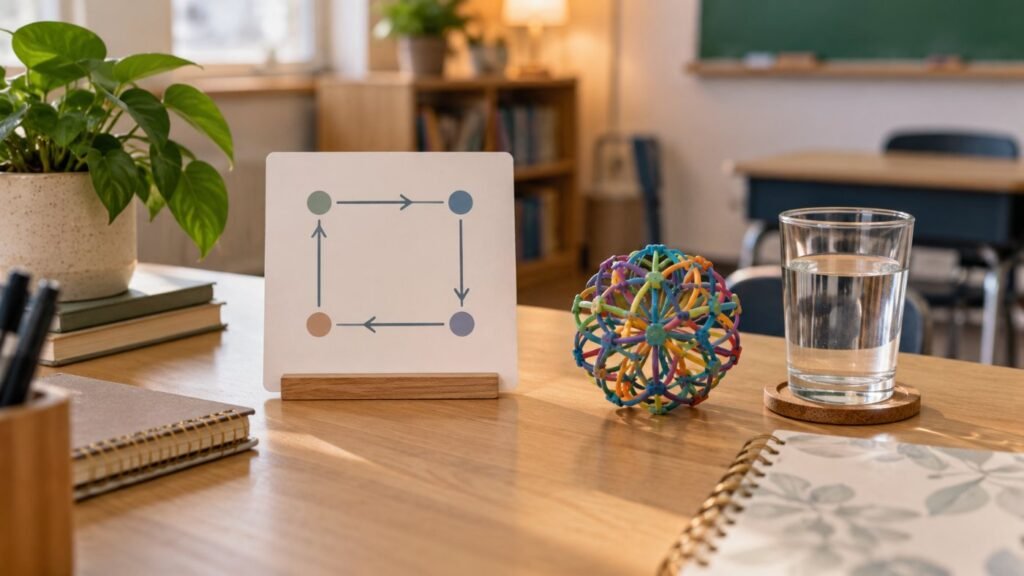
The Lend-Your-Calm Method
Five co-regulation strategies to use in order when a student starts to escalate. The goal is connection first, correction later.
Check Yourself
Notice your own heart rate and tone. Take one slow breath before you move toward the student.
Get Low and Slow
Lower your body, your voice and your pace. Stand at an angle instead of face-to-face.
Name, Don’t Blame
“You look frustrated. That task is hard.” Naming the feeling helps the student feel understood.
Offer One Calming Option
“Do you want to breathe with me or take your break card?” One or two choices, never a list.
Stay Until It Passes
Remain nearby and quiet. Return to the task only when the student’s body has settled.
What to Say and Do
A classroom guide from the Mental Health Technology Transfer Center Network lists self-awareness, attunement, self-soothing, regular feelings talk and modeling self-regulation as core co-regulation practices for teachers.
Do This
- “I’m here. You’re safe.”
- “Let’s breathe together.”
- Use fewer words, more pauses
- Match their level, physically
- Offer water or a break
- Repair later, kindly
Avoid This
- “Calm down.”
- Raising your voice to be heard
- Standing over the student
- Arguing about the rule
- Many questions at once
- Consequences mid-crisis
For tested phrases, see our list of de-escalation scripts for teachers. If a student is already in a full meltdown, our guide to autistic meltdowns in the classroom explains what to do next.
Co-Regulation Strategies by Age
- Early elementary: physical closeness (if welcome), simple feeling words, visual calming steps, lots of modeling.
- Upper elementary: feelings check-ins, choice of calming tool, short private reflection after.
- Middle and high school: respect for privacy, side-by-side conversations, collaborative problem-solving, more autonomy.
The OPRE brief stresses that co-regulation remains important into young adulthood. It changes shape, but it does not disappear.
Building a Team Co-Regulation Plan
Consistency across adults is what turns co-regulation strategies into progress. Agree as a team on each student’s early signs, the calming options that work, the exact words you will use, and who steps in if the first adult is dysregulated.

A calm corner in the classroom and a behavior de-escalation log make the plan visible and easy to track.
In Class, At Home and in Life
IN CLASS
Write co-regulation into the IEP as an accommodation: access to a trusted adult, regulation breaks and a calm space. Pair it with a self-regulation goal that grows over time.
AT HOME
Share your plan with families. When adults at home and school use the same calm words and tools, students learn faster.
LIFE
Every successful co-regulation moment is a rehearsal for self-regulation. Over time, students start to say the calm words to themselves.
Frequently Asked Questions About Co-Regulation Strategies
What is co-regulation in the classroom?
Co-regulation is the process in which a calm, caring adult helps a student manage emotions and behavior through relationship, a predictable environment and coaching. It comes before self-regulation and helps build it.
What is the difference between co-regulation and self-regulation?
Self-regulation is managing your own emotions and behavior. Co-regulation is getting help from someone else to do that. Students learn self-regulation through many repeated experiences of co-regulation.
What are examples of co-regulation strategies?
Lowering your voice, slowing your movements, naming the feeling, offering a choice, breathing together, sitting nearby in silence and giving a predictable routine are all co-regulation strategies.
Do older students still need co-regulation?
Yes. Co-regulation changes with age but remains important through adolescence and young adulthood. Teens may need less physical closeness and more respectful problem-solving and autonomy.
How do teachers co-regulate when they are stressed themselves?
Start with your own regulation: a slow breath, a short pause or a tag-out with another adult. You cannot lend calm you do not have, so planning for your own stress is part of the strategy.
5 Actions You Can Take This Week
- Notice your own stress signals. Pick one breath or pause routine for yourself.
- Choose two calm phrases. Use them with every student.
- Practice breathing together. Once a day, when everyone is calm.
- Map one student’s early signs. Share them with your team.
- Plan a tag-out. Decide who steps in when you need a break.
Sources
- Rosanbalm, K. D., & Murray, D. W. (2017). Caregiver Co-Regulation Across Development: A Practice Brief. OPRE, Administration for Children and Families. acf.gov
- MHTTC Network and NCSMH (2021). Classroom Strategies to Support Students Experiencing Distress. education.ne.gov
- National Autistic Society. Autism and sensory processing. autism.org.uk
- Child Mind Institute. How to De-Escalate an Autistic Meltdown. childmind.org