Table of Contents
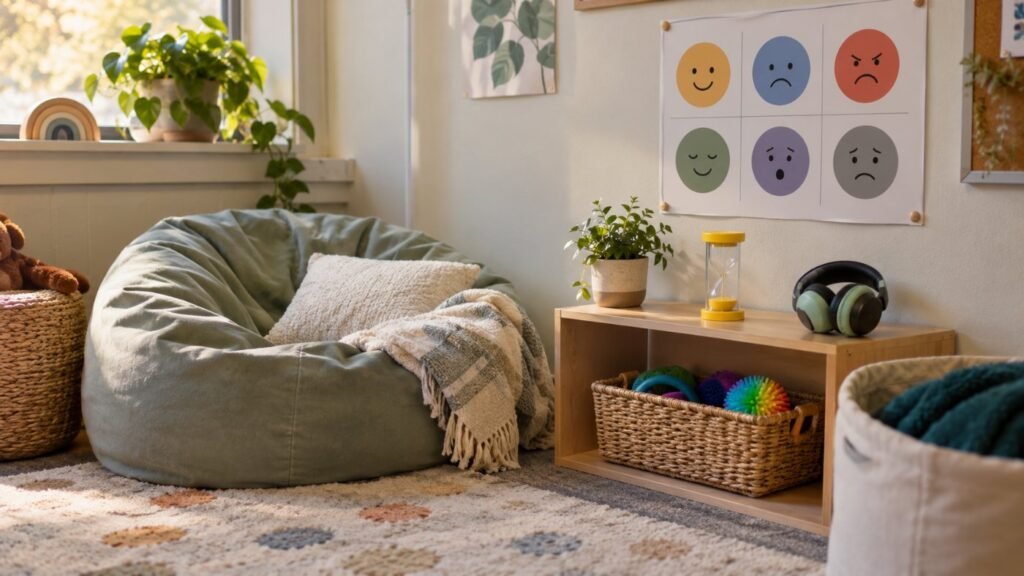
The best time to use a calm corner is before a student thinks they need it. Most calm corners fail not because the idea is wrong, but because students only meet the space in the middle of a crisis, when they can no longer learn anything new.
This guide walks you through setting up a calm corner in the classroom step by step: where to put it, what to include, how to teach it, and how to keep it from turning into a hiding place or a punishment. It is written for special education and general education teachers, from preschool to middle school.
Why a Calm Corner in the Classroom Works
A calm corner gives students a place to reduce input and reset their nervous system without leaving the room. Stepping in early matters: the Child Mind Institute notes that removing triggers in the earliest stages can stop a meltdown from escalating. Schools are also studying these spaces more formally, such as a 2024 evaluation of “Peace Spaces” in a middle school that looked at how teachers perceived them and how students used them.
Free resource
Emotional Regulation Scripts for Teachers
25 situational scripts for calm, consistent responses in tough moments.
Where to Put Your Calm Corner
- Away from traffic: not next to the door, the pencil sharpener or the sink.
- Still visible to you: you should be able to see the student from where you teach.
- Partly enclosed: a bookshelf, a tent or a curtain gives a sense of privacy.
- Lower stimulation: away from bright windows, speakers and busy walls.
- Small: room for one student at a time keeps it calm and fair.
What to Put in a Calm Corner
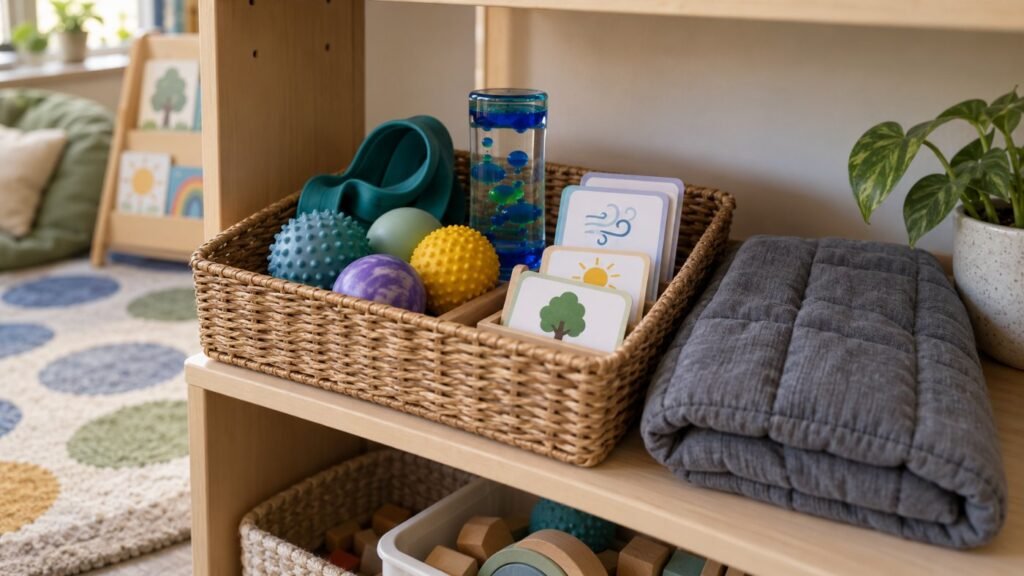
Less is more. Five well-chosen tools beat a basket of twenty. Rotate items every few weeks so the space stays fresh.
Scroll to see full table
| Need | Tool ideas | Why it helps |
|---|---|---|
| Seating | Beanbag, floor cushion, small rug | Soft, low seating signals rest |
| Sound | Noise-cancelling headphones | Reduces auditory overload |
| Touch | Stress ball, stretchy band, weighted lap pad | Calming deep pressure and movement |
| Sight | Liquid motion timer, dim lamp | A slow visual focus point |
| Time | Sand timer or visual timer | Makes the break predictable |
| Feelings | Feelings chart, breathing cards | Helps students name and shift emotions |
To choose tools for a specific student, start with their sensory profile. Our free sensory needs guide for kids helps students and teachers identify what calms and what overwhelms.
The BERMED Calm Corner Blueprint: 5 Steps
The Calm Corner Blueprint
Five steps to build a calm corner in the classroom that students trust and use well. Follow them in order during the first two weeks.
Design for One
Choose a small, semi-private spot you can see. One student at a time keeps the space calm and predictable.
Stock Five Tools
Pick one tool for seating, sound, touch, sight and time. Add a feelings chart and simple breathing cards.
Post Visual Steps
Show the routine with pictures: notice, go, set timer, use a tool, check in, return.
Teach It While Calm
Model and practice the routine with the whole class during calm moments, like any other classroom procedure.
Check In and Adjust
After each visit, a quick thumbs-up check-in. Track use for a few weeks and adjust tools or timing.
How to Teach the Calm Corner
- Introduce it to everyone. Everyone feels big feelings, so the space belongs to everyone.
- Model it yourself. “I feel frustrated. I’m going to take two minutes and breathe.”
- Practice when calm. Let each student try the routine once during the first week.
- Give a signal. A break card or hand signal lets students ask without words.
- Offer, don’t order. “Would the calm corner help?” keeps it a choice.
When a student is already in crisis, the calm corner may not be enough. Our guides to autistic meltdowns in the classroom and de-escalation scripts for teachers cover what to do next.

Calm Corner Mistakes to Avoid
Do This
- Keep it open to all students
- Use a timer and a check-in
- Teach it before it is needed
- Keep tools few and rotated
- Track who uses it and when
- Praise asking for a break
Avoid This
- Sending students there as punishment
- Calling it “time-out”
- Filling it with screens or toys
- Placing it by the door
- Letting several students crowd in
- Removing access as a consequence
Calm Corners and the IEP
Access to a calm space, a break card or scheduled regulation breaks are common accommodations under IDEA. Pair the accommodation with a goal, such as “the student will request a break using a card in 4 out of 5 opportunities.” A behavior de-escalation log helps you show whether the calm corner is reducing incidents over time.
In Class, At Home and in Life
IN CLASS
Combine the calm corner with movement breaks and flexible seating. For active students, our list of strategies to manage hyperactivity in the classroom pairs well with a calm space.
AT HOME
Share the calm corner routine with families so children can use the same steps at home. Parents trying to understand outbursts can read our guide to meltdown vs tantrum.
LIFE
Learning to notice stress and step away to reset is a skill adults use every day. A calm corner in the classroom is often a student’s first safe place to practice it.
Frequently Asked Questions About a Calm Corner in the Classroom
What is a calm corner in the classroom?
A calm corner is a small, quiet space where students can go to regulate their emotions and bodies before returning to learning. It usually includes soft seating, sensory tools, visual calming steps and a timer.
Is a calm corner a time-out?
No. A time-out removes a student as a consequence. A calm corner is a support the student chooses or is offered to help them regulate. It should never be used as punishment.
How long should a student stay in the calm corner?
Most teachers start with 3 to 5 minutes using a visual timer, then a quick check-in. Some students, especially autistic students, may need longer during high-stress moments.
What if students use the calm corner to avoid work?
Teach clear routines, track use for a few weeks and look for patterns. Frequent use often signals a real need, such as a task that is too hard, sensory overload or a problem with peers.
Can a calm corner be written into an IEP?
Yes. Access to a calm space or regulation breaks is a common accommodation in IEPs and 504 plans, often paired with a break card and a self-regulation goal.
5 Actions You Can Take This Week
- Choose the spot. Quiet, semi-private and visible to you.
- Pick five tools. Seating, sound, touch, sight and a timer.
- Print visual steps. Notice, go, timer, tool, check in, return.
- Teach it to the whole class. Practice once with every student.
- Start a simple log. Track who uses it and when for two weeks.
Sources
- National Autistic Society. Autism and sensory processing. autism.org.uk
- Child Mind Institute. How to De-Escalate an Autistic Meltdown. childmind.org
- Liang et al. (2024). Formative evaluation of Peace Spaces in a middle school: Teacher perceptions and student usage. Psychology in the Schools. onlinelibrary.wiley.com
- U.S. Department of Education. Individuals with Disabilities Education Act (IDEA). sites.ed.gov