Key Takeaways
- A learning disability is a difference in how the brain processes information, not a sign of low intelligence or lack of effort.
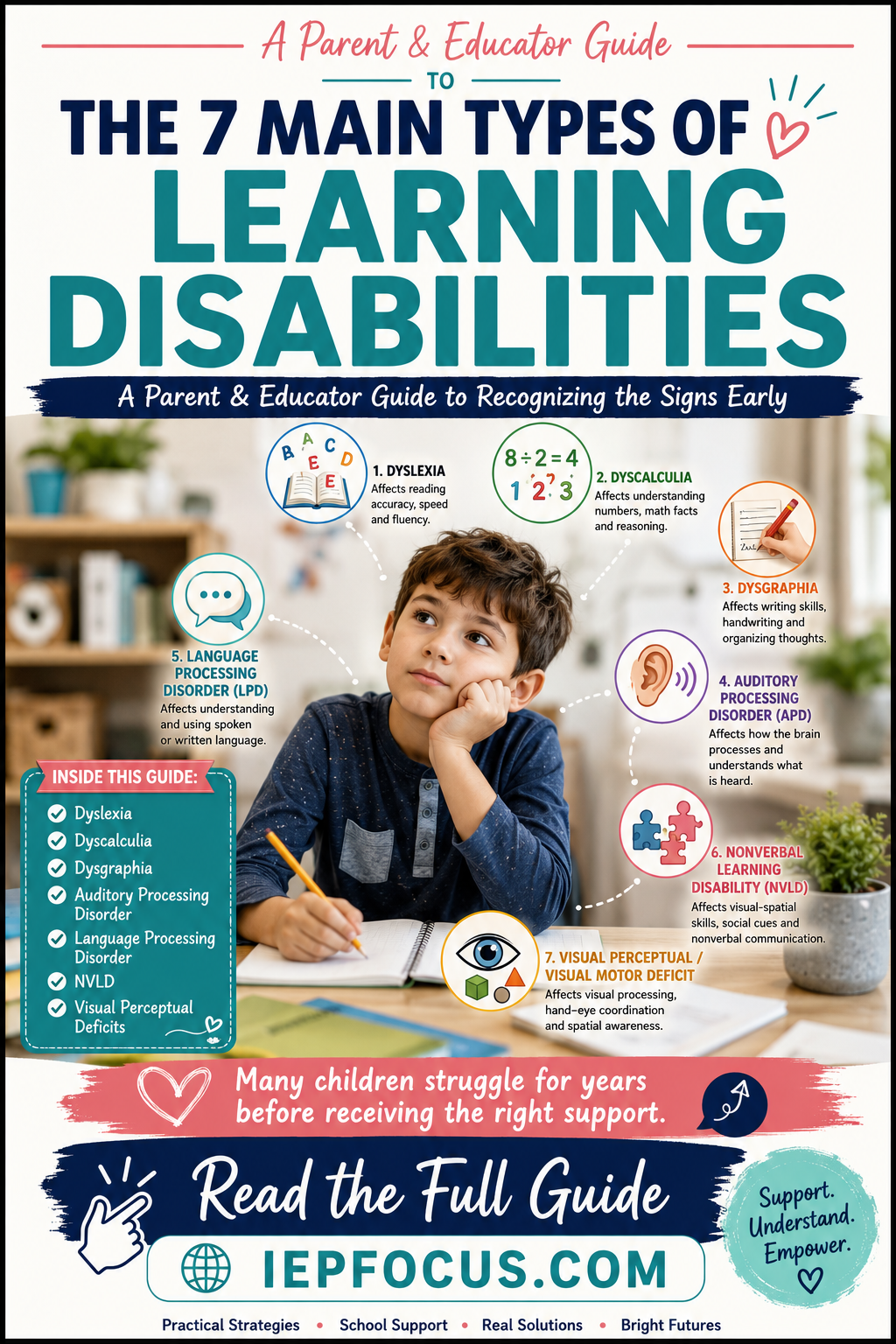
- There are seven main types of learning disabilities: dyslexia, dyscalculia, dysgraphia, auditory processing disorder, language processing disorder, nonverbal learning disabilities, and visual perceptual/visual-motor deficit.
- Signs change with age, and the children most often missed are the ones earning average grades while working twice as hard.
- A formal evaluation is the only way to confirm a learning disability, and families have the right to request one through their school for free.
- With the right accommodations through an IEP or 504 plan, most students with a learning disability thrive academically and beyond.
The most common myth: that you can spot a learning disability by looking at the report card. In reality, the students who go undiagnosed the longest are often the ones with average or even good grades. They are not behind because they cannot learn. They are exhausted because they are quietly compensating for a specific processing gap that no one has named yet. Understanding the different types of learning disabilities is what makes that invisible effort visible, and it is the first step toward giving a child support that actually fits.
What Is a Learning Disability? (Quick Definition)
A learning disability is a neurological difference that affects how the brain takes in, processes, stores, or expresses information. It shows up as an unexpected gap between a person’s overall ability and their performance in one specific area, such as reading, writing, or math. The key word is specific. A child can be bright, curious, and capable across the board, and still hit a wall in a single skill because the underlying brain process works differently.
There are two definitions worth knowing, because they do different jobs.
The legal definition (IDEA). Under the federal Individuals with Disabilities Education Act (IDEA), the term is “specific learning disability,” and it is one of the 13 disability categories that can qualify a student for special education and an IEP. IDEA defines it as a disorder in one or more of the basic psychological processes involved in understanding or using language, which can affect the ability to listen, think, speak, read, write, spell, or do math.
The clinical definition (DSM-5). In a doctor’s or psychologist’s office, the same idea is called “specific learning disorder,” diagnosed with specifiers for reading, written expression, or mathematics. This is the language you will see on a private evaluation report.
What a learning disability is not
Clearing up what gets confused with learning disabilities is just as important as defining them:
- Not an intellectual disability. Learning disabilities occur across the full range of intelligence, including in gifted students.
- Not an emotional or behavioral disorder. Anxiety and frustration are often the result of an unsupported learning disability, not the cause of it.
- Not the same as ADHD. ADHD affects attention and executive function rather than a specific academic skill, so it is not classified as a learning disability under IDEA. The two do frequently travel together, which we cover below.
- Not a vision or hearing problem. Those are ruled out during evaluation.
- Not caused by poor teaching, laziness, or a lack of motivation. The difference is in how the brain is wired, and it is lifelong, though its impact can be managed well.
How common are learning disabilities?
The widely cited statistic is that 1 in 5 people in the United States have learning and attention issues, a figure popularized by the Learning Disabilities Association of America and the National Center for Learning Disabilities. It is worth reading that number carefully. The “1 in 5” framing covers learning and attention issues together, which includes ADHD, so it is broader than learning disabilities alone. When you look only at students formally identified with a learning disability through school, the figure is closer to 5 percent, with many more children whose needs are never identified. Either way, the takeaway is the same: in any classroom, several students are affected, and most of them benefit from being understood rather than corrected.
The 7 Main Types of Learning Disabilities
Most learning disabilities fall into seven categories. A child can have one, or several at once, since these processing systems overlap in the brain. Here is the quick reference, followed by what each one actually looks like.
| Type | Area affected | Common signs |
|---|---|---|
| Dyslexia | Reading and decoding | Slow, effortful reading; trouble matching letters to sounds; spelling struggles |
| Dyscalculia | Math and number sense | Difficulty with quantities, math facts, sequences, time, and money |
| Dysgraphia | Writing | Illegible or laborious handwriting; difficulty getting thoughts onto paper |
| Auditory Processing Disorder | Processing sound | Trouble following spoken directions, especially in noisy settings |
| Language Processing Disorder | Making meaning from language | Word-finding difficulty; trouble understanding or explaining ideas |
| Nonverbal Learning Disabilities (NVLD) | Visual-spatial and social processing | Strong verbal skills alongside trouble with math, coordination, and reading social cues |
| Visual Perceptual / Visual-Motor Deficit | Interpreting visual information | Reversals; losing place when reading; difficulty copying and with hand-eye coordination |
1. Dyslexia (reading)
Dyslexia is the most common learning disability by a wide margin. It is a difficulty with the phonological side of reading, meaning the brain struggles to connect letters to the sounds they make. Despite the popular image, dyslexia is not about seeing letters backwards. It looks like slow and effortful reading, trouble sounding out unfamiliar words, weak spelling, and avoidance of reading aloud. Because nearly every subject depends on reading, an unsupported reading disability quietly drags down performance in science, social studies, and even word problems in math.
2. Dyscalculia (math)
Dyscalculia affects number sense: the intuitive feel for quantity, magnitude, and how numbers relate. Signs include trouble memorizing math facts, confusion with sequences and place value, relying on finger-counting well past the expected age, difficulty telling time or managing money, and intense math anxiety. A student with dyscalculia may reason beautifully in a class discussion and then freeze at a page of equations.
3. Dysgraphia (writing)
Dysgraphia is a difficulty with the physical and organizational act of writing. It can show up as illegible or painfully slow handwriting, an awkward pencil grip, physical fatigue when writing, and a striking gap between what a child can explain out loud and what they can produce on paper. Because writing is how schools ask students to prove what they know, dysgraphia can hide real understanding behind a messy page.
4. Auditory Processing Disorder (APD)
Auditory processing disorder is not a hearing problem. The ears work fine; it is the brain’s processing of sound that lags. Children with APD often miss or scramble spoken directions, struggle to distinguish similar sounds, lose the thread in noisy classrooms, and ask people to repeat themselves frequently. It can make phonics-based reading instruction and group discussion especially hard.
5. Language Processing Disorder (LPD)
Language processing disorder is a specific type of auditory processing difficulty focused on meaning rather than sound. It affects expressive language (getting words out) and receptive language (taking words in). Signs include word-finding trouble, difficulty following or retelling a story, and struggling to explain a thought clearly even when the idea is fully formed in the child’s head. It often surfaces in reading comprehension and class participation.
6. Nonverbal Learning Disabilities (NVLD)
NVLD is one of the most misunderstood profiles because the signs are easy to miss. These students usually have strong vocabularies and excellent rote verbal memory, which masks real difficulty with visual-spatial reasoning, math concepts, motor coordination, and reading nonverbal social cues like body language and tone. They tend to take language literally, struggle with the big picture, and find transitions and unstructured situations stressful.
7. Visual Perceptual / Visual-Motor Deficit
This involves how the brain interprets visual information and coordinates what the eyes see with what the hands do. Signs include reversing letters or numbers, losing place while reading, difficulty copying from the board, trouble judging distance, and clumsy hand-eye coordination. It can affect reading fluency, handwriting, and any task that requires accurate copying or spatial judgment, such as geometry.
Signs of Learning Disabilities by Age Group
Learning disabilities do not announce themselves the same way at every stage. A sign that is invisible in kindergarten becomes obvious in fourth grade, and a student who coped fine in elementary school can hit a wall when middle school raises the workload. This is what to watch for at each stage.
| Stage | Signs to watch for |
|---|---|
| Preschool (3 to 5) | Late talking; trouble learning letters, numbers, colors, or shapes; difficulty rhyming; struggles to follow simple directions; weak fine motor skills with buttons, scissors, or crayons. |
| Elementary (6 to 11) | Reading below grade level; trouble sounding out words; avoiding reading aloud; slow or messy writing; difficulty memorizing math facts; losing place on the page; homework that takes far longer than it should. |
| Middle and high school (12 to 18) | Avoiding specific subjects or assignments; poor organization and time management; slow reading that drags down every class; dread around writing tasks; visible effort that does not match the grades. |
| Adults | Persistent difficulty with reading, writing, or math; heavy reliance on workarounds and technology; trouble with dense forms or documents; avoiding tasks that expose the gap. Many adults were never formally identified, especially those who learned to mask it well. |
One pattern cuts across every age: a learning disability shows up as a mismatch. When a child’s effort, curiosity, or talk is clearly ahead of their output in one specific area, that gap is the signal worth investigating.
Learning Disabilities vs. ADHD vs. Autism: What Is the Difference?
These three are often confused, partly because they look similar from the outside and partly because they frequently co-occur. They are, however, distinct.
| Learning Disability | ADHD | Autism | |
|---|---|---|---|
| Core feature | A specific processing gap in an academic skill | Differences in attention, impulse control, and executive function | Differences in social communication, sensory processing, and patterns of interest |
| Main challenge | Reading, writing, or math specifically | Focus, organization, follow-through across all tasks | Social navigation, sensory load, flexibility with change |
| IDEA category | Specific Learning Disability | Usually Other Health Impairment | Autism |
| Overlap | Co-occurs with both ADHD and autism | Co-occurs often with learning disabilities | Can co-occur with learning disabilities |
Overlap is the rule, not the exception. Research commonly cites that 30 to 50 percent of children with ADHD also have a co-occurring learning disability, according to figures compiled by the National Center for Learning Disabilities. A child can be dyslexic and have ADHD, or autistic with dyscalculia. When attention and autism traits show up together, the combined profile has its own dynamics, which our guide to AuDHD covers in depth. This matters because supporting only one part of the picture rarely works. The most effective plans look at the whole child.
How Are Learning Disabilities Diagnosed?
You cannot diagnose a learning disability from a worksheet or a single test. It takes a comprehensive evaluation that compares a student’s overall cognitive ability against their performance in specific academic areas, then looks at the underlying processing skills to explain the gap. A diagnosis is made when there is a meaningful, unexpected discrepancy that is not better explained by something else, such as a vision problem, limited instruction, or a language barrier.
Who can evaluate
There are two main routes:
- The school psychologist. Under IDEA’s “Child Find” obligation, public schools must identify and evaluate students suspected of having a disability, at no cost to the family. This evaluation determines eligibility for an IEP.
- A private evaluation. An educational psychologist or neuropsychologist can complete a detailed assessment outside the school, usually for a fee. Private reports are often more in-depth and can be useful when a school disagrees or moves slowly.
What parents have the right to do
Families do not have to wait for the school to act. Under IDEA, a parent can request a free evaluation in writing, and the school must respond. Timelines vary by state, but many require the evaluation to be completed within about 60 days of parental consent. If you disagree with the school’s findings, you have the right to request an Independent Educational Evaluation. Putting the request in writing and dating it is the single most useful thing a parent can do to start the clock.
The process, step by step
- A concern is raised, or a parent requests an evaluation in writing.
- The school seeks written parental consent to evaluate.
- A team conducts the assessment across cognitive, academic, and processing areas.
- An eligibility meeting reviews the results with the family.
- If the student qualifies, the team develops an IEP. If not, a 504 plan or other supports may be offered.
The process comes with its own vocabulary. If the acronyms start to blur together, our special education glossary translates the terms you will hear in meetings and on evaluation reports.
School Support: IEP vs. 504 Plan for Learning Disabilities
Once a learning disability is identified, the question becomes which support framework fits. The short version: an IEP provides specialized instruction; a 504 plan provides accommodations within the general classroom. For a full breakdown of the legal and practical differences, see the dedicated guide comparing an IEP and a 504 plan.
A learning disability qualifies for an IEP when it adversely affects educational performance and the student needs specialized instruction to make progress, for example structured literacy instruction for dyslexia. It qualifies for a 504 plan when the student can access the general curriculum but needs accommodations to do so, such as extended time. A diagnosis alone does not guarantee either one; the need for the support has to be demonstrated.
Accommodations should match the specific type of learning disability. Here is a starting point by type.
| Type | Helpful accommodations |
|---|---|
| Dyslexia | Audiobooks and text-to-speech; structured literacy instruction; extended time; not grading spelling on content work |
| Dyscalculia | Calculator and formula reference sheets; concrete manipulatives; extra time; fewer problems that test the same skill |
| Dysgraphia | Speech-to-text; the option to type; a scribe or copies of notes; reduced copying from the board |
| Auditory Processing Disorder | Written instructions to back up spoken ones; preferential seating; an FM listening system; a quieter testing space |
| Nonverbal Learning Disabilities | Explicit instruction in social and organizational skills; graphic organizers; advance notice of schedule changes |
| Visual-Motor Deficit | Copies of notes instead of copying; graph paper for alignment; reduced visual clutter on worksheets |
For a fuller, classroom-ready reference that every teacher in the building can use, see the special education accommodation cheat sheet covering IEP, 504, and RTI/MTSS. If attention challenges show up alongside the learning disability, the regulation-first ideas in our guide to managing hyperactivity in the classroom pair well with these accommodations.
Strategies: In Class, At Home, and Beyond
Support works best when it is consistent across a child’s whole world. The same strengths-based, neuroaffirmative approach can be applied in three settings, and each one reinforces the others.
In Class
Partner with the teacher early and keep a shared log of what helps. Ask for accommodations to be used routinely, not just on test days, so the student never has to flag themselves as different. Build in low-stakes ways to show knowledge that do not depend on the affected skill, like answering verbally instead of in writing.
At Home
Protect the relationship over the worksheet. Read together so reading stays connected to enjoyment, use audiobooks and dictation tools freely, set a clear homework time limit to stop the spiral of frustration, and name your child’s strengths out loud often. A child’s belief that they are capable is the strongest predictor of long-term progress.
Life
A learning disability is lifelong, but its impact shrinks with the right tools and self-knowledge. Teach self-advocacy early so a teenager can explain what they need. Treat assistive technology as a permanent ally, not a crutch. Point toward strengths when thinking about careers. Many successful adults credit their learning disability for the creativity and persistence it forced them to build.
Practical strategies by type
- Dyslexia: pair audiobooks with text so the eyes and ears reinforce each other, and lean on structured, phonics-based reading practice.
- Dyscalculia: make math concrete with objects and visuals, and allow reference sheets so working memory is freed up for reasoning.
- Dysgraphia: separate the idea from the handwriting by letting the child dictate first, then format later.
- Auditory or language processing: give instructions in writing as well as out loud, and check for understanding by asking the child to restate the task.
- NVLD and visual-motor: make the implicit explicit, using step-by-step routines, graphic organizers, and clear previews of what is coming.
Resources and Organizations
These national organizations offer free, reliable information for families and educators:
- Learning Disabilities Association of America (LDA), advocacy, research summaries, and state chapters.
- National Center for Learning Disabilities (NCLD), policy, research, and parent guides.
- Understood.org, practical, plain-language tools for learning and attention differences.
- Child Mind Institute, clinical articles on diagnosis and support.
- International Dyslexia Association, specialist guidance on reading disabilities.
Frequently Asked Questions
What are the most common types of learning disabilities?
Dyslexia, which affects reading, is by far the most common. It is followed by dyscalculia (math) and dysgraphia (writing), with auditory processing disorder, language processing disorder, nonverbal learning disabilities, and visual-motor deficits making up the rest of the seven main types.
Is ADHD a learning disability?
No. ADHD is a neurodevelopmental condition that affects attention, impulse control, and executive function rather than one specific academic skill, so it is not classified as a learning disability under IDEA. It does co-occur with learning disabilities very often, which is why the two are frequently confused.
Can a child have more than one learning disability?
Yes, and it is common. The brain systems involved overlap, so a child might have dyslexia and dysgraphia together, or a learning disability alongside ADHD. Identifying every piece matters, because supporting only one part of the picture usually leaves the child still struggling.
What is the difference between a learning disability and a learning difficulty?
In the United States, “learning disability” is a specific clinical and legal term tied to defined criteria and educational rights. “Learning difficulty” is a broader, more informal phrase that can describe any struggle with learning, including temporary or situational ones that do not meet the threshold for a diagnosis.
How do I get my child tested for a learning disability?
Start by putting a request in writing to your child’s school asking for a full evaluation under IDEA, and date it. The school must respond, and the evaluation is free. You can also pursue a private evaluation with an educational psychologist or neuropsychologist if you want a more detailed report or a faster timeline.
Sources
- U.S. Department of Education, Individuals with Disabilities Education Act (IDEA). Available at: sites.ed.gov/idea
- Learning Disabilities Association of America. The State of Learning Disabilities Today. Available at: ldaamerica.org
- National Center for Learning Disabilities. The State of Learning Disabilities report. Available at: ncld.org
- Understood.org. Learning Disabilities by the Numbers. Available at: understood.org
- International Dyslexia Association. Dyslexia Basics. Available at: dyslexiaida.org
- Child Mind Institute. Learning disorders resources. Available at: childmind.org