Most people think an IEP is a stack of paperwork about what a child can’t do. They’re wrong. In nearly two decades of working alongside special education teams, the single most consistent finding is this: the schools that treat an IEP as a strengths-based roadmap, not a deficit checklist, produce dramatically better outcomes for their students.
Over 7.5 million students in the United States receive services under an IEP, yet parents and even some general education teachers still struggle to explain what an IEP actually is in schools, what it legally guarantees, or how to use it strategically. The confusion costs children services they’re entitled to and time they can’t get back.
This guide breaks down every component of an IEP in education, clearly, practically, and without the jargon, so that teachers, parents, and advocates can walk into every IEP meeting feeling confident and prepared.

- What Is an IEP in Education?
- Who Qualifies for an IEP?
- IEP vs. 504 Plan: Key Differences
- The 10 Required Components of an IEP
- Who Is on the IEP Team?
- How Does the IEP Process Work?
- Writing Meaningful IEP Goals
- Accommodations and Supports in the IEP
- IEP Planning for Specific Neurodivergent Profiles
- Parent and Student Rights Under IDEA
- 5 Common IEP Mistakes to Avoid
- Frequently Asked Questions
- Action Steps for Teachers and Families
What Is an IEP in Education?
An IEP: Individualized Education Program: is a written plan developed collaboratively by a team of educators, specialists, and the student’s family. It is created for a student who has been evaluated and determined eligible for special education services under one of the 13 disability categories defined by the Individuals with Disabilities Education Act (IDEA), the federal law governing special education in the United States.
The “individualized” in IEP is not a formality. It means that no two IEPs should look alike, even for students with the same diagnosis. The plan must reflect this student’s specific strengths, challenges, learning profile, family context, and educational environment. Federal law requires schools to provide every eligible student with a Free and Appropriate Public Education (FAPE) in the Least Restrictive Environment (LRE), and the IEP is the legal document that defines what “appropriate” means for each child.
An IEP is reviewed and updated at least once per year (the “annual review”) and must be re-evaluated every three years to determine continued eligibility (the “triennial re-evaluation”). Parents or guardians must provide informed written consent before the initial IEP is implemented and before any significant changes are made. For a deeper look at how the IEP functions day-to-day within the school building, see our companion guide: What Is an IEP in Schools?
Who Qualifies for an IEP?
To be eligible for an IEP, a student must meet two conditions: (1) they must have a disability that falls under one of the 13 IDEA categories, and (2) that disability must have an adverse effect on their educational performance, requiring specialized instruction.
| IDEA Disability Category | Examples / Notes |
|---|---|
| Specific Learning Disability (SLD) | Dyslexia, dyscalculia, dysgraphia |
| Other Health Impairment (OHI) | ADHD, epilepsy, diabetes affecting school performance |
| Autism Spectrum Disorder (ASD) | All levels of support needs; sensory, communication, social |
| Emotional Disturbance (ED) | Anxiety, depression, ODD affecting educational performance |
| Speech or Language Impairment | Articulation, fluency, language processing disorders |
| Intellectual Disability | Significant cognitive impact on academic and adaptive functioning |
| Developmental Delay | For children ages 3–9 not yet fitting a specific category |
| Multiple Disabilities | Combination of two or more impairments |
| Hearing Impairment / Deafness | Includes partial and total hearing loss |
| Visual Impairment / Blindness | Including low vision |
| Orthopedic Impairment | Cerebral palsy, spina bifida, limb differences |
| Traumatic Brain Injury (TBI) | Acquired brain injuries affecting cognition or behavior |
| Deaf-Blindness | Combined hearing and visual impairments |
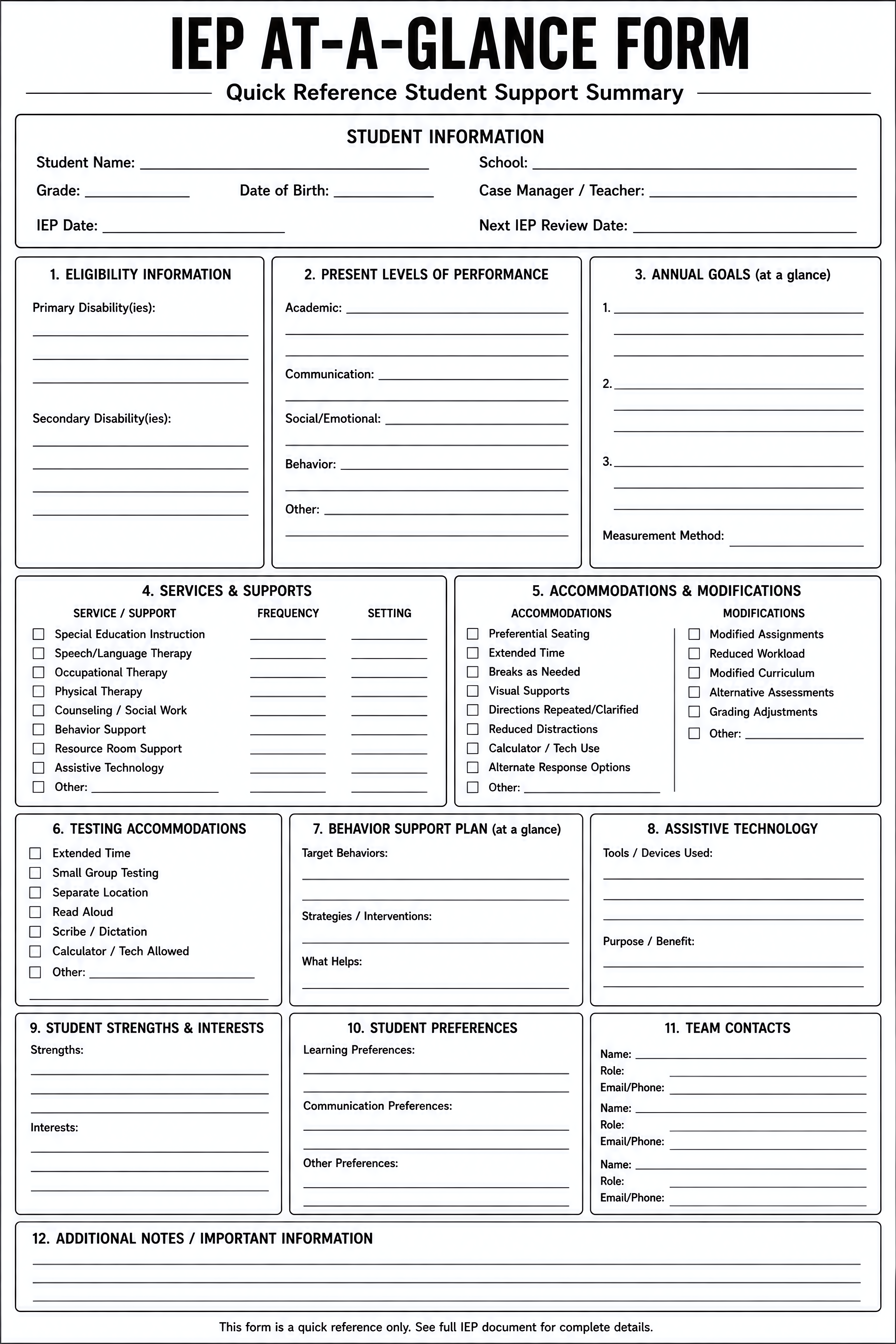
Free resource
IEP At-a-Glance Form
A one-page student support summary every teacher can use.
Download free →Is an IEP the Same as a 504 Plan? Key Differences
This is one of the most common questions families ask, and the difference matters enormously in terms of legal protections, services available, and who is responsible for implementation. The short version: an IEP provides specialized instruction; a 504 provides accommodations only. For a full side-by-side comparison with decision-making guidance, see our dedicated resource: IEP vs. 504 Plan: Key Differences and How to Choose (2026).
| Feature | IEP | 504 Plan |
|---|---|---|
| Governing law | IDEA | Section 504 / ADA |
| Eligibility standard | Disability + adverse educational impact + need for specialized instruction | Disability that substantially limits a major life activity |
| Specialized instruction | Yes, pull-out, push-in, resource room, self-contained | No, accommodations only |
| Related services | OT, PT, SLP, counseling, transportation, assistive technology | Limited; typically accommodations, not therapy services |
| Legal enforceability | Federal compliance obligations + full due process rights | Civil rights law; fewer procedural safeguards |
| Annual review required | Yes, every year | Recommended but not federally required |
| Placement decisions | LRE determination required | Not applicable |
| Who implements it | Special education teacher + general ed team | General education teacher with 504 coordinator oversight |
What Are the Required Components of an IEP?
Federal law (IDEA §300.320) specifies exactly what every IEP document must contain. Missing any of these components is a procedural violation that can be grounds for dispute. Here are the 10 legally required elements:
1. Present Levels of Academic Achievement and Functional Performance (PLAAFP)
This is the foundation of the entire IEP. The PLAAFP describes the student’s current abilities, academically, behaviorally, socially, and functionally, based on recent evaluation data, teacher observations, and parent input. It must explain how the disability affects involvement and progress in the general curriculum. A strong PLAAFP reads like a portrait of the whole child: what they do well, how they learn best, where they need support, and what matters to them.
2. Measurable Annual Goals
Goals must be specific, measurable, achievable, relevant, and time-bound. They address the areas of need identified in the PLAAFP. Our IEP Goal Bank provides hundreds of ready-to-adapt goals across all domains and disability categories, a go-to reference for both new and experienced special educators.
3. Description of How Progress Will Be Measured
The IEP must specify how and when the school will monitor progress toward each annual goal, and how often parents will receive progress reports. This is frequently under-implemented, families are often entitled to more frequent data reporting than they actually receive.
4. Special Education and Related Services
This section lists all specialized instruction and related services the student will receive, type of service, frequency, duration, location, and projected start date. Related services may include speech-language therapy, occupational therapy, physical therapy, counseling, assistive technology, and transportation.
5. Supplementary Aids and Services
These are supports provided in the general education classroom to enable the student to participate alongside non-disabled peers. Examples include preferential seating, visual schedules, sensory tools, modified materials, and paraeducator support.
6. Explanation of Participation in General Education
The IEP must explain the extent to which the student will not participate in general education classes and activities. Under IDEA, the default assumption is inclusion; any removal from the general education environment must be justified in writing.
7. Participation in State and District-Wide Assessments
The team must decide whether the student will take standard assessments (with or without accommodations) or an alternate assessment. If alternate assessment is selected, the IEP must explain why the standard assessment is not appropriate for this student.
8. Dates and Frequency of Services
The IEP must state when services begin, their frequency, duration, and location (general ed classroom, resource room, specialist’s office, etc.).
9. Transition Planning (age 16 and older)
Starting no later than the IEP in effect when the student turns 16 (earlier in many states), the IEP must include measurable post-secondary goals related to training, education, employment, and, where appropriate, independent living.
10. Age of Majority Transfer of Rights
At least one year before the student reaches the age of majority (18 in most states), the IEP must inform the student that their IDEA rights will transfer to them. The school must then provide a copy of the IEP directly to the student, not only to parents.

Who Is on the IEP Team?
Federal law defines IEP team membership. While the exact composition varies by student, the following members are required under IDEA. For teachers managing the organizational complexity of caseloads and meeting prep, our list of the best IEP planners for special education teachers in 2026 is a practical resource.
| Team Member | Role in the IEP |
|---|---|
| Parents / Guardians | Equal participants; bring knowledge of the child outside of school; must give informed consent |
| Student (where appropriate) | Required to be invited beginning at age 16; strongly encouraged earlier for self-advocacy |
| Special Education Teacher | Expert in specially designed instruction; typically the primary author of the IEP document |
| General Education Teacher | Required if the student is or may be participating in general ed; provides curriculum perspective |
| LEA Representative | District rep with authority to commit resources; often an administrator |
| Evaluation Specialist | Interprets evaluation results, typically the school psychologist or diagnostician |
| Related Service Providers | As appropriate: SLP, OT, PT, counselor, assistive technology specialist |
| Other Individuals | Outside advocates, private therapists (with parental consent), transition agency reps |
How Does the IEP Process Work? Step by Step
The IEP process follows a structured federal timeline with legal deadlines at each stage. Understanding the sequence helps both families and educators navigate it confidently.
| Step | What Happens | Timeline |
|---|---|---|
| 1. Referral | Teacher, parent, or specialist requests an evaluation in writing. | School must respond within 10–60 school days (varies by state) |
| 2. Parental Consent | Parents receive a Prior Written Notice and consent form for the initial evaluation. | Before any evaluation begins |
| 3. Comprehensive Evaluation | Full evaluation in all areas of suspected disability by qualified professionals. | Within 60 calendar days of consent |
| 4. Eligibility Determination | IEP team reviews data and determines whether IDEA eligibility criteria are met. | Within the 60-day evaluation window |
| 5. IEP Development | IEP team meets collaboratively to develop the IEP document. Parents are full members. | IEP in effect within 30 days of eligibility |
| 6. Implementation | Services begin as specified. All service providers must follow the plan. | As stated in the IEP document |
| 7. Progress Monitoring | School tracks progress toward each annual goal and reports to parents. | Ongoing throughout the year |
| 8. Annual Review | IEP team meets to review progress and update the document. | At least every 12 months |
| 9. Triennial Re-evaluation | Full re-evaluation to determine continued eligibility and updated needs. | Every 3 years |
How Are IEP Goals Written? What Makes a Good One?
IEP goals are the heart of the document, and the area where quality varies most dramatically from school to school. A well-written goal gives the entire team a clear, shared target and makes progress monitoring straightforward. A vague goal is essentially a blank check with no accountability.
The Anatomy of a Strong IEP Goal
Weak vs. Strong IEP Goals: Examples
| Area | Weak Goal | Strong Goal |
|---|---|---|
| Reading fluency | “Marcus will improve his reading skills.” | “Marcus will read a grade-3 passage aloud at 90 words per minute with 5 or fewer errors, across 3 consecutive CBM probes, by May 2027.” |
| Self-regulation | “Priya will manage her emotions better.” | “When experiencing frustration, Priya will independently use a pre-agreed regulation strategy within 2 minutes of identifying her trigger, with 80% accuracy across 4 of 5 observed opportunities per week, by June 2027.” |
| Written expression | “Jordan will write better paragraphs.” | “Jordan will write a 5-sentence paragraph with a topic sentence, 3 supporting details, and a concluding sentence, with correct capitalization and end punctuation on 90% or more of sentences, in 4 of 5 consecutive writing samples, by May 2027.” |
| Communication (AAC) | “Sam will use his device to communicate.” | “During structured social activities, Sam will initiate a communicative exchange using his AAC device at least 3 times per 30-minute session, across 4 of 5 consecutive sessions, by June 2027, as measured by SLP session data logs.” |
Accommodations and Supports in the IEP
Accommodations are changes to how a student accesses learning, not what they are expected to learn. They level the playing field without lowering expectations. Every accommodation listed in the IEP must be implemented consistently by every teacher who works with that student, across all settings where the IEP applies.

Common IEP accommodations include: extended time on assessments, preferential seating, reduced-distraction testing environments, access to fidget tools or sensory supports, use of a calculator for non-math subjects, text-to-speech or speech-to-text technology, oral testing options, modified assignment length, and visual supports such as anchor charts and graphic organizers.
The legal distinction between accommodations and modifications matters significantly: accommodations do not change the content standard; modifications do (e.g., reducing the number of problems, simplifying grade-level text to below grade level). Both can appear in an IEP, but modifications may affect credit and graduation requirements, which is why they must be documented with specific intent and team agreement.
IEP Planning for Specific Neurodivergent Profiles
One of the most significant shifts in neuroaffirmative special education practice is the recognition that a diagnostic label, autism, ADHD, anxiety, is far less informative for IEP planning than a clear understanding of the student’s individual cognitive, sensory, and social profile. Two students with the same diagnosis may need entirely different IEP structures.
That said, certain neurodivergent profiles present recurring patterns of need that benefit from targeted goal-writing and accommodation strategies. The resources below address the most complex and frequently misunderstood profiles in the IEPFOCUS.COM library.
- AuDHD (Autism + ADHD): IEP Goals and Strategies 2026
- PDA (Pathological Demand Avoidance): IEP Planning Guide
- Rejection Sensitive Dysphoria (RSD): IEP Goals and Supports
- Autistic Burnout: IEP Goals and Classroom Strategies
- Selective Mutism: IEP Goals and Communication Supports
- Selective Mutism SMART Goal Bank 2026
On PDA profiles: Students with a demand-avoidant presentation, whether formally identified as PDA or presenting with high autonomy needs, require IEP structures that prioritize collaborative goal-setting, flexible pacing, and reduced directive framing. Traditional compliance-based behavioral goals tend to increase distress in these students rather than build capacity. Our PDA IEP Planning guide walks through what effective goals, accommodations, and team communication look like for this profile.
On AuDHD: The intersection of autism and ADHD creates a profile that is often misread as primarily behavioral. Executive function challenges, sensory sensitivity, monotropic focus, and variable regulation capacity all need to be addressed in the IEP simultaneously. Our full guide on IEP goals for AuDHD students provides domain-specific SMART goals and co-occurring accommodation frameworks.
What Are Parents’ and Students’ Rights Under IDEA?
IDEA is, at its core, a civil rights law. The procedural safeguards it establishes are not bureaucratic formalities, they are enforceable legal protections. Every family must receive a copy of these rights in their native language at specific points in the IEP process.
Prior Written Notice (PWN)
The school must notify parents in writing before making any proposal or refusal to change the student’s identification, evaluation, placement, or provision of FAPE. The PWN must explain what the school proposes or refuses to do, and why, in plain, accessible language.
Informed Consent
Consent is required before the initial evaluation, before the initial provision of services, and before re-evaluation in some circumstances. Consent is voluntary and can be revoked at any time. Revocation of consent for services stops the school from providing special education going forward, a serious decision families should make in consultation with a knowledgeable advocate.
Independent Educational Evaluation (IEE)
If parents disagree with the school’s evaluation, they may request an IEE at public expense. The school must either fund it or challenge the request through due process. Many families are unaware of this right, and exercising it can significantly change eligibility and placement outcomes.
Access to Records
Parents have the right to access all educational records within 45 days of the request and before any IEP meeting or hearing, including evaluation reports, progress monitoring data, behavior logs, and prior IEP documents.
Dispute Resolution Pathways
IDEA offers three formal pathways when families and schools disagree: (1) mediation: voluntary, confidential, and free; (2) state complaint: filed with the state education agency, resolved within 60 days; and (3) due process hearing: a formal legal proceeding with an impartial hearing officer. Additional complaints related to Section 504 and Title II of the ADA may be filed with the Office for Civil Rights (OCR).
5 Common IEP Mistakes That Undermine Student Outcomes
After reviewing hundreds of IEPs across multiple states, the same patterns appear repeatedly. These are the five mistakes most likely to result in a legally deficient document, and, more critically, in a child not receiving what they need.
Mistake #1: PLAAFP Statements That Are Vague or Deficit-Only
A PLAAFP that reads “Student struggles with reading and has difficulty focusing” tells the team nothing actionable. It doesn’t describe what the student can do, doesn’t reference evaluation data, doesn’t explain how the disability affects the general curriculum, and doesn’t capture the student as a learner. Strengths must be explicitly named, not as fluff, but because they are the levers the team will use to build meaningful skills.
Mistake #2: Goals That Cannot Be Measured
Goals like “will improve social skills” or “will increase reading comprehension” are not measurable. If you can’t collect data on it, you can’t prove progress, and you can’t adjust instruction when the student isn’t making gains. Browse the IEP Goal Bank for SMART-formatted alternatives by domain.
Mistake #3: Accommodations Listed Without Implementation Plans
Writing “extended time” in the IEP is meaningless if general education teachers don’t know how, when, or under what conditions to provide it. Our Accommodation Cheat Sheet is a one-page classroom reference that every educator in the building should have. Accommodations require communication, training, and monitoring to produce real outcomes.
Mistake #4: Ignoring Executive Function as a Root Cause
Many IEP goals target surface behaviors, task completion, organization, on-task behavior, without addressing the executive function deficits that drive them. Our deep-dive on executive function accommodations for IEP students offers a research-grounded framework for addressing this gap systematically.
Mistake #5: Parents as Passive Recipients Instead of Active Co-Creators
An IEP meeting where the school presents a pre-written document and asks parents to sign is not a collaborative process, it is a legal violation of the spirit of IDEA, and often of its letter as well. Meaningful participation includes advance sharing of draft documents, genuine discussion of competing perspectives, and documented consideration of parental input even when the school ultimately disagrees.
More on the IEP in Education
- Special education glossary (210 terms)
- Advocating for your child with special needs
- IEP planner 2026-2027
Trusted outside sources: U.S. Department of Education: IDEA and Understood: IEPs vs 504 plans.
Frequently Asked Questions About IEPs in Education
What does IEP stand for in education?
IEP stands for Individualized Education Program. It is a legally binding document developed for students with disabilities who qualify for special education services under IDEA. The word “individualized” reflects the requirement that the plan must be specifically designed around each student’s unique needs, strengths, and goals, not applied categorically by diagnosis or copied from a template.
How long does an IEP last?
An IEP is reviewed and updated at least once per year at an annual review meeting. Students remain eligible for services until age 21 (or graduation, whichever comes first) as long as they continue to meet eligibility criteria, which are re-verified every three years through a triennial evaluation.
Can a parent request an IEP for their child?
Yes. Any parent or legal guardian may submit a written request for an evaluation to determine IEP eligibility. Teachers, school counselors, and other professionals may also make referrals. The school is legally required to respond in writing, either proceeding with the evaluation (with consent) or explaining in writing why it is declining to evaluate.
Does an IEP follow a student to a new school?
Yes. When a student transfers within the same state, the receiving school must provide services comparable to those in the existing IEP while deciding whether to adopt the plan or develop a new one. When transferring from another state, the school must also provide comparable services while conducting its own eligibility determination. An IEP does not expire upon transfer, it travels with the student.
What is the difference between an IEP and special education?
Special education is the broader system of services for students with disabilities; the IEP is the individualized document within that system. Think of special education as the program and the IEP as the map. A student receives special education services through their IEP, the document defines what those services are, who provides them, how often, where, and how their effectiveness will be evaluated.
Can a student’s IEP be changed outside of the annual review?
Yes. IEPs can be amended at any time if all team members agree a change is needed. Minor amendments can sometimes be made in writing without a full meeting (with parental consent). Significant changes, including placement, related services, or annual goals, typically require a full team meeting. Parents may request a meeting at any time; schools must respond within a reasonable timeframe.
What happens if a school does not follow the IEP?
Failure to implement an IEP as written is a violation of federal law. Parents may file a state complaint with their state education agency, request mediation, or initiate due process proceedings. In some cases, schools may be required to provide compensatory services, additional instruction or therapy, to make up for services not delivered. Documenting all communications in writing is essential for any family considering a formal dispute.
- Request a copy of the student’s most recent IEP and read the PLAAFP carefully. Does it describe a whole child, including strengths? Is it backed by recent evaluation data? If not, you can request an amendment in writing at any time, not just at the annual review.
- Check every goal for measurability. Can you write down what data would look like if the student achieved this goal? If not, the goal needs revision. Browse the IEP Goal Bank for SMART-formatted alternatives organized by domain and profile.
- Map accommodations to daily practice using the Accommodation Cheat Sheet. Write next to each accommodation: how, where, and when it is actually being provided. Close the gap between what’s written and what’s happening.
- Know the annual review date and request agenda topics 10 days in advance. Submit parent and teacher concerns in writing before the meeting so they are part of the official record, this matters significantly if a dispute arises later.
- For students 14 and older: begin building self-advocacy skills now. A student who understands their own IEP, what it says, what they’re entitled to, and how to ask for what they need, is the most powerful voice in the meeting room. Our AuDHD IEP goals, PDA IEP planning guide, and RSD IEP goals all include self-advocacy goal frameworks for complex profiles.