
Quick answer: Self-monitoring strategies teach students to observe and record their own behavior or work, for example checking “Was I on task?” when a timer beeps, or ticking off steps of an assignment. Self-monitoring builds independence, attention and self-regulation, and is part of the self-management practice identified as evidence-based for autistic learners. It works well for students with ADHD, learning disabilities and executive function challenges, from early elementary through adulthood.
In this guide
Adults constantly redirect some students: “Focus.” “Are you working?” Each reminder helps for a moment but keeps the student dependent on someone else’s attention. Self-monitoring strategies flip this: the student learns to notice and track their own behavior, and the adult becomes a coach rather than a reminder system.
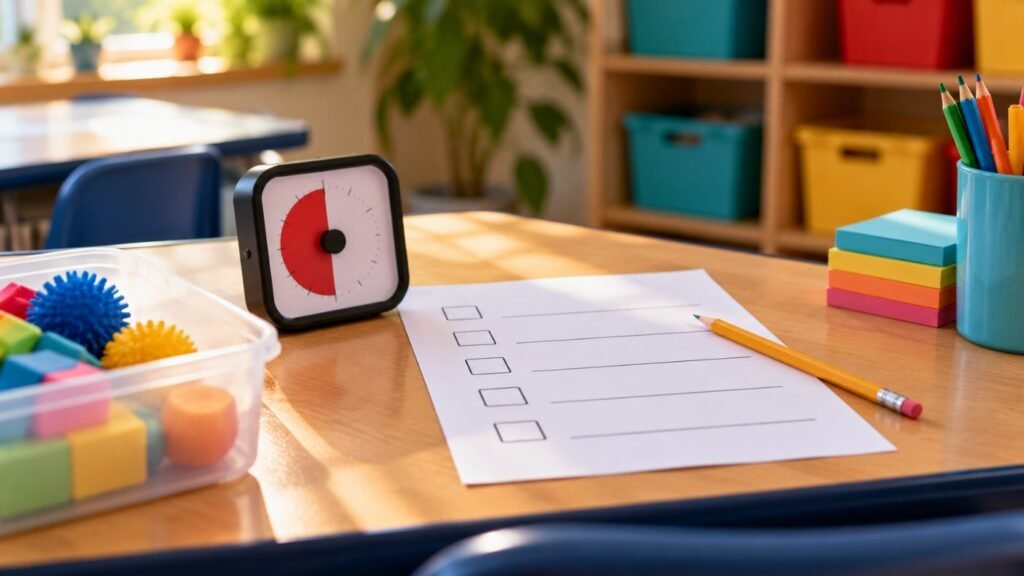
Two Kinds of Self-Monitoring Strategies
| Self-monitoring of attention | Self-monitoring of performance | |
|---|---|---|
| Question the student asks | “Was I paying attention?” | “How many did I finish? How many are correct?” |
| Typical cue | Timer or vibration at intervals | End of a task or work period |
| Best for | Staying on task during independent work | Productivity and accuracy |
| Example | Tick yes or no every 5 minutes | Graph problems completed each day |
Key point: Self-monitoring strategies move responsibility from the adult to the student, which builds lasting independence.
How to Set Up Self-Monitoring in 6 Steps
From adult reminders to self-management
The IRIS Center describes self-monitoring as a core self-regulation strategy (IRIS Center).
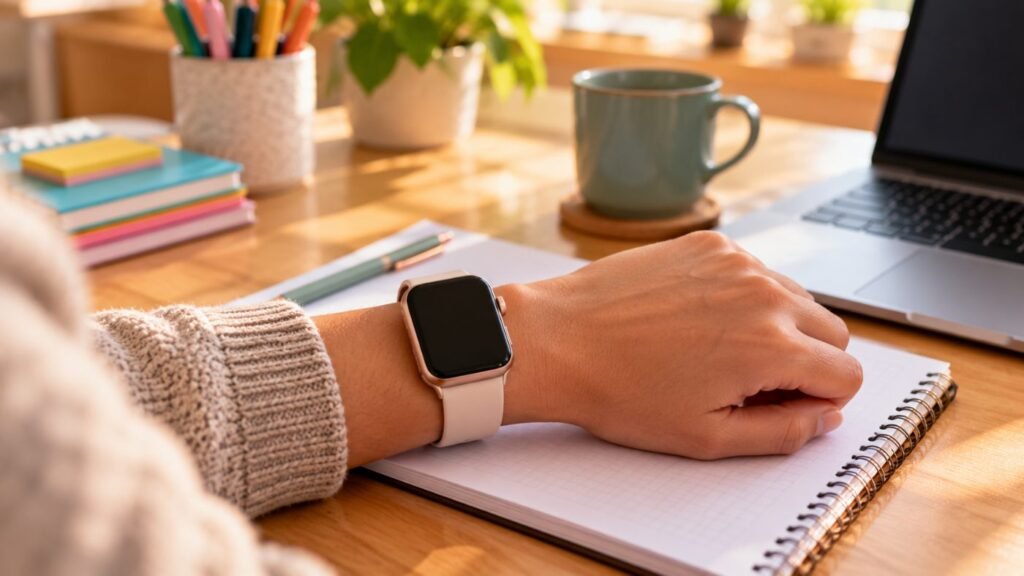
Sample Self-Monitoring Tools by Age
| Age | Tool | What it looks like |
|---|---|---|
| 5 to 7 | Picture card with smiley or thumbs | “Was I sitting and working?” Circle a face when the chime sounds |
| 8 to 11 | Interval checklist | Ten boxes, tick yes or no every 5 minutes; count yes at the end |
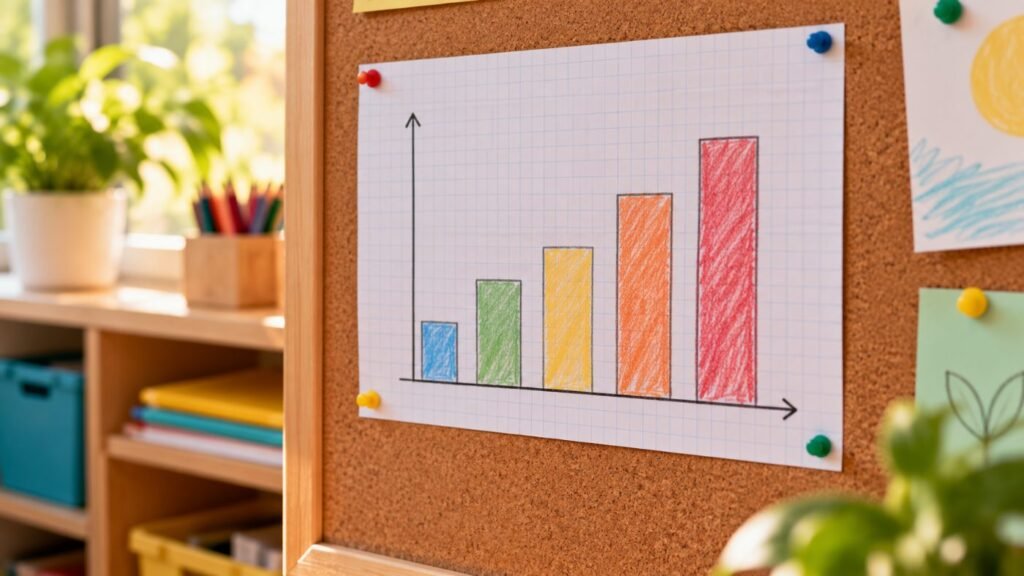
| 12 to 14 | Task checklist and graph | Steps of an assignment; graph completed tasks across the week |
| 15 to 18 | Phone app or planner | Rate focus after each study block; review weekly |
| Adults | Habit tracker | Track routines, medication, sleep or work tasks |
Cues: Beeps, Vibrations and Visuals
- Audio: a soft chime from a timer app; can disturb others.
- Tactile: a vibrating watch or device; private and discreet.
- Visual: a sand timer or a card at the corner of the desk.
- Natural: the end of each worksheet section.
Tactile cues often suit older students who do not want peers to notice.
Real-Life Example
Case story
Ali, 10, with ADHD, was on task about 40 percent of the time during independent math. His teacher defined on-task behavior with him, practiced with examples, and gave him a vibrating watch set to 4 minutes and a ten-box card. For the first week, she rated at the same time and they compared. After four weeks, Ali was on task about 80 percent of the time, and the interval moved to 8 minutes. He asked to use the same card in science.
Writing Self-Monitoring Into the IEP
Sample goal
“By [date], during 20-minute independent work periods, [student] will use a self-monitoring checklist with a tactile cue to record on-task behavior, maintaining on-task behavior in at least 80% of intervals across 4 of 5 consecutive sessions, as measured by teacher-student agreement data.”
See more examples in self-regulation IEP goals and executive functioning IEP goals.
Teacher’s note: Reward honest self-ratings, not just high ones. Accuracy matters more than perfection in the first weeks.
Self-Monitoring Strategies FAQ
What are self-monitoring strategies?
Methods students use to observe and record their own behavior or work to improve it.
Do self-monitoring strategies work for ADHD?
Yes. They are widely used to improve on-task behavior and work completion for students with ADHD.
Is self-monitoring evidence-based?
Self-management, which includes self-monitoring, is one of 28 evidence-based practices for autistic learners (NCAEP 2020).
How often should the cue sound?
Start short, often 3 to 5 minutes, then lengthen as success grows.
Can parents use self-monitoring at home?
Yes, for homework, routines and chores, using the same tools as school.
In short: Self-monitoring strategies turn reminders into skills. Define, teach, check accuracy and fade. This article is part of our Teaching Strategies That Work series.
Was this article helpful?
Tap a star to rate
Sources
- IRIS Center. SOS: Self-Monitoring
- Vanderbilt Kennedy Center. Self-monitoring tip sheet
- Steinbrenner et al. (2020). Evidence-Based Practices for Autism. NCAEP
- ODU T/TAC. Self-monitoring: helping students help themselves
This article is educational and does not replace professional advice.

