
Quick answer: “Behavior is communication” means that every behavior, from work refusal to shutting down or throwing materials, sends a message about what a student needs. Behind most challenging behavior is an unmet need: help starting, a break, safety, connection, sensory relief, predictability or recovery. When adults look for the message instead of only stopping the behavior, they can teach the missing skill and change the conditions, which reduces the behavior over time. This guide decodes 10 common classroom behaviors with 100 real examples.
In this guide
- What “behavior is communication” really means
- The four functions of behavior
- 1. Work refusal
- 2. Leaving the area
- 3. Calling out and interrupting
- 4. Shutting down
- 5. Aggression and throwing
- 6. Arguing and defiance
- 7. Crying and emotional explosions
- 8. Escape behaviors and clinginess
- 9. Silly or off-task behavior
- 10. Sleepy, zoned out or slowed down
- The BERMED decoding routine
- When to ask for a functional behavioral assessment
- FAQ
A student rips a worksheet in half. Another hides under the table. A third laughs every time the teacher corrects her. In a busy classroom, it is easy to see these moments as disrespect and to answer with a consequence. But the same behavior can mean very different things: “I don’t know where to begin,” “I do not feel safe,” “I feel embarrassed.” The idea that behavior is communication asks us to pause and translate before we react. This guide gives you that translation for 10 common behaviors, with our illustrated BERMED posters and practical strategies for each one.
What Does “Behavior Is Communication” Really Mean?
Every behavior serves a purpose. When a student does not yet have the words, skills or safety to say “this is too hard” or “I need a break,” the body says it instead. Psychologist Ross Greene summarizes this with the idea that kids do well if they can: challenging behavior shows where expectations are outstripping a child’s skills, such as flexibility, frustration tolerance, problem solving or emotional regulation (Smart Kids with LD, on Ross Greene’s approach).
Seeing behavior as communication does not mean accepting unsafe behavior or removing expectations. It means changing the question from “How do I stop this?” to “What is this student telling me, and what do they need to learn or receive?”
Key point: Behavior is communication. The behavior is the message, not the problem itself. When we answer the message, the behavior usually becomes less necessary.
The Four Functions of Behavior
Behavior specialists describe four main functions, or reasons, that keep a behavior going (Nurturing Potential, University of Wisconsin):
| Function | What the student gets or avoids | Classroom example |
|---|---|---|
| Attention or connection | A response from an adult or peers | Clowning for classmates, interrupting the lesson |
| Escape or avoidance | Relief from a task, noise, people or a situation | Bathroom requests during writing, walking out |
| Access to tangibles | An object or activity | Grabbing the tablet, refusing to stop a game |
| Sensory | Sensory input or relief from overload | Making noises, covering ears, pacing |
The posters below go one step further: they translate each behavior into the student’s possible inner message. Use them as a starting point for observation, not as a diagnosis. The same behavior can have different messages for different students, and even for the same student on different days.
Teacher’s note: Read each poster as “What might this mean for this student, right now?” Then check your guess with data: when does it happen, what comes before, and what changes after?
1. Work Refusal: What the Student May Be Trying to Communicate
Work refusal is rarely about laziness. Most of the time, the task feels too big, too unclear or too risky, and refusing protects the student from failing in front of others.
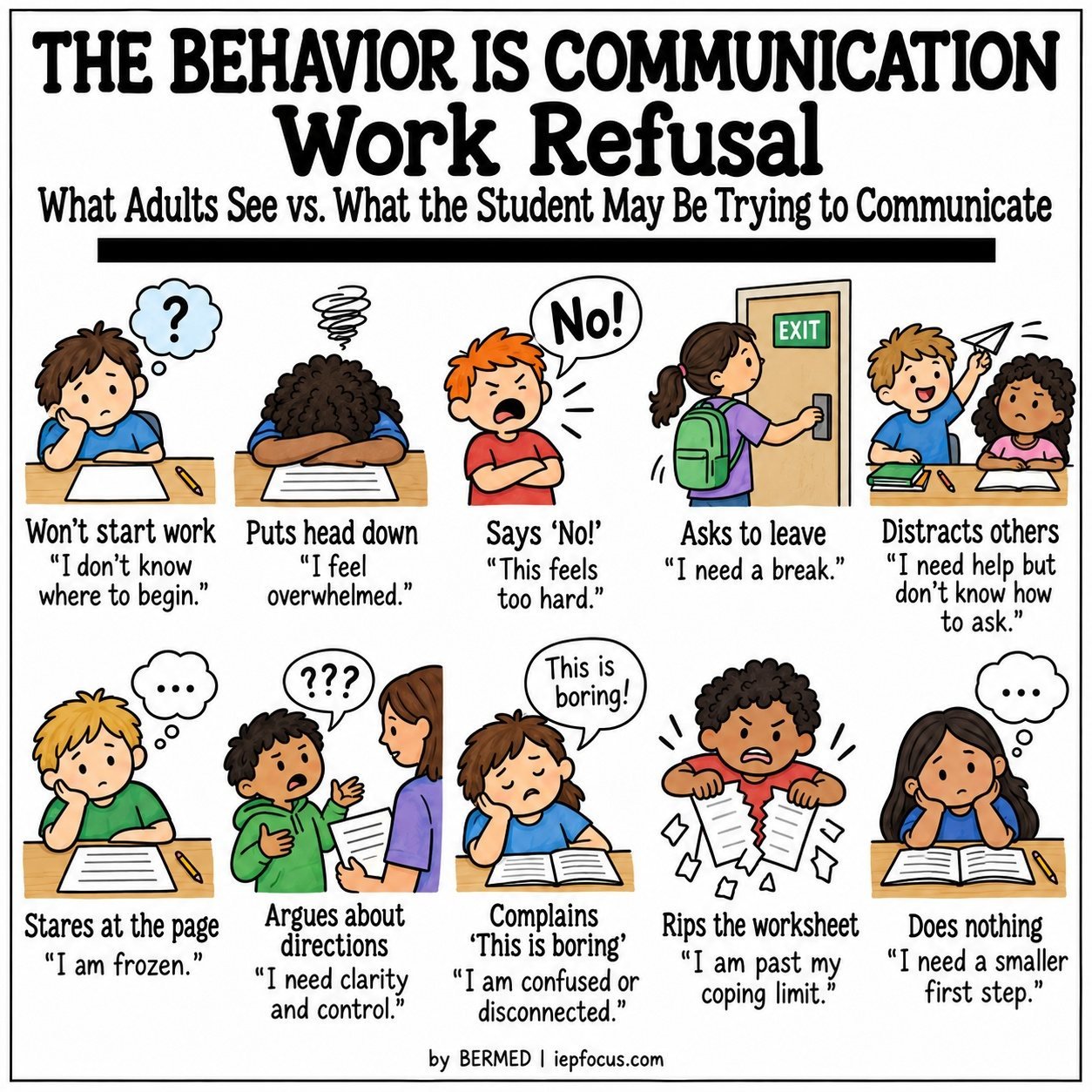
| What adults see | What the student may be trying to communicate |
|---|---|
| Won’t start work | “I don’t know where to begin.” |
| Puts head down | “I feel overwhelmed.” |
| Says ‘No!’ | “This feels too hard.” |
| Asks to leave | “I need a break.” |
| Distracts others | “I need help but don’t know how to ask.” |
| Stares at the page | “I am frozen.” |
| Argues about directions | “I need clarity and control.” |
| Complains ‘This is boring’ | “I am confused or disconnected.” |
| Rips the worksheet | “I am past my coping limit.” |
| Does nothing | “I need a smaller first step.” |
What helps:
- Give a tiny first step: “Write your name and the first answer, then check with me.”
- Show a finished example so the student can see what done looks like.
- Offer a choice of order or tool, such as pencil or keyboard, problem 1 or problem 3.
- Teach and post a help signal, like a card on the desk, so asking for help is private.
- Check in after one or two minutes instead of waiting for the work to be finished.
Avoid: Repeating the direction louder, threatening loss of recess, or adding more work as a consequence.
2. Leaving the Area: What the Student May Be Trying to Communicate
Leaving is often the student’s own regulation strategy. The body says “too much,” and moving away is the fastest way to lower the load. The goal is not to stop the movement but to make it safe and planned.
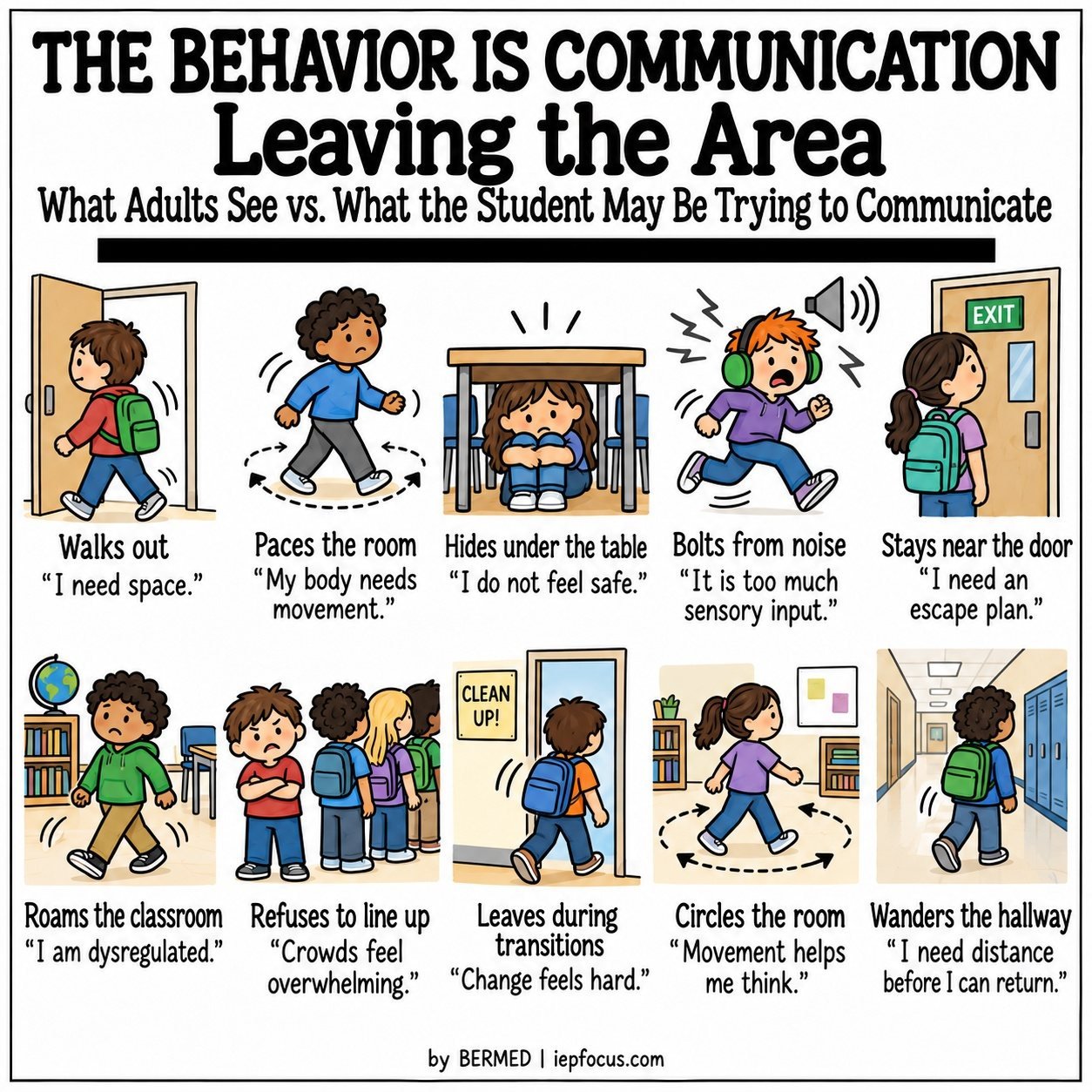
| What adults see | What the student may be trying to communicate |
|---|---|
| Walks out | “I need space.” |
| Paces the room | “My body needs movement.” |
| Hides under the table | “I do not feel safe.” |
| Bolts from noise | “It is too much sensory input.” |
| Stays near the door | “I need an escape plan.” |
| Roams the classroom | “I am dysregulated.” |
| Refuses to line up | “Crowds feel overwhelming.” |
| Leaves during transitions | “Change feels hard.” |
| Circles the room | “Movement helps me think.” |
| Wanders the hallway | “I need distance before I can return.” |
What helps:
- Create a planned break spot inside or near the room, and teach when and how to use it.
- Give a break pass that does not require explaining in front of peers.
- Preview transitions with a visual schedule and a 2 minute warning.
- Let the student line up first or last to avoid crowding.
- Build movement into the lesson: standing work, errands, stretch breaks.
Avoid: Chasing the student, blocking the door, or forcing an immediate return before the body is calm.
3. Calling Out and Interrupting: What the Student May Be Trying to Communicate
Calling out is very common in students with ADHD, anxiety and language differences. The thought feels urgent, and working memory makes holding it in very hard.
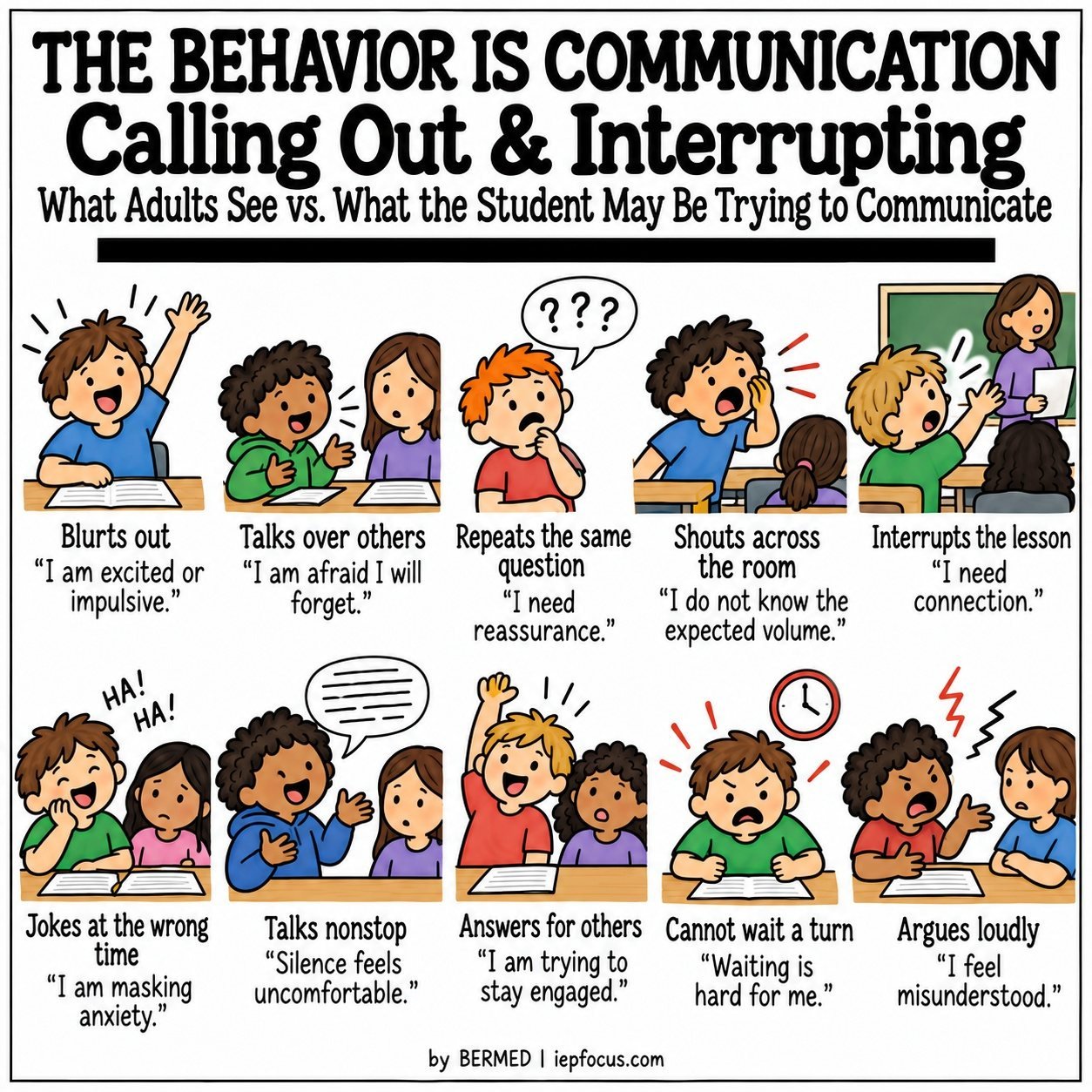
| What adults see | What the student may be trying to communicate |
|---|---|
| Blurts out | “I am excited or impulsive.” |
| Talks over others | “I am afraid I will forget.” |
| Repeats the same question | “I need reassurance.” |
| Shouts across the room | “I do not know the expected volume.” |
| Interrupts the lesson | “I need connection.” |
| Jokes at the wrong time | “I am masking anxiety.” |
| Talks nonstop | “Silence feels uncomfortable.” |
| Answers for others | “I am trying to stay engaged.” |
| Cannot wait a turn | “Waiting is hard for me.” |
| Argues loudly | “I feel misunderstood.” |
What helps:
- Give a place to park the idea: sticky notes, a whiteboard or a “thought jar.”
- Use whole class response tools, such as mini whiteboards or turn and talk, so everyone answers.
- Teach and show voice levels with a visual scale.
- Give planned connection: a quick check-in at the door, a classroom job.
- Praise specific waiting: “You held that thought, thank you.”
Avoid: Public correction every time, ignoring the student completely, or taking away participation as punishment.
4. Shutting Down: What the Student May Be Trying to Communicate
A shutdown is the quiet side of overload. It is easy to miss because the student is not disruptive, but the stress level can be as high as in a meltdown.
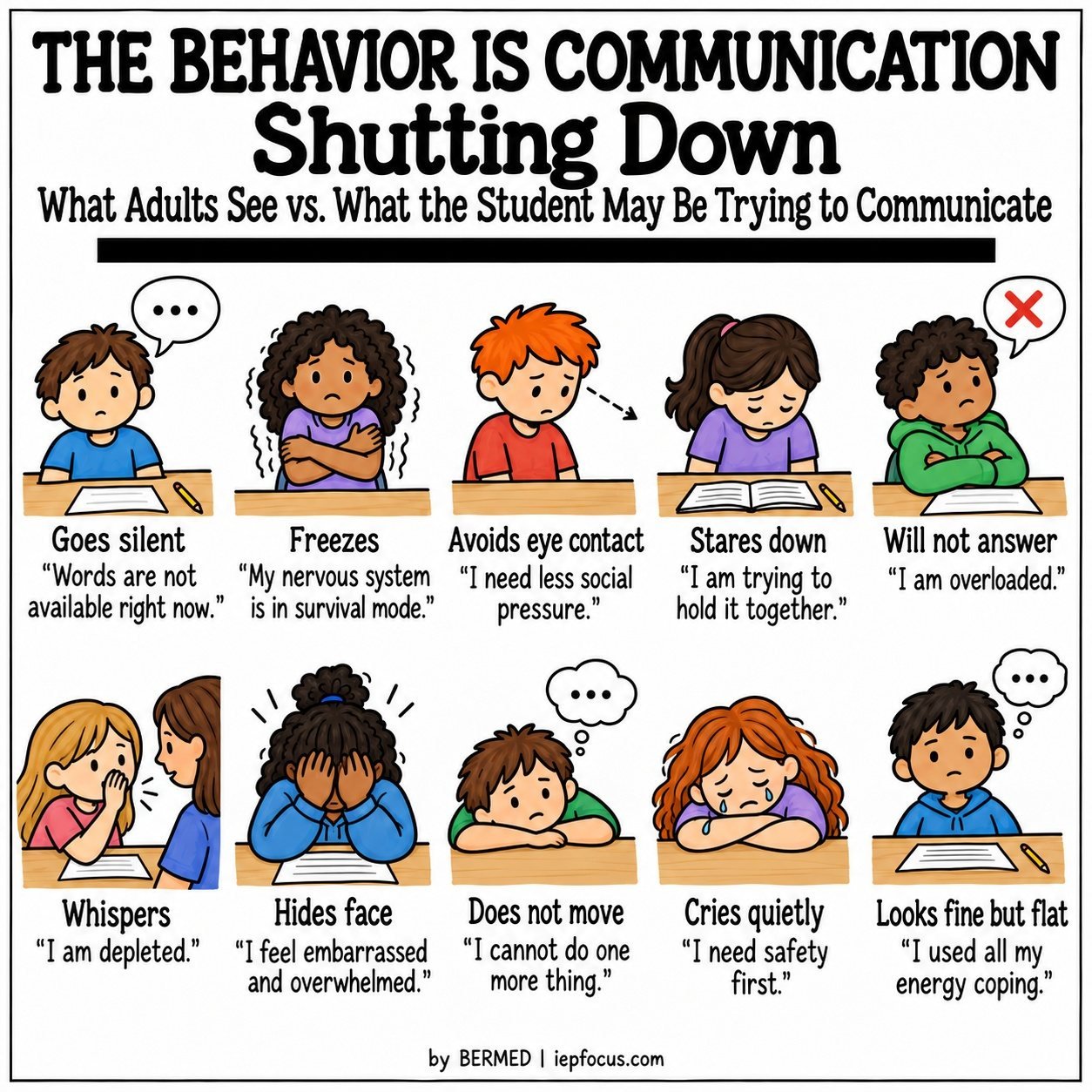
| What adults see | What the student may be trying to communicate |
|---|---|
| Goes silent | “Words are not available right now.” |
| Freezes | “My nervous system is in survival mode.” |
| Avoids eye contact | “I need less social pressure.” |
| Stares down | “I am trying to hold it together.” |
| Will not answer | “I am overloaded.” |
| Whispers | “I am depleted.” |
| Hides face | “I feel embarrassed and overwhelmed.” |
| Does not move | “I cannot do one more thing.” |
| Cries quietly | “I need safety first.” |
| Looks fine but flat | “I used all my energy coping.” |
What helps:
- Lower language: fewer words, calm voice, no questions that demand answers.
- Offer a non-verbal way to communicate, such as pointing, cards or writing.
- Give time and a quiet space without an audience.
- Reconnect later with a gentle check-in once the student is regulated.
- Look at what came before: noise, social stress, demands, fatigue.
Avoid: Demanding eye contact, insisting on an answer, or reading silence as defiance.
5. Aggression and Throwing: What the Student May Be Trying to Communicate
Aggression is the most frightening behavior for adults, and the most urgent signal from the student. In the moment, the brain is in survival mode. Safety comes first, teaching comes later.
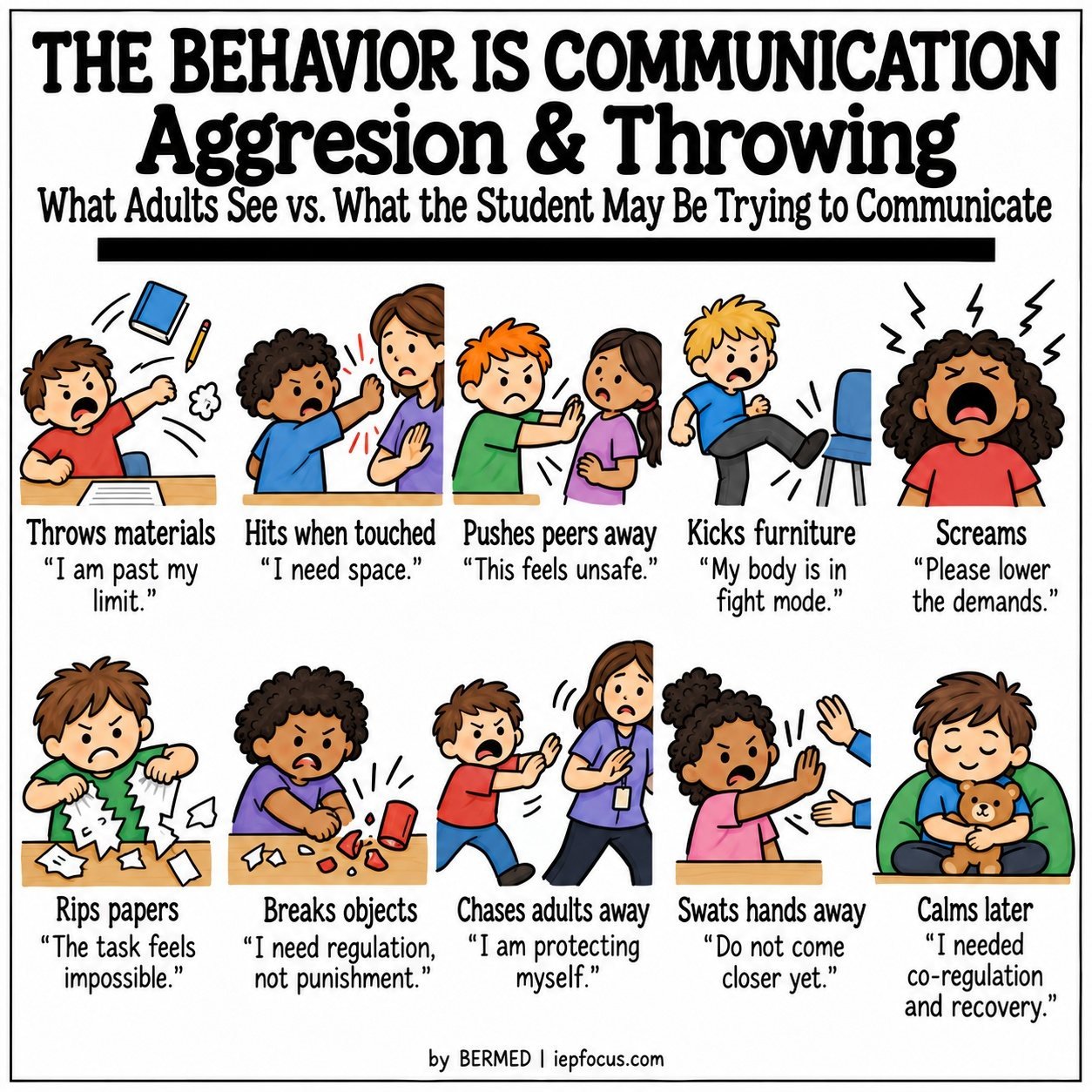
| What adults see | What the student may be trying to communicate |
|---|---|
| Throws materials | “I am past my limit.” |
| Hits when touched | “I need space.” |
| Pushes peers away | “This feels unsafe.” |
| Kicks furniture | “My body is in fight mode.” |
| Screams | “Please lower the demands.” |
| Rips papers | “The task feels impossible.” |
| Breaks objects | “I need regulation, not punishment.” |
| Chases adults away | “I am protecting myself.” |
| Swats hands away | “Do not come closer yet.” |
| Calms later | “I needed co-regulation and recovery.” |
What helps:
- Keep everyone safe: move other students, remove objects, give space.
- Use few words and a calm, low voice. Do not argue or lecture during the crisis.
- Avoid touching unless it is necessary for safety.
- After calm, repair and reflect together: what happened before, what can help next time.
- If aggression repeats, ask for a functional behavioral assessment and a behavior plan.
Avoid: Grabbing the student, raising your voice, or applying consequences while the student is still dysregulated.
6. Arguing and Defiance: What the Student May Be Trying to Communicate
Defiance usually grows from a need for control, fairness or safety. Students with anxiety, PDA profiles or past negative experiences can feel direct demands as threats.
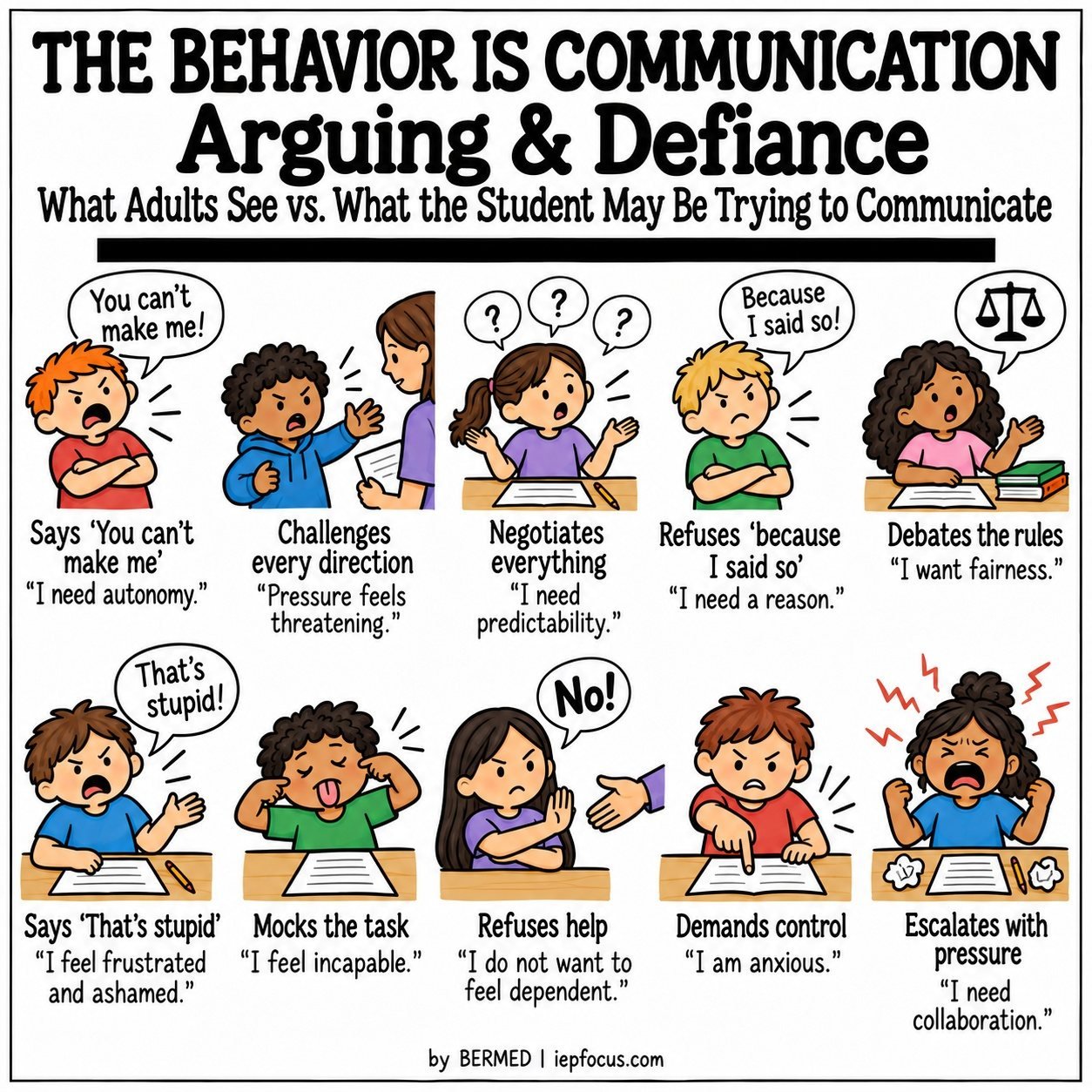
| What adults see | What the student may be trying to communicate |
|---|---|
| Says ‘You can’t make me’ | “I need autonomy.” |
| Challenges every direction | “Pressure feels threatening.” |
| Negotiates everything | “I need predictability.” |
| Refuses ‘because I said so’ | “I need a reason.” |
| Debates the rules | “I want fairness.” |
| Says ‘That’s stupid’ | “I feel frustrated and ashamed.” |
| Mocks the task | “I feel incapable.” |
| Refuses help | “I do not want to feel dependent.” |
| Demands control | “I am anxious.” |
| Escalates with pressure | “I need collaboration.” |
What helps:
- Give the reason behind rules, briefly.
- Offer two acceptable choices instead of one order.
- Use declarative language: “I notice the timer is almost done” instead of “Stop now.”
- Solve recurring problems together at a calm time, not in the moment.
- Protect dignity: correct privately, avoid power struggles in front of peers.
Avoid: Getting into a public debate, “winning” the argument, or escalating consequences step by step.
7. Crying and Emotional Explosions: What the Student May Be Trying to Communicate
When tears seem too big for the moment, the moment is usually not the cause. The cup was already full, and one small thing made it overflow.
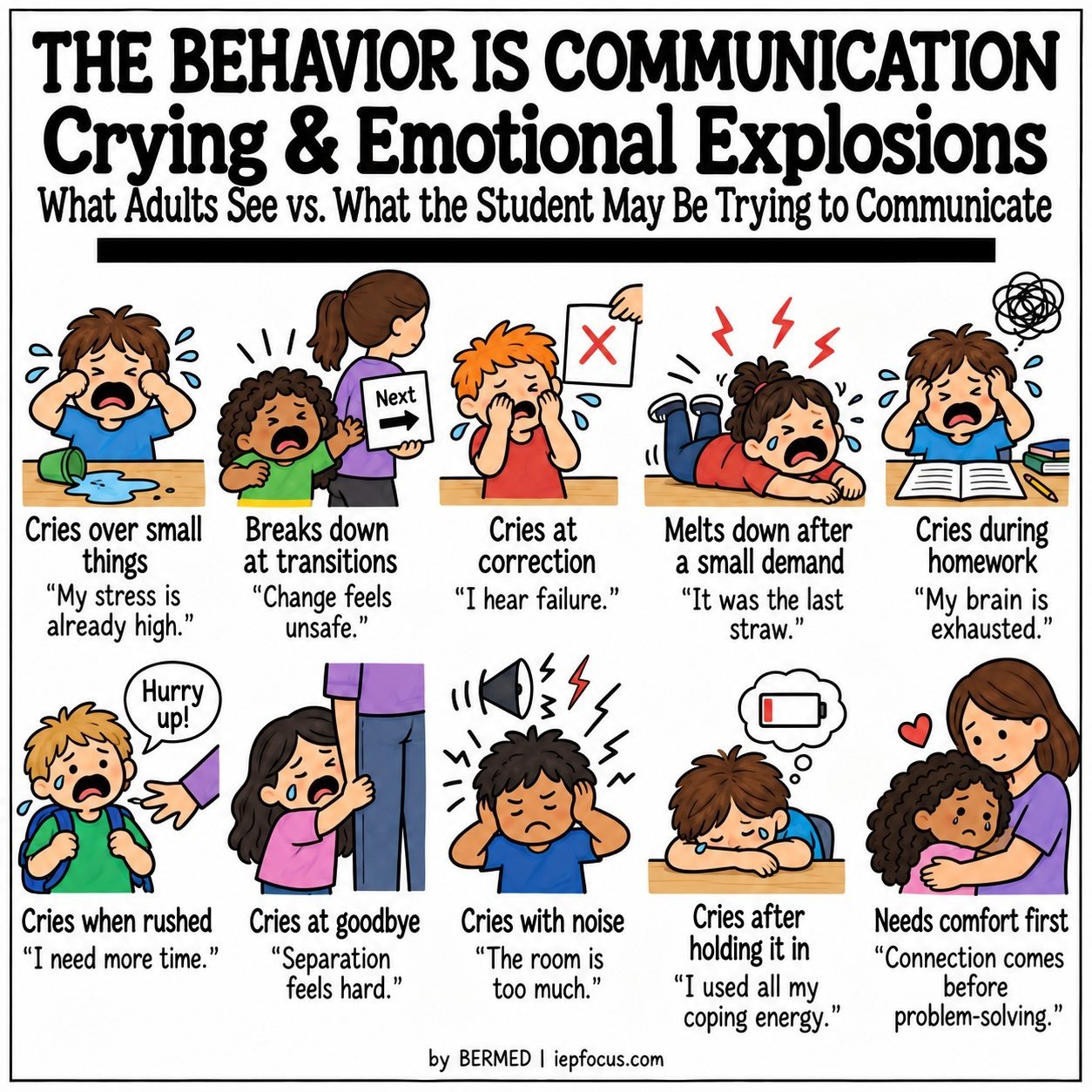
| What adults see | What the student may be trying to communicate |
|---|---|
| Cries over small things | “My stress is already high.” |
| Breaks down at transitions | “Change feels unsafe.” |
| Cries at correction | “I hear failure.” |
| Melts down after a small demand | “It was the last straw.” |
| Cries during homework | “My brain is exhausted.” |
| Cries when rushed | “I need more time.” |
| Cries at goodbye | “Separation feels hard.” |
| Cries with noise | “The room is too much.” |
| Cries after holding it in | “I used all my coping energy.” |
| Needs comfort first | “Connection comes before problem-solving.” |
What helps:
- Connect before correcting: name the feeling and stay close.
- Lower demands until the student is calm.
- Give feedback in small, kind doses, starting with what went well.
- Prepare transitions and goodbyes with routines and visual supports.
- Track patterns across the day to see when the cup fills up.
Avoid: “Stop crying,” “It’s not a big deal,” or sending the student away alone while still upset.
8. Escape Behaviors and Clinginess: What the Student May Be Trying to Communicate
Escape and clinginess are two sides of the same need: feeling safe enough to try. Some students move away from the hard thing, others move closer to a trusted adult.
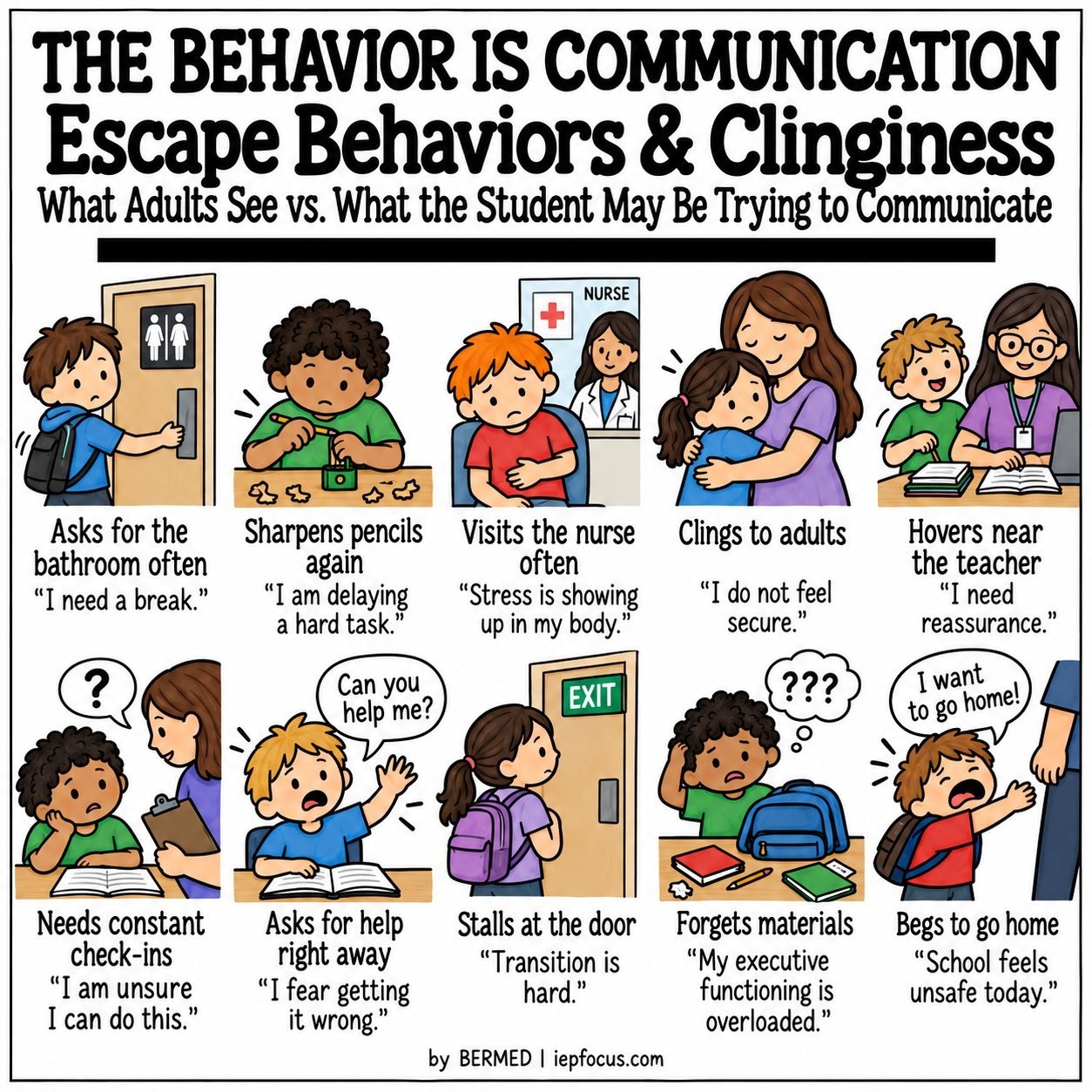
| What adults see | What the student may be trying to communicate |
|---|---|
| Asks for the bathroom often | “I need a break.” |
| Sharpens pencils again | “I am delaying a hard task.” |
| Visits the nurse often | “Stress is showing up in my body.” |
| Clings to adults | “I do not feel secure.” |
| Hovers near the teacher | “I need reassurance.” |
| Needs constant check-ins | “I am unsure I can do this.” |
| Asks for help right away | “I fear getting it wrong.” |
| Stalls at the door | “Transition is hard.” |
| Forgets materials | “My executive functioning is overloaded.” |
| Begs to go home | “School feels unsafe today.” |
What helps:
- Schedule breaks before the student needs to escape.
- Break tasks into short parts with a check-in after each.
- Teach a script for asking for help after one try: “I tried this, can you check?”
- Use a consistent arrival routine and a familiar adult at the door.
- Keep a spare set of materials so forgetting does not become a crisis.
Avoid: Denying all breaks, labeling the student “attention seeking,” or ignoring frequent stomachaches and headaches.
9. Silly or Off-Task Behavior: What the Student May Be Trying to Communicate
Being the class clown can protect a student from looking “stupid,” give needed sensory input or win the connection they crave. Humor is often a coping tool, not a lack of respect.
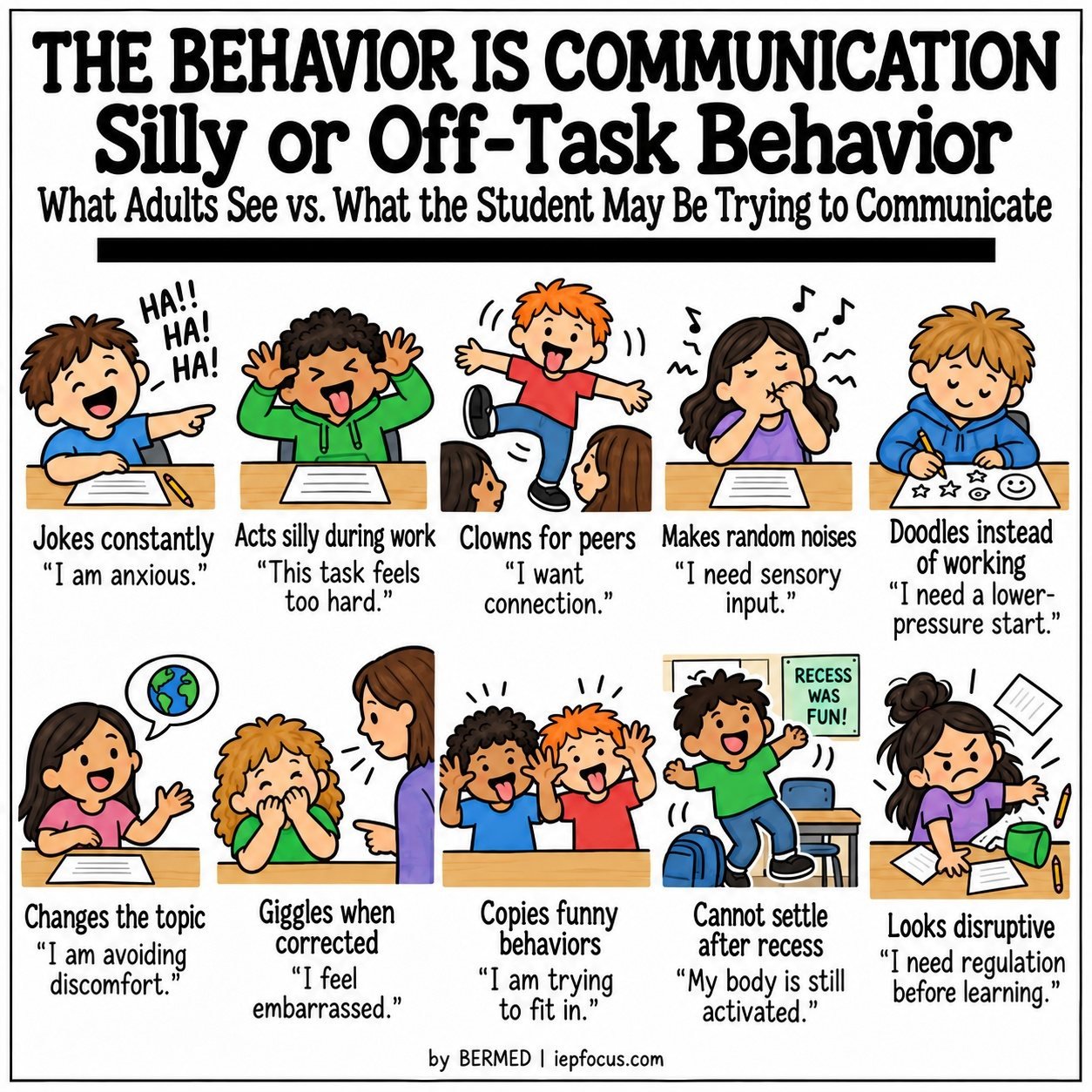
| What adults see | What the student may be trying to communicate |
|---|---|
| Jokes constantly | “I am anxious.” |
| Acts silly during work | “This task feels too hard.” |
| Clowns for peers | “I want connection.” |
| Makes random noises | “I need sensory input.” |
| Doodles instead of working | “I need a lower-pressure start.” |
| Changes the topic | “I am avoiding discomfort.” |
| Giggles when corrected | “I feel embarrassed.” |
| Copies funny behaviors | “I am trying to fit in.” |
| Cannot settle after recess | “My body is still activated.” |
| Looks disruptive | “I need regulation before learning.” |
What helps:
- Check task difficulty first: can the student actually do it alone?
- Give positive roles for humor and connection, such as a class job or a leadership role.
- Offer sensory tools: fidgets, movement breaks, chewing gum if allowed.
- Use a calming routine after recess: lights low, water, two minutes of breathing.
- Redirect privately with a smile instead of public correction.
Avoid: Shaming in front of peers, sarcasm, or treating every joke as disrespect.
10. Sleepy, Zoned Out or Slowed Down: What the Student May Be Trying to Communicate
Quiet, tired students rarely get referred, yet they may be struggling the most. Masking, poor sleep, slow processing and working memory limits all look like low motivation from the outside.
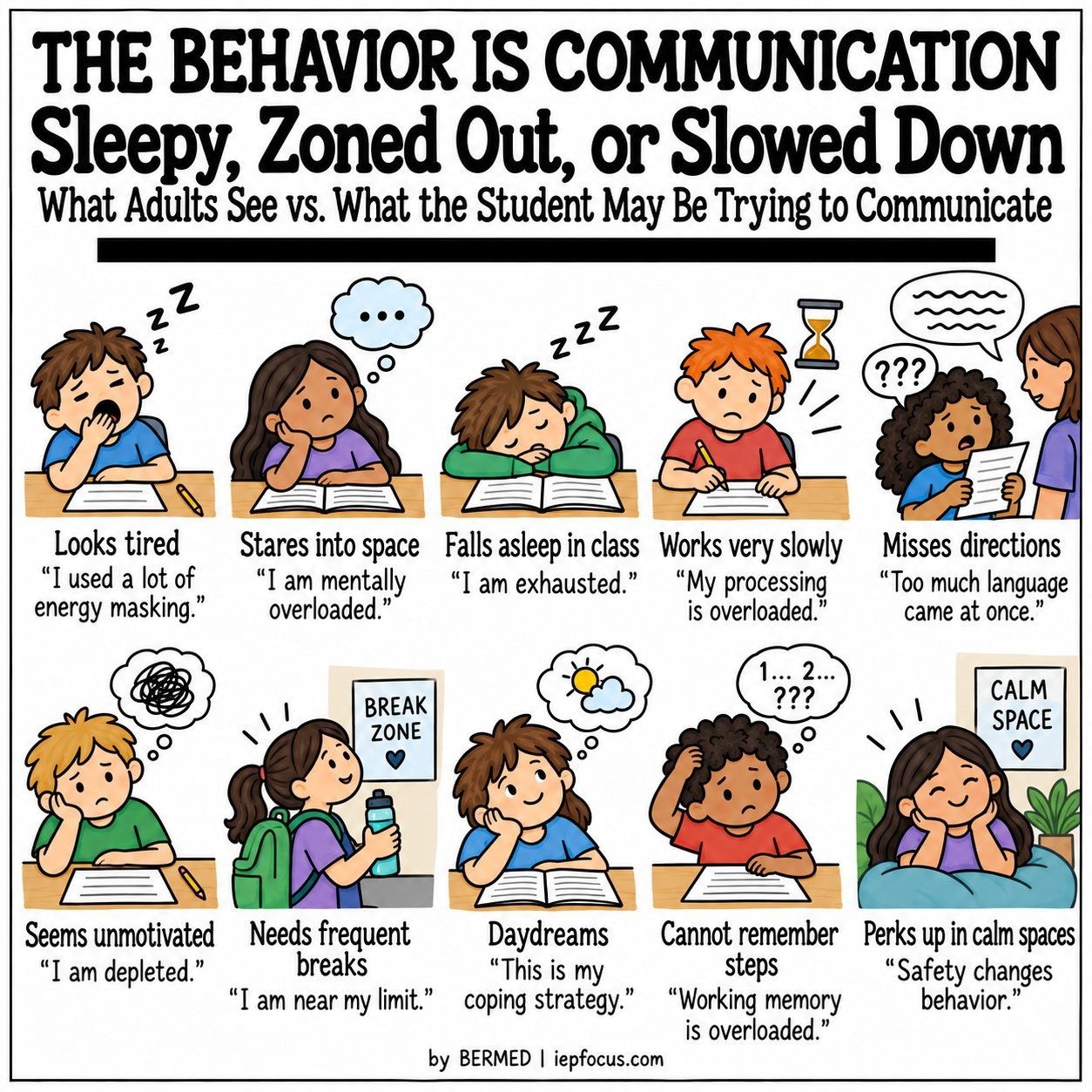
| What adults see | What the student may be trying to communicate |
|---|---|
| Looks tired | “I used a lot of energy masking.” |
| Stares into space | “I am mentally overloaded.” |
| Falls asleep in class | “I am exhausted.” |
| Works very slowly | “My processing is overloaded.” |
| Misses directions | “Too much language came at once.” |
| Seems unmotivated | “I am depleted.” |
| Needs frequent breaks | “I am near my limit.” |
| Daydreams | “This is my coping strategy.” |
| Cannot remember steps | “Working memory is overloaded.” |
| Perks up in calm spaces | “Safety changes behavior.” |
What helps:
- Give directions in short steps and in writing.
- Offer a checklist the student can tick off.
- Check basics with families: sleep, food, medication changes.
- Provide short movement or calm breaks before energy drops.
- Notice and protect the spaces where the student does well.
Avoid: Calling the student lazy, waking them with public comments, or loading extra work as a consequence.
The BERMED Decoding Routine
Use these six steps whenever a behavior repeats. Behavior is communication, and this routine helps you read the message.
- B: Behavior. Describe exactly what you see, without labels like “defiant” or “lazy.”
- E: Events before. Note what happened just before: task, transition, noise, correction, people.
- R: Result after. What did the behavior get or help the student avoid?
- M: Message. Use the posters to guess the message: “I need a break,” “I do not feel safe.”
- E: Equip. Teach a safer way to send the same message: a break card, a help signal, a script.
- D: Data. Track for two weeks to see if the new support reduces the behavior.
When Behavior Is Communication: Ask for a Functional Behavioral Assessment
When a behavior is frequent, intense or unsafe, a formal functional behavioral assessment (FBA) helps the team identify its function and build a behavior intervention plan (BIP). Research supports this approach. A meta-analysis of 82 single case studies of students with ADHD found that function-based interventions produced significantly larger effects than interventions not based on function (Miller and Lee, Journal of Behavioral Education, 2013).
Under IDEA, when a student’s behavior impedes learning, the IEP team must consider positive behavioral interventions and supports. An FBA is required in certain discipline situations, for example when a behavior leading to a change of placement is found to be a manifestation of the disability (Arizona Department of Education, summary of 34 CFR 300.530 and 300.324). Families and teachers can request an FBA at any time when they are concerned.
For more support, see our guides on supporting students with emotional dysregulation, de-escalation scripts for teachers, co-regulation strategies, the calm corner in the classroom and the difference between a meltdown and a tantrum.
5 Actions to Take This Week
- Choose one student and one behavior that repeats.
- Find the matching poster and circle the two messages that fit best.
- Write down what happens before and after the behavior for five days.
- Teach one replacement: a break card, a help signal or a calm space routine.
- Share what you learn with the family and the support team.
Behavior Is Communication FAQ
What does “behavior is communication” mean?
It means every behavior sends a message about a need, such as help, a break, safety, connection or sensory relief, especially when a student cannot yet express that need in words.
Does behavior is communication mean no consequences?
No. Safety and clear expectations still matter. The difference is that adults also respond to the need behind the behavior and teach a better way to express it.
What are the four functions of behavior?
Attention or connection, escape or avoidance, access to tangibles, and sensory input or relief.
How do I find out what a behavior is communicating?
Observe what happens before and after the behavior, look for patterns over several days, ask the student at a calm time, and request a functional behavioral assessment if the behavior is serious.
Is behavior is communication only for autistic students?
No. It applies to all students, including those with ADHD, anxiety, learning disabilities, trauma histories or no diagnosis at all.
In short: Behavior is communication. Work refusal, walking out, calling out, shutting down, aggression, defiance, tears, escape, silliness and zoning out all carry a message. When adults decode the message and answer the need, students learn safer ways to communicate and classrooms become calmer for everyone.
Sources
- Smart Kids with LD. Ross Greene on Challenging Behavior (Collaborative and Proactive Solutions)
- Nurturing Potential. Behavior Serves a Purpose: The Four Functions of Behavior
- Miller, F. G. and Lee, D. L. (2013). Do Functional Behavioral Assessments Improve Intervention Effectiveness for Students Diagnosed with ADHD? Journal of Behavioral Education, 22(3)
- Arizona Department of Education. Functional Behavioral Assessment and Behavior Intervention Plans under IDEA
Illustrations: BERMED, iepfocus.com. This article is educational and does not replace an individualized behavior assessment.

