Quick answer: Dysgraphia in the classroom shows up as slow, effortful, hard-to-read handwriting, and often weak spelling, even when a student’s ideas are strong. It is a learning difference in transcription, not a sign of laziness or low ability. The best support combines explicit handwriting and spelling instruction with accommodations like typing, speech to text, extra time, and reduced copying.
In this guide
You ask the class to write three sentences about the experiment. Most students finish in five minutes. One student is still on the first line, pencil gripped hard, letters drifting off the margin, eraser holes in the page. When you ask them to tell you their answer, it is detailed and smart. That gap between thinking and writing is the heart of dysgraphia in the classroom.

What Is Dysgraphia?
The International Dyslexia Association describes dysgraphia as impaired handwriting, which can affect letter formation, spelling, or both. Understood.org adds that it involves transcription skills: handwriting, typing, and spelling, rather than the ability to organize ideas.
Dysgraphia often appears alongside other learning differences. Many students also have dyslexia or ADHD, and some have dyscalculia too. Our overview of types of learning disabilities shows how these overlap.
Key point: A student with dysgraphia spends so much mental energy forming letters that little is left for ideas, spelling, and punctuation. Lowering the handwriting load frees up thinking.
Signs of Dysgraphia in the Classroom
- Handwriting that is hard to read, with uneven size, spacing, or slant
- Very slow copying from the board or a book
- Awkward or tight pencil grip, and complaints of hand pain or fatigue
- Mixing upper and lowercase letters or print and cursive
- Spelling that is much weaker in writing than in speech
- Big difference between oral answers and written work
- Avoiding writing tasks, or shutting down when asked to write
Writing avoidance can look like a behavior problem. It is usually a skill gap plus frustration. If you see escalation around writing, our behavior de-escalation guide can help.
The BERMED Writing Support Framework
Use this checklist to plan support for dysgraphia in the classroom.
- B: Baseline. Collect writing samples, copying speed, and an oral answer to compare.
- E: Explicit instruction. Teach letter formation and spelling directly and often, as IDA recommends.
- R: Reduce the load. Cut copying, give notes, shorten written output where the goal is content.
- M: Modes. Allow typing, speech to text, scribing, or oral answers.
- E: Ergonomics. Pencil grips, slant boards, raised line paper, good seating.
- D: Document. Write accommodations into the IEP or 504 plan and track progress.
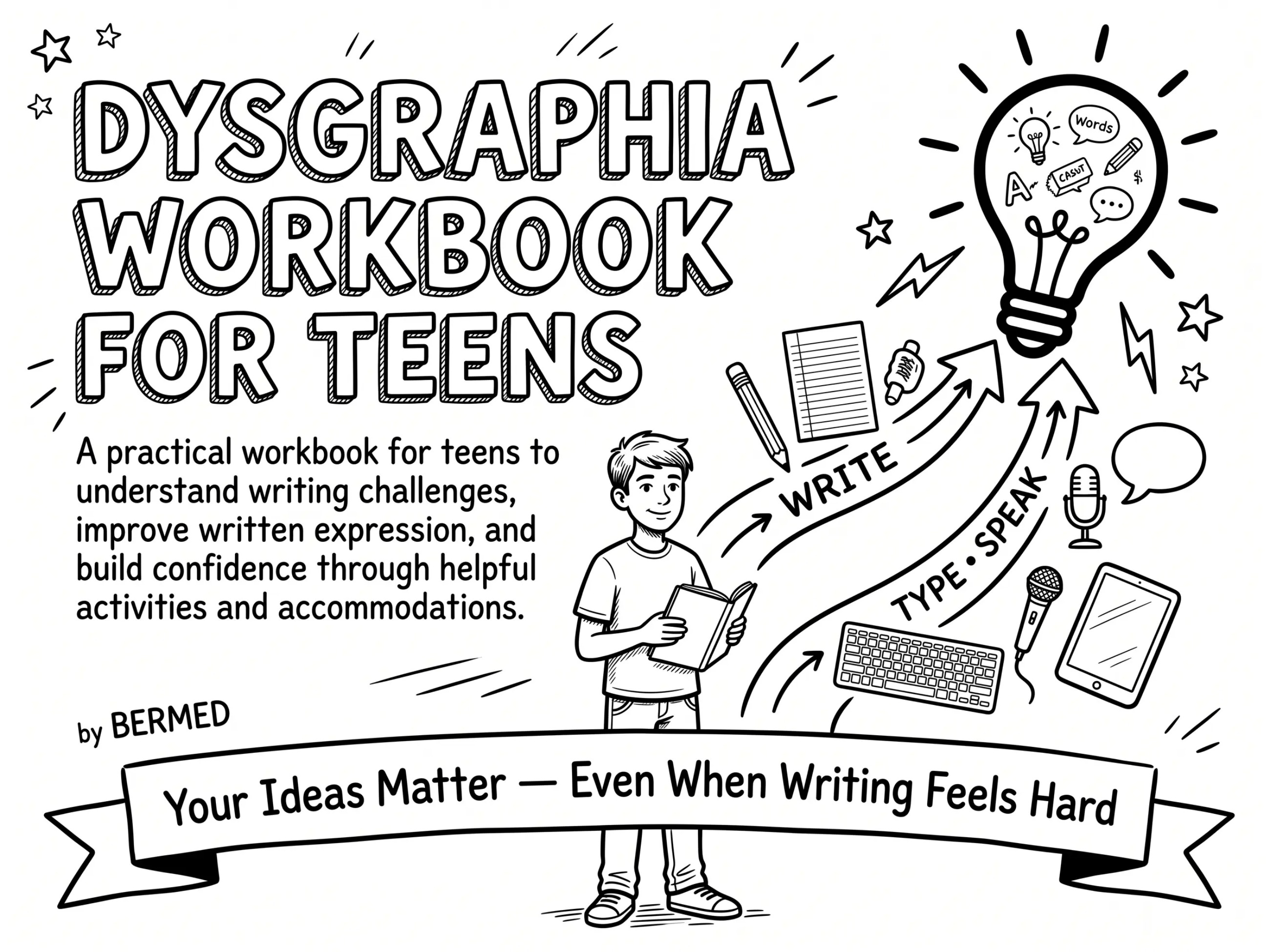
Free resource
Dysgraphia Workbook for Teens
Understand writing challenges and practice strategies that make writing easier.
Dysgraphia Accommodations That Work
| Challenge | Accommodation | Why it helps |
|---|---|---|
| Slow handwriting | Extra time, shorter written tasks | Measures knowledge, not speed |
| Copying from board | Printed notes or photo of the board | Removes a high-load, low-value task |
| Illegible work | Typing or speech to text | Makes ideas readable |
| Spelling | Spell check, word banks | Keeps focus on content |
| Organizing writing | Graphic organizers, sentence starters | Breaks writing into steps |
| Hand fatigue | Grips, breaks, slant board | Reduces physical strain |

Do
- Grade ideas separately from handwriting
- Teach keyboarding early
- Offer choice in how students show learning
- Keep short, daily handwriting practice
Avoid
- Making students recopy messy work
- Taking away recess to finish writing
- Marking down for neatness on content tasks
- Using only accommodations with no instruction
Many of these supports also help with planning and organizing. See executive function accommodations for more ideas.
Dysgraphia IEP Goals and Plans
Dysgraphia can be addressed in an IEP under specific learning disability in written expression, or with accommodations in a 504 plan. Not sure which fits? Read IEP vs 504 plan.
Handwriting goal example: By the annual review, the student will copy a 3 sentence passage with 90% legible letters and correct spacing in 4 of 5 trials.
Keyboarding goal example: The student will type 15 words per minute with 90% accuracy using correct finger placement.
Written expression goal example: Using a graphic organizer and speech to text, the student will produce a 5 sentence paragraph with a topic sentence and 3 details.
Find more examples in our IEP goal bank.

At Home: Supporting a Child With Dysgraphia
- Play with fine motor activities: clay, Lego, tongs, drawing.
- Let your child dictate homework answers while you scribe, when the goal is content.
- Practice typing a few minutes a day with a fun program.
- Ask the school about an occupational therapy evaluation if hand strength or grip is a concern.
Remember: Messy handwriting does not mean a messy mind. Students with dysgraphia often have big ideas. Our job is to build a bridge from their head to the page.
What does dysgraphia look like in the classroom?
Common signs include messy or hard-to-read handwriting, very slow copying, an awkward pencil grip, hand fatigue, poor spelling in writing, and a big gap between oral and written answers.
Is dysgraphia a learning disability?
Yes. Dysgraphia affects written expression and can qualify a student for an IEP under specific learning disability, or for accommodations under a 504 plan.
What accommodations help students with dysgraphia?
Helpful accommodations include extra time, printed notes, typing or speech to text, graphic organizers, word banks, pencil grips, and grading ideas separately from handwriting.
Can a child with dysgraphia improve handwriting?
Yes. Explicit, regular instruction in letter formation and spelling helps. Occupational therapy can support grip and motor planning, and keyboarding gives another path to writing.
Is dysgraphia linked to dyslexia or ADHD?
Often. The International Dyslexia Association notes that dysgraphia frequently occurs alongside dyslexia, ADHD, and oral or written language disorders.
5 Actions to Take This Week
- Collect a writing sample and an oral answer on the same question.
- Replace one copying task with printed notes.
- Offer typing or speech to text for one assignment.
- Grade ideas and handwriting separately.
- Raise dysgraphia accommodations at the next IEP or 504 meeting.
Sources