
Quick answer: Your child may need a speech evaluation if they miss speech or language milestones, are hard to understand for their age, have trouble understanding words or directions, stutter for more than a few months, or lose skills they had. A speech evaluation by a speech-language pathologist (SLP) looks at understanding, talking, speech sounds, social communication, play and fluency, and usually includes a hearing check. It is free through early intervention for children under 3 and through the public school district from age 3.
In this guide
Requesting a speech evaluation can feel like a big step, even a sign of failure. It is neither. A speech evaluation gives you facts instead of worries, and if your child is on track, you leave with peace of mind.

Signs Your Child Needs a Speech Evaluation
| Area | Signs |
|---|---|
| Words | No words by 18 months, fewer than 50 words or no phrases by 2 years |
| Understanding | Trouble following directions or answering questions |
| Clarity | Family cannot understand most speech at 3; strangers cannot at 4 |
| Fluency | Stuttering lasting more than 6 months, or with tension and frustration |
| Social | Few gestures, not responding to name, little shared attention |
| Any age | Loss of words or skills |
ASHA advises seeing an SLP when you notice trouble with sounds, words, sentences, following directions or understanding questions (ASHA).
Key point: If you are wondering whether your child needs a speech evaluation, that concern alone is a valid reason to ask.
Where to Get a Speech Evaluation
Free and private options
See early intervention services. For school-age requests, see IDEA special education law.
What Happens During a Speech Evaluation
- Parent interview: history, milestones, concerns.
- Play-based observation of communication.
- Standardized tests of understanding and talking.
- Speech sound and oral-motor check.
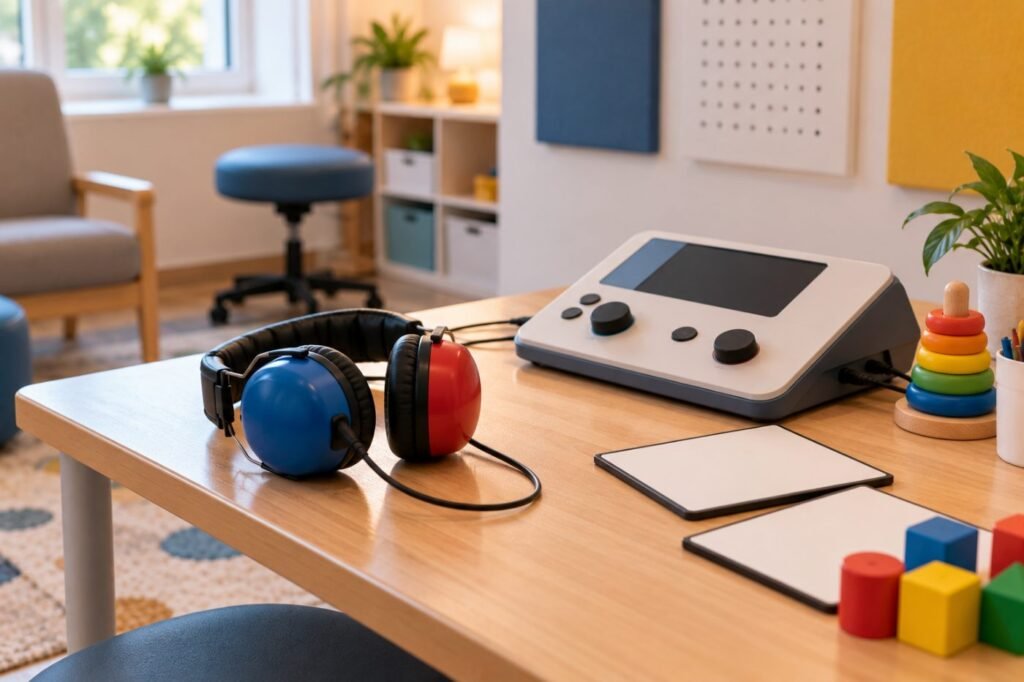
- Hearing screening or referral to an audiologist.
- Results meeting with recommendations.
A hearing test is often part of a speech and language evaluation because hearing affects speech (NIDCD).
How to Prepare
| Bring | Why |
|---|---|
| A word list from the past week | Children often talk less with strangers |
| Short videos of your child talking at home | Shows typical communication |
| Medical and hearing history | Ear infections and prematurity matter |
| Favorite toy or snack | Helps your child feel comfortable |
| Your questions | So you leave with clear next steps |
Request letter to a school district (age 3+)
“I am requesting a full evaluation of my child, Eva Martin, age 3, in speech and language, including understanding, expression and speech sounds. I give consent and request the consent form be sent to me.”

Real-Life Example
Case story
Eva, 3, was hard to understand even for her parents. They sent a written request to the school district. The evaluation found a speech sound disorder with typical language. Eva qualified for preschool speech services twice a week, and her teacher learned cues to support her in class.
Related: See speech milestones by age and articulation disorders in children.
Speech Evaluation FAQ
How long does a speech evaluation take?
Usually 1 to 2 hours, sometimes across two visits.
Do I need a doctor’s referral?
Not for early intervention or school evaluations; insurance may require one.
What if my child does not talk during the test?
Your videos and word list help; SLPs are used to shy children.
Is a speech evaluation free?
Yes through early intervention and public schools.
What happens after?
You receive results and, if eligible, an IFSP, IEP or therapy plan.
In short: A speech evaluation turns worry into a plan. Ask early, bring examples and include a hearing test. This article is part of our Speech Delay series.
Was this article helpful?
Tap a star to rate
Sources
- ASHA. Childhood Spoken Language Disorders
- NIDCD. Speech and Language Developmental Milestones
- CPIR. Post-Referral Procedures (Part C)
This article is educational and does not replace professional advice.

