IEP Planner 2026-2027: The Essential Tool to Cut Teacher Workload

Special education paperwork does not take more hours because there is more work. It takes more hours because the same information gets tracked in three or four different places. The IEP Planner 2026-2027 consolidates caseload management, IEP meeting prep, goal tracking, and parent communication into a single 251-page system, so the workload itself does not shrink, but the time lost hunting for information does.

Ask a special education teacher what actually exhausts them by November, and it is rarely the meetings themselves. It is rewriting the same accommodation list for the third time this month. It is scrolling through old emails to remember what was promised to a parent in September. It is opening four different documents to prepare for one thirty-minute IEP meeting.

The common mistake is treating this as a time-management problem that willpower will eventually fix. It is not. It is a systems problem. Research on special educator burnout consistently points to administrative workload and role stress, not classroom instruction itself, as the strongest predictors of exhaustion. A planner will not remove a single legal requirement from your caseload. What it can do is stop you from doing the same organizational work over and over, which is where most of the wasted hours actually live.
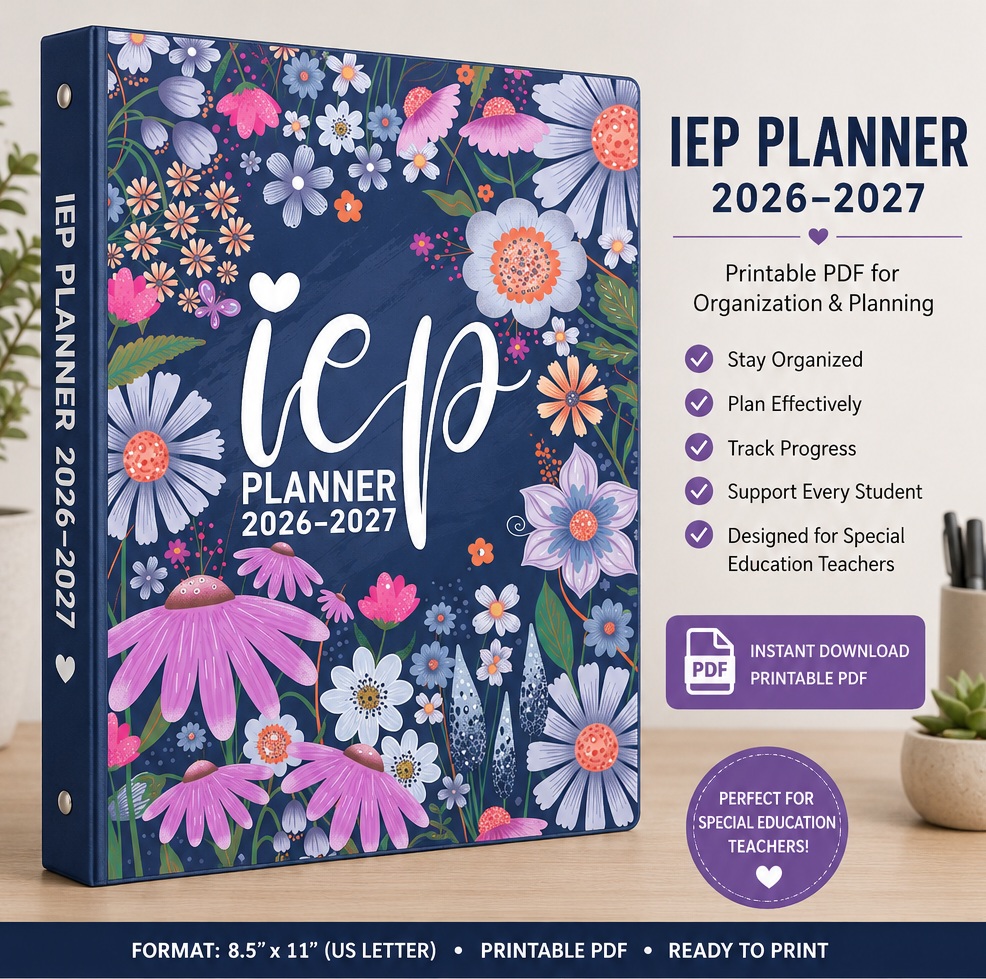
IEP Planner 2026-2027 mockup showing the caseload management and IEP tracking pages
The IEP Planner 2026-2027, 251 pages built for a 30-student caseload.
53% Of K-12 teachers reported feeling burned out in RAND’s 2025 State of the American Teacher survey
30 Average student caseload for a U.S. special education case manager
29 Studies reviewed linking administrative workload and role stress to special educator burnout

Why Paperwork, Not Teaching, Is the Real Workload Problem

General classroom teachers plan lessons and manage a shared calendar. Special education case managers do that too, and on top of it, they carry legal responsibility for every IEP on their caseload: annual reviews, re-evaluations, goal progress, accommodation implementation, and a documented paper trail of parent communication for every single student. None of that disappears because a teacher is tired. It just gets shuffled between whatever notebook, spreadsheet, or sticky note is closest at hand, which is exactly what turns a manageable caseload into a constant, low-grade sense of falling behind.

For the legal side of what these responsibilities actually require, see our companion guide on what an IEP is and how it functions in schools.

Compliance note: Under the Individuals with Disabilities Education Act (IDEA), annual IEP reviews must occur at least every 12 months, and re-evaluations at least every 3 years. These deadlines do not adjust for how full your week already is, which is exactly why they need a system that surfaces them automatically instead of one you have to remember to check.

How the IEP Planner 2026-2027 Is Built to Cut the Busywork

The IEP Planner 2026-2027 is a 251-page PDF designed around one idea: every piece of information a case manager needs during the school year should live in a predictable, dedicated place, not scattered across separate systems that all need updating separately.

Comprehensive table of contents — find any section in seconds instead of flipping pages during a meeting
Teacher information section — certifications, professional development, and contact info kept in one place
Year at a Glance (2026-2027) — the full academic year visible at once, so nothing catches you off guard
IEP meeting management — dates, times, checklists, and notes, so meeting prep stops being a scramble
Monthly and weekly planner (July 2026–June 2027) — one calendar for appointments, deadlines, and lesson planning instead of three
IEP caseload management for up to 30 students — organized by student name for quick access, no searching required
IEP Snapshot — accommodations, goals, and progress for each student on a single concise page
IEP meeting checklist and notes — a structured tracker so nothing gets overlooked before or during a meeting
IEP goals tracker — monitor progress over time without a separate spreadsheet
Small group tracker — plan up to 10 groups of 5 students each without rebuilding the schedule weekly
Assignment and accommodation tracker — modifications and support strategies recorded where you will actually see them again
IEP team specialist contact info — every collaborator’s details within reach, no digging through email
Parent engagement log — calls, emails, and meeting summaries in one place, organized by student
Passwords log and resource section — credentials, useful websites, and recommended readings, without the daily password hunt

For goal-writing support that pairs directly with the IEP Goals Tracker, see our IEP Goal Bank guide, covering measurable, neuroaffirming goal language across disability categories.

In the Classroom, Concretely

It is Tuesday morning and a parent stops a case manager in the hallway to ask about her son’s reading accommodations. Without a system, that means promising to “check and get back to her,” then spending part of lunch searching a shared drive for the right document.

With the IEP Snapshot and Assignment and Accommodation Tracker in one planner, the answer is on a single page: current accommodations, last progress note, and the date they were last discussed with the family. The conversation happens in the hallway, in under two minutes, and nothing gets added to the evening to-do list.

251 pages
Clean, structured layout
8.5″ x 11″
Fits any briefcase or school bag
PDF format
Print at home or annotate on a tablet

When to Set This Up

Today

If you are already re-explaining the same case to yourself every week, the time you lose searching for information is costing you more than the time it takes to set up a system.

This week

Before your next round of fall IEP meetings, fill in all 30 student sections so every accommodation and deadline is visible from the start.

Long term

Log parent contact and goal progress weekly, not just before a meeting. The workload reduction only holds if the habit does.

Stop rebuilding your caseload tracking from memory every week. See the full IEP Planner 2026-2027.

View the IEP Planner on TPT →

Frequently Asked Questions

Will a planner actually reduce my workload, or just organize it?
It organizes it, and that is exactly what reduces the workload. The legal responsibilities of a caseload do not shrink, but the time spent searching for information, rewriting the same notes, and reconstructing context before every meeting does. That search-and-reconstruct time is where most of the daily overload actually comes from.
Is this planner digital, printable, or both?
It is a PDF, so you can print and bind it at home for a physical planner or annotate it directly on a tablet with any standard PDF app.
Does it cover lesson planning as well as IEP tracking?
Yes. The monthly and weekly planner sections cover appointments, deadlines, and lesson planning from July 2026 through June 2027, alongside the dedicated IEP caseload, goals, and meeting management sections.
How many students does it support?
The caseload management system is built for up to 30 students, organized by name, matching the average caseload size for a U.S. special education case manager.

What to Do Next

  • Open the product preview on TPT and check the table of contents before deciding if it fits your caseload.
  • If it fits, get the IEP Planner 2026-2027 and fill in your 30 student sections before your first fall meeting.
  • Log your very next parent conversation directly into the Parent Engagement Log, to build the habit early instead of retrofitting it in October.
  • Mark your closest annual review and re-evaluation dates first, since those carry the hardest compliance consequences.
  • Set a five-minute weekly check-in with the IEP Goals Tracker, so progress data never has to be reconstructed from memory before a meeting.

Sources

RAND Corporation. “State of the American Teacher Survey, 2025.” rand.org, 2025.

Brunsting, N. C., Morin, L. E., Gómez, L. R., Jones, B., Bettini, E., Cumming, M. M., Garwood, J. D., & Ruble, L. A. “Burnout and Occupational Wellbeing of Special Education Teachers: Recent Research Synthesized.” Review of Educational Research, 2026.

U.S. Department of Education, Office of Special Education Programs. “About IDEA.” sites.ed.gov/idea/about-idea, 2026.

More from author

LEAVE A REPLY

Please enter your comment!
Please enter your name here

Recommended

IEP Individualized Education Programspot_img

Latest posts

ADHD Test: The Complete Screening Quiz for Teachers, Parents & Adults (2026)

Take a free ADHD test built for teachers, parents, or adults. Get an instant subscale score, a named pattern, and clear next steps to take right away.

What Is Pathological Demand Avoidance (PDA)? A Complete Guide for Parents & Educators

What is pathological demand avoidance? An anxiety-driven autism profile. Learn the signs, the PDA vs ODD difference, and what actually helps in 2026.

Types of Learning Disabilities: A Complete Guide (2026)

Types of learning disabilities explained: dyslexia, dyscalculia, dysgraphia and more, plus signs by age, how testing works, and IEP accommodations by type.

Want to stay up to date with the latest news?

We would love to hear from you! Please fill in your details and we will stay in touch. It's that simple!