In This Guide
- What Does a Resource Teacher Actually Do in First Grade?
- Why Does First Grade Matter More Than Any Other Year?
- IN CLASS: Differentiation Strategies That Work on Monday Morning
- How Does the Resource Teacher Collaborate With the General Ed Teacher?
- What Are Strong IEP Goals for a First-Grade Resource Setting?
- AT HOME: How to Partner With First-Grade Families
- LIFE: Building Independence Foundations in Year One
- The BRIDGE Framework: A Practical System for Resource Teachers
- FAQ

Here is the mistake most first-grade resource teachers make in September: they wait. They wait for data. They wait for the general ed teacher to flag struggling students. They wait to see if the child will “catch up on their own.” A 2022 NIH study tracking children from kindergarten through fifth grade found that students who entered special education before or during first grade showed dramatically superior reading gains compared to those who entered in second or third grade, and that gap widened over the follow-up years. The window is not just important. It is closing faster than we think.
The second mistake: treating the resource room as a remediation waiting room rather than a strategic learning environment. First grade is the year the brain solidifies the phonological code. It is the year children either internalize that reading is a decipherable system, or conclude, quietly, that it is not for them. The resource teacher in first grade is not a support act. She is the architect of the child’s reading identity.
This guide covers everything a resource teacher needs to be effective in first grade: the full scope of the role, evidence-based differentiation strategies, the six co-teaching models and when to use each, SMART IEP goals with examples, and a family partnership framework grounded in neuroaffirmative practice. Whether you are new to the position or ten years in, there is something here to use tomorrow morning.
What Does a Resource Teacher Actually Do in First Grade?
The resource teacher role is one of the most misunderstood in elementary schools. Administrators sometimes describe it as “helping kids who need extra support.” That is accurate the way “drives a vehicle” describes a Formula 1 race. The actual scope is far more demanding.
← Scroll to see full table →
| Responsibility Area | What It Looks Like in First Grade | Time Investment (weekly) |
|---|---|---|
| Direct Instruction | Small-group phonics, decoding, math fluency sessions (3–5 students max) | 8–12 hrs |
| Co-Teaching | Parallel, station rotation, or team teaching in the gen ed classroom | 4–6 hrs |
| IEP Management | Goal tracking, progress notes, data collection, annual review prep | 3–5 hrs |
| Assessment | Diagnostic reading/math probes, DIBELS, curriculum-based measures | 1–2 hrs |
| Collaboration | Co-planning with gen ed teacher, team meetings, specialist consultations | 2–3 hrs |
| Family Communication | Progress updates, IEP meeting facilitation, home strategy coaching | 1–2 hrs |
| Behavior & SEL Support | Regulation check-ins, FBA data collection, visual supports, social scripts | 2–3 hrs |
Notice that direct instruction, the part most people picture, accounts for roughly half the role. The rest is coordination, documentation, and relationship-building. First-grade resource teachers who collapse under their caseload are often those who have not established efficient systems for the non-instructional half of the job.
7:45 AM: Pull two phonics groups back-to-back (15 min each) before morning meeting. 9:30 AM: Co-teach during whole-class reading block, station rotation model, resource teacher runs the decoding station. 11:15 AM: IEP data logging for three students, update progress-monitoring spreadsheet. 12:30 PM: Lunch and 10-minute co-planning check-in with gen ed teacher. 1:00 PM: Small-group math intervention (place value, counting-on strategy). 2:15 PM: Regulation support during transition, brief check-in with a student who had a hard morning. 2:45 PM: Phone call to a parent with a quick wins update.
Why Does First Grade Matter More Than Any Other Year?
The research on early literacy intervention is one of the clearest findings in education science. Children who receive specialized reading support in first grade make gains approximately twice as large as children who receive equivalent support starting in third grade, and that advantage holds at follow-up assessments years later.
The neurological explanation is straightforward: the brain’s phonological processing circuits are most plastic between ages 5 and 7. Explicit, systematic phonics instruction during this window builds neural pathways that become increasingly automatic. Wait until third grade, and you are working against a brain that has already begun to consolidate less efficient reading strategies.
This is not a reason for panic, it is a reason for urgency. The resource teacher in first grade has a rare and powerful lever. Using it well means:
- Completing diagnostic assessments in the first three weeks of school, not the first three months
- Prioritizing phonological awareness and phonics above all other literacy sub-skills for students with IEPs
- Structuring intervention frequency at a minimum of three sessions per week, research shows 30-minute sessions three times weekly produce measurable gains within 15 weeks
- Communicating to families in September, not November, what the intervention plan looks like and why it matters
A landmark longitudinal study published in PMC/NIH (2022) tracked children from first grade through fifth grade and found that earlier special education entry was significantly associated with superior reading achievement. First-grade intervention participants continued growing at faster rates than second-grade participants on six of eight key reading outcomes at follow-up. The finding held even after controlling for IQ and vocabulary.
IN CLASS What Differentiation Strategies Work Best for First-Grade Resource Settings?
Differentiation in a first-grade resource room is not about making things easier. It is about making the same rigorous content accessible through a different entry point. The most effective resource teachers in first grade consistently use a small set of high-leverage strategies rather than trying to do everything.
1. Explicit, Systematic Phonics (Non-Negotiable)
The Science of Reading consensus is unambiguous: students with reading disabilities require explicit, systematic phonics instruction with immediate corrective feedback. This means the resource teacher introduces one phoneme-grapheme correspondence at a time, uses blending drills, practices with decodable texts, and tracks mastery before moving forward. Programs like RAVE-O, Wilson Reading, and SPIRE are evidence-based starting points, but the key variables are explicitness and sequencing, not the specific program.
2. Concrete–Representational–Abstract (CRA) for Math
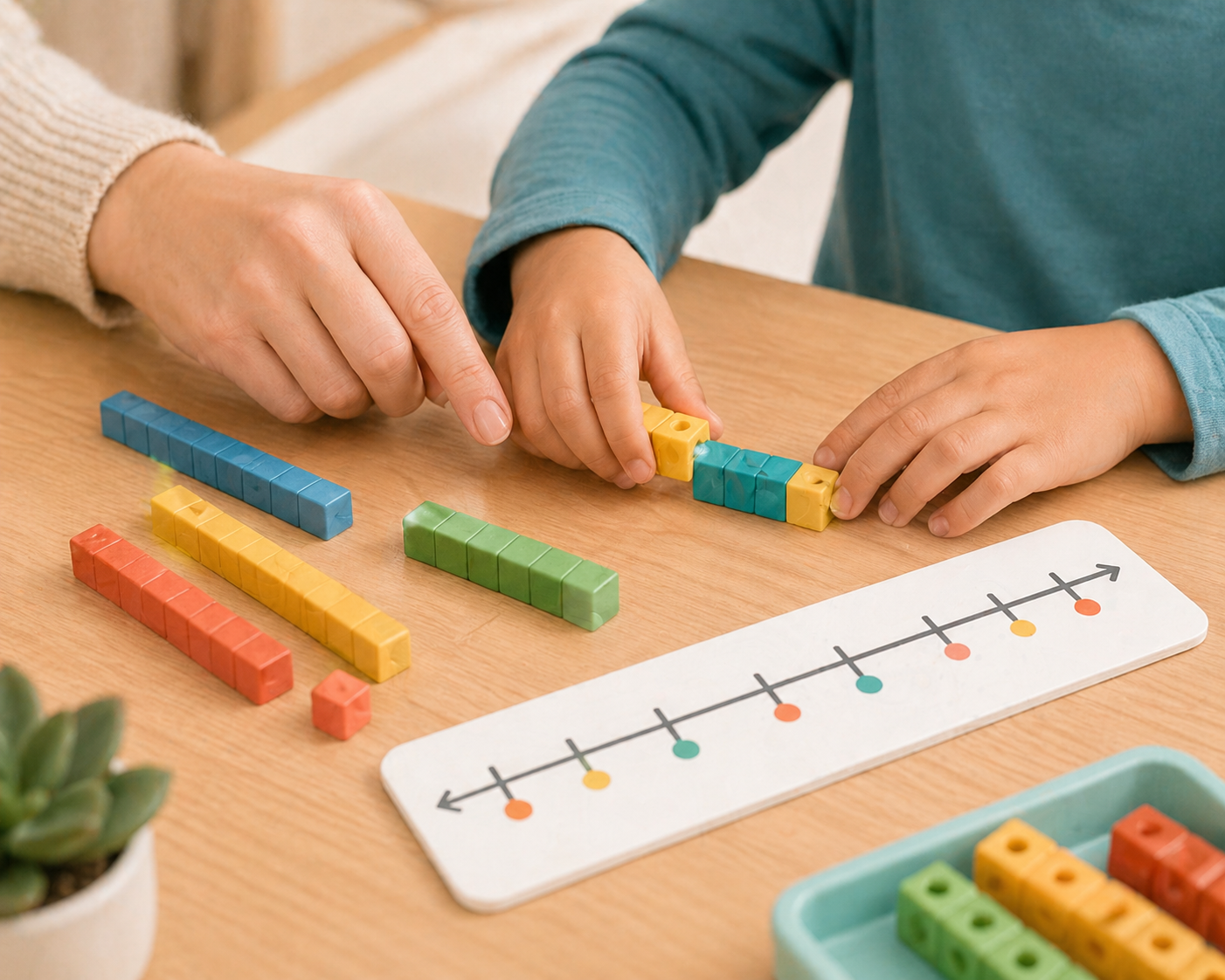
First-graders with math learning differences respond exceptionally well to the CRA progression: manipulatives first (base-ten blocks, linking cubes), then drawings or diagrams, then abstract numerals. Resource teachers who jump straight to worksheets are skipping the neurological foundation. A child who can physically group ten cubes into a rod before they see “10” written develops place-value understanding that is far more durable.
3. Visual Supports and Anchor Charts
First-graders with language processing differences, autism, or working-memory challenges benefit from persistent visual references. A phonics wall, a counting-on strategy anchor chart, a morning routine visual schedule, these are not crutches. They are external scaffolds that free up cognitive bandwidth for higher-order thinking. The goal is always gradual release: the scaffold stays until the student demonstrates internalization, then fades.
4. Choral Response and Immediate Feedback Loops
Small-group instruction in the resource room should look energetic, not quiet. Choral response (whole group answers simultaneously), partner turns, mini whiteboards for show-and-erase, these active response formats provide a response opportunity every 30–60 seconds and give the teacher real-time data on understanding. A student who is passive in a group of three is not hiding; something is not landing.
5. Regulation-First Routines
A regulated nervous system is a prerequisite for learning. First-grade students arriving to the resource room from a chaotic hallway transition or a frustrating whole-class lesson need a brief, predictable re-entry ritual: a two-minute breathing exercise, a sensory fidget, a quick movement break. Resource teachers who skip this step often spend the first fifteen minutes of a session managing behavior rather than teaching. A 90-second regulation check-in prevents thirty minutes of dysregulation.
← Scroll to see full table →
| Strategy | Target Skill Area | Evidence Base | Implements In |
|---|---|---|---|
| Explicit phonics (systematic scope & sequence) | Decoding / reading fluency | Strong (IES Practice Guide) | Day 1 |
| CRA progression | Math number sense | Strong (What Works Clearinghouse) | Day 1 |
| Visual supports + anchor charts | Language, memory, executive function | Moderate–Strong | Day 1 |
| Choral response / active responding | Engagement + real-time formative data | Moderate (PBIS research base) | Week 1 |
| Regulation routines (pre-session) | Self-regulation / readiness to learn | Strong (PBIS, Zones of Regulation) | Day 1 |
| Decodable text practice | Reading fluency + decoding transfer | Strong (Science of Reading) | Week 2 |
| Peer-assisted learning structures | Reading / math fluency | Strong (PALS research) | Month 1 |
IN CLASS How Does the Resource Teacher Collaborate With the General Ed Teacher?
Co-teaching research is encouraging but sobering. A 2021 research analysis found that students with disabilities performed better in language arts and math in team-taught classrooms than in special-education-only settings. But the same body of research consistently identifies two obstacles that derail collaboration: insufficient shared planning time and unclear role delineation. These are structural problems, not personality problems, and they require structural solutions.
The Six Co-Teaching Models: First Grade Applications

← Scroll to see full table →
| Model | What Happens | Best For in Grade 1 | Caution |
|---|---|---|---|
| One Teach, One Observe | One teacher leads; the other collects behavioral/engagement data | FBA data collection; early-year baseline | Avoid overuse, resource teacher should never only observe |
| One Teach, One Support | One teacher leads; the other circulates and supports | Whole-class phonics review lessons | Most common, least effective when overused (Edutopia, 2025) |
| Parallel Teaching | Both teachers teach the same content to half the class simultaneously | Phonics instruction, math games, oral reading practice | Requires solid co-planning for parity |
| Station Teaching | Students rotate between multiple stations; each teacher runs one | Literacy centers, math rotations, ideal model for grade 1 | Transition management must be explicitly taught |
| Alternative Teaching | One teacher takes a small group for re-teaching or enrichment | Pre-teaching vocabulary before a new unit; targeted reteach | Avoid stigmatizing always the same students |
| Team Teaching | Both teachers co-deliver instruction simultaneously | Morning meeting, shared read-aloud, explicit phonics lessons | Requires the highest level of partnership and trust |
The research is clear that effective co-teaching requires both educators to be genuinely equal partners, co-planners, co-instructors, and co-assessors. A resource teacher who arrives at the classroom door, circulates to “her” students for forty minutes, then leaves has not co-taught. She has supervised.
The 10-Minute Monday Check-In: Set a standing 10-minute Monday morning meeting (before students arrive) with the general education teacher. Agenda: (1) What IEP accommodations are active this week? (2) Which students need pre-teaching before Thursday’s unit? (3) What is each teacher’s role during the Friday assessment? Protect this time fiercely. Co-teaching without co-planning is improvisation, not inclusion.
What Are Strong IEP Goals for a First-Grade Resource Setting?
Weak IEP goals are one of the most persistent problems in special education. Goals that say “the student will improve reading skills” are not measurable, not motivating, and not legally sufficient under IDEA. Strong first-grade IEP goals are SMART: Specific, Measurable, Achievable, Relevant, and Time-bound. They reference the grade-level standard the student is working toward and specify the exact conditions and criteria for mastery.
Literacy IEP Goals: First Grade
← Scroll to see full table →
| Skill Area | Example IEP Goal | Progress Measure |
|---|---|---|
| Phonemic awareness | By [annual IEP date], when given 10 spoken words, the student will segment each word into individual phonemes with 80% accuracy across 3 consecutive sessions. | Phoneme segmentation fluency probe (weekly) |
| Phonics / decoding | By [annual IEP date], when presented with a list of 20 CVC and CVCE words, the student will correctly decode 16/20 words in two consecutive probes. | Word reading probe (bi-weekly) |
| Reading fluency | By [annual IEP date], the student will read a first-grade decodable passage at 40 words per minute with no more than 3 errors, as measured on 3 separate occasions. | DIBELS ORF or curriculum probe (monthly) |
| Reading comprehension | By [annual IEP date], after listening to or reading a 1–2 paragraph grade-level text, the student will answer 3/4 literal comprehension questions with 75% accuracy. | Comprehension checklist (bi-weekly) |
| Phonological awareness (rhyme) | By [annual IEP date], when given pairs of words, the student will correctly identify rhyming vs. non-rhyming pairs with 90% accuracy across 3 sessions. | Rhyme identification task (weekly) |
Math IEP Goals: First Grade
← Scroll to see full table →
| Skill Area | Example IEP Goal | Progress Measure |
|---|---|---|
| Counting and cardinality | By [annual IEP date], when given a set of up to 20 objects, the student will count and state the total with 90% accuracy across 4 consecutive trials. | Counting task (weekly) |
| Addition within 10 | By [annual IEP date], the student will solve addition equations within 10 using a counting-on strategy, achieving 8/10 correct on three consecutive assessments. | Math fact fluency probe (bi-weekly) |
| Place value (tens and ones) | By [annual IEP date], when given two-digit numbers up to 50, the student will correctly identify the tens and ones digits with 80% accuracy using manipulatives, then independently. | Place value task (monthly) |
| Problem solving | By [annual IEP date], when read a one-step word problem with a visual support, the student will select the correct operation and produce an answer with 75% accuracy. | Problem-solving probe (bi-weekly) |
Social-Emotional and Behavioral IEP Goals
← Scroll to see full table →
| Area | Example IEP Goal |
|---|---|
| Self-regulation | By [annual IEP date], when given a regulation visual scale, the student will independently identify their zone and select a coping strategy with adult prompt fading to verbal cue only, across 4/5 opportunities per week. |
| Task initiation | By [annual IEP date], when given a two-step visual task card, the student will begin the assigned task within 2 minutes without a verbal prompt in 4/5 daily observations. |
| Peer interaction | By [annual IEP date], during structured partner activities, the student will initiate and maintain a 3-turn conversation with a peer in 3/5 opportunities per week. |
| Transition | By [annual IEP date], when given a 2-minute transition warning, the student will complete the classroom transition without a behavioral incident on 4/5 school days. |
AT HOME How Does the Resource Teacher Partner With First-Grade Families?
First-grade families are anxious. They are watching their child navigate learning for the first time, and many of them carry their own histories with school, some of those histories are painful. A resource teacher who communicates only during IEP meetings is missing the most powerful lever she has.
Neuroaffirmative family partnership means three things in practice:

- Clarify the IEP in plain language at the first meeting, not jargon, not acronyms, not deficit framing. “Here is what Marcus is great at, and here is the specific thing we are working on together.”
- Offer one home strategy at a time. Families of first-graders are already stretched. One phoneme-a-week home routine beats a 12-page packet they will never open.
- Note wins proactively. A 90-second voice message or a one-sentence class app update saying “Maya decoded her first CVCE word today” builds more trust than three crisis calls in a row.
- Navigate evaluation results with the family present, not before or after. They are part of the team; treat them as primary experts on their child.
- Explain the “why” behind every accommodation. When families understand that extended time is about processing speed, not intelligence, they advocate more effectively at home and at school.
- Co-create the home communication plan. Ask: How do you prefer updates, app, email, weekly note? Respecting that preference is inclusion too.
- Track and share progress data at every IEP meeting in visual form, a simple bar chart is more meaningful to most families than a paragraph of numbers.
James’s mother comes to the October IEP meeting convinced her son is “just slow” and has resigned herself to a difficult school career. The resource teacher opens with: “I want to show you something James did this week.” She plays a 30-second video of James successfully segmenting a three-phoneme word, the first time this week he attempted it without prompting. By the time the formal IEP review begins, the mother’s posture has changed. The meeting ends with her asking to see the phonics scope and sequence so she can do “the little practice cards” at home. That shift did not happen because of legal compliance. It happened because of one video clip and a teacher who understood that family hope is an intervention tool.
LIFE Building Independence Foundations in Year One
First grade feels early to think about long-term independence. It is not. The foundational skills that predict adolescent and adult self-determination, self-advocacy, task persistence, flexible thinking, and tolerance of difficulty, begin forming in the earliest school experiences. Resource teachers who design their first-grade instruction with long-term autonomy in mind make different choices than those who are focused only on grade-level benchmarks.
Self-Advocacy Starts at Age 6
Teaching a first-grader to say “I need more time” or “Can you show me again?” is not a soft skill. It is the beginning of IEP self-determination competency. Resource teachers can build this by modeling the language explicitly (“Watch how I ask for help when I am confused”), reinforcing when students use it, and creating low-stakes opportunities to practice, small-group settings are perfect for this.
Choice Architecture in the Resource Room
Offering structured choice, which task to complete first, which fidget to use, whether to work at the table or the floor, builds executive function and intrinsic motivation simultaneously. The choices must be real and the options must all be acceptable to the teacher. Fake choices (“Would you like to do your work now or start by getting in trouble?”) destroy trust faster than no choice at all.
The BRIDGE Framework: A Practical System for Resource Teachers
After working across hundreds of first-grade cases, I have found that resource teachers who sustain high impact over time share one characteristic: they have a consistent system. The BERMED BRIDGE framework organizes the resource teacher’s week into six non-negotiable domains. Nothing falls through the cracks because everything has a designated place.
- Baseline first: Complete diagnostic assessments in the first two weeks. No goal-writing before data.
- Routines that regulate: Every session begins with a 90-second regulation check-in. Non-negotiable.
- Intentional grouping: Group by skill need, not by disability label. Re-form groups every 6–8 weeks based on data.
- Data visible: Progress-monitoring charts are on the wall of the resource room. Students see their own growth. This is not surveillance, it is agency.
- General ed connected: At least one co-planning touch point per week with each general education teacher on your caseload. Brief is fine. Missing is not.
- Explicit IEP bridges: Every session connects explicitly to at least one IEP goal. Students should be able to answer “What are we practicing today and why?”
More Guides for the Resource Teacher in First Grade
- What is an IEP in education?
- IEP vs 504 plan
- IEP goal bank
- Accommodation cheat sheet for special education
Frequently Asked Questions
5 Things to Do Before Next Monday
- Run a baseline probe on every student on your caseload who does not have current diagnostic reading data. Use DIBELS, AIMSweb, or a phoneme segmentation fluency measure. You cannot write strong IEP goals without a real baseline.
- Schedule your co-planning check-ins with every general education teacher you co-teach with. Put it on both calendars. Ten minutes weekly, protect it.
- Audit your IEP goals for specificity and measurability. If any goal cannot be graphed on a progress-monitoring chart, it needs to be rewritten.
- Send one positive communication to each family on your caseload this week. Voice message, app note, email, one sentence about something their child did well. Do this before you ever call about a concern.
- Add a regulation routine to the start of every resource room session. Ninety seconds. Breathing, movement, or a sensory tool. Track behavior incidents for four weeks. The data will convince you to keep it.
Sources
- Coyne, M. D., et al. (2022). Early intervention for children at risk for reading disabilities: The impact of grade at intervention and individual differences on intervention outcomes. PMC / National Institutes of Health. https://pmc.ncbi.nlm.nih.gov/articles/PMC9164258/
- Friend, M., Cook, L., Hurley-Chamberlain, D., & Shamberger, C. (2010). Co-teaching: An illustration of the complexity of collaboration in special education. Journal of Educational and Psychological Consultation, 20(1), 9–27. Tandfonline
- Spear-Swerling, L. (2015). The reading profiles framework. In Handbook of Reading Disabilities Research. Reading Horizons / Stanford University. Reading Horizons
- Edutopia. (2025). Effective Co-Teaching Strategies. edutopia.org
- Edutopia. (2025). Collaboration Between General and Special Education Teachers. edutopia.org
- Institute of Education Sciences. (2016). Foundational Skills to Support Reading for Understanding in Kindergarten Through 3rd Grade. IES Practice Guide. ies.ed.gov
- What Works Clearinghouse. (2021). Teaching Math to Young Children. U.S. Department of Education. ies.ed.gov/wwc
- Individuals with Disabilities Education Act (IDEA), 20 U.S.C. § 1400 (2004). sites.ed.gov/idea