
These de-escalation scripts for teachers are short on purpose, because stressed brains cannot process long sentences.
Most classroom de-escalation training focuses on what to do with your body: keep your voice calm, give space, use open hands. What gets far less attention is the exact language coming out of your mouth. In seventeen years of observing SPED classrooms, one pattern stands out above all others: teachers who are physically calm but verbally commanding still escalate students. The nervous system doesn’t just read tone, it reads meaning, autonomy, and threat.
Here’s the mistake almost everyone makes: treating a behavioral crisis as a compliance problem. When a student yells, shuts down, or refuses to move, the instinctive response is a command, “Stop that right now,” “You need to calm down,” “Go back to your seat.” Every one of those phrases signals threat to a dysregulated nervous system. And a nervous system reading threat cannot learn, cannot comply, and cannot reconnect. It can only defend.
This article gives you 10 field-tested, neuroscience-grounded scripts for the most common classroom escalation scenarios, plus the research explaining why each phrase works at the level of the brain, not just good manners.
Why Your Words Matter More Than Your Rules
Research from the Center on Positive Behavioral Interventions and Supports (PBIS) is clear: despite well-designed, safe, and predictable school environments, students will still reach points of acute dysregulation, and the adult’s verbal response in that moment directly determines whether the situation stabilizes or spirals. Punitive or exclusionary language doesn’t just fail to work; it actively worsens behavioral outcomes over time by reinforcing shame cycles and eroding the relational safety students need to regulate.
The implication for educators is profound: you aren’t just managing behavior in the moment. Every verbal interaction during a crisis is either building or eroding the neural templates your students carry into every future confrontation, with you, and with every other adult in their lives.
The Neuroscience Behind the Scripts
Understanding why these scripts work requires a brief look at Polyvagal Theory, the neurobiological framework developed by Dr. Stephen Porges that has transformed how leading schools think about behavior.
According to Polyvagal Theory, the autonomic nervous system continuously assesses environmental cues for safety or threat: a process Porges calls neuroception. This assessment happens below conscious awareness, milliseconds before a student can think or choose. When neuroception detects threat (including threatening language), the nervous system shifts from the ventral vagal state, the calm, connected state where learning and social engagement happen, into sympathetic activation (fight-or-flight) or, in severe cases, dorsal vagal shutdown (freeze or collapse).
What this means practically: a student who has reached the fight-or-flight or shutdown state cannot comply, even if they want to. The prefrontal cortex, the seat of reasoning, impulse control, and language processing, is functionally offline. Commands and corrections aimed at that offline cortex will always fail. The scripts below are designed to work with the nervous system’s actual wiring, not against it.
Frontiers in Education (2022) documented that schools shifting from punitive to trauma-informed, strengths-based language saw dramatic reductions in behavioral incidents and recovered significant instructional time, not because of new consequences, but because of changed language.
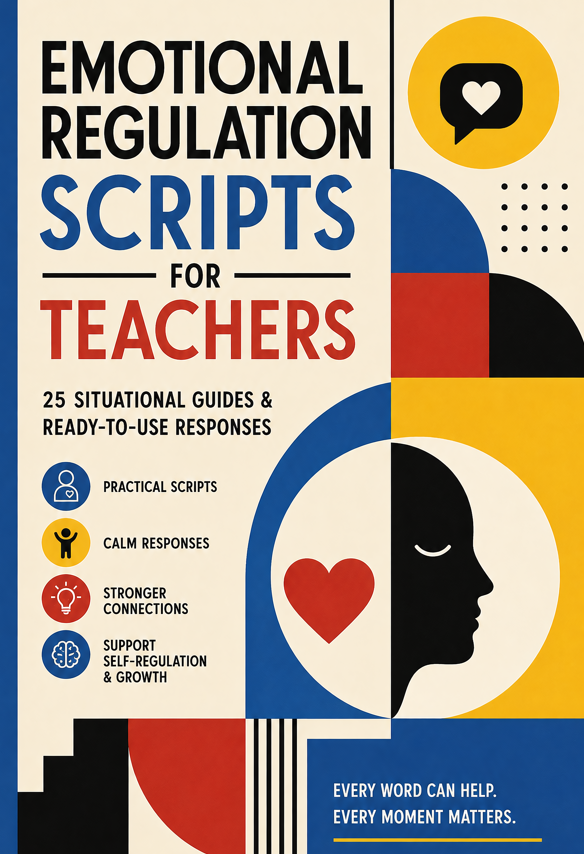
Free resource
Emotional Regulation Scripts for Teachers
25 situational scripts for calm, consistent responses in tough moments.
Download free →10 Ready-to-Use De-Escalation Scripts (With Context)
Each script below is mapped to a specific classroom situation, contrasted with the reflex phrase most teachers default to, and accompanied by a brief explanation of the mechanism at work. Memorize the Try Instead column. Laminate it. Put it on your lanyard.
| # | Situation | ❌ Don’t Say | ✅ Try Instead | Why It Works |
|---|---|---|---|---|
| 1 | Student can’t follow a direction right now | “Don’t talk to me like that!” | “I see you’re upset. Let’s take a minute. We can talk when you’re ready.” | Acknowledges state; removes demand pressure; supports co-regulation |
| 2 | Student yells or slams materials | “That’s it! You’re in trouble!” | “That looks like a big feeling. Let’s find a quieter way to handle it.” | Names emotion without judgment; keeps the relationship intact |
| 3 | Student debates or pushes back | “Stop arguing!” | “I want to hear you. Let’s talk one at a time.” | Validates voice; builds respect and communication |
| 4 | Student avoids work | “Just try harder!” | “This feels hard right now. Let’s break it into smaller steps.” | Reduces cognitive overwhelm; signals task is manageable |
| 5 | Student shuts down | “Come back right now!” | “I’ll stay nearby. Take your time. I’m here when you’re ready.” | Creates safety and trust; honors the shutdown response without abandoning |
| 6 | Student speaks in anger | “Watch your mouth!” | “I hear you’re frustrated. Let’s find calmer words together.” | Teaches emotional expression as a skill, not a character flaw |
| 7 | Student questions a rule | “I’m the teacher!” | “We both want things to go well. Let’s figure this out together.” | Invites collaboration; reduces power-struggle activation |
| 8 | Student struggles with transitions | “Hurry up!” | “Transitions can be hard. Let’s take it step by step.” | Supports predictability; reduces sensory and executive function load |
| 9 | Student feels misunderstood | “Stop making excuses.” | “Let’s think about what you can do next.” | Encourages self-reflection without dismissing experience |
| 10 | Student needs to leave the space | “Go ahead and walk out!” | “I want you to be safe. Let’s take a break and figure out the next step together.” | Honors the flight response; maintains connection and safety without power struggle |
Quick Reminders for In-the-Moment Use
These principles should run in the background of every interaction during a behavioral escalation:
🧭 What to Do
- Keep your voice calm and steady, volume and pace regulate more than content
- Use fewer words, not more, a dysregulated brain cannot process lengthy explanations
- Support first, correct later, relationship before compliance
- Offer simple choices, two options restore a sense of autonomy
- Honor AAC and all forms of communication, a nonverbal response is still a response
- Reflect after, not during, debriefing belongs to the calm window
🚫 What to Avoid
- Arguing logic with a flooded nervous system
- Issuing ultimatums that back the student into a corner
- Involving an audience, peers escalate, they never help
- Touching without explicit consent from a known plan
- Taking behavior personally, it is neurological, not personal
- Using sarcasm or eye-rolls, neuroception reads both instantly
Wisconsin DPI’s prevention framework underscores a key principle: the manner in which adults respond will influence the student’s response. Co-regulation is not a soft concept, it is the mechanism by which a calm nervous system literally entrains a dysregulated one. Your regulated state is the intervention.
Reflection Questions to Use After the Moment
Once the student is calm, and this is critical: not before: these questions invite genuine self-reflection without shame. They are designed to be asked in a quiet, one-to-one setting, with full attention and no rush.
- What was happening for you?
- What was your body trying to tell you?
- What helped you feel better?
- What could help next time?
- What did you learn about yourself?
- And, said aloud as a teacher: What did I (the adult) need in that moment too?
That final question, what did I need?, is not incidental. Research on de-escalation in high-stakes care settings (PMC, 2024) found that adult self-regulation and reflective practice are among the strongest predictors of de-escalation success. Teachers who reflect on their own state don’t just become better at the next crisis, they reduce the frequency of crises by changing their anticipatory language and body language.
A Critical Note for PDA Learners
Reduce direct demands: Replace “Let’s break it into steps” with “I wonder if there’s an easier way to start this…”
Offer genuine choice: “You could do X, Y, or something else entirely, what sounds right?”
Lower the stakes explicitly: “Nothing bad will happen either way. We can figure this out.”
Prioritize safety over compliance: A PDA learner who is dysregulated will never comply under pressure, connection and lowered demand are the only paths back to engagement.
For a deep-dive, see the IEPFOCUS.COM full guide on PDA classroom strategies.
5 Common Language Mistakes That Escalate Instead of Calm
1. The “Calm Down” Command
Telling a dysregulated student to “calm down” is the verbal equivalent of telling someone with a broken leg to walk it off. The student cannot access calm on command, their nervous system is in a defensive state. The phrase also implicitly blames them for being dysregulated, which adds shame to an already overloaded system.
2. The “Why Did You Do That?” Interrogation
Asked during or immediately after a behavioral incident, “why” questions are inaccessible to the brain. As trauma-informed educator Betsy de Thierry notes, the child is often asking the same question internally, “Why did I do that?”: and has no answer. The question signals judgment, not curiosity.
3. The Power-Play Statement
“I’m the teacher.” “Because I said so.” “You don’t have a choice.” These phrases activate threat neuroception instantly in students who have histories of adult authority being used against them. They guarantee an adversarial response.
4. The Public Correction
Correcting or redirecting a student in front of peers is almost never a de-escalation strategy, it is a social threat. The student’s need to protect their reputation will override everything else. Any real work happens privately.
5. The Time-Based Ultimatum
“You have until the count of three.” “You need to be at your desk in thirty seconds.” Time pressure is one of the most powerful nervous-system activators. For many neurodivergent students, particularly those with ADHD, autism, or trauma histories, time urgency is a sensory and cognitive load, not a motivator.
More De-Escalation Scripts for Teachers and Tools
- Behavior de-escalation in the classroom
- Free behavior de-escalation log
- Free sensory needs guide for kids
- Strategies to manage hyperactivity in the classroom
Frequently Asked Questions
Apply It Starting Tomorrow
5 Things You Can Do in the Next 24 Hours
- Print and laminate the 10-script table and attach it somewhere you’ll see it during a crisis, lanyard, desk corner, or door frame.
- Identify your two most common trigger phrases: the words that tend to come out automatically when a student escalates. Write the replacement script next to each one.
- Practice one script out loud today in a calm moment, alone if needed. The script needs to live in your motor memory, not just your reading memory.
- Brief your paraprofessional or co-teacher on the scripts, share the table and ask for mutual accountability. Consistency between adults is a force multiplier.
- Build one reflection question into your post-incident routine: start with “What was happening for you?” and practice sitting with the silence that follows.
Language is not decoration in a special education classroom. It is infrastructure. The words you reach for in the hardest moments are either building neural pathways toward safety and trust, or toward threat and shame. These scripts are not about being soft. They are about being effective: and choosing the interventions that actually work at the level of the nervous system, where all behavior begins.
You are not your hardest moments. And neither are your students.