
Most teachers don’t have time to dig through 30-page policy documents during a planning period. Yet every week, IEP teams ask the same questions: Which accommodation fits this student’s diagnosis? Is this an IEP support or a 504 support? What does Tier 2 actually look like in a real classroom?
The mistake most teams make is treating accommodations as a generic checklist, copying the same five supports onto every student’s plan regardless of their profile. That approach doesn’t just waste time. It fails students. Effective accommodations are specific, legally grounded, and consistently implemented across every classroom the student enters.
This guide fixes that. Below, you’ll find a complete accommodation cheat sheet for special education covering all three major frameworks used in US schools, with a free PDF download your whole team can reference year-round.
📋 Table of Contents
What Are Accommodations in Special Education?
Accommodations change how a student accesses learning, not what they are expected to learn. This distinction matters legally and practically. An accommodation levels the playing field; a modification changes the academic standard itself.
Three separate legal frameworks govern how accommodations are delivered in US schools. Each has different eligibility criteria, legal authority, and implementation requirements.
| IEP | 504 Plan | RTI / MTSS | |
|---|---|---|---|
| Legal basis | IDEA | Rehabilitation Act, Section 504 | IDEA 2004 + ESEA |
| Who qualifies | 1 of 13 IDEA disability categories affecting educational performance | Any disability substantially limiting a major life activity | All students; targeted to non-responders |
| What it provides | Specially designed instruction + related services + accommodations | Accommodations only | Tiered instructional and behavioral supports |
| Enforced by | OSEP / State SEA | Office for Civil Rights (OCR) | State and school-level teams |
IEP Accommodations: 6 Categories Every Teacher Should Know
IEP accommodations are organized into six functional categories. Each addresses a different dimension of how a student accesses, processes, and demonstrates learning.
IEP 1. Presentation Accommodations
Presentation accommodations change how information is delivered to the student. These are among the most commonly written IEP supports, and the most frequently under-implemented in general education classrooms.
- Read aloud for instructions and test items (all disabilities affecting reading decoding)
- Written directions provided in addition to verbal (ADHD, Autism, Processing Disorders)
- Visual supports: charts, graphic organizers, diagrams (Autism, Intellectual Disability)
- Preferential seating near the teacher or board (ADHD, Hearing/Vision impairment, Anxiety)
- Reduced visual clutter on worksheets and tests (ADHD, Processing Disorders, Low Vision)
- Text-to-speech technology (Dyslexia, Autism, Cerebral Palsy)
- Large print materials, minimum 18pt (Visual Impairment, Low Vision)
- Audio recordings of textbooks via Learning Ally or Bookshare (Dyslexia, TBI, Blind/VI)
IEP 2. Response Accommodations
Response accommodations change how students demonstrate knowledge. They are especially critical for students with dysgraphia, physical disabilities, or significant anxiety around written output.
- Verbal responses permitted in lieu of written (Dysgraphia, Cerebral Palsy, Anxiety)
- Use of word processor or keyboard (Dysgraphia, Physical Disability, ADHD)
- Scribe for written responses, verbatim, no correction (Physical Disability, VI)
- AAC device access for responses (Autism, Cerebral Palsy, non-verbal students)
- Speech-to-text technology such as Dragon NaturallySpeaking (Dysgraphia, LD)
- Graphic organizer to structure written responses (LD, ID, Autism, ADHD)
- Reduced written output requirements, focus on content quality (Dysgraphia, ADHD)
- Calculator or math tool access, specify in IEP whether allowed on tests (Dyscalculia)
IEP 3. Time & Scheduling Accommodations
Extended time is the most requested IEP accommodation, but the ratio must be specified in writing. “Extended time” without a ratio (1.5x, 2x, or unlimited) is unenforceable and inconsistently applied.
- Extended time 1.5x: ADHD, LD, Anxiety, Processing Disorders (all grades)
- Extended time 2x, significant cognitive or processing delays (document rationale)
- Frequent breaks during instruction and testing (ADHD, Autism, Sensory needs)
- Preferential scheduling, math/ELA in the morning for peak attention (ADHD, Seizure Disorder)
- Chunked assignments with checkpoints (ADHD, Executive Function deficits)
- Advance notice of tests and due dates, post weekly agenda (ADHD, Anxiety)
- Assignment completion across multiple sessions (Chronic Illness, Anxiety, TBI)
- Late submission without grade penalty: IEP-specific, distinguish from modification
IEP 4. Setting & Environment Accommodations
Where a student works and tests matters as much as what they are asked to do. Environment accommodations are often the lowest-cost, highest-impact supports available, and among the most frequently overlooked.
- Small group testing (up to 5 students in a separate space): ADHD, Autism, LD
- Individual 1:1 testing environment (significant Anxiety, Autism, severe ADHD)
- Reduced-distraction workspace: carrel, library, resource room (ADHD, Sensory Processing)
- Access to sensory tools during instruction: fidgets, weighted items (Autism, SPD)
- Flexible seating: standing desk, wobble stool, floor seating (ADHD, Autism, Anxiety)
- Quiet cool-down space, non-punitive, student-chosen access (Emotional BD, PTSD)
- Noise-canceling headphones, train student on independent use (Autism, ADHD)
- Consistent seating assignment, communicate to substitute teachers (Autism, Anxiety)
IEP 5. Materials & Tools Accommodations
Specialized tools and modified materials remove access barriers without reducing academic expectations. Assistive technology accommodations must be assessed, trained, and explicitly documented in the IEP.
- Copy of class notes or teacher slides (ADHD, LD, Physical Disability, TBI)
- Highlighted or color-coded textbooks and materials (LD, Dyslexia, ADHD)
- Manipulatives for math: base-10 blocks, number lines, fraction tiles (Dyscalculia, ID)
- Personal word wall or vocabulary reference sheet, updated monthly (LD, ELL, Autism)
- Assistive technology: AAC, screen reader, magnifier: IEP-documented (Multiple disabilities)
- Audio books via Bookshare or Learning Ally (Dyslexia, VI, TBI)
- Modified or leveled reading materials matched to Lexile level (ID, Dyslexia)
- Number line, times table, or formula reference card, specify test use in IEP
IEP 6. Behavioral & Social-Emotional Accommodations
Behavioral accommodations are often the most individualized, and the most important for neurodiverse students whose nervous systems require different regulatory conditions to access learning.
- Check-in / check-out (CICO) daily support with a mentor (Emotional BD, ADHD, Anxiety)
- Non-verbal cues instead of public correction: signal card, desk tap (Anxiety, Autism, ODD)
- Pre-teaching of social situations using social stories or video modeling (Autism)
- Scheduled sensory breaks: OT-recommended, written into IEP schedule (Autism, ADHD)
- Calm-down kit co-created with student and stored at desk (Anxiety, PTSD, Autism)
- Reduced homework load, quality over quantity, IEP documentation required (ADHD, Anxiety)
- Access to trusted adult or safe person, student knows who, where, and when (PTSD, SM)
- Modified behavioral expectations during transitions, structured routine + visual support
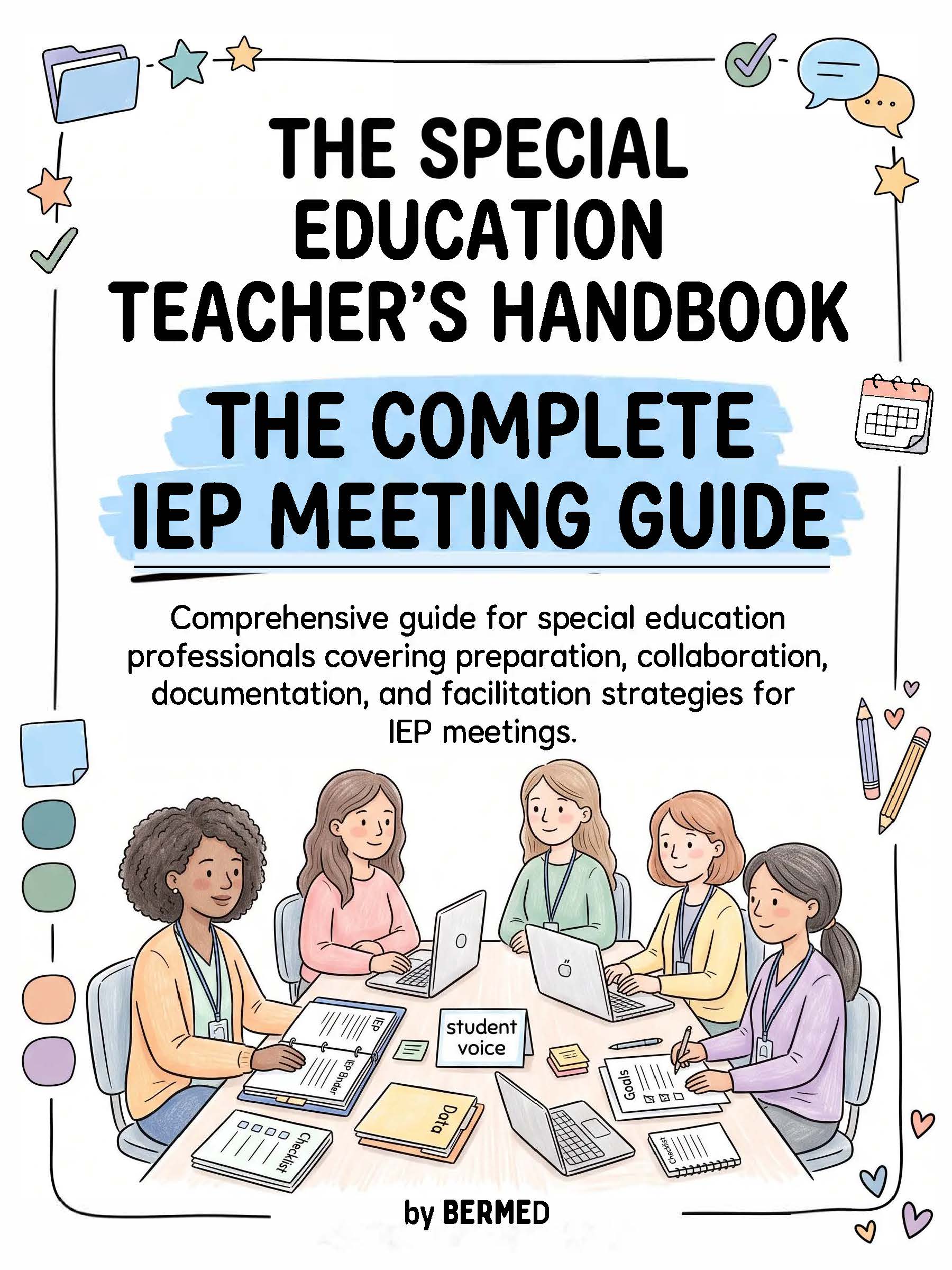
Free resource
The Special Education Teacher’s Handbook
Your complete IEP companion: forms, checklists and planning tools in one place.
Download free →504 Plan Accommodations: What’s Different?
A 504 Plan is not an IEP. Students with 504 Plans remain in general education full-time and receive accommodations only, no specially designed instruction, no related services, no IEP goals. 504 is enforced by the Office for Civil Rights (OCR), not IDEA. The legal stakes are just as real.
504 Academic & Instructional Accommodations
- Extended time on tests and quizzes (1.5x): ADHD, Anxiety, Chronic Illness, Depression
- Preferential seating in low-distraction area, communicate to all teachers each semester
- Copies of notes or guided notes, teacher or peer notes, consistent format
- Chunked assignments with teacher check-ins at each milestone (ADHD, Executive Function)
- Text-to-speech technology access, app or school-provided device (Dyslexia, Low Vision)
- Visual schedule posted at desk, digital or laminated, updated weekly (ADHD, Anxiety)
- Graphic organizers for writing (ADHD, LD, Processing Disorder)
504 Testing Accommodations
- Separate testing room or small group setting (ADHD, Anxiety, Sensory Sensitivity)
- Extended time 1.5x or 2x on ALL assessments, must apply to standardized tests too
- Breaks during testing, clock stops during breaks (ADHD, Chronic Illness, Seizure Disorder)
- Multiple test sessions, not all in one sitting (Chronic Illness, TBI)
- Large print test versions, minimum 18pt (Low Vision, Migraine History)
- Test scheduled in AM only for peak performance (ADHD, Chronic Illness, medication timing)
504 Health & Medical Accommodations
- Access to medication during the school day, authorization form required (Diabetes, ADHD)
- Attendance flexibility for medical and mental health appointments, absences marked medical
- Permission to leave class for medical needs without asking, private signal (Diabetes, Crohn’s)
- Access to water bottle and snack during class, medical documentation on file (Diabetes, ADHD)
- Emergency action plan on file and communicated to all staff (Seizure Disorder, Severe Allergy)
- Modified PE participation plan, doctor’s note + PE teacher coordination
RTI/MTSS Strategies by Tier
RTI and MTSS are prevention frameworks, not special education pipelines. They provide increasing levels of support based on student data, organized across three tiers. Approximately 80% of students succeed at Tier 1 alone; 15% need Tier 2; 5% require Tier 3 intensive supports.
Tier 1 Universal Supports: All Students
High-quality core instruction and proactive classroom design that benefits every student. If Tier 1 is strong, fewer students need Tier 2 or 3 interventions.
- Universal Design for Learning (UDL), multiple means of representation, engagement, expression
- Clear and consistent classroom routines, post daily schedule, review regularly
- Differentiated instruction by readiness, flexible grouping, tiered tasks, choice boards
- Brain breaks every 20–30 min (K–5) and every 45 min (6–12)
- PBIS school-wide expectations, consistent positive reinforcement across all staff
- Formative assessment and weekly progress monitoring, data drives instruction adjustments
- Vocabulary pre-teaching before units, graphic organizer, visual + definition + example
- Culturally responsive teaching, inclusive materials, affirming classroom environment
Tier 2 Targeted Interventions, ~15% of Students
Small-group, evidence-based interventions for students who do not respond adequately to Tier 1. Typically 3–5 sessions per week in groups of 3–5 students, delivered in addition to core instruction.
- Small group reading intervention: 30 min/day, 3–5x per week, evidence-based program
- Small group math intervention, targeted skill focus, 30 min/day
- CICO (Check-In/Check-Out), daily mentor contact AM and PM with goal card
- Social skills group, weekly explicit instruction plus role-play
- Explicit phonics instruction (Orton-Gillingham or structured literacy) for decoding gaps
- Fluency-building: partner reading, reader’s theater, recorded reading
- Attendance monitoring and family outreach for chronic absenteeism
Tier 3 Intensive Interventions, ~5% of Students
Individualized, diagnostic-driven interventions for students who do not respond to Tier 2 supports. Delivered 1:1 or in very small groups. Tier 3 does not automatically mean special education.
- Intensive reading intervention: 45–60 min/day, diagnostic assessment guides program
- Individualized behavior intervention plan (BIP): FBA-based, positive strategies
- Individualized social-emotional learning plan, weekly counselor sessions
- Crisis prevention and de-escalation plan, written, shared with all staff
- Parent/family collaboration, weekly contact, shared tracking tool, clear goals
- Coordination with outside agencies, mental health, medical, release of information
- Consideration for special education evaluation, document 6–8 weeks of Tier 3 data first
3 Myths About Accommodations That Harm Students
Free PDF: Accommodation Cheat Sheet for Special Education
The complete reference guide: 130+ accommodations across IEP, 504, and RTI/MTSS frameworks, is available as a free, print-ready PDF. Share it with your entire team, bring it to IEP meetings, or keep it in your planning binder.
Looking for editable DOCX versions, expanded goal banks, and classroom-ready strategy tables? Browse the full BERMED special education resource library in the IEPfocus Shop for premium, print-ready tools built for real IEP teams.
More Tools Beyond the Accommodation Cheat Sheet for Special Education
References
U.S. Department of Education: Individuals with Disabilities Education Act (IDEA) | U.S. Department of Education OCR: Section 504 FAQ | National Center on RTI: RTI4Success.org | IRIS Center: Accommodations to the Physical Environment (Vanderbilt) | CDC: ADHD and School Success | CHADD: For Educators
This article is for educational purposes only and does not constitute legal advice. Always consult your district’s special education coordinator and applicable state guidelines.