Match & Say is a colorful, child-friendly memory and vocabulary game specially designed for children with special educational needs, including autism, ADHD, and learning differences. The game uses bright colors, emojis, and simple visuals to make learning engaging and accessible. Players flip cards to match pairs while hearing words spoken aloud to reinforce language and memory skills. This online educational tool supports visual learners, encourages focus, and helps children improve communication and cognitive flexibility. Match & Say includes themed decks such as emotions, colors, animals, fruits, weather, and more—making it perfect for use in special education classrooms, speech therapy sessions, and home learning environments.
Fidget tools can help students stay focused, calm, and engaged especially in inclusive classrooms. The right tool reduces anxiety without creating distraction. This guide presents classroom-friendly fidgets that help students succeed.
What Makes a Good Classroom Fidget?
A classroom-appropriate fidget should be:
Quiet
Safe
Durable
Easy to hold or store
Not visually distracting
1. Silent Fidget Cubes
Unlike clicking cubes, silent cubes offer tactile input without noise. Students can use them during lessons, independent work, or transitions.
Best for: Students with ADHD or anxiety.
2. Stretchy Resistance Bands for Chairs
Placed around chair legs, these bands allow students to move their feet without leaving their seat.
Best for: Students who need movement to maintain attention.
3. Tangle Toys
These twisting toys provide smooth movement and are easy to use with one hand. They help with focus during reading or listening.
Best for: Students who need calm, repetitive motion.
4. Putty or Therapy Dough
A small amount of firm putty can reduce anxiety and support motor development.
Best for: Students needing hand strength and calming sensory input.
5. Marble Maze Fidgets
A soft fabric maze with a single marble inside encourages focus through fine motor engagement.
Best for: Students who benefit from quiet, goal-oriented movement.
6. Simple Stress Balls
Soft, durable stress balls are easy to store and work well during breaks or independent work.
Best for: Students needing quick physical release without distraction.
Conclusion
The right fidget tool supports focus, reduces stress, and promotes emotional regulation. When chosen carefully, fidgets become powerful classroom tools that help students learn more effectively.
Special Education teachers devote time, energy, and heart to supporting diverse learners. The right gift can show appreciation while also being genuinely useful in their daily work. This guide presents thoughtful and practical gift ideas for SPED teachers.
1. Organizational Tools
Special Education teachers juggle data, IEP meetings, progress reports, and lesson planning. High-quality planners, binders, and desktop organizers help bring structure to a demanding job.
Why it works: It reduces stress and helps teachers stay on top of complex responsibilities.
2. Sensory Tool Kits
A small sensory kit can be used in calm-down corners, reward stations, or short regulation breaks. Items may include fidgets, stress balls, visual timers, or tactile objects.
Why it works: It directly supports students and enhances classroom management.
3. Personalized Classroom Decor
Custom nameplates, posters, or classroom signs add warmth and personalization to the SPED environment.
Why it works: Teachers appreciate unique items that reflect their identity and classroom culture.
4. Self-Care Gifts
SPED teaching is demanding. Gifts such as essential oil diffusers, relaxing teas, or stress-relief sets promote well-being and balance.
Why it works: A healthier teacher supports healthier students.
5. Portable Label Makers
With materials, folders, visuals, and routines, a label maker is one of the most underrated but essential classroom tools.
Why it works: It boosts organization and saves time every day.
6. Books on Neurodiversity
Thoughtful books help teachers grow professionally and stay inspired.
Why it works: It strengthens classroom practice and fosters continuous learning.
Conclusion
A meaningful gift does not have to be expensive. The best gifts show appreciation and support the real work teachers do every day. These ideas are practical, thoughtful, and well-suited for the unique demands of Special Education.
Supporting sensory needs at home or at school begins with choosing the right tools. High-quality sensory gifts can help children develop emotional regulation, focus, and confidence, while also providing comfort and structure. This guide highlights some of the most helpful sensory gift ideas for kids with diverse needs.
What Makes a Sensory Gift Effective
A good sensory gift should meet at least one of the following needs:
Helps regulate emotions
Supports concentration and calm
Provides safe sensory stimulation
Encourages independence
Reduces anxiety or overwhelm
1. Weighted Items
Weighted blankets, vests, or lap pads offer deep pressure that helps children feel grounded. They are suitable for homework time, bedtime, quiet corners, or classroom reading spaces.
Ideal for: Children who seek pressure, struggle with anxiety, or benefit from calming routines.
2. Sensory Swing or Hammock
A sensory swing offers vestibular input that supports balance, coordination, and emotional regulation. Many children use it before homework or during transitions to reset and refocus.
Ideal for: Kids with sensory-seeking behaviors, difficulty sitting still, or high energy.
3. Noise-Reducing Headphones
These headphones reduce distracting background noise and help children stay calm in crowded places such as classrooms, malls, or restaurants.
Ideal for: Kids who are sensitive to noise or become overwhelmed in loud environments.
4. Chewable Jewelry (Chewelry)
Safe chewable necklaces or bracelets provide oral sensory input. They prevent shirt chewing and are easy to use in class.
Ideal for: Children who chew on clothes, pencils, or fingers.
5. Visual Timers
A visual timer supports transitions, time awareness, and task completion. It is one of the simplest tools for reducing meltdowns around changing tasks.
Ideal for: Kids who struggle with flexibility, routines, or time management.
6. Sensory Bins and Kits
Filled with textures such as beads, kinetic sand, or rice, sensory bins help develop motor skills while providing a calming experience.
Ideal for: Hands-on learners, children with high sensory needs, or kids needing regulation breaks.
Conclusion
Choosing the right sensory gift can make daily routines calmer and more enjoyable. These ideas offer practical, supportive tools that help children grow with greater comfort and confidence.
Stimming is one of the most misunderstood aspects of neurodivergent experience. Teachers, parents, and caregivers witness it daily — rocking, flapping, humming, tapping, pacing — yet many still wonder: Why is my child doing this? Should I stop it? Is it harmful? Is it a sign of distress?
The truth is that stimming is not a problem to eliminate. It is a natural self-regulation strategy used by countless neurodivergent children — and even many neurotypical people — to cope with sensory input, emotional intensity, and daily stressors. It is a form of communication, a coping mechanism, a sensory-processing tool, and often a sign of how the child is navigating their environment.
This guide explores stimming in depth: what it is, why it happens, how to interpret it, how to distinguish it from behavioral escalation, and how to support children safely and respectfully. It combines research-based insights with practical strategies for both home and school settings.
The goal is to help adults shift from trying to stop stimming to trying to understand it.
1. What Stimming Really Is
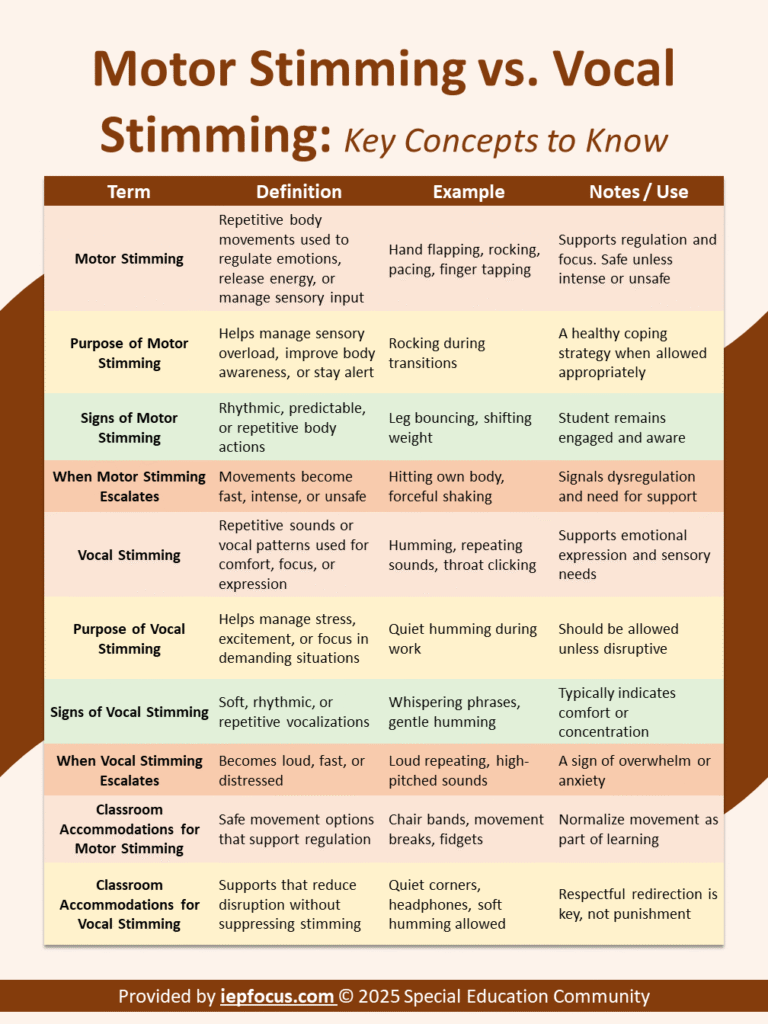
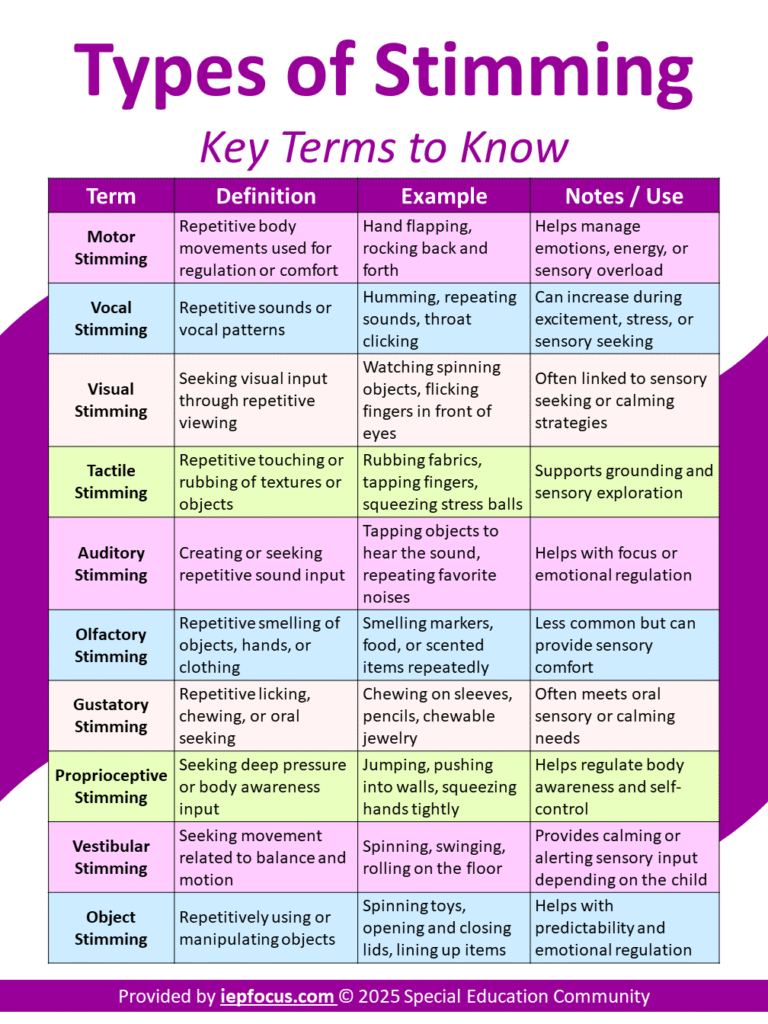
Stimming (self-stimulatory behavior) refers to repetitive movements, sounds, or sensory actions used by a person to regulate their internal experience. While the word may sound clinical, the behavior itself is completely natural.
Examples include:
rocking or swaying
hand flapping
pacing or running back and forth
humming, whistling, or repeating phrases
tapping fingers or objects
staring at spinning objects
rubbing fabrics or surfaces
squeezing hands together
smelling objects
chewing on items
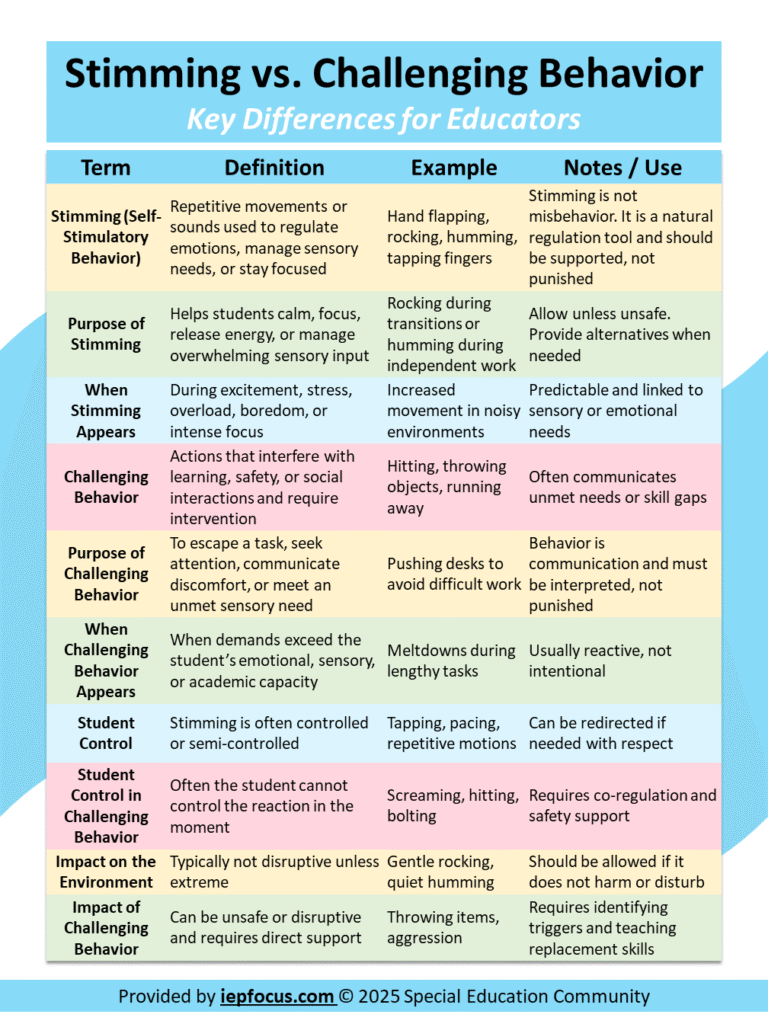
What makes stimming “different” in neurodivergent children is not the behavior itself, but the frequency, intensity, and purpose behind it.
For many children, stimming is not optional. It is essential.
2. Why Children Stim
Understanding the why behind the behavior is the foundation of all supportive responses.
2.1 Sensory Regulation
Many neurodivergent children have sensory systems that are either over-responsive, under-responsive, or inconsistent. Stimming helps them:
block overwhelming sensory input
increase needed sensory input
make unpredictable environments feel more predictable
reduce sensory stress
maintain comfort and balance
For example:
A child who feels overwhelmed by noise may hum to create predictable sound.
A child who feels unbalanced may rock to find body rhythm.
A child who is under-stimulated may jump repeatedly to increase input.
A sensory-informed space is preventative, not reactive.
8.2 Teaching Children to Express Needs
Model statements like:
“I need a break.”
“I need quiet time.”
“This sound is too much for me.”
“I want to move.”
“I need my fidget.”
Self-advocacy supports independence, especially during puberty and adolescence.
8.3 Collaboration Between Home and School
Effective support requires consistency:
share observations
share calming strategies
communicate triggers
discuss preferred stimming tools
align responses across environments
Children thrive when adults work together.
9. Realistic Scenarios and Professional Responses
Scenario 1 – Noise Overload in Class
A child begins rocking and covering their ears during a loud group activity. The teacher quietly guides the child to a calm corner and offers noise-reducing headphones.
Outcome: the child returns regulated and ready to participate.
Scenario 2 – Happy Stimming at Home
A child flaps hands and jumps while excited about a TV show. The parent responds with acceptance and continues the routine.
Outcome: the child associates joy with safety, not shame.
Scenario 3 – Stimming During Transitions
A child hits their head during classroom transitions. The team identifies transitions as overwhelming and introduces:
visual transition cards
predictable countdowns
break cards
deep-pressure alternatives
Outcome: reduced distress and safer regulation.
Conclusion
Stimming is not a flaw, a misbehavior, or a sign of failure. It is a meaningful, functional, and often essential strategy that helps neurodivergent children navigate a world that can feel noisy, bright, confusing, or emotionally intense.
Parents and SPED teachers who understand the purpose behind stimming become powerful allies in a child’s journey toward self-regulation, confidence, and independence. By responding with empathy, adapting the environment, and supporting sensory needs, adults help children thrive — not despite their stimming, but often because of it.
Stimming is not the problem. Misunderstanding it is.
When we understand stimming, we understand the child.
Emotional regulation in children is a foundational skill that supports academic success, social-emotional development, and long-term well-being. When children can recognise their feelings, calm themselves when upset, and choose constructive responses, they are better prepared to engage in learning, form positive relationships, and manage everyday challenges. For teachers, parents, and special-education professionals working with children who may have additional support needs, strengthening self-regulation strategies is especially important. This article explores why emotional regulation matters, how difficulties present, and practical, evidence-based techniques to build calm, control, and confidence in children.
Why Emotional Regulation Matters
Research in developmental and educational psychology shows that children who have solid emotion-regulation skills are more successful socially and academically. For example, one study found that children’s emotional-regulation skills predicted how well they adapted to the demands of the school environment. ScienceDirect+1 Moreover, interventions which support children’s regulation show benefits for their well-being and learning opportunities. SpringerLink+1 For children in special-education settings, or those with conditions such as Attention‑Deficit/Hyperactivity Disorder (ADHD), Autism Spectrum Disorder (ASD), or anxiety, emotional regulation becomes even more critical. When regulation is weak, children may experience frequent outbursts, disengagement, or social difficulties, which in turn impede learning, relationships, and self-confidence.
Understanding Emotional Dysregulation in Children
Signs of Emotional Dysregulation
Here is a clear table to help teachers, parents, and professionals identify emotional-dysregulation warning signs:
Behaviour / Sign
Description
Frequent meltdowns or sudden outbursts
Child reacts strongly and disproportionally to minor frustration or change. Child Mind Institute
Difficulty calming down / long recovery time
Child remains upset, agitated or dysregulated long after an upsetting event.
Impulsive responses
Child interrupts, hits, shouts, or engages in aggressive behaviour when distressed.
Avoidance or shutdown
Child withdraws, appears emotionally ‘frozen’, or refuses to engage after strong emotion.
Poor awareness of feelings or triggers
Child struggles to label emotions (“I’m angry / sad / frustrated”) or identify what sets them off.
Frequent transitions difficulties
Child struggles with changes in routine, transitions between activities, or unpredictability.
How Dysregulation Manifests in ADHD, Autism or Anxiety
Children with ADHD often show immediate, strong emotional reactions without much lead-in time. They may struggle to inhibit a response or to calm down once triggered. Child Mind Institute In Autism Spectrum Disorder, children may have difficulties recognising and expressing their own emotions, understanding others’ emotions, or coping with sensory overload or unexpected changes — all of which affect emotional-regulation capacity. Children with anxiety may experience heightened internal emotional arousal (worry, rumination) and may therefore be more prone to avoidant behaviours or strong responses when upset. In all these cases, the typical support for emotional-regulation development may need adaptation: sensory supports, visual cues, co-regulation by adults, explicit teaching of calming strategies and scaffolding responses. Understanding the nature of dysregulation in your learner population helps you tailor self-regulation strategies and special-education classroom management appropriately.
Practical Strategies and Evidence-Based Techniques
1. Teach and Model Emotions and Regulation
Use emotion-vocabulary lessons: label feelings (“I feel frustrated”), discuss body signals (“my heart is racing”), and encourage children to identify their own signals.
Model calm regulation: for example a teacher saying, “I notice I am feeling irritated because the computer froze. I am going to take three deep breaths and ask for help.”
Co-regulation: adults scaffold children’s regulation by staying calm themselves, offering comfort or guidance (“Let’s take a quiet minute together”), then gradually hand over control. Research shows teacher-child interaction is key in early childhood regulation development. MDPI+1
2. Mindfulness, Breathing and Grounding Tools
Simple breathing exercises: e.g., “balloon breath” (inhale slowly, hold for two counts, exhale slowly), or “five-finger breathing” tracing hand.
“Mindful pause” before reaction: teach the child to stop, take a breath, choose a response.
Guided mindfulness sessions: short (2-5 minutes) at the start or end of class or home routine to calm the nervous system and build awareness of internal states. These tools support self-regulation by giving children a concrete way to calm their bodies and minds — research emphasises self-regulation can be taught and is not purely innate. Child Mind Institute+1
3. Visual Supports and Structured Routines
Visual emotion charts: a chart with faces depicting emotions; children can point to how they feel.
Regulation tools area: a corner of the classroom or home with calm-down items (soft cushion, stress ball, calm-down cards, breathing poster).
Predictable routines and transitions: when children know what to expect and transitions are supported (via countdowns, timers, social stories), regulation demands are lower and success is more likely. Such supports reduce cognitive load and help children apply the regulation strategies they are learning.
4. Scaffolding and Gradual Release of Control
Break challenging tasks into smaller steps, provide support for the early steps, then gradually hand over more independent regulation. Child Mind Institute
Use “practice runs” for known challenging activities—e.g., “Let’s rehearse the game transition earlier today so when it happens tomorrow you are ready”.
Positive reinforcement for regulation efforts (“I saw you take three breaths when you felt upset—great job!”). This gradual approach helps children build confidence in their regulation skills.
5. Social-Emotional Learning (SEL) Integration
Embed regulation teaching within SEL: identify feelings, recognise triggers, practice regulation strategies, reflect on what worked.
Use role-play and peer discussions: For example, in classrooms ask children “What would you feel if…?” and “What could you do to calm yourself in that situation?”
Collaborate across settings: ensure home and school use consistent language and tools for regulation. This alignment enhances generalisation of skills.
6. Co-Regulation and Partnerships with Parents/Caregivers
Communicate with parents about tools and vocabulary used in school so the same strategy can be reinforced at home.
Suggest home-based regulation practices: designate a “calm-down corner”, daily check-ins (“How are you feeling today?”), shared breathing rituals after school.
Encourage collaboration with therapists or counsellors when needed — for children with dysregulation tied to emotional disorders or complex needs, consultation supports consistent strategies.
Classroom and Home Setting Examples
Classroom Example: Ms. Khan teaches a class with several children who struggle with transitions. She begins each lesson with a 1-minute breathing exercise, then shows a visual timer when moving from one activity to the next. When Ahmed becomes upset during group work, Ms. Khan gently invites him to the “emotion chart” corner, helps him label his feeling, and practises a balloon-breath with him. She says, “You used your breath—now you’re ready to join us again.” Home Example: At home, parents of Lina create a “calm box” with a soft toy, colouring sheet and a breathing-instruction card. After her after-school snack they sit together for 2 minutes of breathing before homework. When Lina becomes frustrated with her math task, her father says: “I see your body is telling you something—let’s take two deep breaths and pick a tool from the calm box.” Later they reflect: “What helped you? Let’s try it again tomorrow.”
Putting It All Together: Self-Regulation Strategies Overview
Simple Tools to Teach Regulation
Balloon breath / finger trace breathing
Emotion-faces chart
Visual timer for transitions
Calm-down corner / calm box
Practice run for challenging transitions
Role-play conversations about feelings and responses
Consistent adult modelling and language (“I feel…, I choose…”)
Signs of Progress
Child begins to pause and breathe before reacting
Child uses visual tool or calm area independently
Fewer or shorter emotional outbursts
Child begins to express how they feel and choose a strategy (“I’m frustrated so I’m going to take a break”)
Transfer of regulation skills between settings (home ↔ school)
Special Education Classroom Management and Emotional Regulation
For teachers and professionals in special-education settings, emotional regulation must be woven into classroom management and instructional design. Key considerations:
Collaborate with specialists (occupational therapists, speech-language therapists, behavioural specialists) to adapt regulation tools for children with sensory, communication, or cognitive differences.
Use differentiated supports: some children may need daily scaffolded regulation check-ins, others may need visual or tactile supports.
Build the classroom environment to reduce emotional stressors: predictable schedule, visual supports, clear expectations, safe spaces.
Embed social-emotional learning (SEL) within academic tasks, and explicitly teach regulation strategies rather than expecting spontaneous mastery.
Maintain consistent home-school communication regarding regulation tools, vocabulary, and goals — this consistency is part of effective special education classroom management for emotional regulation.
Conclusion
Emotional regulation in children is not optional — it is central to learning, social-emotional development and lifelong resilience. For educators, parents and special-education professionals, building calm, control and confidence begins when regulation is taught, modelled and supported across settings. By using self-regulation strategies, visual supports, co-regulation, and consistent routines, children can become more aware of their feelings, better calm themselves, and engage more fully in learning and relationships. Collaboration between teachers, parents and therapists enriches this process and ensures that regulation strategies travel from classroom to home and back. Together, we create environments in which every child can grow emotionally as well as academically.
About the Author BERMED | IEPFOCUS.COM — creator of special education resources for teachers and parents.
Advocacy is one of the most powerful tools a parent can use to support a child with special needs. Whether your child has a learning disability, autism, ADHD, or another developmental condition, your voice matters. Advocating means ensuring your child receives the right support, accommodations, and opportunities to thrive in school and beyond. This guide will help you understand how to become an effective and confident advocate for your child.
1. Understand Your Child’s Rights
Every child with special needs has legal rights to education and support. In most countries, laws guarantee access to individualized instruction, accommodations, and inclusion in public schools. Take time to learn about local policies and frameworks such as Individualized Education Programs (IEPs) or 504 Plans. Understanding the law gives you confidence when speaking with teachers and administrators.
2. Know Your Child’s Strengths and Needs
Effective advocacy begins with knowing your child inside and out. Identify strengths, interests, challenges, and learning styles. Keep a personal file with assessment reports, IEPs, teacher notes, and progress data. The more clearly you can describe your child’s profile, the easier it becomes to explain what works best for them.
3. Build Positive Relationships with Educators
Advocacy is not about confrontation. It is about collaboration. Communicate regularly with teachers, therapists, and support staff. Thank them for their efforts, and share updates about what helps your child succeed at home. A respectful and solution-focused attitude builds trust and encourages teamwork.
4. Document Everything
Keep written records of meetings, emails, and communication with the school. Documentation ensures that promises are kept and provides a clear history if issues arise. Date every note, store documents in one folder, and review them before any school conference.
5. Ask Questions and Seek Clarity
Never hesitate to ask for explanations about terms, evaluations, or decisions. If something seems unclear, request more information. A good question might be: “Can you show me how this strategy will help my child reach their goal?” Curiosity shows that you are engaged and invested in your child’s success.
6. Collaborate During the IEP Process
Your input in the IEP meeting is vital. Come prepared with notes about progress and concerns. Suggest realistic goals, share what works at home, and ask for strategies that align with your child’s learning style. Remember that the IEP is a living document that can be adjusted whenever needed.
7. Learn the Language of Special Education
Terms like accommodation, modification, intervention, and progress monitoring can sound confusing at first. Understanding these words helps you participate fully in discussions. Take notes during meetings and review them later. Many schools offer parent workshops or online webinars that explain terminology in simple terms.
8. Teach Your Child Self-Advocacy
One of the greatest gifts you can give your child is the ability to speak up for themselves. Encourage them to express what they need and how they learn best. Teach simple phrases such as “I need more time to finish” or “Can you explain it another way?” Self-advocacy builds confidence and independence for life.
9. Stay Calm During Challenges
Disagreements may occur, but staying calm helps you remain persuasive. Focus on facts and solutions instead of emotions. If a situation becomes stressful, take a break and schedule another meeting. Being respectful yet firm communicates that you are serious and professional.
10. Connect with Support Networks
Join local or online parent groups, advocacy organizations, or special education communities. Sharing experiences with others provides emotional support and valuable advice. These networks often share updates about rights, policies, and success stories that can guide your journey.
11. Celebrate Progress
Advocacy is not only about solving problems. It is also about celebrating achievements. Whether your child learns a new skill or meets a small goal, take time to acknowledge it. Recognizing progress keeps motivation strong for both you and your child.
Conclusion
Advocating for your child with special needs takes patience, persistence, and love. You are your child’s most consistent voice and greatest supporter. When families and schools work together, every child can reach their potential. Stay informed, stay confident, and never underestimate the impact of your advocacy.
Down syndrome is one of the most misunderstood conditions in the world. Despite decades of research and advocacy, many myths still shape how society perceives and treats people with Down syndrome. These misconceptions can harm inclusion, opportunities, and self-esteem. This article explains twenty common myths and replaces them with facts to promote understanding, respect, and acceptance.
1. Myth: Down syndrome is rare
Fact: Down syndrome is the most common chromosomal condition around the world. Why it matters: The condition is not rare; it simply varies in visibility from one region to another.
2. Myth: Down syndrome is always inherited
Fact: About ninety-nine percent of cases are not inherited. Only the translocation type may have a hereditary link. Why it matters: Parents should not carry guilt or fear about genetics.
3. Myth: Only older mothers have children with Down syndrome
Fact: While risk increases with age, most babies with Down syndrome are born to mothers under thirty-five. Clarification: Age affects risk, but younger women give birth more often, which explains the numbers.
4. Myth: All people with Down syndrome look and act the same
Fact: Every person is unique, with different features, talents, and personalities. Why it matters: Stereotypes prevent people from seeing individuality and potential.
5. Myth: People with Down syndrome are always happy
Fact: They experience every emotion including joy, sadness, anger, and frustration. Why it matters: Labeling them as always happy can hide their true emotional needs.
6. Myth: People with Down syndrome cannot learn or attend regular school
Fact: Many attend mainstream schools, graduate, and even continue to higher education. Why it matters: With proper support, they can achieve great academic and social success.
7. Myth: People with Down syndrome are always sick
Fact: Some may have health issues, but many live long and healthy lives. Key idea: Health challenges do not define who they are.
8. Myth: There is only one type of Down syndrome
Fact: There are three main types: Trisomy 21, Translocation, and Mosaicism. Why it matters: Knowing the types helps explain different developmental levels.
9. Myth: People with Down syndrome cannot work
Fact: Many work successfully in offices, restaurants, schools, and art centers. Why it matters: Employment gives independence, purpose, and dignity.
10. Myth: People with Down syndrome cannot marry or have relationships
Fact: They can form close friendships and loving relationships, and some do marry. Message: Everyone deserves love, respect, and connection.
11. Myth: People with Down syndrome must always be protected
Fact: They want independence and decision-making power like anyone else. Approach: Focus on support and guidance instead of control.
12. Myth: People with Down syndrome have no future
Fact: Life expectancy has increased, and many live full and meaningful adult lives. Why it matters: Early education and inclusion open real opportunities.
13. Myth: Raising a child with Down syndrome means a life of hardship
Fact: Families face challenges, but also experience joy, pride, and strong connections. Encouragement: Support and information make family life much easier.
14. Myth: People with Down syndrome cannot live independently
Fact: Many adults live on their own or in supported housing. Why it matters: Independence should always be encouraged as part of adulthood.
15. Myth: Nothing can improve life for people with Down syndrome
Fact: Early intervention, education, and therapy make a real difference. Takeaway: Abilities grow when opportunities exist.
16. Myth: Everyone with Down syndrome has severe intellectual disability
Fact: Intelligence varies widely from mild to moderate levels. Why it matters: Each person should be supported based on their individual abilities.
17. Myth: Education or therapy does not help
Fact: Interventions greatly improve communication, motor skills, and independence. Message: Every effort counts and learning never stops.
18. Myth: People with Down syndrome cannot have a social life
Fact: They have friends, hobbies, and take part in sports, music, and community events. Why it matters: Social participation strengthens confidence and belonging.
19. Myth: It is acceptable to use outdated or offensive terms
Fact: Language shapes how people are treated. Words such as “retarded” are disrespectful and should never be used. Recommendation: Always use person-first language such as “a person with Down syndrome.”
20. Myth: People with Down syndrome stay childlike forever
Fact: They grow up, mature, and build adult lives with goals and responsibilities. Reminder: Treat them according to their age, not their condition.
Conclusion
Understanding Down syndrome begins with replacing myths by facts. Every person deserves dignity, opportunity, and respect. People with Down syndrome learn, work, love, and contribute to society. True inclusion starts with awareness, and awareness begins with truth.
Dyslexia is a specific learning disability that is neurobiological in origin, characterized by difficulties with accurate and/or fluent word recognition and by poor spelling and decoding abilities. In plain terms, dyslexia makes it hard to learn to read, even with normal intelligence and adequate teaching. Key characteristics include trouble connecting letters to sounds, slow and effortful reading, and frequent spelling mistakes that can seem illogical (for example, a child might spell the same word differently on the same page). It’s important to note that dyslexia does not stem from low intelligence or laziness – in fact, individuals with dyslexia often have average or above-average IQ and may excel in creativity, problem-solving, and other areas.
Common myths about dyslexia persist, so let’s dispel a few: – Myth:“Dyslexia is seeing letters backwards.” Reality: Letter reversals (like confusing b and d) can happen, especially in young children, but dyslexia is not primarily a vision problem. It’s a language-based difficulty. Brain imaging confirms that the dyslexic brain processes written language differently (involving inefficient activation of certain reading networks) – it’s not about eyesight. – Myth:“Children will outgrow dyslexia.” Reality: Dyslexia is lifelong. With intervention, people with dyslexia can become proficient readers, but they don’t simply “grow out of it”. They will always need to use the strategies they’ve learned. – Myth:“Dyslexia only affects boys.” Reality: Dyslexia affects both boys and girls in significant numbers. Boys might be identified more often in school (possibly due to more frequent behavioral referrals), but research shows little difference in prevalence by gender. – Myth:“Dyslexia = low intelligence.” Reality: Absolutely false. Dyslexia occurs across all intelligence levels. Many individuals with dyslexia are extremely bright and have gone on to great achievements. The classic example often cited: Albert Einstein was dyslexic – clearly demonstrating that reading problems have no bearing on being a genius. – Myth:“Poor parenting or lack of reading at home causes dyslexia.” Reality: Dyslexia is neurological and often hereditary, not caused by environment. A literacy-rich home is wonderful for all children, but a child with dyslexia will struggle to read even in the best environment without proper intervention. (That said, providing enjoyable reading experiences and support at home can help dyslexic children stay motivated – lack of practice can worsen any reading difficulty.)
It’s estimated that 5–15% of the population has dyslexia to some degree, making it one of the most common learning differences. Early recognition is vital – the earlier we understand a child has dyslexia, the sooner we can provide support and prevent secondary issues like anxiety or low self-esteem from taking root.
Not everyone with dyslexia has exactly the same reading profile. Researchers often describe subtypes of dyslexia – mainly phonological dyslexia, surface dyslexia, and a mixed type – to understand the specific nature of a person’s reading difficulties.
Phonological Dyslexia (Dysphonetic Dyslexia): This is the most common subtype people think of with dyslexia. It refers to difficulty processing the sounds of language (phonological awareness). Individuals with phonological dyslexia struggle to decode words – breaking them down into sounds and blending sounds to read them. For example, a child with this subtype may find it extremely hard to sound out new or nonsense words. Common signs include trouble associating letters with their sounds, poor phonemic awareness (like not detecting that cat and car start with the same sound), and very phonetic spelling (spelling based on sound alone). Phonological dyslexia is rooted in a deficit in the phonological component of language – in other words, the brain has a hard time processing the “sound structure” of words.
Surface Dyslexia (Orthographic Dyslexia): Surface dyslexia is almost the flip side of phonological dyslexia. Here, the primary difficulty is with recognizing whole words by sight and remembering irregular spellings. Reading may be slow and labored because the individual is relying on sounding out every word, even those they’ve seen many times. Someone with surface dyslexia can often sound out words phonetically (especially regular ones), but has trouble with words that don’t follow phonetic rules (like knight or debt) and doesn’t instantly recognize common words. They may also read in a choppy way, as if each word is unfamiliar. This happens because of a weakness in forming a mental visual dictionary of words. In surface dyslexia, the brain’s storage and recall of word forms (orthography) is inefficient. Symptoms: difficulty with irregular words, frequent contextual guessing (they might read “house” for “horse” if they only glance at the word), and continuing spelling mistakes even for common words (since they can’t rely on memory, they try to spell everything phonetically).
Mixed Dyslexia: Many individuals have a combination of both phonological and surface dyslexia traits. This is sometimes called “mixed dyslexia” or in some literature “deep dyslexia.” These readers have significant difficulty with both sounding out words and instantly recognizing words. Mixed dyslexia is often associated with more severe reading impairment, because the reader doesn’t have a strong compensating route – both the sound-based and visual word recognition pathways are underdeveloped. A student with mixed features might, for example, struggle to decode and also not recognize words that they’ve seen before, making reading particularly effortful.
It’s important to remember these subtypes are not clear-cut categories with hard boundaries – they exist on a continuum. Many dyslexic learners show elements of each. For instance, one child might mainly exhibit phonological difficulties while another has mild phonological issues plus pronounced orthographic memory problems (mixed). Identifying a profile can help in planning instruction (e.g., a person with surface/orthographic weaknesses might benefit from extra practice with sight word recognition and orthographic patterns, while someone with phonological dyslexia needs intensive work on phonemic awareness and phonics). But in all cases, a structured literacy approach (explicit teaching of sounds, patterns, and meaning) is beneficial.
Modern neuroscience has provided fascinating insights into how dyslexia works at the brain level. Reading is a complex task for the brain, involving several regions (for processing sounds, visual letters, meaning, etc.) working together quickly. In individuals with dyslexia, brain imaging studies (using fMRI and other techniques) have found differences in both the structure and function of these reading networks.
One key finding is that dyslexic readers often show less activation in the left side of the brain during reading tasks – particularly in areas in the left temporo-parietal region and the left occipito-temporal cortex (often called the « visual word form area »). These left-hemisphere regions are critical for efficient word decoding and recognition. In skilled readers, they light up when processing print. In dyslexic readers, the activity is reduced there, and sometimes the brain shows increased activation in other areas (like the right hemisphere or frontal regions) as it tries to compensate.
Structurally, researchers have observed subtle differences such as less gray matter or altered white matter in some of those left-hemisphere language areas in dyslexic individuals. Even the typical asymmetry of the brain can differ – for example, a region called the planum temporale (part of the auditory language cortex) is usually larger on the left in non-dyslexic brains, but in dyslexic brains this asymmetry may be reduced or absent.
What does all this mean? Essentially, the dyslexic brain is organized a bit differently for reading. It may rely on neural pathways that are less efficient for the task of word reading. This explains why reading is laborious for dyslexic individuals – the “word-recognition center” isn’t as easily activated, and other parts of the brain must work harder to compensate.
Encouragingly, neuroscience also shows the brain can change. With effective intervention and practice, dyslexic readers do build better neural pathways for reading. Studies have shown that after a few weeks or months of intensive reading instruction, children with dyslexia can develop brain activation patterns more similar to typical readers. The brain is plastic – especially the young brain. This underscores the importance of early identification and intervention: we can actually see in brain scans that the right kind of instruction (like training in phonological skills and decoding) leads to positive changes in how the brain processes print.
To summarize: the dyslexic brain is not “damaged” – it’s often very efficient in other tasks – but for reading, it doesn’t utilize the same streamlined left-brain network that typical readers do. This neurological perspective reinforces that dyslexia is real and biologically based (it’s not laziness or poor instruction), and it highlights why dyslexic students need specific teaching approaches. The brain can learn to read, but it needs structured, multisensory instruction to rewire itself to make the most of those less-natural pathways.
Classroom teachers are often the first to notice a child’s reading difficulties. Recognizing early warning signs of dyslexia – even in kindergarten or first grade – is crucial, because it allows intervention to start sooner. Some early signs include:
Difficulty with phonemic awareness: Young children with dyslexia often struggle to hear and manipulate sounds in words. For example, they may find it hard to pick out the first sound in a word or to rhyme words. A preschooler might not recognize that cat and bat rhyme, or a kindergartner might be unable to blend sounds like /s/…/a/…/t/ into “sat.” These issues can appear even before formal reading instruction. (In fact, children as young as 2½ or 3 who later are diagnosed with dyslexia often had delays in speech, trouble learning letter names, or difficulty remembering familiar nursery rhymes.)
Difficulty learning letter names and sounds: A classic red flag is when a child has an inordinate amount of trouble learning the alphabet and the sounds each letter makes. If most kids in the class have learned “B says /b/” but one child just can’t get it even after much review, that’s a sign. Similarly, a child might not connect letters to the sounds in their own name or might confuse letters that look somewhat alike (d, b, p, q).
Problems with blending or segmenting sounds: When beginning to read, dyslexic students might skip blending – for instance, shown the letters C-A-T, they may say “cat” by memory or guess “car” from the picture, but if asked to sound it out, they get lost. They may also have trouble breaking words apart. By the end of kindergarten or first grade, most children can tell you that bus without /b/ is “us,” or that if you change the /m/ in “mat” to /s/ you get “sat.” A dyslexic child often cannot do these oral tasks (they might delete the wrong sound or be unable to blend a simple word).
Reading errors that don’t make sense with phonics: One striking sign in early reading is when a child makes wild guesses at words that don’t match the letters. For example, with a picture of a dog and the word “dog” captioned, a child might say “puppy” – they’re using the picture and context, not decoding at all. Or they may see the word “girl” and say “grill” or “gift” – guessing from the first letter or shape rather than actually reading it. This indicates the child is not connecting print to sound properly.
Avoidance of reading and frustration: Children (even very young ones) often realize when something is hard for them. A child with emerging dyslexia might dread circle time if it involves letters or reading. They might “disappear” or act out when it’s time to read aloud. They may also complain that reading is hard or that letters “jump around” (though dyslexia is not primarily a vision issue, the strain can make it feel that way).
Family history or other language difficulties: Dyslexia can run in families. If you know a student has a parent or sibling with similar struggles, it raises your vigilance. Also, many dyslexic children had delayed speech or continue to have some trouble with pronunciation or word retrieval (e.g., mixing up words that sound alike, like saying “tornado” when they mean “volcano”). A cluster of these issues can hint at dyslexia.
A teacher should never ignore these signs or take a “wait and see” approach. It’s a myth that you can’t identify dyslexia until around third grade; research and expert guidance say you can spot warning signs as early as preschool and definitely in K–1. Early screening tools now exist to help flag at-risk children. As a teacher, if you notice these patterns, it’s important to share your observations with special educators or the child’s parents and push for further evaluation or support. Early help can dramatically change the trajectory – a child identified in first grade and given appropriate intervention can become a competent reader by third grade, whereas a child who isn’t identified until much later may endure years of struggle and frustration.
In summary, trust your teacher instincts. If a student is bright, curious, and verbal but just not cracking the code of reading like their peers, consider dyslexia as a possibility. Don’t brush it off as “developmental lag” without probing further. It’s far better to provide extra support early (even before a formal diagnosis) than to wait until the child has fallen far behind.
Students with dyslexia often display distinct patterns in their reading errors and spelling attempts. Being aware of these common patterns can help teachers identify dyslexia and also tailor instruction to address the specific difficulties. Some typical patterns include:
Guesses and “whole word” substitutions: A dyslexic reader might see a word and guess something that looks similar rather than carefully sounding it out. For example, they might read “form” as “from,” or “house” as “horse,” or even say a completely different word that makes sense in context (saying “puppy” when the printed word is “dog” because there’s a picture of a dog). These errors show no connection to the actual letters on the page – the student isn’t decoding letter by letter, possibly because decoding is so difficult that they resort to guessing from context or memory.
Difficulty with small function words: Short common words like and, the, of, was often trip up dyslexic readers. They might skip them, misread them, or substitute another small word (reading “on” for “no,” etc.). These words are hard because they are abstract (can’t use a picture clue) and often not phonetic (e.g., “of” sounds like “ov”). A dyslexic student might read a sentence like “The cat ran out of the house” as “The cat ran out~~of~~the house,” omitting of entirely, or “The cat ran out ~~of~~ the home,” guessing a different word with similar meaning or shape.
Slow, laborious reading (lack of fluency): Dyslexic students often read at a slower rate. Instead of a smooth, quick decoding, they may read word-by-word, pausing frequently. Even if they eventually get the words right, the reading lacks fluency and expression. A sentence like “The boy is running down the street” might be read slowly as “The… boy… is… r-r-running… down… the… sss-… street.” This happens because decoding doesn’t become automatic for them; their brain is treating each word as an unfamiliar puzzle, even if it’s one they saw just minutes ago.
Difficulty sounding out longer words: As words get longer (multi-syllabic), dyslexic students often struggle to break them into parts. They might read “transportation” as “tation” (maybe just guessing the end of the word) or “trans…port…ation” with very slow, fragmented decoding. They may also misread long words by omitting syllables or blending parts incorrectly (reading “entirely” as “early” or “entrily”). This reflects an underlying difficulty in phonological processing and working memory – holding all the sounds in sequence is hard.
Inconsistent spelling with phonetic inaccuracies: Spelling is often more impaired than reading in dyslexia. Common patterns include: spelling the same word differently in the same document (“because” as “becus” in one spot and “becaz” a few lines later); extremely phonetic spellings that show they didn’t remember the correct pattern (e.g., “drive” spelled “dryv”, “special” spelled “speshul”); or bizarre spellings that are so far off one can hardly recognize the word (this happens when the student isn’t perceiving all the sounds in the word, so letters are omitted or in the wrong order). For instance, they might spell “floor” as “flor”, “people” as “peepul,” or “elephant” as “elufnt.” Many dyslexic students have particular trouble with vowels in spelling (since English vowels are inconsistent and tricky), and with remembering letter sequences in words (so “friend” might come out “firend”, etc.). Their spelling can seem at a much “lower level” than their other writing skills.
Letter reversals or transpositions (b/d, p/q, was/saw): While letter reversals alone are not a sure sign of dyslexia (many young children reverse letters), in a dyslexic student these errors may persist longer than usual. They might continue to confuse b and d or p and q in second grade or beyond. They might also transpose the order of letters within words (writing “gril” for “girl”) or the order of digits in numbers. This relates to directional/visual confusion and also difficulties in the automatic recall of letter forms. However, note that not all dyslexic students reverse letters – it’s just one possible clue, especially if it happens along with the other issues above.
Poor handwriting (dysgraphia) and copying skills: Many (though not all) children with dyslexia have messy handwriting and find writing tasks arduous. When copying from the board, they may often lose their place, skip words, or invert letters. Their written work might be sparse – they write as little as possible because forming letters and spelling takes so much effort. (This overlaps with dysgraphia, a handwriting/printing difficulty, which can co-occur with dyslexia.)
Recognizing these patterns helps in two ways: (1) It can signal a teacher or parent that the child is not just “a bit slow to read” but is showing characteristic markers of dyslexia – meaning more formal assessment or targeted help is warranted. (2) It guides instruction – for example, knowing a student frequently guesses wildly at words tells us we need to explicitly teach them strategies to decode systematically and perhaps use tools to keep them focused on the letters (like using a finger or marker under each word). Knowing they can’t remember sight words (like “the”, “what”) means we might incorporate more multisensory drills for those words (chanting, tracing, etc.).
One heartening thing: as students with dyslexia receive effective intervention, these error patterns do improve. A child who was guessing every other word can, with systematic phonics instruction, learn to decode more accurately. Their spelling, while often remaining an area of weakness, will usually become more phonetically logical (even if not perfectly correct). By middle and high school, many dyslexic students read adequately (though slower) – but you might still notice they prefer audiobooks or that their writing avoids unusual words they can’t spell. As an educator, being attuned to these continuing struggles means you can quietly offer supports (like not marking down for spelling in a history essay, or providing text-to-speech for a long reading assignment).
Teaching students with dyslexia can be immensely rewarding when the right strategies are used. These learners are absolutely capable of reading and thriving academically – but they need instruction that is more explicit, structured, and supportive than what typically-developing readers might require. Here are some of the most effective teaching strategies, backed by research and practice:
Structured Literacy (Systematic Phonics Instruction): A structured literacy approach means you teach the structure of language directly – sounds, letters, spelling patterns, word parts, sentence structure, etc. This is done in a systematic, cumulative way (from simple to complex) with lots of review. For a dyslexic student, phonics is not optional; it’s essential. Programs using structured literacy (like Orton-Gillingham-based methods, Wilson Reading System, etc.) break reading and spelling into small skills (like blending sounds, recognizing common phonograms like “ight”) and explicitly teach and practice each one. The evidence is very strong that such explicit, systematic teaching of language skills is critical for dyslexic learners. In contrast, approaches that rely on students “picking up” reading through exposure (often called balanced literacy or whole language, which emphasize context and self-discovery) are ineffective for most dyslexic kids. Instead, teach in a direct way: for example, instead of hoping they infer how silent e works, tell them the rule and practice it extensively.
Multisensory Techniques: Engage multiple senses simultaneously to help imprint learning. This is often summed up as “VAKT – visual, auditory, kinesthetic, tactile.” For instance, when teaching a new letter or phonogram, the student might: look at it (visual), say its name and sound (auditory), trace it in sand or sky-write it (kinesthetic/tactile). Using multisensory methods helps strengthen memory by providing multiple avenues for the information to stick. Dyslexic students benefit greatly from this – e.g., having them use letter tiles or moveable alphabets to build words, using hand motions to represent sounds, tapping out syllables with their fingers, etc. A classic multisensory activity is “arm tapping”: to spell a word like “crash,” a student says the sounds /k/ – /r/ – /a/ – /sh/ while tapping down their arm for each phoneme, then sweeps their arm to blend the word and says “crash!” This kind of whole-body involvement can make abstract phonemes more concrete. Multisensory teaching is a core reason Orton-Gillingham-based approaches work – it links the visual and auditory and kinesthetic pathways in the brain, building stronger neural connections.
Small Group or One-on-One Instruction: Dyslexic students learn best with targeted, small-group instruction. In a whole class of 25, it’s easy for them to hide or get lost, and the pacing might be off – either too fast or sometimes too slow (if they’ve gotten some concept, they might need reinforcement on another). Where possible, provide reading intervention in a small group (or individually) daily. Many schools implement Tier 2 interventions (RTI – Response to Intervention) that pull aside the lowest readers for extra phonics practice. Dyslexic learners must be included in that. They usually need more repetition and practice than other students to master a skill – in a small group you can afford the time to review yesterday’s phonics pattern, whereas in whole class you might be onto a new pattern already. If you have the resources, working one-on-one with a dyslexic student (even briefly) can yield big benefits, because you can diagnose on the fly (“he’s still confusing ch and sh, I’ll review those now”) and tailor every minute to what the student needs.
Explicit Teaching of Vocabulary and Comprehension: While the core issue in dyslexia is decoding, many students also benefit from explicit teaching in other areas, so their comprehension and critical thinking stay strong even if decoding is lagging. Teach vocabulary explicitly (discuss new words, use morphology – like teaching that tele- means distance, etc., to build word-learning strategies). Use graphic organizers or verbalize thought processes to aid comprehension. Dyslexic students often have excellent comprehension when material is read to them; our goal is to get their independent reading up to that level. In the meantime, continue to read aloud rich content to them or let them listen to audiobooks, and discuss it – this builds their language skills and keeps their intellectual growth on track even as they work on mechanics of reading.
Assistive Technology and Tools in class: Embrace tools that help level the playing field. For example, text-to-speech software or audiobooks allow a dyslexic student to access material above their independent reading level (so they can learn content in science or literature without being limited by decoding). Providing audio versions of textbooks or using apps that read aloud (many are available on tablets/computers) can be game-changing. Speech-to-text (dictation) software can help with writing assignments – a student can speak their sentences and have the computer transcribe, bypassing the arduous typing/spelling process (they can then edit the draft). Low-tech tools also help: letting them use a bookmark or reading guide strip to track lines, using wide-ruled or graph paper to help with writing alignment, or colored overlays if they find high-contrast white paper harsh (some dyslexic individuals report better reading with a colored filter). These supports don’t “solve” dyslexia, but they accommodate it so the student can demonstrate their knowledge and keep up with grade-level work while remediation is underway.
Positive Reinforcement and Metacognitive Strategies: Children with dyslexia often feel defeated; effective teachers make a point to celebrate effort and progress, not just perfection. Set up goals that the student can reach (e.g., a new personal best in reading fluency, or mastering 5 new sight words) and recognize those achievements. Also, teach the student how to learn – e.g., show them strategies like “If you’re stuck on a word, try covering the ending to see the root, or try vowel sounds a couple of ways to see which makes a real word.” Encourage them to talk through a challenging word rather than just guess. Over time, we want dyslexic students to become strategic, self-aware readers who know their own strengths and compensatory techniques (for instance, they might learn to mentally preview key vocabulary before reading a text, or subvocalize quietly to hear the words, etc.).
Classroom accommodations: While not “teaching strategies” per se, it’s worth mentioning that how you structure tasks in class can make a huge difference. For example, when dyslexic students are reading a passage, allow them a bit more time. If doing popcorn reading (taking turns aloud), consider giving the dyslexic student their paragraph ahead of time to practice, or skip them in the rotation unless they volunteer – to avoid anxiety. Provide notes or outlines to reduce the burden of copying from the board. On written assignments, don’t grade for spelling (unless it’s a spelling test) – instead, perhaps underline misspelled words and help the student correct a few, but don’t take off points in content areas. These kinds of strategies ensure the student isn’t unfairly penalized for their dyslexia. (We’ll cover more on accommodations in the section on assessments and grading.)
Effective teaching for dyslexic learners often mirrors simply good literacy instruction – structured, explicit, multisensory – which benefits all students. The difference is dyslexic students need it desperately and won’t succeed without it. When provided, though, they often make significant gains. Many will tell you later that a particular teacher’s methods “finally made things click.” The bottom line: teach in a way that makes language crystal clear. Leave nothing implied that could be explicitly taught. And remember that dyslexic students usually can learn everything their peers can; we just have to open alternative paths for learning to read and write.
Traditional assessments (timed tests, lengthy written exams, spelling tests, etc.) can disproportionately challenge students with dyslexia, often measuring their disability rather than their knowledge. Adapting assessments and grading practices creates a more equitable situation – allowing these students to demonstrate what they know without the test format itself tripping them up. Here are several strategies:
Provide Extended Time: Probably the single most common (and critical) accommodation is giving dyslexic students extra time on tests and quizzes. Dyslexia “robs a person of time,” as one expert put it, so extended time gives some of that time back. For instance, if the rest of the class has 20 minutes for a reading quiz, the dyslexic student might get 30 or 40 minutes. This helps because they can decode text more slowly, double-check tricky words, and not be as rushed (rushing massively increases error rates for them). Research shows extra time significantly improves performance for many dyslexic learners, leveling the playing field, and it does not give an unfair advantage – it’s about allowing them to work at a pace that reflects their true knowledge.
Allow Alternative Demonstrations of Mastery: Consider testing in formats that minimize the reading/writing load when those aren’t the skills being assessed. For example, if you’re evaluating history knowledge, you could let the student take the test orally (the teacher or a scribe can read the questions aloud, and the student can respond verbally). Many dyslexic students can articulate excellent answers but might stumble if they had to decode the questions and handwrite responses under time pressure. Another example: instead of a traditional book report entirely written, allow a dyslexic student to present it as a short video or slideshow with oral narration. If spelling is not what you’re measuring, don’t let spelling errors (which will likely be there) cloud the assessment of their content knowledge. In math, if the issue is reading word problems, read them aloud to the student or give them a text-to-speech tool – we want to know can they solve it, not can they decode it.
Modify Test Formats: Simple tweaks in how tests are formatted can help. Use clear, large fonts (avoid tiny or ornate text). Provide plenty of white space – a cluttered page of dense text is tough for dyslexic eyes to track. You can also break longer tests into shorter sections. For younger kids, consider replacing some written responses with matching, fill-in-the-blank (with word bank), or multiple choice (though note: multiple-choice can be tricky if there’s a lot to read; make sure options are short). One creative approach is to let a student draw a response or diagram when appropriate instead of writing sentences. For instance, if the question is “Explain the water cycle,” a dyslexic student could draw and label a diagram – if they can orally explain it to you as well, you know they understand, even if writing a paragraph would have been a huge obstacle. When designing multiple-choice or matching, ensure they’re not overly reliant on fine text discrimination (like very similar answer choices) which could confuse someone who misreads a word.
Use Assistive Tools During Assessments: If the student uses resources like audio textbooks, spell-check, or calculators in daily work, consider allowing those on certain assessments as well (when it doesn’t undermine what you’re measuring). For example, for a content-area test (history, science), you might permit the student to use a text-to-speech app to have the test questions read aloud. Many standardized tests now have read-aloud accommodations or an adult who can read the test (except on the reading test section). Likewise, if writing an essay is required, allow typing on a computer with access to spell-check (or even speech-to-text if spelling isn’t what’s being assessed). These accommodations align with the principle that we want to measure the student’s knowledge of the material, not their deficits. Without accommodations, an assessment may not accurately measure the knowledge/skills of a dyslexic student – it might just be measuring their dyslexia.
Adjust Grading Criteria: It can be helpful to grade dyslexic students with their IEP/504 goals in mind. For instance, if an English teacher normally deducts points for spelling/grammar on an essay, they might waive that for a dyslexic student (or significantly reduce its weight), focusing the grade on content and organization. Some teachers implement a policy like “if you can correct it, you can earn back points,” giving dyslexic students a chance to fix spelling errors afterward – this turns it into a learning experience rather than a permanent hit to their grade. In subjects like spelling or foreign language (where precise spelling may be one of the skills), consider grading the dyslexic student on improvement/growth as much as absolute performance. Another adaptation: if classwork is heavily written, a teacher might allow a dyslexic student to answer fewer questions or complete an assignment with fewer requirements and grade based on what they did complete (quality over quantity). For example, if most students must write 3 pages, perhaps 1.5–2 pages demonstrates mastery for the dyslexic student given the extra time it takes them. As long as the learning objectives are met, this kind of flexibility is fair and often necessary.
Alternate Testing Settings: Sometimes, it’s not the test itself but the environment. Many dyslexic (and ADHD) students do better if allowed to take tests in a quiet room with minimal distractions. If your school has a resource room or testing center, consider sending the student there for their exam. This way they can read aloud softly to themselves if that helps, or take short stretch breaks without embarrassment, or simply concentrate better. This is an easy accommodation that can reduce test anxiety and improve performance.
Frequent, Low-Stakes Quizzes vs. High-Stakes Exams: Some educators find it helpful to do more frequent, shorter quizzes rather than one giant exam. This can benefit dyslexic students because it limits the amount of material they need to decode in one sitting and gives them multiple opportunities to show understanding (one bad day won’t ruin their entire grade). Also, a pattern of frequent checks can actually encourage the student by showing progress incrementally. If any single test grade is poor, allowing retakes or extra-credit work can be a saving grace – the goal is to ensure mastery, so why not give another chance in a different format?
It’s worth noting that adapting assessments is not “giving an unfair advantage” – it’s providing equity. Imagine two students in a history class: one knows the material and can read/write normally, the other knows the material just as well but has dyslexia. If we give the same exact test and time limit, the second student’s performance might look worse, not because they didn’t study or understand, but because the test format itself was a barrier. By adapting the assessment (for example, reading the questions aloud and letting them give spoken answers), we remove or lessen the barrier, and we can more accurately gauge their true knowledge.
Always ensure that any grading adaptations align with the student’s IEP or 504 Plan. Document what accommodations you provided. Communication is key: discuss with the student (age-appropriately) how they’d like to handle certain things. Many older students, for instance, appreciate knowing they can flag a question that was hard to read and have the teacher go over it with them individually.
In conclusion, fair isn’t always equal. Fair assessment means each student gets the opportunity to show what they’ve learned. For dyslexic learners, creative and compassionate assessment strategies can make all the difference in keeping them engaged and accurately evaluating their progress.
In the digital age, there’s an expanding array of tech tools that can support students with dyslexia in reading, writing, and organizing their learning. These assistive technologies (AT) don’t replace instruction, but they provide crucial scaffolding that helps dyslexic learners work more independently and confidently. Here are some of the best and most popular categories of AT for dyslexia:
Text-to-Speech (TTS) Software and Audiobooks: These tools read digital text aloud to the student, which is game-changing for comprehension and learning. Examples include software like NaturalReader, Read&Write Gold, or built-in TTS in devices (like Microsoft’s Immersive Reader, or VoiceOver on Mac). With TTS, a student can have web articles, PDF assignments, or e-books read aloud in a synthetic voice. This allows them to access content above their own reading level – they can learn history or science without being limited by decoding. Audiobook services are also key: Learning Ally and Bookshare are two excellent resources providing thousands of human-narrated or text-to-speech audiobooks (often free for students with print disabilities). For example, a dyslexic 5th grader might listen to Harry Potter or a social studies textbook while reading along with the highlighted text. Hearing and seeing simultaneously can improve word recognition. Many schools provide these through accommodations. Bottom line: text-to-speech and audiobooks help ensure dyslexic students can learn the same content as peers (literature, subject textbooks) even if reading the print is hard.
Speech-to-Text (Dictation) Tools: These allow a student to dictate their writing instead of typing or handwriting it. Dictation used to require expensive software like Dragon NaturallySpeaking, but now tools are everywhere: Google Docs has voice typing, Windows and Mac have built-in speech recognition, and smartphones/tablets do too. There are also specialized apps (like VoiceType AI[1]) claiming very high accuracy and integration. For a student who struggles to spell and write, being able to speak their ideas and have them appear in text is liberating. For instance, a dyslexic student could “write” a story by telling it to the computer, then focus on editing the content rather than getting stuck on spelling every word. Teachers should still teach writing and spelling, but when the task is to express knowledge (say, writing an essay answer on a test), speech-to-text can allow the student’s true voice to shine without getting blocked by mechanics.
Word Prediction and Spelling Support: Some software (like Ghotit, Grammarly, or features within Read&Write) offers advanced word prediction and contextual spelling/grammar correction tailored for dyslexic writers. As the student types, it may suggest the word after a few letters, or autocorrect phonetic misspellings that standard spell-checkers miss. For example, a student types “peeple” and the tool suggests “people.” These tools can reduce frustration during writing and help the student produce cleaner written work. They essentially serve as a smart assistant that knows dyslexic mistakes and can provide the right word (Ghotit, for instance, is specifically designed for dyslexics and can recognize even very unconventional spellings of a word). Even the built-in spell-check in word processors is a huge help; just ensure the student is allowed to use it (some young students are oddly forbidden from using spell-check – but for dyslexic learners, it’s vital).
Note-Taking Aids: Many dyslexic students struggle with taking notes while listening (because writing is slow and spelling is hard). Tools like the Livescribe Smartpen allow a student to write minimal notes with a special pen that records audio; later, they can tap a word in their notes and hear what the teacher was saying at that moment. Alternatively, allowing students to record lessons on a simple digital recorder or phone (with permission) can supplement their note-taking. Some use apps like OneNote or Evernote with audio recording features. There are also note-taking apps that create audio-synced transcriptions, though that’s more advanced. Providing teacher outlines or guided notes in digital form can also help – the student can focus on listening and understanding, then fill in or annotate the provided notes rather than writing everything from scratch.
Reading Support Apps and Displays: Beyond TTS, there are apps that change how text is displayed to make it more readable. For instance, some apps will apply a dyslexia-friendly font (like OpenDyslexic) which can make letters more distinguishable (this helps some individuals, though not all). Others can highlight or enlarge text, adjust background color, or present one line at a time to improve focus. An example: apps like BeeLine Reader add a color gradient to text to help guide the eye from line to line. Eye-tracking software is even being tested to detect where a struggling reader looks, though that’s more research-phase. On a simpler note, just using an e-reader device like a Kindle can be great – dyslexic students can enlarge text, increase spacing, and have words defined easily. Many e-readers also have a built-in TTS voice. These adjustments are essentially digital equivalents of using a finger or ruler on paper and picking high-contrast fonts.
Organizational and Study Tools: Dyslexia often comes with challenges in organization and memory. Digital tools can alleviate some of this. For example, using a digital planner or reminder app helps keep track of assignments (so they don’t have to decipher messy handwriting in an agenda). Apps like Quizlet (with audio) or Anki can help in studying by automating flashcards, useful for reinforcing vocabulary or facts with multimodal input (Quizlet will say the flashcard text aloud). Graphic organizer software (like Inspiration or mind-mapping tools) helps in planning writing – a dyslexic student might find it easier to arrange ideas in a concept map and then translate that into text.
Accessible Educational Materials: Beyond specific apps, it’s good to mention that there’s a broader move toward accessible digital materials. For instance, many schools now ensure that when teachers share PDFs or slides, they’re compatible with screen readers (so a dyslexic student can use TTS). Some are using learning management systems with built-in immersive readers (like Canvas or Office 365’s tools). Encouraging the use of captions on videos is another simple support (captions can reinforce the auditory with text, and the student can also read at their own pace).
In practice, a combination of these tools is often used. For reading: perhaps Bookshare for novels, a scanning pen or app for worksheets, and TTS for web articles. For writing: maybe speech-to-text for rough drafts and Ginger/Grammarly for polishing, plus a human proofread if possible. For studying: a lot of dyslexic students love audiobooks so they might listen to study material repeatedly, and use tools like voice memos to self-quiz.
Teachers and parents should introduce these technologies and practice with the student on how to use them effectively. It’s also critical to note that while AT is fantastic, it should complement ongoing reading instruction, not replace it. The goal is two-fold: improve the student’s reading/spelling skills through instruction, and use AT to accommodate and support their learning in the meantime (and even long-term, because even a skilled dyslexic reader may choose to use audiobooks for efficiency and that’s perfectly fine).
Finally, remember that no assistive tool requires “permission” in the moral sense – if it helps the student learn, it’s valid. Sometimes there’s a misplaced stigma that using an audiobook or speech-to-text is “cheating” – it is not. These tools give dyslexic students access to the richness of education that their peers get naturally through print.
Parents play an indispensable role in helping children with dyslexia thrive. Support at home can reinforce what’s done at school, boost the child’s confidence, and create a positive climate around reading and learning. Here are some ways parents can help:
Educate and Empower Yourself: First, it’s important for parents to learn about dyslexia – what it is and isn’t. Knowing that dyslexia is a common learning difference (affecting up to 1 in 5 people in some degree) and that it’s not an indicator of low intelligence can help parents approach their child’s struggle with understanding and optimism. When parents are informed, they can better advocate for their child and explain dyslexia to other family members or teachers. It also helps in being patient – understanding that your child’s brain processes reading differently, so they need different strategies and more time.
Read Aloud and Embrace Audiobooks: Continue reading to your child well past the point where other kids might be reading on their own. This is huge for dyslexic kids. It allows them to access stories and information at their intellectual level without the barrier of decoding. It builds vocabulary, knowledge, and a love of stories. Make it a cozy, enjoyable daily routine. Additionally, audiobooks can be a lifesaver. Listening to books (either together or the child alone) “counts” as reading – it builds comprehension skills and keeps them engaged with books. Resources like Learning Ally and Bookshare (free with proof of a reading disability) have thousands of titles. The library often has audiobooks too. For school assignments, if there’s a novel to read, get the audiobook version for your child to follow along. Some families play audiobooks in the car or during downtime. This shouldn’t replace working on reading skills, but it supplements so the child’s literary world isn’t limited by their current reading ability.
Practice Phonological and Phonics Skills in a Fun Way: Depending on the guidance from teachers or tutors, parents can do short practice sessions at home to reinforce what the child is learning. Make it multisensory and game-like so it doesn’t feel like drudgery. For example: use magnetic letters on the fridge to practice spelling words (let the child tap the letters, say the sounds). Play sound games orally (like, “Think of all the foods that start with mmm – milk, muffins, mango…” or “What rhymes with star?”). There are also apps that turn phonics into a game – for instance, Nessy or ABC Phonics games – these can be good for extra practice. The idea is to gently increase exposure to print and sounds outside of school, without turning the home into another pressure-filled classroom. Keep sessions short and praise effort. If your child is using a particular tutoring program (like Wilson or Barton), ask the tutor how you can reinforce those lessons at home – they might have specific activities or readers to use.
Focus on Strengths and Interests: Make sure a lot of your home life focuses on what your child loves and excels at, not just their reading difficulty. If they’re great at building with LEGO, doing experiments, dancing, sports, art – nurture those talents. Dyslexia can be discouraging; shining in another area can hugely boost their self-esteem. Also, leverage their interests to slip in literacy. If they love comics, get comic books (and read them together if needed). If they adore space, get the beautiful coffee-table books with lots of pictures and captions – you read the captions with them. If they like cooking, use recipes as reading practice (and you can read it together). Encourage activities that they like and feel good at – this builds confidence. It also gives them a mental break; they’re working so hard at school on what’s difficult, they need to come home to things that come easier.
Create a Dyslexia-Friendly Home Environment: This can mean practical adjustments like having a quiet, organized place for homework. Many dyslexic kids benefit from using a computer or tablet for written work (typing is often easier than handwriting), so consider providing access to one for homework – and let them use tools like spell-check or dictate into it if allowed. When helping with homework, if you notice the reading material is too hard, don’t hesitate to read it to them or with them. Over time, teach them how to use the text-to-speech tools on a computer for independence. Also, keep a print-rich environment without pressure – have books around (including easy-to-read and high-interest low-reading-level books), but also alternative materials: magazines about their hobby, manuals for their favorite game, graphic novels, etc. Even reading captions in a wildlife documentary or lyrics to songs can be literacy practice. Just expose them to language in various forms.
Communicate and Collaborate with Teachers and Tutors: Parents can support a dyslexic child by staying in the loop with the school. Know what interventions your child is getting (ask about the reading program being used, the qualifications of the interventionist, etc.). Attend IEP or 504 meetings and be an active team member (more on advocacy later). At home, follow consistent strategies. For instance, if the school uses a certain phonics approach or mnemonic, use the same language at home. If the teacher sends home decodable books (special books that only contain patterns the child has learned), make time to read those with your child – these are meant to build confidence. Also, share with the teacher what you observe at home: maybe your child reads a passage fine but then can’t retell anything (so comprehension strategies might be needed), or perhaps they spend hours on homework that should take 20 minutes – teachers need to know that to adjust workload.
Talk About Dyslexia Openly and Positively: As a parent, how you talk about your child’s learning differences sets the tone for how they feel about it. Explain dyslexia to your child in age-appropriate terms. Emphasize that many smart, wonderful people have dyslexia – it’s just that their brains handle reading differently. Let them know it’s not their fault, and it’s not a thing to be ashamed of. For example, you might say: “You know how you’ve been working really hard on reading? We found out it’s because you have something called dyslexia. It means reading is harder for you than for some other people, but you are just as smart. We’ll get some special teaching to help with reading, and you’ll use some cool tools. And remember, having dyslexia also can mean you think really creatively – like how you build those unique LEGO designs. Dyslexia is just one part of you.” Encourage questions and be upbeat. Over time, as they grow, you can discuss advocacy: e.g., when they feel ready, they might explain to a close friend why they get extra time on tests, or request help themselves. Make home a “safe space” where they can vent about frustrations but also where dyslexia is normalized (not a taboo word).
Provide Emotional Support and Celebrate Effort: Your child might come home exhausted or discouraged, especially after a hard day (like when they had to read aloud in class and it didn’t go well). Be their cheerleader. Listen to their feelings – if they say “I hate reading” or “I’m dumb,” acknowledge the feeling: “I know it’s really hard and frustrating. But you are NOT dumb. You’re very bright. Your brain just does reading in a different way. We’re going to keep working at it, and it will get easier.” Celebrate their effort and small victories. If they finished a book (even with audiobook help), celebrate that accomplishment (“You finished Charlie and the Chocolate Factory! That’s awesome – let’s talk about your favorite part.”). If they learned a new word or tried writing a story, praise them for it. Building resilience and self-esteem at home is crucial, so they can handle the challenges at school without losing faith in themselves. Some parents find it helpful to point out famous dyslexic individuals (like “Did you know Whoopi Goldberg has dyslexia and she became a famous actress?,” or involving the child’s heroes if any are dyslexic – e.g., many entrepreneurs, artists, athletes are).
Homework Strategies: When it comes to homework, help structure it so it’s manageable. Break assignments into chunks and allow breaks (e.g., 10 minutes of reading, then a movement break). Serve as a scribe when appropriate – for instance, if the homework is answering comprehension questions and your child knows the answers but would take 30 minutes to write a 3-sentence answer, have them dictate to you and you write it (or they type with spell-check). It’s not “cheating” to help like this; it’s ensuring they can practice the skill (comprehension) without getting derailed by the weakness (writing). Communicate with the teacher if homework is consistently too hard or long – perhaps modifications can be made (like reduced assignments) as an official accommodation. Use checklists or visual schedules to help them organize their work. And as mentioned, encourage use of technology for homework: for reading assignments, use audiobooks; for writing, let them use a computer. Over time, teach them to be proactive: if they have a big project, help them map out a timeline, use graphic organizers for writing essays, etc. These executive function supports often benefit dyslexic students who might struggle with sequencing and organization.
Supporting a dyslexic child at home is a marathon, not a sprint. Parents might sometimes feel overwhelmed too – it’s okay to seek support for yourself, whether that’s a local parent dyslexia group or an online community, to share tips and encouragement. By providing a loving, understanding environment and practical help, parents can dramatically influence their child’s trajectory. Many successful dyslexic adults say that supportive parents who “believed in them” and “fought for them” made all the difference.
Helping a student with dyslexia requires a team effort. When teachers, reading specialists (or tutors), and parents work in unison, the child’s support system is stronger and more consistent. Collaboration ensures that everyone is on the same page about the child’s needs, progress, and strategies that work. Here are key practices to build effective collaboration:
Regular Communication: Establish a consistent channel and schedule for communicating about the student. Teachers and parents should touch base frequently – not just when there’s a problem. This might mean a quick email summary every Friday about how the week went, or a communication notebook that goes back and forth. Many schools schedule regular parent-teacher meetings (perhaps every 4-6 weeks) for kids with IEPs or learning challenges, which is great for checking in on goals. Even a brief check-in can ensure that small issues are caught early. For instance, if the parent notices the child is spending two hours a night on homework, they should alert the teacher sooner rather than later. Likewise, teachers can let parents know, “We started a new approach to decoding multi-syllable words; here’s how you can reinforce it at home.” Make it a two-way street: parents have insights from home (like “Johnny seems to read his graphic novels without too much trouble because of the pictures, but he is completely stuck on chapter books”) that can inform instruction; teachers have professional insights (like “He does much better when directions are broken into steps”) that parents can apply at home.
Consistent Strategies Across Settings: Collaboration is especially effective when everyone uses a common approach. If a reading specialist is providing Orton-Gillingham lessons, the classroom teacher and parent should know the key techniques or cues being used. For example, if the specialist has taught the child a hand sign for each short vowel sound, the classroom teacher can subtly prompt with that hand sign during a spelling test to jog the student’s memory – same with parents during homework. Similarly, if the teacher finds that letting the student use graph paper helps keep math work aligned, they can tell the parent so it’s used on home assignments as well. When strategies are consistent, the student doesn’t have to reinvent the wheel in each environment. Coordination on accommodations is also critical: say the IEP allows oral testing – the classroom teacher provides that, and parents can also orally quiz the child at home to prep. If the child is learning touch-typing via a software at school, maybe the parent can have them practice 10 minutes at home too. Specialists and teachers might share specific keyword mnemonics or “rules songs” they teach so that everyone can encourage the same language. This unity creates a really supportive net for the student.
Joint Problem-Solving Meetings: When a student isn’t making expected progress or is experiencing a particular challenge, it’s useful for the teacher, specialist, and parents (and older student, if appropriate) to sit down together and hash it out. These could be formal IEP meetings or informal conferences. For example, if despite intervention the child is still refusing to read at home, the team can brainstorm why: Is the material too hard? Is the child discouraged? Does the child need a different type of book? Each person brings perspective – the parent might say, “He’ll read on the iPad but not on printed sheets,” and the teacher might suggest getting digital text. The specialist might present progress monitoring data and suggest an increased frequency of intervention. By working together, the team can adjust the plan. A collaborative attitude is key: it’s not about blame (“you aren’t doing enough at home” or “the school is dropping the ball”) but rather “what can we change or do better to help this child?”
Share Successes and Strategies that Work: Collaboration isn’t only about problems – it’s also about sharing what’s going well. For instance, if a teacher finds that the student wrote a great poem when allowed to dictate it first, she should tell the parents and specialist, “He has real strength in poetry when the writing barrier is removed.” That could lead to the parent getting some poetry books or encouraging more creative writing at home, which boosts confidence. If the parent discovers the child loves a particular series of audiobooks and is highly motivated by that topic, tell the teacher – maybe the teacher can incorporate that topic in an assignment or let the child do a project related to it. When the specialist sees notable gains in a specific skill (say the child finally mastered the “Magic E” rule), informing the classroom teacher means the teacher can reinforce it in class reading and also praise the student (“I see you know how silent e changes a word – great!”). Positive news keeps everyone motivated and reinforces effective approaches.
Use a Team Communication Tool: Some schools use online platforms or apps (like ClassDojo, SeeSaw, or even a shared Google Doc) where teachers can post updates and parents can comment. This can streamline collaboration. Others have a daily or weekly notebook that goes home with the student – the teacher writes a quick note about reading group progress, the parent writes back about homework or reads logs. Find whatever method works and stick with it.
Respect and Leverage Each Other’s Expertise: Parents are experts on their child. Teachers and reading specialists are experts on curriculum and remediation. A collaborative relationship respects both types of knowledge. For example, a parent might say, “Mornings are really hard for her focus-wise. Is there any chance she could do reading intervention later in the day?” – this is valuable info for scheduling. A teacher might explain, “At school, I notice she does better when seated near the front and given a checklist. Perhaps that structure would help with homework time too.” Everyone should approach with an open mind. Avoid defensiveness; keep the focus on “How can we best support the child?”
Include the Student’s Voice (when appropriate): Particularly as kids get older, involving them in these discussions can be powerful. Teach them to self-advocate in a supportive way. Maybe at a meeting the student can share, “It really helps me when Ms. Smith lets me preview the text before reading out loud. I feel less nervous.” Then all teachers can consider similar approaches. Or the student might say to parents and teachers, “Listening to the audiobook while reading along has been great – I want to do that for all my chapter books.” When the child sees everyone working together and hears consistent messaging from home and school, it reinforces that they are not alone in this – they have a whole team behind them.
Consistency in Expectations and Support: Teachers and parents should align on expectations. For example, if the teacher says the student only needs to read 10 minutes at night (because of intensive intervention already in school), the parent shouldn’t push for 30 thinking more is better – that could burn the child out. Or if an accommodation at school is no spelling penalties on writing assignments, parents should mirror that by not harping on every spelling mistake in something the child writes at home. Conversely, if the school is encouraging the student to use a bold line paper or some strategy, parents should encourage it too so the child doesn’t feel weird using it in class (it becomes just normal tool they always use).
Advocacy and Follow-Through: A strong school-home collaboration is also the best advocacy. When parents and teachers unite in advocating for what the student needs (be it a certain program, or more time with a specialist, or assistive technology), it’s far more effective. For instance, a teacher might tell the parent that the school’s reading intervention isn’t quite enough and suggest outside tutoring; or a parent might ask the teacher to support a request for the child to get 504 accommodations in art and music class too, not just core classes. One side can write a letter and the other can back it up with their own letter or data.
In short, collaboration means no one is working in isolation. The student benefits from a cohesive support network. It also means consistency – children with dyslexia often thrive on routine and predictability, and that extends to the consistency of approach between home and school. By working hand-in-hand, teachers, specialists, and parents can ensure the child with dyslexia is understood, supported, and given every opportunity to succeed.
A dyslexia-friendly classroom is one where students with dyslexia (indeed, all students) feel supported, included, and able to learn without unnecessary barriers. The idea is to proactively design the environment and teaching methods in ways that accommodate the needs of dyslexic learners. This benefits not only those with identified dyslexia, but also the many students with milder reading difficulties or other learning differences. Here are key elements of a dyslexia-friendly classroom:
Encourage Strengths and Maintain High Expectations (with Flexibility): A dyslexia-friendly classroom doesn’t dumb down content; it holds high expectations for dyslexic students’ learning while providing alternative routes for them to demonstrate knowledge. For instance, a teacher expects a student with dyslexia to grasp the same science concepts as everyone else, but maybe the student can do an oral presentation or a poster instead of a long written report. The classroom culture should celebrate the strengths of dyslexic learners – maybe their creative ideas, oral storytelling, or knack for building things – so that these students are valued by peers not just for “trying hard” but for concrete contributions. Posting famous dyslexic role models, or occasionally highlighting how someone like a successful inventor struggled in school but succeeded, can send a powerful message. In group work, make sure the dyslexic student can take on roles that play to their strengths (like being the group’s artist, presenter, or idea-person, rather than the note-taker).
Alternatives to Reading- and Writing-Heavy Tasks: Whenever possible, provide options beyond heavy reading/writing. For example, if you’re assigning a project, allow choice: maybe a video, a slide presentation, an art project, or a live demonstration, not just a written essay. Use assistive technology openly in class – maybe text-to-speech is available on tablets for anyone who wants to use it (so the dyslexic student doesn’t feel singled out). If students are doing independent reading time, include audiobooks with headphones as an option. In assessments, as discussed earlier, allow oral responses or typed responses. A dyslexia-friendly teacher might also occasionally untimed a quiz or give everyone a bit of extra time, normalizing that different people work at different speeds (so the dyslexic student isn’t the only one). By building in flexibility, you ensure dyslexic students can fully participate without constantly needing special exceptions – it’s built into the class design.
Grading Focuses on Content Mastery: In a dyslexia-friendly class, grading policies are adjusted so that dyslexic students aren’t unfairly penalized for spelling, handwriting, or reading speed in content areas. For instance, the teacher might grade a story based on its creativity and structure, not deducting points for spelling errors. If the class gives points for reading a certain number of books, the dyslexic student might earn equal credit by listening to books or by reading shorter/high-low books. The idea is to grade the knowledge or skill intended, not the mechanics of reading and writing (except in subjects specifically targeting those). This might mean IEP or 504 accommodations like “provide credit for knowledge demonstrated orally” or “do not grade handwriting.” It’s communicated to the student that we care about their ideas and understanding, which encourages them to put effort into learning, not just avoid writing.
Visual Aids and Multisensory Teaching: A dyslexia-friendly classroom heavily employs visuals, charts, and hands-on learning to support textual information. Key vocabulary might be illustrated with pictures. Timelines, mind maps, and graphic organizers abound on the walls. For instance, if teaching story structure, the teacher might have a big color-coded story mountain diagram on display. In math, use base-ten blocks, fraction tiles, etc., rather than only numbers on a page. Multisensory techniques aren’t just for pull-out intervention – in whole class, things like having students clap syllables, use magnetic letters, or act out a scene can help dyslexic learners cement concepts. A creative teaching style that goes beyond lecture/reading can keep dyslexic kids engaged and learning alongside their peers.
Classroom Setup and Materials: Some small tweaks in the physical environment can help. For example, seating – a dyslexic student may do best seated near the front (to see the board better, hear clearly, and focus). Make sure lighting is good (some dyslexic folks are sensitive to fluorescent flicker or glare; natural light or lamp light can be softer). Reduce clutter on the board – present instructions clearly and read them aloud. Provide handouts or notes: If you write something lengthy on the board, consider giving dyslexic students a printed copy – copying from the board is tough (they often lose place due to tracking issues). Use color-coding in materials: maybe each phonics pattern or grammar rule is highlighted in a certain color to aid memory. Some dyslexia-friendly classrooms use pastel-colored paper for handouts instead of stark white, which some say reduces visual stress. Keep materials organized and labeled (with words and icons) so a dyslexic child can easily find what they need without stress (like clearly labeled bins for scissors, markers, etc., because dyslexia can sometimes come with organizational challenges).
Allow Use of Assistive “Cheats”: In a supportive classroom, students can use things like index cards with key word spellings, the alphabet strip on their desk, or a multisensory item (like a textured card to trace letters) freely. For instance, maybe a child has a little notebook of sight words they commonly misspell – let them pull it out during writing rather than trying to recall from memory and derailing their thought process. Or let them use a simple text-to-speech device to decode a hard word on their own. In essence, class shouldn’t be a constant test of their working memory for things we know are hard for them (like alphabet sequence, etc.). Providing and allowing reference tools, like charts of phonics or a steps checklist for reading strategies, can foster independence – they learn to use resources rather than constantly needing to ask.
Sensitive Classroom Culture: Perhaps most importantly, the emotional climate is supportive. The teacher sets the tone that everyone learns differently, and mistakes are okay. No making fun of someone’s reading or spelling – that’s an absolute rule. The teacher might do an exercise early in the year, like a simulation of what reading is like with dyslexia (there are activities where letters are jumbled to mimic it) to build empathy among all students (older kids especially). When reading aloud, provide options: not everyone has to read aloud to the whole class; perhaps use small groups or volunteer basis. If a dyslexic student does read aloud and struggles, the teacher calmly and quickly supplies a word they get stuck on (modeling that it’s fine to accept help and move on), and classmates are taught to be patient and respectful. This ties back to awareness – often, when classmates understand that a student has dyslexia just like some might wear glasses for vision, they become allies rather than critics. Some dyslexia-friendly schools have peer tutoring or buddy reading systems, pairing students to help each other in a way that’s mutually beneficial and not stigmatizing.
Early Identification and Ongoing Alertness: A truly dyslexia-friendly environment also means teachers are vigilant to identify kids who might be struggling and not dismiss signs. In such a classroom, a teacher noticing a child reversing letters or struggling to spell common words would discreetly provide help and possibly flag assessment for dyslexia sooner rather than later. It’s an environment where getting help is normalized. For example, maybe in learning centers, one of the stations is “reading with teacher,” and every child rotates through it, so the ones who need extra practice get it without feeling singled out, and the teacher can give differentiated support.
Overall, a dyslexia-friendly classroom is one where a dyslexic student can say, “I feel safe here. I can learn here. I have what I need here.” It extends the principles of Universal Design for Learning (UDL) – multiple ways of representing information, multiple ways for students to express understanding, and multiple ways to engage learners. By implementing these, teachers reduce the barriers posed by dyslexia and allow these students to participate fully and successfully in classroom life.
For many children (and adults) with dyslexia, the journey of learning to read and write can be emotionally tumultuous. Early on, they often experience intense frustration: imagine trying your absolute hardest at something day after day and still struggling where others seem to sail through. This can lead to a variety of emotional responses – confusion, anger, feelings of inferiority, anxiety about school, and even depression in severe cases.
Frustration and Low Self-Esteem: It’s heartbreakingly common for dyslexic students to start doubting their own intelligence or worth when they hit the reading wall. They notice when they’re pulled out to a special group, or when classmates finish a passage in 2 minutes that takes them 10. Especially before diagnosis or proper support, they might internalize messages like “I’m stupid” or “Something’s wrong with me.” In fact, research shows many undiagnosed dyslexic children suffer lower self-esteem and feelings of shame – they think their struggles are due to a personal failing. They might become very self-conscious about reading aloud or doing anything academic in front of peers, fearing embarrassment. Some develop school avoidance or somatic complaints (stomach aches, headaches) as a reaction to the stress of daily reading challenges.
Behavioral and Social Coping: Children handle that frustration differently. Some withdraw – the quiet student who never raises their hand, who tries to disappear during reading activities. Others act out – the classic “class clown” or disruptive student who’d rather be seen as defiant than dumb. These behaviors can mask the dyslexia: for instance, a child might clown around during spelling lessons to distract from the fact they can’t do the task. Classmates might tease or label a dyslexic student as “slow” or “dumb” if they don’t understand what’s going on, leading to potential bullying or isolation. Being bullied or feeling ostracized because of an academic issue amplifies the emotional toll – it can result in anxiety and depression, as well as avoidance of social situations where reading might be involved.
Family Impact: At home, parents might inadvertently pressure the child (“Why can’t you just try harder?” before they understand the issue) or siblings might make offhand comparisons (“I read all these books, why don’t you?”). Without meaning to, even a supportive family can add to a dyslexic child’s sense of failing, if they don’t grasp that the child is truly trying. This can strain parent-child relationships or lead to the child feeling like a disappointment.
However – and this is important – with identification, support, and understanding, the narrative can shift from one of frustration to one of resilience and empowerment. Many dyslexic individuals, once they get the help they need and realize they are not “broken” or alone, show remarkable resilience – often developing strong grit, creativity in problem-solving, and empathy for others.
Building Resilience: Resilience in the context of dyslexia means the ability to bounce back from setbacks (like a bad reading day or a low test score) and maintain confidence and effort. Several factors help move a child from frustration to resilience: – Adult support and reassurance: When teachers and parents explicitly tell the child “We know you’re smart. We know you’re trying. It’s just that your brain learns differently, and we will work with that,” it can be a huge relief. Once a child understands what dyslexia is – a name for what they experience – and hears that many successful people have it, that burden of mystery and shame often lifts. This understanding is part of what the Yale Center calls “demystifying” dyslexia for the child. Knowledge is power: “You have dyslexia. So did Disney, Einstein, Whoopi Goldberg… We’re in good company!” – Experiencing success (even small wins): Early intervention and effective instruction allow the child to make progress. Each little achievement – reading a short book by themselves, improving a spelling test score, finishing a writing assignment they’re proud of – chips away at the “I can’t” mindset and builds “I can.” Adults should celebrate those victories and frequently acknowledge the child’s hard work and improvement. Over time, the child starts to internalize, “Okay, I am learning. It’s coming slowly but I see progress.” That sense of growth is a foundation of resilience, because it proves to them that effort pays off. – Strength-based activities: As mentioned earlier, focusing on areas where the child shines (art, sports, kindness, humor, mechanical skill – whatever) gives them confidence that extends into other domains. A child who feels “I’m a good artist” or “I’m a star on the soccer field” has more emotional armor to handle reading struggles – they have a counterweight to the negativity. Many dyslexic individuals have exceptional strengths (sometimes related to dyslexia, like out-of-the-box thinking, 3D visualization, narrative reasoning). Nurturing those can not only provide outlets for success but also sometimes leverage into academic success (e.g., a storytelling strength can be funneled into writing creative content, even if someone else helps with spelling). – Emotional support and possibly counseling: Some children benefit from working with a counselor or therapist, especially if anxiety or low self-esteem has taken root. Counseling can help them reframe negative thoughts (“I’m stupid” becomes “Reading is hard for me, but I’m smart in other ways”) and develop coping strategies for stress. Support groups or just meeting other kids with dyslexia can also normalize their experience. Knowing “I’m not the only one” is huge – it turns isolation into a community. In schools or communities that celebrate neurodiversity, kids can even take pride in their difference.
From Vulnerability to Empowerment: Often, with support, dyslexic students develop a kind of resilient attitude: they become used to working hard and overcoming challenges, which is a life skill. They might become great problem-solvers because they’ve had to figure out workarounds. Many dyslexic teenagers and adults say dyslexia made them stronger or more determined. For example, a dyslexic high schooler who has learned to advocate for themselves (“I need these accommodations; I learn better this way”) is gaining leadership and self-advocacy skills that will serve them in college and work.
That said, the journey to resilience isn’t instantaneous. It’s a gradual shift as the student experiences understanding, success, and the rewiring of their identity from “I’m a failure” to “I’m a capable person who happens to learn differently.” Educators and parents can facilitate this by consistently reinforcing the child’s worth and progress, explicitly teaching them about dyslexia and self-advocacy, and framing dyslexia in a positive or neutral light instead of as a tragic flaw. For instance, praising not just results but the effort and strategies the student uses fosters a growth mindset (“You remembered to use your strategy of chunking the word – great job, that persistence is why you figured it out!”).
In conclusion, dyslexia initially often brings significant emotional challenges – frustration, embarrassment, even hopelessness. But with the right environment and support, those same individuals can develop a resilience that carries them through academics and life. They learn to bounce back, to persevere, and often to empathize and help others (because they know what it’s like to struggle). Watching a child transform from discouraged to confident is one of the most rewarding parts of working with dyslexic learners. As one dyslexic adult famously said, “Dyslexia is not my disability, it’s my superpower” – a testament to the journey from vulnerability to empowerment.
Nurturing a positive self-esteem in children with dyslexia is as crucial as teaching them to read. These kids often need deliberate encouragement and experiences to counteract the negative feelings that can come with their academic struggles. Here are strategies for parents and teachers to help boost their confidence and sense of self-worth:
Highlight Their Strengths and Talents: Every child has areas where they shine. Identify these and make a big deal out of them. Is the child a music whiz, a Lego master, a compassionate friend, a talented athlete, or a creative storyteller? Provide opportunities for them to demonstrate and develop those talents. In class, maybe the dyslexic student who is artistic can be “in charge” of illustrating a project, or if they have great verbal ideas, let them be the speaker for a group activity. At home, reinforce those strengths: “You are so good at building models – I’m really impressed with your creativity.” This helps the child see themselves as more than their reading difficulty. It’s important to also share these strengths with the child explicitly: “I know reading is hard for you, but remember how amazing you are at math and drawing. Everyone has different strengths.” Over time, they internalize a more balanced self-image (yes, reading is hard, but I have these other abilities I’m proud of).
Recognize and Praise Effort – Not Just Outcome: Children with dyslexia may not always bring home top grades to earn praise, so it’s critical to praise the process and effort instead. Celebrate the attempts and perseverance. For example, “I saw how hard you studied for that spelling quiz – that effort matters, and I’m proud of you for sticking with it,” even if the grade wasn’t high. If they voluntarily read something or write a little story for fun, make it a big deal: “Wow, you read that all by yourself? That’s fantastic! And you even figured out two new words on your own – high-five!” By acknowledging the small wins and the hard work, you send the message that you value their determination and improvement, not just perfect results. Over time, this can help them develop a growth mindset (the belief that they can improve with effort) rather than feeling doomed by their dyslexia.
Set Achievable Goals and Celebrate Progress: Work with the child to set realistic, attainable goals so they can experience success. The goals should be tailored to their current level – like “Finish one short chapter book this month” or “Improve by 5 words per minute in reading fluency” or “Write a half-page journal entry without help.” When they meet the goal, celebrate it in a meaningful way. Maybe create a progress chart or badges for skills (kids love visual progress trackers). For instance, a teacher might have a “reading star” chart where each student, including the dyslexic student, moves up as they progress in reading level – make sure the dyslexic student does have measurable progress so they can also move up and feel that pride. At home, if the child read for 15 minutes every day this week, perhaps reward them with something they enjoy (an outing, a small gift, extra playtime). The key is they need to see evidence that they are getting better at things, which combats feelings of stagnation.
Encourage Self-Advocacy and Involve Them in Solutions: Oddly enough, self-esteem can blossom when the child gains some control and voice over their situation. Teach them to understand their learning style and to speak up for what they need (in a respectful way). For example, help them practice how to ask a teacher for audiobook support or seating at the front. When kids successfully advocate – like asking, “Can I have the test questions read aloud to me?” – and that helps them do better, they feel empowered. It changes the narrative from “I’m a passive sufferer of this problem” to “I can take steps to help myself.” Of course, this depends on age; even a younger child can, say, learn to put a colored overlay on their paper or use a special reading guide – praise them when they remember to use their tools. This fosters a sense of competence and autonomy.
Foster an Understanding of Dyslexia (in a Positive Light): Knowledge can alleviate feelings of weirdness or isolation. Talk to the child about dyslexia in a positive, factual way. Emphasize the famous dyslexic individuals who have achieved great things – e.g. “You know, people like Steven Spielberg and Whoopi Goldberg have dyslexia, and look how successful they are!”. Perhaps share age-appropriate books or videos about dyslexia (there are many aimed at kids that highlight strengths and famous people). When a child realizes they’re in the company of inventors, CEOs, artists, etc., it can really boost their esteem. Some families frame dyslexia as the child having a “superpower” of thinking differently – being the one who can see the big picture or think out of the box. Certainly we don’t want to be Pollyanna-ish and ignore the struggles, but balancing difficulties with potential advantages can reshape how the child feels about themselves. Dyslexic Advantage (a community) often discusses strengths like entrepreneurship, creativity, mechanical reasoning in dyslexics – if the child shows any such inclinations, reinforce that. For example: “I notice you can solve puzzles so fast – that might be connected to how your brain works with dyslexia, seeing things in a unique way.”
Protect Them from Humiliation and Bullying: This is preventative but crucial for self-esteem. Ensure, as a teacher, that classroom practices don’t single out the dyslexic student for embarrassment (like forcing them to read aloud long passages they’re not ready for). Proactively educate classmates about learning differences if needed and cultivate empathy in the class. A supportive peer environment means the child doesn’t have to live in fear of mockery. At home, be vigilant if siblings or relatives tease about reading – shut that down and educate them. Also, don’t let siblings overshadow them completely in family praise; each child should be praised in their own arena.
Engage Them in Activities They Love (Not All Focus on Remediation): Balance their schedule so it’s not 100% tutoring and therapy – that can wear on self-esteem, because it constantly emphasizes “you’re deficient.” Yes, get the needed intervention, but also ensure the child has ample time doing what they love, whether it’s art class, karate, coding, whatever. If they excel in those, that success feeds their self-esteem which actually can circle back to academic confidence. Extracurriculars often allow them to form friendships and be seen in contexts where reading isn’t the focus, which is refreshing and identity-building.
One-on-One Time and Unconditional Support: Parents especially should ensure the child feels loved and valued regardless of academic performance. Spend quality time not involving reading – like cooking together, playing a sport, etc. Use that time to remind them of their positive qualities: “I really enjoy hanging out with you because you’re so funny/kind/curious.” Kids with dyslexia often have to work so hard, they might misinterpret parental concern as disappointment. So explicitly affirm: “I love you and am proud of you always, reading troubles or not. We’re a team in this.” This consistent emotional support is the bedrock of healthy self-esteem. And when the child does express negative self-talk (“I’m dumb” or “I’ll never get this”), address it head-on: acknowledge their feeling but reframe it (“I know it feels that way when reading is hard. But remember how far you’ve come and how smart you are in so many ways. You’ll get there – and I’ll help you.”).
Therapeutic Activities: Some kids benefit from specific activities like journaling (even if with inventive spelling) about feelings, or reading stories of characters who overcame challenges (bibliotherapy). Art or play therapy can let them express frustration safely. Building resilience and self-esteem might also involve teaching coping skills – like how to calm down when frustrated (deep breaths, break tasks into smaller bits) so they feel more in control.
In boosting self-esteem, small gestures matter big: a sticker on a good day’s work, a discreet thumbs-up after they answer a question correctly, putting their artwork on the wall, nominating them for something they’re good at (maybe they can be class messenger since reading the office note is brief and they can excel at the responsibility aspect). Over time, these add up to a child who feels “I am valued, I am capable, I have an important place in the world” despite (and even with) their dyslexia.
Ultimately, a child with healthy self-esteem will be more willing to take on challenges, including reading, because they believe they can improve and that mistakes won’t diminish their worth. That attitude is what carries them to achieve their full potential.
It’s inspiring and empowering for students (and adults) with dyslexia to know that many high-achieving, famous people are dyslexic. Dyslexia occurs in people of all intellectual levels and talents – including some of the most creative and successful minds in history and today. Sharing these examples can help dispel the myth that dyslexia equals lack of intelligence, and instead highlight that one can have dyslexia and still change the world. Here are just a few notable dyslexic individuals across various fields:
Scientists and Innovators: Albert Einstein – Arguably the most famous physicist of all time, Einstein is often cited as having exhibited signs of dyslexia (he had delayed speech and was a slow reader as a child). Clearly, it didn’t stop him from developing the theory of relativity and winning a Nobel Prize. Thomas Edison – The inventor of the lightbulb and phonograph was believed to be dyslexic. He struggled in school and was even labeled “addled” by a teacher, but his mother homeschooled him. Edison’s innovative thinking led to world-changing inventions. Dr. Carol Greider – A molecular biologist who won the Nobel Prize in Medicine, Dr. Greider has dyslexia. She has spoken about how she struggled with spelling and reading, but her curiosity and persistence in science propelled her career – a great modern example that dyslexic students can become top scientists. Steve Jobs – Co-founder of Apple, Steve Jobs, was dyslexic. His ability to think differently contributed to revolutionizing personal computing and smartphones. Henry Ford – The pioneering automobile manufacturer (founder of Ford Motor Company) was dyslexic. He perfected the assembly line technique and made cars accessible to the masses.
Artists and Entertainers: Whoopi Goldberg – An actress, comedian, and television host, Whoopi Goldberg has been very open about her dyslexia. She struggled in school (was even misjudged as lazy), but she found her passion in drama and comedy, eventually winning Emmy, Grammy, Oscar, and Tony awards. She often encourages kids with dyslexia to not give up on themselves. Steven Spielberg – One of the most influential film directors (with movies like E.T., Jurassic Park, Schindler’s List), Spielberg disclosed later in life that he is dyslexic. He said that reading scripts was challenging, but his dyslexia made him a better storyteller because he had to visualize everything. Agatha Christie – The best-selling novelist of all time (author of Murder on the Orient Express, etc.) was dyslexic. Despite trouble spelling and with some aspects of language, she wrote 66 detective novels; her creative storytelling and understanding of human nature were her strengths. Octavia E. Butler – A renowned science fiction writer (and the first sci-fi writer to receive a MacArthur Genius Grant), Butler was dyslexic. She, too, spoke about how writing was laborious but her imagination and persistence led her to success. Cher – The famous singer and actress Cher has dyslexia (and ADHD). She didn’t discover it until adulthood. Her success in music (an Oscar, a Grammy, an Emmy) shows that dyslexia has no bearing on musical talent or performance skill.
Entrepreneurs and Leaders: Richard Branson – The billionaire founder of the Virgin Group (airlines, music, telecom, etc.) is dyslexic and considers it a strength in business. He credits dyslexia with helping him simplify things and communicate clearly – as well as with his ability to delegate and think creatively. Branson is a vocal advocate for dyslexia awareness, framing it as “different thinking.” (He’s mentioned alongside Whoopi Goldberg and Cher in many lists). Daymond John – Entrepreneur and star of TV’s Shark Tank, Daymond John has dyslexia. He built the clothing brand FUBU from the ground up. He often speaks to students about how dyslexia taught him to be resourceful and determined. John F. Kennedy – 35th President of the United States, often listed as dyslexic (as are some other U.S. presidents like George Washington and George W. Bush). If true, it shows that leadership and oratory skills can flourish despite reading difficulties (Kennedy was known for his charismatic speeches). Erin Brockovich – An environmental activist (made famous by the film about her) with dyslexia. She has said, “it’s not a curse; it’s a gift” – because her dyslexia made her more tenacious and detail-oriented in fighting legal battles.
Athletes: Many successful athletes have dyslexia, which can be motivating for sports-inclined kids. Examples: Muhammad Ali (legendary boxer), Magic Johnson (basketball Hall-of-Famer), Tim Tebow (Heisman-winning quarterback) – each overcame reading struggles and excelled in sports, often emerging as team leaders as well.
This list could go on – there are astronauts (like NASA’s Dr. Shannon Walker), chefs (like Jamie Oliver), architects, journalists, and more, who have dyslexia. The key takeaway for students is that dyslexia didn’t prevent these individuals from achieving extraordinary things. In some cases, they attribute part of their success to dyslexia pushing them to think differently or work harder. For example, students might be intrigued to hear that some dyslexics credit their ability to see the big picture or think creatively to their dyslexic brain wiring – Einstein, Branson, and others have made such comments.
When introducing these role models to children, it helps to tailor it to the child’s interests. If a child loves art, talk about Picasso or Leonardo da Vinci (both believed to have had dyslexia) as creative minds who weren’t textbook scholars but changed art forever. If they love tech, mention engineers or code-breakers like Alan Turing (dyslexic father of computer science) or Jack Horner, a famed paleontologist who inspired Jurassic Park (also dyslexic).
One effective classroom/home activity is a “Wall of Fame” or scrapbook of famous dyslexics – let the student research a famous person with dyslexia and present about them. It not only practices reading/writing (in a manageable way), but profoundly reinforces that being dyslexic can be consistent with greatness.
Beyond motivation, these examples also help in advocacy: when someone doubts a dyslexic student’s potential, one can politely remind them of these figures. It resets expectations – dyslexia doesn’t limit one’s dreams. As the saying goes, “Dyslexia is not a predictor of failure, it’s a predictor of resilience and often of genius in disguise.”
So whether it’s showing a young child that “See, even Disney’s founder (Walt Disney) had trouble reading but made all these movies you love,” or a teen that “The CEO of JetBlue is dyslexic, and he runs a huge company,” these real-world examples can ignite a spark of self-belief: “If they could do it, maybe so can I.”
Dyslexia is often accompanied by remarkable strengths – sometimes directly tied to the same brain differences that make reading hard. Many dyslexic individuals have exceptional creativity, imaginative thinking, problem-solving skills, oral storytelling ability, or spatial reasoning. Nurturing these strengths not only helps students succeed in life but also boosts their confidence and engagement in school. Here are ways educators and parents can draw out and cultivate the natural gifts of dyslexic learners:
Provide Creative Outlets in the Classroom: Incorporate activities that allow students to use non-traditional talents. For instance, include art, drama, music, or building projects in your curriculum. If learning history, maybe a dyslexic student can draw a comic strip about an event instead of writing an essay, or they can act out a historical dialogue. If studying literature, allow them to create a diorama or a short film of a scene instead of a written report. By doing so, you’re not only teaching content but also enabling them to shine creatively. Dyslexic learners often excel at big-picture thinking and making connections, so project-based learning or interdisciplinary projects (where they can link different ideas together) can really showcase their abilities. For example, a project connecting science and art – like designing a poster or model of the solar system – might highlight a dyslexic student’s 3D visualization talent or design flair.
Celebrate “Thinking Differently”: Explicitly recognize and praise when a student comes up with an innovative approach or solution, even if they struggle elsewhere. Perhaps in a class discussion, the dyslexic student offers a perspective no one else thought of – point out how valuable that is. This reinforces that you value how they think, not just how well they read or spell. Many dyslexics are out-of-the-box thinkers; in fact, research from Cambridge suggests dyslexic brains may have an “explorative bias” contributing to creativity and discovery. Use that as a talking point: “We really need creative problem solvers, and dyslexic people often bring that to the table. Thank you, Jordan, for suggesting that unique solution to the math problem – that was really creative.” This not only boosts that student but teaches the class to appreciate diverse thinking styles.
Offer Enrichment Opportunities Aligned with Strengths: If a dyslexic child shows a particular interest or aptitude, go deeper with it. For example, if a student is great at engineering or building things, maybe the school’s STEM club or a robotics team would be a perfect place for them. If one has a talent for storytelling or acting, encourage them to join drama club or oral storytelling competitions (like a school speech contest focusing on content, not reading from a paper). If a student is good at visual arts, find ways to integrate art into their learning or suggest outside art classes. By channeling energy into areas of strength, you help them develop those talents to a high level. Many dyslexic individuals have become famous artists, architects, chefs, fashion designers, etc., because they followed their strengths.
Use Technology to Unleash Creativity: Technology can be a great equalizer and enhancer for dyslexic students. For instance, if a student has amazing ideas for stories but can’t write easily, let them use speech-to-text to dictate their novel or script – freeing them from mechanics and letting their imagination flow. Or if they’re a visual thinker, let them make a digital animation or a slideshow instead of a written report. There are mind-mapping tools that cater to global thinkers; letting a student turn in a concept map as an assignment might allow them to show their comprehensive understanding in a way linear writing wouldn’t. Coding is another area where dyslexic thinkers sometimes excel – many see patterns well and think logically; if you notice that, maybe guide them to coding exercises or robotics where they can apply it.
Connect Strengths Back to Academics: Find ways to leverage their strengths to aid their areas of weakness. For example, if a student is a strong artist, encourage them to draw scenes from a book they’re reading – it can improve comprehension and engagement. If they have a great verbal memory (many dyslexic kids have excellent auditory memory), let them listen to complex content and then discuss it orally instead of reading silently – they may shine in those oral debates or summaries. If a student is mechanically inclined or good at real-world thinking, use manipulatives in math or relate problems to real contexts (they might solve a complex multi-step problem if it’s framed as building something, whereas numbers on a worksheet seem meaningless). By integrating their strengths, you keep them motivated and also help them grasp tough material. It’s a form of multisensory teaching – engaging their best modalities to support the weaker ones.
Encourage Creative Problem Solving and Entrepreneurship: Some educators do activities like “Invention Convention” or “Shark Tank” style pitches in class. Dyslexic students often shine here because they can visualize new solutions and persuasively pitch ideas (many have strong oral communication). This nurtures their creativity and might spark entrepreneurial spirit. As mentioned, researchers believe dyslexics specialize in exploration and big-picture thinking which has played a crucial role in human innovation. So giving them opportunities to practice innovating in school (like designing a better lunchroom system, or solving a community problem through a project) both leverages and hones their innate skills.
Allow for Nonlinear Learning: Creativity is often nonlinear. Dyslexic students sometimes make unique associations or jump around when learning, which can be frustrating in a rigid environment. Being a bit flexible – for instance, if a student draws a mind-map in a seemingly random way but it reflects their understanding, accept that as a valid method rather than insisting they do a numbered outline. If during a writing project, they come up with the ending first, let them record that then build backward. Embrace that “different road” approach as long as it reaches the learning destination. This supports creativity and shows them their way of doing things is okay.
Value Visual-Spatial and 3D Skills: Some dyslexic individuals have extraordinary spatial reasoning – future engineers, architects, surgeons, pilots can be dyslexic. In class, include things like geometry models, puzzles, or having students create things with their hands. If a kid can solve a complex puzzle or build a fantastic model, recognize that intellectual skill publicly, because academic recognition is often dominated by reading/writing achievements. Let that student be known as “the class designer” or “the fix-it person” – roles that confer esteem.
Foster a Classroom of Diverse Talents: Make it a theme in class that everyone has different talents and that those are celebrated. For example, have a “Genius Hour” occasionally where each student (dyslexic or not) teaches something they’re good at – maybe one teaches a magic trick, another shows a skateboard move, the dyslexic student might demonstrate building a simple circuit from electronics. This not only boosts that student’s confidence but also positions them as knowledgeable, which improves peer respect. It normalizes that reading is one of many skills, and not being great at it doesn’t mean one isn’t talented in other areas.
In summary, nurturing creativity and strengths means seeing dyslexic students for what they can do, not just what they can’t yet do. It means giving them avenues to develop those abilities, which not only prepares them for future careers where they might excel but also feeds back positively into their academic life by increasing engagement and self-worth. A student who feels “I’m a great inventor” is going to approach reading with more resilience (“I need to read this to build my invention, so I’ll figure it out”) versus a student who feels “I’m just a bad student.”
Moreover, by fostering their strengths, we enrich the whole learning community – many of the world’s breakthroughs have come from people who thought differently. The dyslexic student in your class could be the next entrepreneur, artist, or scientist to bring something amazing into the world. Helping them to see and use their gift isn’t just good for them – it’s good for all of us.
One of the cornerstones of effective dyslexia instruction is the multisensory teaching approach. This approach engages multiple senses simultaneously – typically sight (visual), sound (auditory), and touch/movement (tactile/kinesthetic) – to help students learn and remember information. For dyslexic learners, whose brains have trouble linking written symbols to sounds, multisensory techniques can be a game changer. Here’s why they work so well:
Forming Stronger Memory Links: In dyslexic students, the typical pathway for reading (print → meaning via phonological processing) is weak or atypical. By using multiple input channels, we give the brain more “hooks” to grab onto. For example, when learning the letter “A” and its sound /ă/, a multisensory lesson might have the student: – See the letter A (visual), – Hear the teacher say “/ă/ as in apple” (auditory), – Say the sound “/ă/” themselves (auditory + oral motor), – Trace or write the letter in sand or sky-write it with their arm (tactile/kinesthetic).
Now, instead of a single tenuous connection between the abstract shape and sound, the student has a network of associations – the feeling of making the letter shape, the sound on their lips and ears, the picture of an apple in their mind, etc. This greatly enhances memory and recall. Margaret Byrd Rawson, a former IDA president, famously said dyslexics need to link “eye, ear, voice, and hand” – that combined input is powerful.
Addressing Various Learning Modalities: Dyslexic learners often have strengths in areas outside of print. Some are very visual thinkers, others learn best through hands-on doing or through listening. Multisensory teaching taps into all these modalities, so we’re not relying solely on the student’s weakest channel (text). For instance, many dyslexic kids have sharp ears for story and good verbal skills – so hearing a word or talking through a spelling can help them learn it (where just seeing it might not). Engaging the kinesthetic sense (movement) can be especially effective. Dyslexic students might remember a letter better if they’ve formed it in clay or with their body, because it becomes a muscle memory as well. Think of a child who can’t remember if b faces left or right – if we teach them a consistent motion (like “make a big line down, then a circle” for b vs “make a circle, then a line down” for d), their hand motion helps cue their brain about orientation.
Active Learning Keeps Students Engaged: Multisensory activities are usually more fun and engaging than just paper-and-pencil drills. They involve games, movement, and interactive elements. A student tossing a ball as they segment sounds (“c-a-t”) or clapping syllables is actively involved and often enjoying the process more than if they were just looking at a worksheet. This boosts attention and motivation. Dyslexic students, who may otherwise feel bored or defeated during reading lessons, often perk up when there’s something to touch or move. For example, using letter tiles to build words turns it into a puzzle rather than a chore. High engagement = better learning.
Better Phonological Awareness and Articulation: Many multisensory programs (like Orton-Gillingham, Wilson, etc.) incorporate kinesthetic aids for phonemic awareness. For instance, using hand gestures for each phoneme type (a vowel vs. consonant, or a multi-syllable tapping system) gives students a physical way to break apart and manipulate sounds. This is crucial because phonological awareness is often weak in dyslexia, and doing something like tapping out sounds or using finger cues can bridge the gap. A concrete example: Lindamood-Bell’s LiPS program has kids use mirrors and feel their mouth positions (tactile/kinesthetic) to distinguish sounds; this kind of approach can dramatically improve a dyslexic child’s ability to “hear” the difference between similar sounds because they’re also feeling it.
Why It’s Particularly Suited for Dyslexia: Research suggests that dyslexic brains may have less automaticity in connecting visual and auditory language information. Multisensory instruction essentially builds new neural pathways by pairing those inputs with motor and sensory feedback, gradually improving those connections. Dr. Samuel Orton (a pioneer in dyslexia research) observed that reinforcing visual and auditory associations with kinesthetic-tactile methods helped correct confusions and improve memory. Multisensory teaching is an evidence-based practice – MRI studies even show that after intensive multisensory phonics instruction, dyslexic readers’ brains start to show more normalized activation patterns, likely because these methods effectively remediate the skills.
What It Looks Like in Practice: Some hallmarks of multisensory lessons: – Sand or Shaving Cream Writing: Student says the sound as they write the letter in a tactile medium. – “Air Writing”: Student uses two fingers to write a huge letter in the air (involves whole arm movement) while saying the corresponding sound. – Sound Tapping or Finger Tap Spelling: Breaking a word into sounds by tapping out each phoneme on the table or on fingers (great for segmenting phonemes in a word). – Magnet or Card Manipulation: Physically moving letter tiles or cards to build words, or swapping one letter for another to see patterns (helps orthographic mapping – the student sees the change and hears it). – Use of Color and Texture: Maybe vowels are in red and consonants in blue to cue the student visually; or b’s and d’s have visual cues (like a bed picture). Some programs use textured letters (felt, sandpaper letters like in Montessori) so the act of tracing them sends a touch signal to the brain. – Rhythmic or Musical Elements: Clapping syllables or using a simple song to remember a rule (like a chant for a spelling rule). – Physical Gestures: For example, hold up one finger for each sound in a blend as you pronounce it, or gesture a scoop under a word as you blend it together – giving a visual to the blending process.
By consistently using these techniques, dyslexic students start to internalize the language patterns. They aren’t just memorizing letter sequences; they are building a body-based and sensory-based understanding of language structure. Over time, the goal is that the brain doesn’t need such overt methods because those pathways have been strengthened – but even older students often continue to use subtle versions of these techniques (like quietly tapping out a word under the desk) as needed, and that’s perfectly fine.
To illustrate effectiveness: imagine teaching the word “cat” multisensorily – a student might: 1. Orally segment: say “/c/ /a/ /t/” tapping a finger for each sound. 2. Represent it: use letter tiles C, A, T – say each sound as they push the tile down. 3. Blend it: slide finger under the tiles while blending “cat” (visual + movement with auditory). 4. Write it: in a workbook or sand tray, saying “c – a – t” then “cat” (kinesthetic + auditory + visual). That one simple word has been attacked from all angles! The child’s brain has much more input than just looking at “cat” and trying to remember it.
Countless teachers have stories of kids who “didn’t get it” through traditional teaching, who bloom when multisensory techniques are applied. It respects the dyslexic brain’s need for explicit, thorough, and engaging instruction.
It’s worth noting that multisensory teaching is a key component of what the International Dyslexia Association calls “Structured Literacy” – which we’ll discuss shortly. Structured Literacy approaches are almost always multisensory, explicit, and systematic.
In summary, multisensory teaching works for dyslexic learners because: – It strengthens memory through multi-modal encoding. – It engages learning channels that may be stronger (e.g., tactile or auditory memory vs. visual print memory). – It helps make abstract language concepts more concrete (feeling a sound or seeing it in color). – It keeps students active and focused, reducing frustration and fatigue. – It directly addresses phonological and orthographic weaknesses by “tricking” the brain into learning them via other avenues.
For any teacher or parent of a dyslexic child, employing multisensory methods is a fundamental strategy. It’s not gimmicky – it’s grounded in how our brains learn best. And for a student with dyslexia, it can truly be the bridge from confusion to understanding.
The Orton-Gillingham (OG) approach is a highly respected, evidence-based methodology for teaching reading and spelling, specifically designed for students with dyslexia. It’s not a packaged curriculum or a one-size scripted program, but rather a flexible approach that trained teachers use to guide instruction. Let’s break down what OG is, its key principles, and why it’s effective:
Historical Background: The approach is named after Dr. Samuel T. Orton, a neuropsychiatrist and pioneer in identifying dyslexia, and Anna Gillingham, an educator and psychologist who worked with Orton. In the 1920s-30s, Orton studied children with “word blindness” (old term for dyslexia) and found they needed explicit, multisensory teaching of language. Anna Gillingham, along with Bessie Stillman, compiled and published the first OG teaching manual in 1936, which included sequential lessons for teaching the structure of English (sounds, rules, patterns) using multisensory techniques. Their work has been updated and expanded by others over the decades, but their core insight remains.
Key Characteristics of Orton-Gillingham: OG is often described with a set of important attributes. It is: – Direct and Explicit: Nothing is left for the student to infer or “pick up naturally.” Skills are taught directly. For example, an OG instructor doesn’t assume a child will learn the silent-e rule by exposure – they explicitly teach “Silent E at the end makes the vowel say its name,” demonstrate it, and have the student practice it extensively. – Multisensory: As discussed in the previous section, OG engages visual, auditory, and kinesthetic/tactile senses at the same time. Students might simultaneously see a letter, say its name/sound, and trace it. This is fundamental to OG – every lesson incorporates multisensory learning. – Structured, Sequential, and Cumulative: OG follows a logical order of skills, from simple to more complex. It doesn’t jump randomly; each new concept builds on what’s been taught before, with continuous practice of earlier skills (cumulative review). For instance, an OG sequence starts with letter sounds, builds to blending CVC words, then maybe digraphs like “sh”, then consonant blends, then vowel teams, etc., always moving in small steps. The student only moves forward when they’ve demonstrated mastery of the current step. This structured sequencing is critical for dyslexic learners who need clear organization of language’s building blocks. – Diagnostic and Prescriptive (Individualized): OG teachers are trained to diagnose on the fly how a student is responding and then adjust (prescribe) the next steps accordingly. It’s not a scripted curriculum where you must do Lesson 5 on Tuesday regardless of student progress. Instead, if a student is struggling with a concept (say, still confusing b and d), the teacher will provide more practice or approach it differently until it’s firm, before moving on. Each OG lesson typically follows a general routine, but the content of what sounds/words are covered is tailored to the student’s needs. The teacher might spend more time on one area for Student A, but quickly move through it with Student B. This flexibility ensures the approach meets each learner where they are. – Language-based and Linguistically Thorough: OG isn’t just about phonics in the simplistic sense. It teaches all layers of language: phonology (sounds), orthography (letters and spelling patterns), morphology (roots, prefixes, suffixes), syntax (sentence structure), and semantics (meaning) – especially as students advance. For younger/beginner readers, the emphasis is on phonics and phonological awareness. But as they progress, OG includes spelling rules (like why “catch” is spelled with tch), common prefixes and Latin roots, even grammar components. Dyslexic learners benefit from having the language’s structure clearly taught to them, rather than absorbing it by osmosis. – Emotionally Sound: While OG is very structured, it’s also supportive and positive. The instructor ensures the student experiences success and feels safe. Because it’s diagnostic, the child isn’t pushed to frustration point—time is spent until they master something. OG teachers also incorporate lots of encouragement and keep the pacing right for the student, which builds confidence. Many dyslexic kids come to OG instruction feeling defeated; the OG approach strives to rebuild their self-esteem through attainable steps and genuine success. – Proven Track Record: OG has been around for nearly a century and has a huge body of anecdotal success and increasing research support. It’s often called the “gold standard” of dyslexia intervention. In practice, approaches and programs derived from OG (such as Wilson, Barton, S.P.I.R.E., and others) form the backbone of what’s called Structured Literacy, recommended by the International Dyslexia Association.
What an OG Lesson Looks Like: A typical OG one-on-one lesson (or small group) might include: 1. Review of previously taught sounds and concepts (maybe flashcards of letters or phonograms with the student giving sounds, a quick drill). 2. Phonological awareness warm-up (like orally segmenting or blending a few words). 3. Introduce new material: e.g., a new letter or digraph, or a new rule like “-ck comes after a short vowel”. The teacher explicitly teaches it (using multisensory techniques, like having student trace the new phonogram in sand while saying it). 4. Controlled Practice Reading: reading lists of words that use only the sounds and patterns the student has learned so far (including the new one). These words are often dictated or built with tiles first, to connect spelling and reading. 5. Sentence or Story Reading: reading a few sentences or a decodable text that incorporates many of the review and new words (to practice fluency and comprehension a bit). 6. Spelling (Dictation) Practice: the teacher dictates sounds, then words, then perhaps a sentence for the student to spell/write. This reinforces reading skills from the other direction. Spelling is taught alongside reading in OG. 7. Oral Reading from a Book (if the student is at that level): The teacher may conclude with the student reading a book aloud at their independent level (or slightly instructional level) to apply skills in context, with teacher guidance. 8. Review and Reinforcement: any words that were difficult might be practiced again before lesson’s end. The teacher takes notes on what needs review next time (diagnostic teaching).
OG is often delivered one-on-one or in very small groups, because of its diagnostic nature and need to be tailored. In schools, an OG-trained reading specialist might pull dyslexic students for 1:1 or group of 2-3 intervention sessions, typically several times a week for 30-60 minutes.
Effectiveness and Usage: Studies (and a 2018 meta-analysis) have shown that interventions following OG principles have positive effects on reading skills for students with reading disabilities. Many states and districts now encourage or require training teachers in OG or OG-based programs due to dyslexia laws. The Orton-Gillingham Academy (formerly AOGPE) certifies practitioners, ensuring quality. As educators, if you’re considering OG: it does require significant training to do properly (because it’s not scripted; you have to understand the structure of language deeply and know how to respond to student errors, etc.). But once trained, teachers often say OG allows them to really reach those struggling readers with a confidence that “this works.”
In sum, the Orton-Gillingham approach is: – Explicit, systematic, and multisensory instruction in the structure of English, – Individualized and responsive to student performance, – Mastery-based, ensuring foundational skills are solid, – Backed by decades of successful practice (and aligning with what we now call the “Science of Reading”).
For educators, understanding OG is understanding the blueprint of how to teach reading to anyone who isn’t picking it up easily. Even in general ed, elements of OG can inform better teaching for all (indeed, many aspects of OG are being integrated into mainstream instruction as “Structured Literacy” because it helps all learners). But for a child with dyslexia, an OG-based intervention can be life-changing – taking them from illiteracy or guess-reading to decoding with confidence. That’s why it’s frequently recommended and considered a gold standard.
In the world of reading instruction, two broad approaches have often been contrasted: Structured Literacy and Balanced Literacy. For students with dyslexia, the consensus among experts is that a Structured Literacy approach is far more effective in helping them learn to read. Let’s clarify what each approach entails, and why Structured Literacy is better suited for dyslexic learners (and really, beneficial for all).
Structured Literacy: This is a term adopted by the International Dyslexia Association to encompass programs and approaches (like Orton-Gillingham, Wilson, etc.) that are: – Explicit and Systematic: They directly teach the correspondence between letters and sounds, spelling patterns, and other language structures in an organized sequence. There’s no assumption that kids will “pick it up” on their own. – Cumulative and Sequential: Skills build logically from simple to complex, with lots of cumulative review to ensure mastery. For example, start with short vowels and consonants, then consonant blends, then digraphs, then vowel teams, etc., reviewing old patterns as new ones are added. – Multisensory and Diagnostic: As discussed, they often incorporate multisensory techniques, and they involve continual assessment of what the student knows, to inform instruction. – Comprehensive: Structured Literacy teaches all components of reading: phonemic awareness, phonics, fluency, vocabulary, and comprehension strategies explicitly. For spelling (encoding) and writing, it teaches morphology, syllable types, spelling rules, etc. Content is language-focused. – Examples of Structured Literacy approaches: Orton-Gillingham, SPIRE, Wilson Reading System, Barton Reading & Spelling, Logic of English, Reading Horizons, etc.
For a dyslexic child, this approach is effective because it leaves nothing to chance. It recognizes that these students will not intuit the phonics system or infer phonemic patterns reliably; they need to be taught in a systematic way that ensures all necessary subskills are acquired. The research strongly supports explicit phonics and phonemic awareness instruction for struggling readers. In fact, the IDA points out that all students (not just dyslexic) tend to benefit from this structured teaching, but for dyslexic students it’s critical – they cannot learn to read well with implicit methods.
Balanced Literacy: This approach emerged in the 1990s-2000s as a sort of middle ground between phonics and whole language. Balanced Literacy usually includes: – A daily read-aloud by teacher and independent reading (to foster love of reading and expose kids to texts). – Guided Reading with leveled books: teachers work with small groups using books categorized by difficulty (often based on a system like Fountas & Pinnell levels). These books often have certain patterns and rely on using context and pictures to guess some words, with the idea kids will use multiple “cueing” strategies (meaning, syntax, visual/letters) to figure out words. – A focus on meaning and strategy instruction: Balanced literacy does teach some phonics, but typically in a less systematic way (maybe a phonics mini-lesson each day, but the sequence might not be as tight, and some phonics rules might not be covered explicitly). There’s a big emphasis on comprehension strategies, predicting, inferring, etc., even from early on. – Writing workshop: kids are encouraged to write freely, with lessons on writing craft, while spelling and mechanics may be taught through mini-lessons or addressed in editing. In early stages, inventive spelling is accepted. – In Balanced Literacy, teachers often use the 3-cueing system: prompting kids to use context (“Does it make sense?”), syntax (“Does it sound right?”), and visual cues (“Does it match the letters?”) when reading unfamiliar words. Phonics is one cue among others, not necessarily the primary one.
Why doesn’t this work well for dyslexic kids (and arguably is suboptimal for many other struggling readers)? Several reasons: – Insufficient Explicit Phonics: Balanced literacy does not ensure a systematic, cumulative phonics progression. It often leaves gaps or assumes kids will generalize a pattern without intensive practice. A dyslexic child might memorize some words or use context to guess, masking their lack of decoding skills – until texts get harder and those crutches fail. Evidence has shown that approaches heavily reliant on context-clue guessing can actually hamper word recognition development in poor readers, because they’re not honing their decoding ability. – Cueing encourages guessing: Dyslexic students often excel at using context and picture clues (they rely on their intelligence and inference skills to compensate). Balanced literacy, with its cueing, might inadvertently encourage a dyslexic child to keep guessing rather than systematically sounding out. For example, in guided reading, a teacher might say “Try something that makes sense” or “Look at the picture” when the child is stuck, instead of prompting them to decode the word fully. A dyslexic child may then focus on context and initial letter and still get the word wrong or only partially right. This reinforces bad habits and can fossilize reading errors. – Leveled Books Issue: Early leveled books (Level A, B, C etc.) often have repetitive sentence patterns and pictures that basically tell the story (“I see the dog. I see the cat. I see the bird.” with pictures of each). A dyslexic child can “read” those by pattern and picture, appearing to read but not actually decoding anything beyond the first letter perhaps. They move up levels without the code knowledge to back it up. Then by level E or F, when more text appears and pictures less helpful, they hit a wall. Structured Literacy, conversely, would use decodable texts that align with phonics taught (e.g., if you’ve learned short a and t, m, s, etc., you read “Sam sat at map.” etc.). Decodable books might sound stilted, but they ensure the child is practicing decoding, not guessing. – Lack of Repetition/Mastery: Balanced literacy, favoring variety of books and more incidental phonics, might not give dyslexic students the heavy repetition and review they need to truly master letter-sound correspondences. A phonics pattern might be addressed one week and then assumed known; a dyslexic brain often needs much more practice and overlearning to make it stick. – Assuming discovery that might never happen: Balanced literacy often has kids “discover” patterns (“noticing” that certain words have similar chunks) or learn from context and wide reading. Dyslexic learners usually don’t make those discoveries easily – they need to be explicitly told. For example, expecting a dyslexic child to pick up that -ed can make a /t/ or /d/ sound by just reading lots of past tense words is unrealistic; they’ll likely misread those consistently until directly taught. – Comprehension vs Decoding: Balanced literacy tends to emphasize comprehension strategy instruction from early on. But for dyslexic kids, the primary bottleneck is decoding. If you free them from decoding difficulty (e.g., read aloud to them or allow audiobooks), they often can comprehend at a high level. But if you don’t systematically fix decoding, no amount of predicting or summarizing practice will improve their reading – they need phonological and orthographic intervention. Structured Literacy prioritizes getting the decoding accurate and fluent (without ignoring meaning, but acknowledging that you must be able to lift the words off the page to comprehend text independently). Balanced literacy’s heavier weight on comprehension strategies (which research shows don’t require nearly as much instructional time as phonics for most kids) can be time taken away from what dyslexic kids truly need: decoding practice.
The Science of Reading movement in recent years has highlighted that explicit, systematic phonics (within a structured approach that also includes phonemic awareness, etc.) is superior for teaching reading, and that the cueing strategies of balanced literacy are not supported by cognitive research. Many school districts that formerly used balanced literacy curricula (like Units of Study by Lucy Calkins, or Reading Recovery) are now revising their approach towards Structured Literacy due to poor outcomes and the realization that many kids (especially those with dyslexia) were being left behind.
To phrase it succinctly: Structured Literacy is aligned with what we know about how the brain learns to read (especially a dyslexic brain that needs a more intensive approach), whereas Balanced Literacy often leaves too much to chance and encourages habits that can be detrimental to dyslexic learners. For dyslexic students, a structured approach isn’t just better – it’s necessary. Many parents of dyslexic kids will tell you that their child failed to progress under a balanced literacy approach, but then took off when switched to an Orton-Gillingham-based tutoring (which is Structured Literacy). That anecdotal evidence is now backed by more formal studies and shifting expert consensus.
In practice, what does this mean for a teacher? If you suspect or know you have dyslexic students, you should: – Teach phonics systematically and thoroughly (don’t skip the complex code, teach it explicitly rather than expecting discovery). – Use decodable texts initially so they practice the phonics you taught. – Discourage guessing from pictures or context; encourage decoding through the word. (You might say, “Let’s sound it out” instead of “Take a guess”). – Continue to build comprehension, but realize that for dyslexic kids, comprehension will flourish once decoding is strong. In the meantime, use read-alouds and discussion to keep their comprehension skills and love of stories high, while you remediate decoding in their instructional reading.
One could also mention Whole Language vs. Phonics as the extreme, but Balanced Literacy was an attempt to blend those – unfortunately for dyslexic kids, that blend still didn’t give enough emphasis to phonics and phonemic awareness.
Evidence of Effectiveness: The IDA fact sheet notes that evidence is strong that most students (and certainly those with dyslexia) learn to read better with structured teaching of basic language skills, and that popular approaches that are not explicit/systematic are not as effective. Balanced literacy was popular, but many balanced literacy-heavy curricula have shown poor outcomes in national literacy scores and particularly low outcomes for struggling readers (the lowest quartile). Thus, for any child with dyslexia, Structured Literacy is the recommended approach by virtually all dyslexia experts today.
In conclusion, for educators: if a child is dyslexic or significantly struggling, move to a Structured Literacy approach. Balanced Literacy may work okay for some children who come to school with strong language skills and no reading impairments (they kind of figure things out despite the approach), but it’s often disastrous for dyslexic children who will not intuit the code without direct teaching. With Structured Literacy, you’re giving them the keys to decode – systematically, sequentially – which is exactly what they need to become independent readers.
Building strong phonemic awareness and decoding skills is essential for readers with dyslexia – and really for all beginning readers. Phonemic awareness (the ability to identify and manipulate individual sounds in spoken words) underpins decoding (reading) and encoding (spelling). Dyslexic students often need more explicit and continuous practice in these areas than other students. Integrating phonemic awareness and decoding strategies into daily lessons ensures that these foundational skills are consistently reinforced until they become automatic. Here are ways to do that and why each is important:
Phonemic Awareness – Daily “Sound Play”: Even after students start reading print, continue short oral activities that exercise their awareness of sounds. For example: – Start the day or lesson with a quick warm-up: say a word and have students break it into sounds (segmenting) or blend sounds you give into a word. For instance, teacher says “Let’s play with sounds: what word is /s/-/u/-/n/?” Students say “sun!” Or vice versa: “Tell me the sounds in lamp,” and the student says “/l/ /ă/ /m/ /p/.” This can be quick and fun (perhaps toss a beanbag to the student as you say a segmented word, they have to blend and respond). – Include phoneme manipulation practice: like, “Say pan. Now change /p/ to /m/. What word?” (man), or “Say slap. Now without the /l/.” (sap). These exercises improve their ability to handle sound substitutions, deletions, etc. which is great for reading and spelling (because to decode slip vs sip, they need to notice that /l/ is there or not). – Use Elkonin boxes or tokens: give the student 3 tiles for a CVC word. Say “map” and have them push a tile for each sound /m/ /ă/ /p/, then say it fast “map.” Even without letters, this helps cement the idea that sounds map to positions in words. These phonemic games can be done with the whole class too, and usually just take 5 minutes. For dyslexic students, it’s ongoing training for the brain to pay attention to phonemes. Research has shown phonemic awareness is a strong predictor of reading success, and often a deficit area in dyslexia, so daily practice is worthwhile.
Explicit Decoding Strategy Instruction: When it comes to decoding printed words, teach students how to approach unknown words systematically: – Sound It Out (Blend): This may seem obvious, but many kids resort to guessing or looking at pictures first. Train them that the first strategy is to look at all the letters, make the sounds, then blend left to right. Initially, they might need to “fingerspell” or use a phoneme finger-tapping (touch one finger for each sound, then run a hand across to blend). Reinforce this in context: if a child stuck on “shut”, instead of telling them the word or letting them guess from context, prompt: “Let’s use our decoding steps: first, chunk it – sh says /sh/, u says /ŭ/, t says /t/. Now blend those: /sh/ /ŭ/ /t/.” They get “shut” and you praise the strategy. Over time, they internalize that process. – Segment Longer Words (Structural Analysis): As students advance, teach strategies for decoding multisyllabic words. For example, spotting syllable types and syllable division rules (like dividing between two consonants, etc.), finding prefixes/suffixes. A structured approach will teach syllable patterns (open, closed, magic e, etc.) and you can practice these daily: “Today’s mystery word has two syllables. Let’s split it between the double consonant: nap-kin, napkin!” For a dyslexic learner, explicitly working through longer words is essential – left to their own, they might just guess or only read the first part of a long word. So daily practice on breaking apart words (maybe one word a day as a bell-ringer: “Word of the day: fantastic. Fan-tas-tic, 3 parts, now let’s read it.”). – Decoding by Analogy: Once some phonogram patterns are known, you can quickly review them daily. E.g., word families or rimes: “If we can read make, how do we read take, cake, brake?” This uses known patterns to decode new words by analogy. It’s a way to build a large reading vocabulary by remembering chunk patterns. But be careful: ensure they truly know the pattern from explicit teaching first (Structured Literacy doesn’t do “pick up rimes” purely by exposure; it teaches them). But practice is key: maybe have a mini-whiteboard exercise where you write “-ake” and students put different letters in front to form new words, then read them. This kind of reinforcement can be daily (a different pattern each day). – Teach and Prompt Self-Monitoring: Help students develop the habit: “Does that look right and make sense?” after decoding. Dyslexic kids may misread a word as another similar one (reading form as from). Encourage them to double-check. For example, if they read a sentence “The bear was from the honey,” you might ask, “Did that make sense to you? Bear was from the honey? Let’s look at that word again.” Then guide them to spot that it’s “form” not “from” or whatever. This trains them not to just approximate but to accurately decode and then reflect if it fits context (the final check for meaning). Balanced literacy overly relied on guessing for meaning, but we do want meaning to check decoding: if a child decodes “There was a big winder”, you’d hope they think “winder isn’t a word that fits here, maybe I need to adjust pronunciation – oh, window.” You can foster this by occasionally asking, “Did that sound like a real word you know? No? Let’s try something different with those letters.” – Continuous Practice in Text: Provide material at the right level where they can practice decoding in context (like decodable or controlled texts early on). But also daily short readings where you focus on decoding: for instance, one sentence on the board that uses many of the patterns they’ve learned (a sort of cumulative sentence). Have a student or the class read it. Or have students highlight or find specific phonics patterns in a short passage as a warm-up (“underline all the digraphs you see, now let’s read the passage together”).
Spelling (Encoding) as Reinforcement: Spelling and reading are reciprocal; practicing one helps the other. Incorporate spelling strategies daily too, even if brief: – Do a quick phoneme-grapheme mapping: say a word and have student break it into sounds and write the corresponding letters (could use Elkonin boxes on paper: one box per sound, they fill in letters). This helps solidify sound-letter mapping which improves decoding speed. – Practice spelling rules like doubling or dropping e. For example, a quick drill: “I’ll say a base word and a suffix, you write the combined word: hop + ing = ?” They write “hopping”. Discuss why it’s double P (short vowel rule). These kind of exercises, just a couple a day, make them think through word structure which in turn makes them more conscious when decoding. – Dictation of a short sentence each day encompassing recent phonics patterns can be a powerful review. It hits phonemic awareness (student has to segment sounds to spell), phonics, and even memory/writing skills.
Integrating Into Different Subjects: Don’t isolate decoding only to reading class. If in science there’s the term “photosynthesis,” take a moment to decode it together (pho-to-syn-the-sis). This shows students that their decoding strategies apply everywhere, not just in “reading time.” For vocabulary, teaching the phonetic breakdown or the morphological pieces (photo = light, etc.) both boosts decoding and comprehension.
Routine and Repetition: Dyslexic learners benefit from routine. So perhaps each day after morning announcements, you do 5 minutes of Heggerty-style phonemic awareness, then 5 minutes of phonics drill, then move into the main lesson. That consistency ensures they get their “daily dose” of foundational skill practice. Even older students (middle school) struggling with decoding can benefit from a few minutes of phonemic awareness games or word study as a warm-up – if done in a respectful, game-like way, it doesn’t feel babyish, it feels like brain exercise.
To emphasize importance: A huge body of research (like work by Kilpatrick, etc.) indicates that phonemic awareness (especially advanced, like manipulation) is often deficient in dyslexia and needs addressing beyond just early grades, and that systematic phonics (decoding) is vital. Teaching decoding strategies (like sounding out, chunking, applying syllable rules) should be an everyday part of reading instruction for those who haven’t mastered it.
Prevent Over-reliance on Weak Strategies: Ensure that children aren’t compensating with guessing or memorizing a few letters of a word. By daily requiring them to articulate the decoding process (at least out loud some of the time), you reinforce the habit of looking at all letters. If a child continuously guesses “horse” for “house,” step in with decoding practice to differentiate those. Over time, repeated correct decoding experiences retrain their habits.
In short, embedding phonemic awareness and decoding into daily practice ensures that dyslexic students are continually strengthening the neural pathways for reading. It counteracts their natural tendency to avoid or gloss over decoding. Combined with other reading activities (like comprehension, fluency practice), it creates a well-rounded approach but with the needed emphasis on what they find hardest. Consistency and repetition are key – a little bit every day is more effective than a lot once a week.
For teachers, it may feel like going back to basics, but those basics are the ladder these students need to climb to higher-level reading. Once decoding is solid, reading truly opens up for them.
Dyslexia does not always travel alone. There are other learning differences that can co-occur, and it’s important to distinguish them:
Dyslexia – As we’ve discussed, this is a specific learning disability in reading. It primarily affects the skills involved in accurate and fluent word recognition and spelling. Hallmarks are trouble with phonological processing (matching letters to sounds), slow or inaccurate reading, and often poor spelling. Dyslexia is language-based; it’s not about letter reversals (though those can happen) but about difficulty processing the sounds of language and mapping them to print. Dyslexia can also affect reading comprehension indirectly (if you can’t decode well, understanding suffers), but if text is read to them, people with dyslexia often have good understanding. In sum, dyslexia = reading (and spelling) difficulty due to underlying phonological processing differences.
Dysgraphia – This is a learning disability in writing, particularly the physical act of writing and organizing written expression. Dysgraphia manifests as:
Poor handwriting: extremely messy or illegible writing, inconsistent sizing, difficulty with cursive, difficulty staying on lines or spacing words.
Slow, labored writing: it might take a student an inordinate amount of time to write a short paragraph due to fine-motor challenges or trouble recalling letter shapes.
Difficulty with spelling and formulating writing: If dysgraphia overlaps with dyslexia, spelling will be bad. But even dysgraphic students without dyslexia might spell okay orally but have lots of spelling mistakes when writing because the act of writing overloads their memory. They also might have trouble organizing their thoughts on paper, often writing shorter or simpler content than they could express verbally.
They may also have an awkward pencil grip or complain that writing causes hand pain.
Dysgraphia is basically an impairment in the brain’s ability to generate written output – translating your thoughts into writing (either because of motor coordination issues, or sometimes a processing issue in sequencing letters/words). So whereas dyslexia is reading, dysgraphia is writing. A child with dysgraphia might tell a brilliant story but their written version is brief and full of errors, not reflecting their spoken language ability.
Dyscalculia – This is a specific learning disability in math. It affects a person’s ability to understand and manipulate numbers and mathematical concepts. Signs of dyscalculia include:
Trouble learning and recalling basic math facts (like 2+5=7, or multiplication tables). The person might use fingers or count out even for simple problems well beyond the age when peers stop needing to.
Difficulty with numerical reasoning: e.g., understanding quantities, magnitude (which is larger, 8 or 5?), or the concept of place value.
Struggling with math procedures: they might mix up steps in long division, or have trouble aligning numbers in columns for addition.
Anxiety or avoidance of math. Dyscalculia can be thought of as the math equivalent of dyslexia. Sometimes people call it « math dyslexia, » though that’s not scientifically accurate, but it conveys the idea: it’s an unexpected difficulty with math despite normal intelligence and schooling.
Dyscalculia = math difficulty (especially arithmetic and understanding numbers).
Now, these can co-occur in one person, but they are distinct: – A child could have dyslexia and dysgraphia – in fact that’s common, because both involve language output (spelling difficulties in dyslexia often go hand-in-hand with messy writing in dysgraphia). If a student has illegible handwriting and trouble decoding, they likely have both. But you can also have dysgraphia without dyslexia: for example, a student reads fine but their writing output is way below expectation – that suggests pure dysgraphia. – Dyslexia and dyscalculia can co-occur (some estimates say 30-60% of dyslexics have some math learning issues), but you also see many dyslexic kids who are quite strong in math. If a student is only struggling in reading/spelling but is quick and accurate with math concepts and facts, it’s likely just dyslexia. If they also can’t remember math facts or sequence a multi-step problem, they might also have dyscalculia. – It’s possible to have all three (sometimes colloquially called a “triple deficit”), which can be very challenging academically because reading, writing, and math are all affected.
Why understanding the differences matters: If a student with dyslexia is also dysgraphic, interventions should address both – they might need reading remediation and something like occupational therapy or specialized writing instruction. If a dyslexic student is fine in math, you wouldn’t assume they need math help; you’d leverage math as a confidence booster perhaps. Conversely, a child struggling in math way more than reading might have dyscalculia and not dyslexia.
From a teacher’s perspective: – Dyslexia signs: issues with reading and phonics, slow reading, difficulty spelling, misreading common short words, better listening comprehension than reading comprehension. – Dysgraphia signs: gripping pencil awkwardly, avoiding writing, very messy or slow writing, content of written work not matching oral expression, complaints of hand hurting, extremely poor spelling in writing (beyond what phonics alone would explain, e.g., they might spell the same word three different ways in a paragraph). – Dyscalculia signs: counting on fingers long past early years, not seeing patterns (like 5+3 = 8 so 3+5 = 8, they might treat as different), difficulty understanding word problems (beyond reading issue), trouble with time, money, sequencing steps in math operations.
Approaches differ: – Dyslexia interventions we’ve described (Orton-Gillingham-based, etc.). – Dysgraphia interventions often involve occupational therapy for fine motor skills, exercises to improve handwriting (like Handwriting Without Tears program), allowing assistive tech like typing or speech-to-text to bypass the handwriting issue, and explicit teaching of planning & organizing writing. – Dyscalculia interventions might involve using concrete manipulatives and visual representations to teach number sense, specialized programs that teach numerical reasoning step by step, extra practice to overlearn math facts (maybe via multisensory methods or software), and often accommodations like allowing calculator for complex calculations so they can focus on conceptual math.
It’s also important to note that schools sometimes interchange terms like “specific learning disability in reading/written expression/math” instead of dys- labels, but here we’re using the dys- terms for clarity.
Co-morbidity and differences: – A child with dyslexia often has to concentrate intensely on reading; if you notice similar severe difficulties in writing and spelling, consider dysgraphia as an additional issue. Dysgraphia is not just ugly handwriting – it’s an output disorder. For example, the dysgraphic student’s writing might omit letters or words without noticing, because their brain can’t manage the translation of thought to hand effectively. – Dyscalculia vs dyslexia: dyslexic student might excel in math word problems once read to them, whereas dyscalculic student might read the problem fine but not know how to set up the equation or constantly make calculation errors. If a student reliably reverses digits or misreads math symbols, check if it’s a reading issue (like misreading a + for a ×) due to dyslexia or if it’s part of dyscalculia’s confusion with symbols.
Knowing the differences prevents mislabeling. You wouldn’t want to assume a child is lazy in writing when they actually have dysgraphia impacting their ability. Or assume a dyslexic kid is « bad at math » because they can’t do math word problems, when the barrier is reading the problem, not math reasoning – once given reading support, their math might be fine.
In many cases, students can have a mixed profile. Some examples: – Student A: Dyslexia only. Reading/spelling below grade level, writing content is okay if dictated, math on track. This child needs reading intervention specifically. – Student B: Dyslexia + Dysgraphia. Struggles to read and has awful handwriting and trouble getting thoughts on paper. This child needs reading intervention and writing accommodations (maybe learning to type early, etc.). – Student C: Dyscalculia + maybe Dyslexia. Struggles in math (can’t remember basic arithmetic, trouble with math concepts), also a bit slow to read. It happens; they’d need support in both, perhaps an OG approach for reading and a multisensory math program for numeracy. – Student D: Dysgraphia alone. Writes terribly and slowly, but reads above grade level and math is fine. This student specifically needs help with writing skills, perhaps use a computer, and not necessarily reading intervention.
Understanding these differences helps ensure each student gets targeted help. It also helps in communicating to parents and the student: “Your child’s dyslexia affects reading and spelling, but the reason writing is painful is dysgraphia – we will address that differently.” Or, “Dyslexia doesn’t typically impact math, so let’s see if there’s also a math-specific issue (dyscalculia) at play, because reading support alone might not fix those math struggles.”
Lastly, though not asked here, note that dyslexia, dysgraphia, and dyscalculia often co-exist with ADHD or other attention/executive function issues, as well as other differences like dyspraxia (motor planning issues). So a comprehensive evaluation often looks at all these areas when a child is struggling broadly.
Dyslexia and Attention-Deficit/Hyperactivity Disorder (ADHD) are two distinct conditions, but they quite frequently co-occur in the same individual. It’s estimated that anywhere from 25% to 40% of individuals with dyslexia also have ADHD, and vice versa. This co-occurrence is higher than would be expected by chance, suggesting some underlying links. Understanding the connection can help in effective support.
ADHD Overview: ADHD is a neurodevelopmental disorder characterized by persistent patterns of inattention and/or hyperactivity-impulsivity that interfere with functioning. There are different presentations: – Primarily Inattentive (what used to be called ADD): difficulty sustaining attention, forgetfulness, disorganization, easily distracted, often appears to not listen, etc. – Primarily Hyperactive-Impulsive: fidgety, can’t stay seated, talks excessively, interrupts, very impulsive. – Combined Type: features of both.
Children with ADHD often struggle with executive functions like planning, focusing, self-monitoring, and regulating behavior. This can obviously affect school performance in general ways (finishing tasks, following instructions, sitting through lessons, etc.), regardless of any learning disabilities.
How Dyslexia and ADHD can affect each other: – A child with both may have trouble focusing during reading instruction or practice, making it even harder to acquire those reading skills. They might also appear more inattentive specifically during reading tasks because it’s extra challenging for them – the ADHD might become more pronounced when faced with dyslexia-related frustration. – ADHD can also impact working memory and processing speed, which could exacerbate dyslexic difficulties (like holding phonemes in mind while blending might be harder if attention is slipping or working memory is limited). – Behaviorally, these kids might avoid reading more intensely – not just because it’s hard (dyslexia) but also because sitting still and concentrating (ADHD) is difficult. So they may be more likely to “act out” or daydream during reading lessons, which could be misinterpreted as laziness or lack of motivation, when it’s really their ADHD at play on top of dyslexia.
Genetic Links: Research suggests that dyslexia and ADHD share some genetic risk factors. They are both heritable conditions and it seems some genes involved in brain development and neurotransmitter regulation may contribute to both. A recent study from University of Edinburgh found many of the same genes implicated in reading ability and attentional regulation. This can make them “distinct but related” developmental disorders. In fact, these overlapping genetic influences make some experts consider them different manifestations of atypical brain development in related neural circuits.
Neurobiological differences: Dyslexia is often linked to differences in left hemisphere language networks; ADHD is linked to differences in networks for executive control (often frontal lobes and their connections). One interesting finding: both conditions have been associated with differences in the cerebellum and in certain subcortical structures like the caudate nucleus. For instance, neuroimaging has noted the right caudate might be smaller in both dyslexic and ADHD brains compared to typical controls. The caudate is involved in automatizing skills and attention switching, so deficits could impact reading automation (dyslexia) and attention control (ADHD). This could be a clue to overlapping mechanism: difficulty in automatizing skills (like reading becoming automatic) is a hallmark of dyslexia, and ADHD brains struggle with sustaining focus – both might be tied to inefficient dopaminergic pathways in those brain regions.
Impact in classroom: A student with both conditions might: – Need repeated instruction (dyslexia) but also have trouble staying tuned in to that instruction (ADHD). – Show inconsistent performance – sometimes they read something okay (maybe when medication is on board or on a good focus day), other times they fall apart. – Have more pronounced executive function issues like extremely disorganized notebooks, not remembering multi-step directions, etc., beyond what dyslexia alone would cause. Dyslexia might make copying homework down hard, but dyslexia+ADHD means they didn’t even hear the assignment or lost the paper immediately. – Possibly exhibit more behavior issues like calling out (impulsivity) or avoidance tactics (just leaving the reading task, sharpening pencil 10 times).
Addressing both: It’s important to address both components: – For dyslexia: structured literacy intervention as we’ve detailed. – For ADHD: a combination of strategies might be needed, such as behavior modifications, classroom accommodations (like seating close to teacher, breaking tasks into chunks, movement breaks), and often medical treatment (ADHD medication can significantly improve attention, which then allows the student to better engage with reading instruction). Research indicates that treating ADHD (with meds or therapy) in a comorbid kid helps them benefit more from reading intervention, presumably because they can focus better on the learning. – Teachers might need to use more explicit attention cues: like before giving a phonics lesson, ensuring the ADHD/dyslexic student is paying attention (“Jim, we’re about to review these sounds – finger on your letter chart, ready?”) and use strategies like eye contact, touch on shoulder, or calling their name in a positive way to regain attention when it drifts. – Multisensory, interactive lessons (which we already do in dyslexia teaching) actually also help ADHD because they are more engaging than passive listening. Incorporating movement, using manipulatives, etc., is great for both. – Provide structure and routine (helps ADHD so they know what to expect, and helps dyslexia through consistent practice). – Possibly allow use of technology or alternative methods to sustain focus – e.g., listening to audiobooks while following along might hold an ADHD child’s attention better than silent reading alone.
Emotional Considerations: Having both can be a double-whammy to self-esteem. They might feel “I can’t read and I get in trouble for not paying attention.” They may face more negative feedback from teachers (“if only you’d pay attention, you’d read better!” – which might not be true, since even when they do, they have dyslexia). It’s crucial to let them know that both are real, brain-based conditions – “your brain works differently in how it handles reading and how it handles attention, and that’s why it’s extra hard; but we will help with strategies for both.”
Parent and Teacher Strategies: Because homework can be torture for a child with dyslexia+ADHD, strategies like doing short sessions, using a timer (like 10 minutes on, short break – aligning with ADHD attention span), and mixing reading practice with something active can help. Teachers might shorten assignments or provide audiobooks for content reading to reduce cognitive load.
Misdiagnosis and Overlooked Cases: Sometimes one condition masks the other. A very hyperactive kid might not get identified as dyslexic because people think their reading issues are due to not focusing. Conversely, a child struggling to read (dyslexic) might look inattentive in reading class (because naturally they daydream when it’s too hard), and someone might think they have ADHD when it’s primarily frustration/avoidance. Proper evaluation by a psychologist or team can identify both or tease them apart. It’s key to note that they can and often do co-occur – addressing just one will not automatically fix the other.
So the connection is: – They frequently co-occur, possibly due to shared genetics and neural pathways. – Co-morbid dyslexia and ADHD exacerbate each other’s challenges. – Both need to be understood and supported for the child to succeed. For instance, an IEP might have goals for reading decoding and include accommodations like seat in front, use of fidget toy, etc., for attention. – Success stories often involve treating ADHD (making the child available for learning) and providing direct dyslexia intervention. For example, after being treated for ADHD, a child might finally make progress in OG reading instruction because they can stick with the lesson.
In summary: dyslexia and ADHD are separate conditions—one primarily affects reading ability, the other attention and impulse control—but they often go together. Recognizing when a child has both and tailoring interventions accordingly will yield the best outcome. It’s not uncommon to hear a parent say, “My child is dyslexic and also has ADHD; once we got him on an appropriate ADHD treatment, his reading tutor made much faster progress with him.” Both pieces of the puzzle need to be managed.
Dyslexia doesn’t just affect academics; it can also bring a host of social and emotional challenges for children. We’ve touched on self-esteem in an earlier section; here, let’s dive into a broader view of what dyslexic students often face socially and emotionally, and why.
Frustration and Anxiety: From an early age, a child with dyslexia might sense that reading (and maybe other school tasks) are harder for them than for their peers. This can lead to frustration—imagine trying your best but still stumbling over what others do effortlessly. Repeated failure experiences can make kids dread reading. This sometimes develops into performance anxiety, especially in situations like being called to read aloud in class. Many dyslexic students report intense anxiety around reading in front of others or taking timed tests. They fear embarrassment (“What if I mess up? Everyone will laugh.”). Some may even experience physical symptoms of anxiety (stomach aches, headaches) at school or during literacy-heavy activities.
Low Self-Concept (in Academic Sphere): Dyslexic children often label themselves as “stupid” or “dumb,” especially if they haven’t been properly diagnosed yet or had their difficulty explained as a distinct issue. They notice when they get pulled out for special reading help, or when the teacher gives them easier books, and can internalize that as “I’m not as capable.” Over time, if not countered, this can lead to learned helplessness – they expect to fail, so sometimes they stop trying (“Why bother? I can’t read anyway.”). This is heartbreaking because it’s not true intelligence-wise, but repeated negative experiences carve that belief. The research shows dyslexic students often have lower academic self-esteem, even if they might have normal or high abilities in other areas.
Peer Relations and Bullying: Kids can be cruel, and a child who reads slowly or mispronounces words might be subject to teasing or even overt bullying. Phrases like “He’s dumb” might get thrown around by ignorant classmates. Or the child may be the last one to finish reading something and feel “everyone’s waiting on me” – which in a classroom can be socially mortifying. If a dyslexic student has to go to the resource room, a peer might offhandedly call it the “slow class,” which hurts. Bullying can compound issues, leading to the dyslexic child feeling isolated or ashamed. As referenced earlier, dyslexia misunderstanding can lead peers to equate reading struggles with lack of intelligence, fueling teasing or exclusion. Bullying or perceived judgment can cause the student to withdraw socially, skip classes, or even develop avoidance of school altogether.
Behavior and Coping Mechanisms: Not all kids respond by withdrawing – some dyslexic students become the “class clown” or act out to divert attention from their academic difficulties. It’s a coping strategy: better to be seen as the joker than the “dumb kid.” They might disrupt reading activities to avoid exposing their struggles. Others might lean into a different identity (e.g., the athletic kid, if they excel in sports) and neglect academics as a way to protect their self-worth. Some become perfectionists in other areas they can control, or conversely, they might not even try on schoolwork (a kind of preemptive defense: “I didn’t do my homework because I’m lazy, not because I’m incapable”).
Attention and Dyslexia Misconnection: There’s also a subset of kids who develop anxiety or attentional issues as a result of dyslexia. If reading is so taxing, a child might appear inattentive (tuning out when print is on the board), which could be misdiagnosed as ADHD when in fact it’s situational. Or anxiety might cause them to freeze up in testing situations. They might fear being called on so much that they can’t pay attention to the lesson itself, always worrying “Will I have to read?”.
Emotional Outbursts or Depression: Continuous academic struggle without sufficient support can lead to feelings of hopelessness and depression in some kids. They might say things like “I hate school” (common) or even “I wish I didn’t exist” (in more severe despair), which is alarming. They may cry over homework regularly or become unusually angry when asked to read. Their frustration tolerance in academic tasks is low. Over years, some dyslexic adolescents report feeling depressed or anxious at school, particularly if they haven’t found an area where they shine or if they’ve faced a lot of academic failure. It’s not that dyslexia directly causes depression, but the secondary experiences (failure, low esteem, bullying) raise the risk.
Impact on Social Skills: If a child withdraws due to dyslexia, they might miss out on peer interactions, which can stunt social skill development. Additionally, some dyslexic individuals have difficulties with language processing that can extend to oral language nuances (like misremembering sequences or names) which could cause awkward moments socially (for instance, struggling to follow a fast-paced group conversation, or mispronouncing a name and being teased). This isn’t true of all, but it can happen. Also, if a student avoids reading-related games or group study, they might be left out of some bonding experiences.
Building Resilience: On the positive side, with the right support, many dyslexic individuals develop great resilience, determination, and empathy (because they know what struggle is like). A supportive environment that celebrates their strengths (like creativity, as we’ve done before) can mitigate many of the negative emotional impacts. It’s crucial to intervene not just academically but emotionally: – Ensuring the child knows “Dyslexia is just one part of you, it doesn’t define your intelligence. Many smart people have it.” – Connecting them with dyslexic role models or support groups, so they feel less alone and can see examples of success. – Educating peers about dyslexia to create an understanding classroom environment. Simple awareness can reduce teasing; some schools have done simulations for all kids to foster empathy, which often flips attitudes (kids realize, “Oh, reading can be hard—my friend isn’t dumb, it’s a challenge they overcome daily”). – Helping them find an area to excel (art, sports, coding, drama, etc.), so they get confidence that can carry over. Self-esteem from a non-reading domain often buffers the blows from reading struggles.
Family Dynamics: Sometimes parents, not understanding dyslexia, might pressure a child or compare them to siblings (“Why can’t you read like your sister? You’re just not trying!”). This can cause family tension and a child feeling unloved or inadequate. Educating families about dyslexia can improve support at home and reduce negative interactions. In contrast, some parents of dyslexic kids become overprotective, not letting the child do things independently, which can hinder confidence growth. Balance is needed.
Long-Term Social Implications: If not addressed, the social-emotional scars can extend into adulthood. Many adult dyslexics recall traumatic school experiences that affected their self-concept long after they learned to read. For instance, not wanting to take jobs that involve reading in public or writing reports. On the flip side, addressing these emotional challenges early can produce very confident and self-advocating dyslexic youth, who speak up for their needs and emphasize their talents (like some known figures – e.g., actors or entrepreneurs with dyslexia are often vocal and self-assured, possibly because they overcame adversity early).
In summary, dyslexia can lead to a cascade of social-emotional challenges: – Feeling different or inferior academically can impact self-esteem and peer relationships. – Frustration can breed behavior issues or withdrawal. – It can cause anxiety related to school or specific tasks (like reading aloud). – Without understanding from others, dyslexic kids might suffer teasing or mislabeling (e.g., “lazy” or “not trying”), which further harms their emotional well-being.
Addressing dyslexia effectively is not just about reading technique, but also about supporting the child’s emotional health: reinforcing their worth, ensuring successes, and fostering an environment (at home and school) that is patient and encouraging. The goal is to prevent those emotional challenges from turning into lasting scars. Instead, with empathy and support, we want these students to develop resilience, self-awareness of their learning style, and pride in their efforts and strengths. Creating a classroom culture that values different abilities and explicitly condemns bullying is part of that. So too is providing avenues for them to shine, as previously discussed.
Thus, it’s vital for educators and parents to keep an eye not just on the reading scores, but on the child’s mental and emotional state. If a student is increasingly anxious or depressed about school, that needs to be addressed with perhaps counseling or extra emotional support – not just more phonics drills. A holistic approach yields the best outcomes for children with dyslexia, helping them become not just better readers, but happier, well-adjusted kids.
Raising awareness about dyslexia in schools and communities is crucial for fostering an inclusive environment, ensuring early identification, and garnering support for students who learn differently. When people understand what dyslexia is (and isn’t), myths get dispelled, empathy increases, and effective solutions are more readily implemented. Here are some strategies to promote awareness:
Educational Workshops and Professional Development: Host training sessions for teachers and school staff on dyslexia – its signs, interventions, and accommodations. Many general education teachers have limited formal training on dyslexia. Bringing in a specialist (like a reading coach, a dyslexia therapist, or someone from a local IDA branch) to conduct a professional development workshop can enlighten staff about how dyslexia manifests, how to recognize early red flags, and best teaching practices. These could cover topics like “Dyslexia 101,” simulation experiences, or reviewing current research. Similarly, informational sessions for parents can help them understand dyslexia and how to support their children at home. Schools might hold a parent night titled “Understanding Dyslexia and Reading Challenges,” where they share the definition, common signs, and resources for evaluation and tutoring. Empowering parents with knowledge also turns them into advocates who can spread awareness further.
Dyslexia Simulations: One powerful tool to build empathy and awareness is conducting a dyslexia simulation for teachers, parents, or even peers. There are kits and scripts (like the IDA’s “Experience Dyslexia” simulation) where participants attempt reading and writing tasks that mimic what dyslexia might feel like (e.g., decoding jumbled text under time pressure, writing with mirror images, etc.). These simulations often leave a strong impression – teachers often say, “I never realized how exhausting and frustrating it is.” After a simulation, they tend to show more patience and creativity in helping dyslexic students. Some schools do this with entire faculties or parent groups. It quickly dispels the notion that “they’re just not trying hard enough,” as participants experience how hard the “trying” can be in the face of dyslexia.
Student-Led Initiatives and Peer Education: Involving students in awareness can be very effective. For instance, form a “Dyslexia Ambassadors” club at school (perhaps including dyslexic students and allies). They could create presentations to give during homeroom or assemblies about famous dyslexic people, or share personal experiences (if comfortable) to humanize it for peers. Seeing a classmate talk about dyslexia can break down stigma – peers realize it’s not shameful or something to tease about. Some schools do awareness campaigns where morning announcements each day of Dyslexia Awareness Month feature a fact (e.g., “Did you know dyslexia affects up to 1 in 5 people? It just means their brain processes language a bit differently, but they are just as smart.” etc.). Projects like making posters for the school halls about dyslexia myths vs facts (e.g., “Myth: People with dyslexia see letters backwards. Fact: Dyslexia is about language processing, not vision.”). Engaging art students to make creative posters or using the school’s social media to post infographics can reach a wider audience too.
Emphasize Success Stories and Strengths: Awareness isn’t just about the struggle; it’s also about showcasing that dyslexic individuals have strengths and can achieve great things. Arrange a “Famous Dyslexics” display or event. For example, invite a local accomplished person with dyslexia (maybe a business leader, artist, or college student) to talk about their journey. Schools have done bulletin boards with pictures and bios of famous people (Einstein, Whoopi Goldberg, Agatha Christie, Richard Branson, etc.) who had dyslexia. This helps shift perspective from “dyslexia = deficit” to “dyslexia = different ability that can coincide with greatness.” Communities could have library exhibits or townhall proclamations recognizing Dyslexia Awareness Month (October).
Community Seminars and Partnerships: Collaborate with local organizations – for example, public libraries could host a lecture or panel on dyslexia for the general public. Or partner with a local university’s education department or special ed PTA to run a community-wide event, such as “Reading Differences and Your Child: What to Know.” At these, provide resources: brochures explaining dyslexia, lists of signs across ages, tips for parents, contact info for local evaluation centers or literacy centers. When the general community is informed, children benefit from less stigma and more support outside of school too (like a youth sports coach might be more understanding if a dyslexic kid can’t read text-heavy play instructions, etc.).
Dyslexia Awareness Campaigns in School: Adopt or adapt wider campaigns like “Go Red for Dyslexia” (an international campaign where landmarks are lit up red and people wear red to support dyslexia awareness). A school could have a “wear red day” and use that opportunity to talk about dyslexia in homeroom (e.g., “We’re wearing red today to show support for dyslexia awareness. Dyslexia is….”). Or create a hashtag for the school’s social media and share daily facts or student quotes about overcoming dyslexia. If the school has an electronic marquee or newsletter, highlight the month of October as Dyslexia Awareness Month with a snippet of info and encouragement to learn more.
Dyslexia Simulation Nights or Simulated Classroom for Parents: Some schools have done clever interactive events, like a “Dyslexia for a Day” program where parents rotate through stations experiencing reading challenges, math challenges, writing challenges as if they had dyslexia or related LDs. This can be eye-opening and spurs those parents to advocate for better support.
Advocacy at the Policy Level: On a broader scale, raising awareness can also be about informing school boards or legislators to create supportive policies (like early screening mandates, funding for dyslexia specialists, etc.). Community members could organize to present at a school board meeting about the importance of a dyslexia curriculum or teacher training, leveraging awareness events to push for structural changes.
Dyslexia Awareness in Curriculum: Include dyslexia when teaching about differences or human biology or in reading class. For example, when studying the brain or genetics in science, mention learning differences like dyslexia (maybe show brain scan differences to make it scientific). Or when in history class reading about someone like Thomas Edison or Leonardo da Vinci, mention they likely had dyslexia – weaving awareness into everyday learning, which normalizes it. English teachers could assign a memoir excerpt by a dyslexic author or a protagonist with a learning difference, then discuss it.
All these activities should convey key messages: 1. Dyslexia is common and real – not just “seeing backwards” but a brain-based difficulty with language. 2. It’s not an intelligence problem or laziness – dyslexic brains just process language differently; with the right teaching and tools, people with dyslexia can read and succeed. 3. Early recognition and support helps – encourage teachers/parents to notice signs and act, rather than a “wait and see.” 4. Dyslexic individuals have strengths and have contributed greatly – so we should support, not stigmatize.
By raising awareness, the school and community become more inclusive. Teachers may implement accommodations more readily when they understand why they’re needed. Peers become allies instead of tormentors. Parents know how to help and to push for resources. Ultimately, awareness leads to advocacy, where community members might start demanding better services (like, “Does our school have a certified dyslexia therapist? Should we implement universal dyslexia screening in kindergarten?”). That collective advocacy can lead to policy change, benefiting current and future students.
So, raising awareness is both an educational effort and a movement-building effort – it starts conversations that ideally result in concrete improvements for dyslexic individuals in the community.
World Dyslexia Day (sometimes recognized on a specific day, such as early October, or encompassed by Dyslexia Awareness Month in October) is an opportunity to focus global and local attention on dyslexia. Celebrating or acknowledging this day in your school or community can galvanize understanding, support, and even policy action. Here are some meaningful activities and campaign ideas for World Dyslexia Day:
“Light it up Red” Campaign: One international initiative encourages lighting buildings/monuments in red for dyslexia awareness (red is often used as the awareness color for dyslexia). In a community, you might not have skyscrapers to light, but you can ask everyone to wear red on World Dyslexia Day to show solidarity. Schools can decorate bulletin boards or entrances with red-themed posters about dyslexia. A photo of the student body all wearing red could be shared on social media with a message of support (and appropriate hashtags like #WorldDyslexiaDay). This visual unity is a conversation starter, prompting people to ask “Hey, why’s everyone in red?” which opens the door to explaining dyslexia awareness.
Proclamation and Public Recognition: Work with local government to officially declare the day in your city/town. For example, the mayor or city council can issue a proclamation for “World Dyslexia Day” or “Dyslexia Awareness Week” in the community. This can be a media event – invite local news, have dyslexic students or adults speak at the proclamation reading. It lends a sense of importance and can help reach people outside the school environment. Similarly, a school board could pass a resolution acknowledging the day and committing to support students with dyslexia.
Storytelling and Open Mic Events: Host an event where individuals with dyslexia share their experiences. It could be an assembly at school or an evening community event (perhaps co-hosted with a local dyslexia center or IDA branch). Title it something like “Dyslexia Stories: Challenges and Triumphs.” Hearing from a high schooler who overcame reading struggles or a successful dyslexic adult can be incredibly inspiring. It personalizes dyslexia beyond facts and figures. Encourage a Q&A so audience members can learn more intimately. These narratives often stick with listeners and reduce misconceptions.
Dyslexia Education Fair: Organize a small fair in a public space (school gym, library, community center) on or around World Dyslexia Day. Have stations: one with information on signs of dyslexia, one demonstrating assistive technology for reading (people can try text-to-speech or see how audiobooks work), a station with sample IEP accommodations explained, maybe a mini “experience dyslexia” simulation corner. If you can, include local service providers or tutors with booths (e.g., someone from a reading clinic or an educational psychologist offering screening info). Basically, make it a one-stop shop for learning about dyslexia resources in your area.
Social Media Campaign: Use the power of social networks. In the lead-up to World Dyslexia Day, run a campaign like “#31DaysOfDyslexia” (if you do all October) or a shorter one for the week/day with daily posts. Content could include quick facts (with sources) – like “Fact: Dyslexia affects up to 20% of the population, meaning in a class of 25 you could have 5 students with dyslexic traits. #WorldDyslexiaDay”, myth-busting posts (“Myth: Dyslexia is outgrown. Fact: It’s lifelong, but the right support helps individuals manage it successfully.”). Also share profiles of famous dyslexics or local role models. Encourage people to share their stories or wear red and post selfies with a caption about dyslexia awareness. Ensure to tag relevant organizations and use a consistent hashtag so it gains traction.
Student Contests or Projects: Leading up to the day, engage students in creating something to be showcased. Maybe a poster contest with the theme “Support Dyslexia – Embrace Different Learners” or a writing contest on “My Brain’s Superpowers” focusing on strengths beyond dyslexia (this way dyslexic students can share what they excel at, shifting focus to ability). The winners or all entries could be displayed around school or in the community on the day. Or have students create short videos (PSAs) explaining dyslexia, which can be played during morning announcements or posted on the school website. These not only raise awareness but actively involve students in the learning process about dyslexia.
Community Reading Challenge: A clever idea could be a community reading challenge that ties into empathy. For example, challenge community leaders to read a paragraph of jumbled text (simulating dyslexia) on camera and talk about how it felt, then challenge others to do the same (like an ice-bucket challenge concept). Or more straightforward: A read-a-thon where people read aloud (with fluency) to raise awareness that not everyone finds reading easy; raise funds for dyslexia programs in the process.
Resource Drive or Fundraiser: Perhaps use the day to kick off a fundraiser to get more decodable books for the school, or assistive tech for a resource room. If positioned as “in honor of World Dyslexia Day, help us better support our dyslexic students,” people may be motivated to contribute. Or a drive to collect used audiobooks or devices for students who need them.
Teacher Training Commitment: Schools might announce on World Dyslexia Day some positive step, like “All K-2 teachers will undergo training in structured literacy this year” or “Our district is implementing early dyslexia screening” – tie it to the awareness campaign for added significance. It shows concrete action, not just talk, which can be encouraging to parents/advocates.
Library Displays: Partner with public or school libraries to set up a dyslexia-themed display during awareness week/day. Include books with dyslexic characters (e.g., the Hank Zipzer series by Henry Winkler who is dyslexic, or YA novels like “Fish in a Tree” by Lynda Mullaly Hunt), biographies of famous dyslexics, and informational books for parents. The library can put up signage about World Dyslexia Day and maybe hand out bookmarks with dyslexia facts.
Involve Media: Send a press release about what your school or community is doing for World Dyslexia Day. Local news might do a human interest story on a dyslexic student succeeding or a new program launched. Media coverage greatly amplifies awareness beyond those directly in the school.
When planning these activities, ensure they are done respectfully. Sometimes people lean into gimmicks like writing sentences backwards to simulate dyslexia – which isn’t accurate and can perpetuate myths (dyslexia isn’t seeing backwards). So any simulation should be carefully designed (the IDA has guidelines) and always debriefed to convey correct info. Also, highlight positives: yes, talk about challenges to foster empathy, but also talk about creativity, entrepreneurship, spatial gifts often found in dyslexics, to give a balanced, strength-based view.
Ultimately, World Dyslexia Day is about both awareness and celebration – celebrating neurodiversity and the contributions of those who think differently. The activities above aim to educate, but also to make dyslexic individuals in your community feel seen, supported, and valued. By engaging a wide range of participants (students, teachers, parents, officials, general public), such campaigns can sow seeds of lasting understanding and changes in how dyslexia is approached year-round, not just on one day.
Students with dyslexia have certain educational rights protected by laws, and there are frameworks (like IEPs and 504 Plans) to ensure they receive the support they need in school. Knowing these rights and how to navigate the system is crucial for parents and educators to advocate effectively for dyslexic students.
IDEA and IEPs: The Individuals with Disabilities Education Act (IDEA) is a federal law in the U.S. that guarantees a “free appropriate public education” (FAPE) to children with disabilities, including those with learning disabilities like dyslexia. Under IDEA: – Dyslexia is explicitly mentioned as an example of a Specific Learning Disability (SLD). So if a student’s dyslexia is significantly impacting their academic performance, they can qualify for special education services under the SLD category. – Once qualified, an Individualized Education Program (IEP) is developed. An IEP is a legal document that outlines the student’s present levels of performance, specific measurable goals for improvement, accommodations, and the special education services the student will receive. For example, an IEP for dyslexia might include goals like “Increase reading decoding skills to a 4th grade level by end of year” and services such as “4x weekly 30-minute Orton-Gillingham-based reading intervention with a specialist.” – The IEP can mandate specialized instruction (like a reading tutor or a special ed teacher providing multi-sensory reading instruction) and also accommodations (like audiobooks, extra time on tests, etc.). – Importantly, IDEA includes procedural safeguards. Parents have the right to request an evaluation (at the school’s expense) if they suspect dyslexia, and the school must consider it. Once on an IEP, progress must be monitored and the IEP reviewed at least annually. Parents are part of the IEP team and have to consent to services. – If the public school cannot provide an appropriate program (FAPE) for the student, sometimes at public expense the student can be placed in a specialized private program that can (though this often requires legal action/advocacy).
Section 504 of the Rehabilitation Act: Section 504 is a civil rights law preventing discrimination on the basis of disability in any program getting federal funds (which includes public schools). Its definition of disability is broader – any physical or mental impairment that substantially limits a major life activity (learning is one). A student with dyslexia who maybe doesn’t qualify for an IEP under IDEA (perhaps because they’re getting by academically, albeit with difficulty), might still be eligible for a 504 Plan. – A 504 Plan provides accommodations and modifications to level the playing field, but typically not specialized instruction. For example, a student with milder dyslexia or one who has improved with intervention might not need an IEP’s direct services, but they still need accommodations like extra time on tests, use of text-to-speech, exemption from reading aloud, copies of teacher notes, etc. – 504 plans are less formal than IEPs. There’s no standard format, but it will list the specific accommodations the student gets. E.g., “Student will receive time-and-a-half on exams, may use a quiet room for testing, will not be penalized for spelling errors in content classes, and can use audiobooks for novel studies.” Those accommodations, once in the 504, are legally required to be provided by all the student’s teachers. – One advantage of a 504 is easier qualification – basically showing the student has a dyslexia diagnosis and needs some support is often enough, without the formal special ed process. But it lacks the more intensive services an IEP can provide. However, a student can have both: sometimes a student on an IEP will also be given 504-like accommodations enumerated in their IEP (no need for separate plan). – Under 504 and ADA, students can also get accommodations for standardized tests (like SAT, ACT, high school exit exams, etc.) given documentation of their disability.
Key Rights & Policies: – Right to Evaluation: If dyslexia is suspected, a parent can request a school evaluation at any time (in writing is best). The school is obligated to evaluate in all areas of suspected disability, which includes reading and writing. Legally, evaluations must be timely (federal law suggests within 60 days of consent). Many states now have laws requiring early screening for dyslexia risk in K-2 (as a proactive measure). – Use of the term “Dyslexia”: A 2015 Dear Colleague letter from the U.S. Dept. of Education clarified that schools can and should use the term dyslexia in evaluations, IEPs, etc., if it is a part of the child’s diagnosis. This is important because some schools used to avoid the word, sticking to SLD, which frustrated parents. Now, ideally, an IEP might state “Specific Learning Disability (Dyslexia)” or include dyslexia in the present levels. – State Dyslexia Laws: Many states have passed dyslexia-specific laws, which may mandate things like teacher training in dyslexia, a dyslexia intervention program, or the appointment of a dyslexia specialist in each district. These vary widely, but awareness of your state’s laws can bolster advocacy. For example, Texas law (as of a few years ago) requires districts to provide dyslexia intervention and even allows 504 or special ed to be used for that. Other states set guidelines for what an appropriate dyslexia program looks like (e.g., must be multisensory, explicit, etc.). – Assistive Technology: Students with dyslexia have the right to AT if needed for FAPE. This could be software or devices: e.g., an IEP might include “text-to-speech software for all class texts” or a smartpen that records lectures. If something like learning Ally (audiobook library) is necessary for equal access to literature content, the school should provide it. Many dyslexic students use AT as an accommodation; it can also be on a 504 plan. – Testing Accommodations & College Entrance Exams: Under disability laws, schools must provide accommodations for classroom and state testing (as appropriate to the child: e.g., if reading speed is slow, more time is a common accommodation; if decoding is poor, tests might be read aloud except on reading tests designed to measure decoding). For college boards like SAT, having a documented history of accommodations (via IEP/504) makes it easier to get those on the exam – extended time, use of computer for essays, etc., can make a huge difference and are absolutely a right if the disability warrants it. Similarly, dyslexic students can often qualify for accommodations in college (through the ADA via the office of disability services at universities), but they need documentation – hence keeping the paper trail of IEP/504 from K-12 is important for that transition.
Advocacy Tips: – If the school is reluctant to acknowledge dyslexia or provide needed services, parents can invoke their rights under IDEA – including independent educational evaluations (IEE) if they disagree with a school’s evaluation, mediation or due process if they believe FAPE isn’t being provided. That’s heavy, but important to know as leverage. Many parents never need to go that far, but being informed helps when negotiating at IEP meetings. – It’s important that accommodations written in IEP/504 are specific. For example, rather than “will get help with reading,” it might say “will receive 60 minutes per week of multisensory reading instruction (OG method) in a small group by a trained reading specialist.” And specific accommodations like “tests can be taken in the resource room with questions read aloud if requested”. Vague accommodations can lead to inconsistent implementation. – Dyslexic students should not be penalized for their disability. That might mean, per their plan, they get reduced spelling word lists, or grading is adjusted so that spelling on content work isn’t counted against them. Also, no forced reading aloud in class unless they volunteer or practice – an accommodation often included to avoid anxiety and humiliation. – Another right: Parents can request school records and ensure reading assessments are done regularly. They can ask the IEP team to include reading fluency or decoding goals and then track progress data. If progress isn’t happening, they have the right to call another meeting and ask for adjustments (maybe more intensive intervention or a different approach). – In some states/cases, if a child with dyslexia doesn’t qualify under IDEA (maybe because they’re low-average but not “below” enough academically), Section 504 is the fallback to ensure they at least get accommodations. But the threshold for IDEA is not fixed – if a child needs specialized instruction to progress, they should qualify, even if they have average IQ and not failing grade-level entirely (the standard is needing specialized instruction, not failing everything). So sometimes advocacy is needed to convince a school that dyslexia, even mild, warrants targeted support beyond the general classroom.
Transition and College: Under IDEA, rights shift after high school. Colleges and workplaces are covered by ADA and Section 504, which mean accommodations must be provided (like extra time on college exams, note-takers, audio textbooks, etc.), but students must advocate for themselves – no IEPs in college, just a disability services plan. It’s important that before leaving high school, a dyslexic student has updated documentation (usually a recent psycho-educational evaluation) and knows how to articulate their needs and accommodations, to succeed in higher ed or job training.
In Summary: Students with dyslexia often qualify for special plans: – IEP (Individualized Education Program) under IDEA – typically for more intensive needs, including direct specialized instruction. Provides legal enforceability of specific services and goals. – 504 Plan under Rehabilitation Act – typically for accommodations in general education, to remove barriers and ensure equal access. Also legally binding, but generally easier to get and implement, focusing on classroom/testing adjustments rather than extra teaching. Both aim to guarantee that dyslexic students receive appropriate help so they can learn and demonstrate their knowledge without being unfairly limited by their disability.
Knowing and leveraging these rights ensures that dyslexic children don’t fall through the cracks and that schools provide what’s needed. As awareness of dyslexia grows, more schools are proactively addressing it, but advocacy remains key, and the legal frameworks empower parents/educators to secure support. Being informed about IEPs/504s turns parents and teachers into effective champions for dyslexic students’ education.
Our understanding of dyslexia has deepened significantly in recent years, thanks to advances in brain imaging, genetics, and educational research. Here are some recent advances and insights from science:
Brain Imaging Discoveries: Functional MRI and other neuroimaging techniques have given us a window into the dyslexic brain. We’ve long known about under-activation in left hemisphere reading networks (the temporo-parietal and occipito-temporal regions, including the so-called « visual word form area »). Recent studies have extended these findings to very young children before they learn to read. For example, longitudinal studies have scanned pre-readers (kindergartners) with a family history of dyslexia and found differences in brain patterns that predict later reading difficulties. This means the neural signature of dyslexia is present early on – it’s not a result of poor reading experience, but likely innate. One recent neuroimaging study might show that certain white matter tracts (connections in the brain) develop differently in kids who become dyslexic, even prior to instruction. Another line of research has looked at neural plasticity: after effective intervention, dyslexic brains show increased activation in those left-side networks and/or greater cooperation with right-side regions – essentially, the brain changes in response to remediation. This confirms that good teaching can rewire the brain, improving reading ability.
Early Screening and Prediction: Because of such findings, there’s a push for screening tools that identify at-risk children before they fail. Recent research has led to screening measures for phonological awareness, rapid automatized naming, letter-sound knowledge, etc., that are quick to administer in preschool or kindergarten and fairly predictive of dyslexia risk. Some studies even use artificial intelligence and machine learning to analyze large datasets of early literacy skills to flag kids who might need intervention. There’s research exploring atypical eye movement patterns in young kids during storybook viewing, or even infant responses to language sounds, as predictors of later dyslexia. The trajectory is clear: the science is telling us we can and should identify dyslexia earlier than the traditional wait-until-third-grade approach.
Genetic Advances: On the genetic front, a lot of work has been done to pinpoint genes associated with dyslexia. It’s complex – dyslexia isn’t caused by a single gene, but multiple genes each contributing a bit (and likely interacting with environment). Studies in the last few years have identified new candidate genes (perhaps 40+ genes have some evidence of influence). For example, genes related to neuronal migration and axon guidance in the brain (like DCDC2, KIAA0319) have been linked to dyslexia. A large genomic study published not long ago (2022, I believe) identified a bunch of gene variants that are more common in people with dyslexia. These genes overlap partly with those for language impairment and ADHD, suggesting why these conditions often co-occur. While we can’t (and wouldn’t) do genetic tests to « diagnose » dyslexia (because it’s many genes with small effects), this research deepens our knowledge of dyslexia as a brain-based, hereditary condition. It moves us away from outdated ideas (like blaming vision or laziness) firmly into biology. Some researchers hope genetic insights could eventually inform individualized interventions – though that’s far off, it’s interesting science.
Dyslexia is Global (Orthography Matters): Recent research has also examined dyslexia across languages and writing systems. We’ve learned that dyslexia exists in every language, but it can manifest differently depending on how complex the written language is. For instance, a consistent orthography like Italian (where letters consistently map to sounds) yields fewer reading errors among dyslexics, but they still read slowly (speed is the issue). In a deep orthography like English or French (many irregularities), dyslexics have both accuracy and speed issues. Research comparing languages has shown the same core deficit – phonological processing – underlies dyslexia across tongues, but the behavioral expression changes. This has led to the understanding that interventions need to be tailored to orthographic context (e.g., focusing more on fluency in consistent orthographies, more on decoding strategies in inconsistent ones). It’s an advance in that we now know dyslexia is universal but influenced by language structure.
Assistive Technology & AI: On the practical side, emerging technologies are leveraging AI for dyslexia screening and support. For example, apps that use machine learning to analyze a child’s reading (recording them reading and detecting patterns of errors that flag dyslexia risk). Some AI tools claim they can detect reading difficulties through subtle facial/eye movements captured via webcam. While these are early, they hint at more accessible screening in the future. Also, AI is being used to create personalized learning experiences – e.g., an AI-based tutoring system might adapt the difficulty or type of exercises in real-time as it detects the student’s pattern of mistakes. Such tools could complement human instruction, especially in areas with teacher shortages.
Efficacy of Intervention (“What works” research): There have been continued studies confirming and refining what instructional methods help dyslexic students. For instance, a recent well-controlled study might show that a specific structured literacy program significantly improves decoding and changes brain activation, whereas a more general reading approach yields less progress. We’re also seeing research on intensity: e.g., 30 minutes daily of intervention vs. 2 hours per week – which yields better results (often daily shorter sessions are better). Additionally, some research focuses on older dyslexic students – showing that it’s never too late to improve reading with systematic instruction, though gains in fluency (speed) are harder to achieve than accuracy when intervention is late.
Beyond Phonology – Executive Function and Attention: Recent research explores how dyslexia intersects with other cognitive domains. For instance, some dyslexic individuals have deficits in rapid automatized naming (RAN) – the ability to quickly name a series of familiar items (like letters, numbers). RAN is now considered another core component that can independently predict reading difficulty. There’s also interest in executive function in dyslexia – some studies suggest dyslexic learners might have working memory or processing speed challenges. This broadens our understanding that while phonology is central, it’s part of a larger cognitive profile. It also suggests multi-pronged interventions (e.g., building working memory through certain games or training might help reading, though evidence on memory training translating to reading improvement is scant).
Dyslexia and Creativity/Strengths: Intriguingly, some recent studies have tried to look at the flip side – are there cognitive advantages associated with dyslexia? A meta-analysis of studies on creativity found that, indeed, adults with dyslexia scored a bit higher on certain creativity measures. Researchers (like Helen Taylor, 2022) have put forth the theory that dyslexia reflects a brain trade-off favoring exploration and big-picture thinking at the expense of fine detail processing. It’s somewhat theoretical, but it’s influencing how we talk about dyslexia – not just as a deficit but as a different cognitive style with potential strengths in innovation. This is more in the realm of cognitive science than classroom practice, but it’s a newer angle gaining interest.
Eye-Tracking Studies: Using eye-tracking technology, researchers examine how dyslexic readers’ eyes move differently on a page. Recent studies have provided more detail on erratic eye movement patterns – for example, more frequent fixations and regressions (back-tracking) in dyslexic readers vs. typical. Some companies are building eye-tracking-based screening tools from this. While eye movement differences are likely a symptom not a cause, they offer another measurable sign of dyslexia and could lead to new support tech (like reading apps that adjust how text is presented if they sense the reader is struggling).
Neuroscientific Intervention Studies: A cool advance is combining neuroscience with intervention. Some researchers do pre- and post-tests of brain activation when kids receive a specific intervention. For example, Washington University had a study where after 8 weeks of tutoring, dyslexic children’s fMRI showed increased activation in left temporal cortex and improved reading – clear evidence linking instruction to brain change. Another area is exploring brain stimulation – e.g., a few experimental trials have used gentle transcranial stimulation on language centers to see if it temporarily improves reading in dyslexics (this is very early and not a practical solution yet, but interesting). It’s a “frontier” idea to possibly combine mild brain stimulation with reading practice to enhance learning rate.
To summarize: Science in the last decade has reinforced that dyslexia is neurological, often genetic, identifiable early, and treatable through structured teaching. New tech and AI are emerging to help identify and support dyslexic learners more efficiently. And there’s a shift towards viewing dyslexia in a more holistic way – acknowledging it as a different brain organization that comes with challenges but maybe some strengths as well.
For educators and parents, these advances tell us: – Don’t wait – we can see it early, so intervene early (research supports this, early intervention can even normalize brain function in reading areas). – Use methods backed by research – structured literacy is validated by studies, whereas approaches that rely on unguided discovery or context-clue reading are not. – Embrace tools – like assistive tech and possibly soon AI tools, which can personalize learning or provide access (like better text-to-speech, etc.). – Maintain optimism – brain plasticity means dyslexic readers can improve at any age with the right approach, and people with dyslexia often excel in other domains (creativity, engineering, etc.), which research is recognizing.
Staying informed on research helps educators apply best practices and helps parents advocate by pointing to science (“e.g., evidence shows my child’s brain will benefit from this type of instruction”). The scientific momentum is definitely towards more effective identification and intervention, which is a bright outlook for future generations of dyslexic students.
Artificial Intelligence (AI) is making inroads into many fields – and dyslexia support is no exception. AI, with its ability to detect patterns and learn from data, has the potential to transform how we identify and help students with dyslexia. Let’s look at some ways AI is being used or developed in screening and support:
Early Screening and Prediction using AI: Traditional screening for dyslexia might involve a checklist or one-on-one assessments of letters and sounds. AI can enhance this by analyzing large datasets of children’s performance on multiple tasks to find subtle patterns that human eyes might miss. For example, researchers have fed AI models with data such as preschoolers’ letter-naming speed, rhyming ability, memory games, etc., and the AI finds complex correlations to predict who is at risk of reading difficulties. An AI might combine factors like a child’s response time consistency or errors in a gamified app to flag risk. This could lead to universal screening apps that are quick and fairly accurate. One project out of MIT used a child’s recordings reading aloud and the timing between words, etc., to predict dyslexia risk with reasonable accuracy.
AI-Powered Speech Analysis: Some companies are developing tools where a child reads a passage into an app, and AI analyzes the recording. It listens for things like mispronunciations, omissions, inserts, and the pace of reading. Over time and training on many dyslexic vs. typical readers’ recordings, the AI learns which patterns (like pausing mid-word, or repeatedly tripping on certain phonemes) correlate with dyslexia. This could enable screening via a phone or computer, remotely, which is especially valuable in early grades or areas lacking specialists. For example, the app “Lyssn” (hypothetically) might say, “This 7-year-old’s reading recording shows low accuracy and slow speed for their age; probability of dyslexia is high, recommend formal evaluation.” The British Dyslexia Association has looked into such tech.
Eye-Tracking with AI: Eye-tracking cameras can capture how a child’s eyes move while reading. Dyslexic readers often have longer fixations on words, more regressions (going back to re-read), and sometimes an erratic pattern of looking around the page. AI can analyze these eye movement patterns to potentially flag reading difficulty. There are experimental programs where a child reads a paragraph on an iPad with an eye-tracker, and the software (with AI) analyzes if their eye movement pattern matches those of known dyslexic readers. Some studies claim fairly good accuracy in distinguishing dyslexic vs. non-dyslexic readers using this method. It’s still in research, but if refined, this method is non-invasive and quick. Imagine a classroom computer that can quietly run an eye-tracking screening during a reading assignment to identify who might need extra help.
Personalized Learning and Tutoring AI: On the intervention side, AI-driven educational programs are being designed to adapt to a student’s specific needs. For instance, an AI reading tutor program could continuously assess what letter patterns a student consistently misses and then adjust the lesson to give more practice on those. If a student reading through an AI app shows difficulty with, say, words ending in -ed, the AI notes that and later serves more -ed words or maybe explicitly teaches that rule. There’s an EU project called “Galatea” or similar aiming to create an AI reading coach that listens to a child read aloud, provides feedback (in a friendly voice, like “Oops, that word is ‘horse’ not ‘house’, those letters make the OR sound.”), and tracks progress. Another example might be an app where kids spell words with a stylus or keyboard, and the AI detects patterns in spelling errors to customize drills – essentially an AI Orton-Gillingham tutor. The promise is that AI could provide more consistent, one-on-one style reinforcement than a busy teacher can.
Assistive Technology with AI: Assistive tech for dyslexics is already game-changing (text-to-speech, speech-to-text, etc.). Now layer AI into it: For example, AI proofreading is getting very good – tools like Grammarly use AI to catch not just spelling but contextually wrong words (something dyslexic writers often struggle with). They might type “defiantly” instead of “definitely,” a normal spell-check might not flag that (both are words), but AI can infer from context that “I defiantly want to go to the park” likely meant “definitely” and suggest it. This helps dyslexic individuals produce cleaner writing with less frustration. Another idea: smart glasses or apps that can overlay information when reading – say a student is reading a hard textbook, their tablet’s AI vision could recognize a word they pause at and automatically show a brief prompt or pronounce it. Or AI in text-to-speech can get better at reading with natural prosody, making audiobooks easier to follow and more engaging (some TTS voices are now AI-trained and very human-like).
AI in Accommodations – like reading pens with AI: There are already scanning pens dyslexics use to read text aloud by sliding it over a line. Future versions with AI might do more, like define the word or simplify the language on the fly. AI translation is advanced; similarly, AI could “translate” complex text into simpler synonyms (a kind of instantaneous text simplification) for a dyslexic student if comprehension is an issue.
Data Analysis for Educators: AI can also be behind the scenes analyzing school-wide data (reading assessments, grades, etc.) to help spot trends. For instance, an AI might flag that “Student X has shown a pattern of low phonemic scores since K and low fluency now in grade 2, with high IQ scores – possible dyslexia” which a busy administrator might overlook. In other words, using AI to make sure no one falls through cracks by crunching all the numbers and highlighting outliers or matches to dyslexia profiles. Some schools or ed-tech services are building dashboards like this.
Genetics and AI: This is more research-phase, but given polygenic (many genes) nature of dyslexia, AI is being used to analyze huge genetic datasets to try to identify the combination of gene markers that best predicts dyslexia. Eventually, one could conceive of a genetic screening (like 23andMe style) where an AI risk algorithm gives a risk score for dyslexia. That’s controversial and not in practice yet, but it could be on the horizon. If used ethically (as in, not to label babies as “dyslexic” at birth, but maybe to know who to monitor more closely for early signs), it might help ensure support is ready as soon as a child shows difficulties, not years later.
Caveats: – AI is only as good as the data and assumptions feeding it. Dyslexia is complex; AI might flag false positives or miss subtleties. So AI tools should complement, not replace, professional evaluation. – Privacy is also a concern – voice and eye tracking data are sensitive. – But when done right, AI could democratize access to screening (imagine an app that a parent in a remote area can use to check if their child might have dyslexia, rather than traveling to find a specialist). – Also, some AI-based personalized learning programs might claim big results, but they need rigorous independent validation. We have to be careful of “snake oil” tech – it’s promising, but we need evidence that, for example, an AI tutor is as effective as a human-delivered intervention.
Exciting developments: – We see prototypes like NLP (natural language processing) tools that can analyze a child’s oral reading in real time – combining speech recognition and language models to identify errors and even categorize their type (phonological error, skipping small words, etc.). That’s essentially automating part of what a reading specialist does when taking a running record. – Some research uses AI to explore different intervention outcomes – e.g., feeding an AI model data from students who got Intervention A vs B to see which profiles benefit from which approach, thus tailoring instruction more scientifically. – AI might also help in content creation – e.g., automatically generating decodable texts at just the right level and interest topic for a student (AI text generation like GPT-3 could be told “write a short story for a 8-year-old reading at 2nd grade level that includes these phonics patterns” – it might produce something usable, saving teachers time).
In summary, AI’s role in dyslexia is growing: – Screening – faster, broader, possibly more nuanced identification of risk, – Personalized practice – adjusting difficulty and providing feedback at scale, – Enhanced accommodations – making reading and writing easier through intelligent tools, – Data-driven decision-making – helping schools and researchers fine-tune how they support dyslexic learners.
It’s an exciting intersection of tech and education. Importantly, AI can help reach underserved populations; not every school has a dyslexia specialist, but maybe every child could have an AI reading coach on a tablet. That could be revolutionary in closing gaps.
However, AI is not a magic fix; it works best combined with human insight and evidence-based instruction. The vision is that AI handles some heavy lifting (like constant monitoring, adapting, initial flagging) to free up human educators to do what they do best – empathy, encouragement, deep teaching.
So, in the near future, we might see dyslexia screening apps in pediatricians’ offices, AI tutors as part of reading intervention classes, and extremely natural audiobooks or reading software that act almost like a knowledgeable reading partner. The goal is always the same: to help dyslexic individuals achieve literacy and confidence – AI is just a new powerful tool in that mission.
In recent years, the push for inclusive education – where students with disabilities learn alongside their peers in general education classrooms as much as possible – has grown stronger. For students with dyslexia, inclusive education means not only placement in the general classroom, but also delivering instruction in a way that accommodates different learning needs and styles. There are several trends and best practices emerging to better include and support students with dyslexia in mainstream settings:
Universal Design for Learning (UDL): This is a framework for designing curriculum and classroom environments that from the outset consider the needs of all learners, including those with dyslexia. UDL principles encourage providing multiple ways of representing information, multiple ways for students to express what they know, and multiple means of engagement. Concretely for dyslexia: A teacher might routinely offer both print text and audio support (like an embedded text-to-speech or audiobook) for reading assignments – that benefits dyslexic kids but also helps others (like a student who is an auditory learner). They might allow any student to choose to do a presentation or an essay or a comic strip to demonstrate understanding, rather than a one-size-fits-all output. That way, a dyslexic student can pick a mode that’s more accessible (maybe oral presentation or creating a video) instead of a lengthy written report, without needing a special exemption – it’s built-in choice for everyone. UDL is gaining traction as an inclusive practice, and it reduces stigma because accommodations are offered to all (though a dyslexic student might need one option, others can also benefit).
Co-Teaching and Collaboration: Many schools have adopted co-teaching models where a general ed teacher and a special ed teacher (or reading specialist) work together in the same classroom. This way, students with dyslexia can get targeted support without being pulled out as often. For instance, during a reading lesson, the co-teacher can quietly support a small group that includes dyslexic students, pre-teaching vocabulary or rephrasing questions, while the gen ed teacher leads the main instruction. Or one teacher leads while the other circulates and prompts/assists any student who needs help decoding directions etc. Co-teaching, when done well, means all students are exposed to grade-level content, but those with special needs get additional scaffolding on the spot. This aligns with inclusive philosophy – providing support in the general ed environment.
Assistive Technology in the Classroom: It’s becoming more common and accepted to see students using assistive tech as a natural part of class. For example, Chromebooks or iPads might be standard, and students with dyslexia have learning Ally or similar audiobook apps running so they can follow along in a novel. Use of speech-to-text for writing assignments is another – and teachers are starting to realize letting a student dictate an essay on the computer (with voice recognition) might allow them to show their true understanding without getting bogged down by spelling. As tech gets more commonplace, the usage by dyslexic students doesn’t stand out as much. Many schools are adopting software like Google Read&Write (an extension that offers text-to-speech, word prediction, etc., and can be available to any student who wants it). So the trend is integration of assistive tech into everyday practice, which not only helps those with dyslexia, but also can improve learning for others (like how captions on videos help both hearing impaired and others).
Differentiated Instruction and Tiered Support (RTI/MTSS): Schools are increasingly using a Multi-Tiered System of Support (MTSS) or Response to Intervention framework. In early grades, all students get a solid core reading program (Tier 1) using evidence-based methods. Then progress is monitored frequently; students who are falling behind (often many dyslexic kids among them) get Tier 2 interventions – maybe small group tutoring in class, extra practice sessions using a structured literacy approach – still in general ed. The most intensive (Tier 3) might be special ed or pull-out. The trend is to catch kids early and provide graduated support, ideally preventing severe failure. This approach can reduce the need for formal special ed identification if done right – a child with dyslexia might get the help they need as part of regular school support as soon as signs show, rather than waiting until they fail badly enough for special ed. It’s inclusive in that these interventions happen for any who need, not siloed too early. Many states require a period of RTI before special ed referral for SLD to ensure the difficulty isn’t just lack of proper instruction. That’s why implementing solid Tier 1 phonics instruction and Tier 2 interventions is a major trend. Dyslexic students benefit because they are recognized and helped sooner.
Focus on Social-Emotional Learning (SEL) & Peer Understanding: Inclusion is not just academic, it’s social. Schools are increasingly addressing acceptance of differences through SEL curricula. Class meetings might discuss how everyone has strengths and challenges, fostering a culture of empathy. Some schools have specific programs to educate classmates about learning differences (like celebrating an “Inclusion Week” where each day they highlight a different disability – one day for dyslexia, where they might do a simulation or watch a kid-friendly video explaining it, etc.). When peers understand dyslexia (“He’s not dumb or lazy; he has trouble reading and here’s how we all can help/be kind”), the dyslexic student feels more accepted and is more willing to participate, which is key to inclusion. Also, SEL practices help dyslexic students cope with frustration and build resilience; teaching all kids self-regulation strategies can particularly help those who get anxious or upset due to reading struggles.
Teacher Training and Knowledge: A crucial behind-the-scenes trend is improved teacher preparation regarding dyslexia and reading science. Some states now require teachers to get training in “Structured Literacy” or pass tests on the science of reading. More teachers being knowledgeable about dyslexia means fewer dismissing it or using ineffective methods. They can incorporate proper phonological and phonics strategies in general ed (benefiting dyslexic kids so they may not even need separate instruction as much). With more teachers skilled, dyslexic students get better support in mainstream classrooms rather than only in pull-out. This is an inclusion boost because ideally, the general ed classroom can address many needs.
Flexible Grouping and Classroom Layout: Rather than 30 kids all doing the same thing, teachers are using small group rotations, learning centers, etc., which allows them to target instruction by skill level at times (differentiation) without segregating kids permanently. For example, during reading block, groups rotate: one group (with some dyslexic kids) works directly with teacher on phonics, another group reads independently (with audiobooks allowed), another works on comprehension questions together. Everyone gets what they need at some point, and because groups shuffle by activity, the same kids aren’t always labeled the “low group” publicly. This fluid grouping is inclusive because kids don’t feel permanently tracked; the classroom feels like we all just need different things at different times.
Policy and Compliance Trends: Many school districts now have specific Dyslexia Handbooks or guidelines (spurred by state laws). These often mandate that dyslexic students must get access to certain interventions, even if they’re not in special ed. So some schools have dedicated “Dyslexia interventionists” that service kids within gen ed. This formal recognition at policy level is new – 15 years ago dyslexia often wasn’t even mentioned by schools; now many have it front and center (e.g., Texas has a long-standing dyslexia program in general ed, and other states followed). This means it’s not all on special ed teachers; general ed has responsibility too. That shows inclusion by acknowledging dyslexia as something general educators will encounter and support.
Collaboration with Parents as Partners: Inclusive trend also involves parents more. For dyslexia, parents are often well-informed (sometimes more than the school), so progressive schools include parent input in planning supports. They might have parent dyslexia advisory committees or workshops for parents to learn how to help at home (and to align methods used at school and home). That partnership fosters an inclusive community, rather than adversarial IEP meetings. It also helps consistency for the student.
Strengths-Based Approach: More educators are taking a strengths-based approach to learning differences: acknowledging dyslexic students may have above-average creativity, problem-solving, or spatial reasoning. This is included in how they plan group projects or roles in class – like maybe giving a dyslexic student leadership in a hands-on part of a project while a strong reader handles text-heavy part, etc., ensuring each can contribute with their strength. Some high schools have begun offering courses or clubs that appeal to dyslexic strengths (like a 3D design or entrepreneurship club), giving them places to excel and be seen as leaders, not just identified by what they find hard.
In all, inclusive education trends are about ensuring that having dyslexia doesn’t bar a student from full participation in the academic and social life of school. It’s acknowledging diversity in learning and planning for it proactively. When done well, an onlooker might not even easily tell who in the class has dyslexia, because the classroom design has supports embedded and everyone is just learning together using varied resources.
For example, in an inclusive 5th grade class: The teacher might allow any student to use ear-reading (audiobooks) for literature, have speech-to-text available on the class tablets for writing assignments, explicitly teach study skills like using graphic organizers (which help dyslexic kids organize writing), and regularly check in with all students in small groups. The dyslexic student gets what they need without being pulled out or singled out all the time, and indeed many of those supports might be appreciated by other students too. That’s the inclusive ideal.
These trends ultimately aim for an education system where differences like dyslexia are accepted and planned for, not treated as aberrations requiring complete segregation. Combined with targeted help (since dyslexic kids still often need some extra remediation), inclusive practices maximize both academic outcomes and emotional well-being for students with dyslexia. The direction is promising – more awareness, more training, better tools – all converging to make schools more accessible and positive for dyslexic learners.
[1] 12 Best Assistive Technology for Dyslexia Tools in 2025 | VoiceType
Attention-deficit/hyperactivity disorder (ADHD) is a common neurodevelopmental condition characterized by inattention, impulsivity, and hyperactivity. Historically, ADHD has been more frequently identified in boys, leading to a perception that it is a “boys’ disorder.” In reality, girls and women also experience ADHD, often with different manifestations and challenges. In childhood, boys are about three times more likely to be diagnosed with ADHD than girls. By adulthood, prevalence rates between men and women become more equal, as many females remain undiagnosed until later in life. Understanding the gender-based differences in ADHD is crucial for accurate diagnosis, effective treatment, and support in educational settings. This report examines recent scientific findings on how ADHD presents differently in girls versus boys, focusing on diagnostic challenges, behavioral traits, treatment differences, and educational impact across the lifespan.
Diagnostic Challenges
Underdiagnosis in Girls: One of the biggest challenges is that ADHD in girls often goes unrecognized in early years. Clinical studies have traditionally reported a male-to-female diagnosis ratio around 4:1, but community-based surveys show a much smaller gap (approximately 2.4:1), suggesting many girls with ADHD symptoms are never formally diagnosed. Large-scale data indicate that girls who exhibit clear ADHD symptoms are significantly more likely than boys to remain undiagnosed, pointing to a lack of recognition of the disorder in females. Often, girls with ADHD do not display the “classic” disruptive hyperactive behaviors seen in boys, so their symptoms (e.g. quiet inattention or internal restlessness) may fly under the radar. Many girls are first identified only in adolescence or adulthood, when academic or life demands exceed their coping strategies.
Biases and Symptom Presentation: Research has uncovered several factors contributing to the underdiagnosis of ADHD in females. Clinicians and educators have long held biases – for example, a historical belief that ADHD is rare in girls (and even rarer in adult women). Diagnostic criteria were originally developed and normed predominantly on male samples, aligning more with male symptom patterns. Consequently, girls’ symptoms, which often skew toward inattention and daydreaming rather than hyperactivity, may be overlooked or misinterpreted. Parents and teachers are also less likely to rate girls as having ADHD even when their behavior is similar to boys’, due to the absence of overt disruptive behavior. Girls tend to use compensatory strategies to mask their difficulties – for instance, a girl might meticulously organize her schoolwork or behave extra quietly to hide her inattention, thus avoiding drawing attention to her struggles. These coping mechanisms, combined with the higher prevalence of internalizing symptoms (like anxiety or depression) in ADHD females, can lead professionals to misattribute a girl’s difficulties to anxiety, mood issues, or personality traits rather than ADHD. Furthermore, the DSM-5 diagnostic framework requires symptoms to be present before age 12, which might exclude girls whose impairments become marked during puberty or adolescence. Emerging evidence even suggests that adjusting diagnostic thresholds might be warranted – one recent study found that requiring only 4 symptoms (instead of the standard 6) for females would capture many girls with significant impairment, without changing the criteria for males. In sum, a combination of stereotyped expectations, subtler symptom profiles, and criteria not fully attuned to female presentations all contribute to diagnostic challenges for girls with ADHD.
Behavioral Traits
Symptom Expression: ADHD manifests with a different emphasis in girls versus boys. Boys with ADHD more often show externalizing behaviors – they tend to be hyperactive, impulsive, and physically disruptive, which makes their ADHD visible in classrooms and at home. Girls with ADHD, on the other hand, frequently exhibit more internalizing features. They are more likely to have the inattentive subtype, characterized by disorganization, forgetfulness, difficulty sustaining attention, and quietly daydreaming. While boys might be constantly out of their seats or blurting out answers, a girl with ADHD might sit in the back appearing withdrawn or “spacey,” struggling to focus on the lesson. Importantly, girls can and do experience hyperactivity and impulsivity, but these behaviors often manifest in less obvious ways. For example, rather than running around the classroom, a hyperactive girl may be excessively talkative or “hyper-verbal,” chatting and fidgeting in her seat. This form of hyperactivity is more socially oriented and thus can be misinterpreted as mere sociability or excitability rather than a symptom of ADHD.
Social and Emotional Differences: Aside from core symptoms, there are gender differences in the social and emotional profile of ADHD. Girls with ADHD often have as much trouble with peer relationships as boys do, and some studies suggest their peer difficulties can be even more pronounced. They may be socially isolated or struggle to maintain friendships, sometimes due to impulsive speech, forgetfulness of social plans, or oversensitivity to social cues. In terms of aggression or disruptive behavior, boys with ADHD are more prone to physical aggression and oppositional conduct, whereas girls (when they do have conduct issues) might engage in more relational aggression (e.g. gossiping, exclusion of peers). Still, the overall rates of overt conduct problems tend to be lower in ADHD girls than in boys, contributing to the perception that girls “behave better.” Emotionally, females with ADHD often experience greater emotional dysregulation – intense mood swings, frustration, and internalized stress – which can be mistaken for or co-occur with mood and anxiety disorders. By adolescence, many girls with ADHD report significant levels of anxiety or low self-esteem, partly as a reaction to chronic difficulties in organization and attention that go unrecognized. Boys with ADHD also face self-esteem and emotional issues, but girls are more likely to internalize their problems (e.g. feeling guilt or shame about not meeting expectations) rather than acting out. This internalizing tendency in girls contributes to higher rates of comorbid conditions like anxiety, depression, or eating disorders among females with ADHD. In fact, teenage girls with ADHD have been found at higher risk for problems such as eating disorders, self-harm, and even suicidal thoughts or attempts compared to their male counterparts with ADHD. On the flip side, boys with ADHD have higher rates of externalizing comorbidities like oppositional defiant disorder or conduct disorder. These differing co-existing problems further color the behavior of each gender: an ADHD boy might end up in the principal’s office for fighting or defiance, whereas an ADHD girl might quietly struggle with anxiety or an eating issue that teachers could miss entirely.
Cognitive and Developmental Trajectories: There is evidence that developmental timing of ADHD symptoms varies by sex. Longitudinal research indicates that girls with ADHD often experience a peak in symptom severity (particularly impulsivity) in early adolescence, around middle school years, whereas boys tend to have more severe symptoms in earlier childhood. In other words, some girls “grow into” noticeable hyperactive-impulsive symptoms as teens – a time when hormonal changes and increasing life demands occur – even if they showed fewer problems in elementary school. Boys, conversely, often present with high activity and impulsivity in early childhood, and some show improvement or adaptation by adolescence. Inattention symptoms in girls and boys also follow different patterns: one study found that inattention tends to remain more stable (and problematic) for girls over time, whereas for boys with severe childhood inattention there was more improvement as they grew older. Such differences mean that the window for catching and addressing ADHD can differ by gender. Additionally, neurocognitive studies suggest subtle differences in executive functioning: for example, girls with ADHD may have relatively greater difficulties with planning and organizing (especially compared to girls without ADHD), whereas boys with ADHD show larger deficits in impulse control (inhibition) relative to boys without ADHD. Still, both genders experience executive function challenges; the differences are in degree and specific profile. The bottom line is that ADHD’s core impairments – inattention, impulsivity, and hyperactivity – affect both boys and girls, but the outward behaviors and secondary effects (social problems, emotional issues, etc.) often differ. These behavioral nuances are key to recognizing ADHD in girls, who might otherwise be dismissed as simply “daydreamy, sensitive, or chatty” rather than identified as children in need of support.
Treatment Differences
Diagnosis and Treatment Gap: Because girls are less frequently diagnosed in childhood, they often miss out on early interventions that many boys receive. Studies show that even after diagnosis, girls with ADHD are prescribed medication less often than boys. This may reflect a continuing bias – perhaps the misconception that girls’ ADHD is less severe – or practical issues such as girls getting diagnosed later when they or their families might be more hesitant about medication. Consequently, many girls go longer without treatment, which can worsen long-term outcomes. Once in treatment, however, there are no separate clinical guidelines by sex; standard evidence-based treatments for ADHD (stimulant medications, behavioral therapy, or a combination) are recommended for both genders. That said, emerging research suggests certain nuances in how girls and boys respond to treatment.
Medication Efficacy and Adherence: Stimulant medications (like methylphenidate or amphetamines) are effective for managing core ADHD symptoms in both boys and girls. However, gender-specific patterns have been observed in treatment response and adherence. Girls with ADHD often report that medication helps them with emotional regulation and social functioning, domains in which they may have greater difficulties than boys. For instance, a girl might find that her stimulant medication not only improves her concentration but also makes her less overwhelmed by emotions and better able to interact with peers – benefits that address the internalized aspects of her ADHD. Boys, who tend to have more overt hyperactive symptoms, often show dramatic improvements in externalizing behaviors (sitting still, reducing impulsive acts) on stimulants, which is readily noticed by teachers and parents. One difference, however, is that females appear more likely to discontinue medication due to side effects or perceived lack of efficacy. Adolescent girls, for example, might stop taking stimulants because of appetite suppression (which can be particularly concerning amid body image pressures) or mood side effects, or simply because they feel the medication isn’t addressing all their problems. Research has found that adherence challenges are higher in females with ADHD than in males, necessitating a more personalized approach to keep girls engaged in treatment. Improving adherence for girls may involve choosing treatments with fewer side effects, providing education about what improvements to expect, and addressing any stigma or family beliefs around ADHD medication.
Treatment Tailoring: Given the differences in symptom profile, comorbidities, and physiology, a one-size-fits-all treatment may not be optimal. Clinicians are beginning to emphasize gender-sensitive treatment plans. For example, girls and women with ADHD often have co-occurring anxiety or depression, so they may benefit more from non-stimulant medications (like atomoxetine or guanfacine) which can treat ADHD without potentially exacerbating anxiety. Evidence suggests females sometimes respond more favorably to these non-stimulant options, especially when mood symptoms are present. Boys, in contrast, generally respond very well to stimulants for their hyperactive/impulsive behavior, and are often less affected by certain side effects. Hormonal differences are another consideration: fluctuations in estrogen levels can influence ADHD symptoms and medication effectiveness in females. For instance, some adolescent girls experience a worsening of concentration and mood symptoms premenstrually, which might prompt adjustments in their treatment plan. Similarly, adult women may notice ADHD symptoms worsening during menopause (when estrogen drops), potentially reducing stimulant efficacy. Though research in this area is still growing, clinicians are advised to monitor how hormonal changes affect their female patients’ ADHD and adjust treatments accordingly. Beyond medication, behavioral and psychosocial interventions are crucial for all children with ADHD, but certain emphases differ by gender. Social skills training or therapy addressing self-esteem may be especially beneficial for girls, who often grapple with social acceptance and internalized criticism. Cognitive-behavioral therapy (CBT) and organizational coaching can help adolescents and adult women with ADHD manage time, work, and home responsibilities, building on the fact that females often have had to develop their own coping strategies. Ultimately, a multimodal approach – combining medication (when appropriate) with behavioral therapy, school accommodations, and psychoeducation – tends to yield the best outcomes for both genders. The key is ensuring girls are not left behind in accessing these treatments and that any unique needs (like treating coexistent anxiety or adjusting for hormonal effects) are addressed.
Educational Impact
Academic Performance and Challenges: ADHD can significantly affect academic achievement, but the impact may differ for girls and boys due to their distinct symptom patterns and the likelihood of intervention. Boys with ADHD, being more frequently identified early, often receive classroom support, individualized education plans, or medication during their school years – interventions that can help mitigate academic problems. Girls with ADHD, especially those who are undiagnosed or diagnosed late, might go through school without such support, despite struggling. This hidden struggle can translate into lower academic performance and lost educational opportunities for girls. Indeed, untreated ADHD in females has been linked to poorer academic achievement and lower rates of educational attainment over time. Many girls with ADHD expend great effort to compensate in school – for example, spending hours each night re-reading materials they couldn’t focus on in class, or relying on friends’ notes – which can lead to exhaustion and burnout. Despite such efforts, they may receive lower grades than their intellectual ability would predict, particularly in subjects requiring sustained attention and organization.
Research indicates some subject-specific impacts and differences. In mathematics, for instance, inattentive symptoms (common in girls) are detrimental to performance: one longitudinal study found inattention correlated with weaker math achievement in both sexes. Notably, in that study, hyperactivity had a small positive correlation with math performance, possibly reflecting that mildly hyperactive students engaged more with classwork, but inattention consistently harmed math learning. Over time, boys with ADHD showed slight improvement in the impact of inattention on math (perhaps as hyperactive behaviors were addressed or as they matured), but for girls the negative impact of inattention on math stayed equally strong, resulting in a persistent performance gap. Large-scale data from schoolchildren have reported that girls with ADHD tend to be more impaired in numeracy (math skills) than boys with ADHD. This could be because their concentration difficulties often remain unremediated and compound over years. On the other hand, in language arts, there is some evidence of girls with ADHD faring relatively better than boys with ADHD. Girls generally develop language skills earlier, which might help them compensate in reading and verbal tasks. In one observational study, girls with ADHD outperformed boys with ADHD in reading fluency and comprehension, even though inattention was strongly linked to reading problems in both genders. Boys with high inattentiveness had especially poor reading comprehension, whereas girls with equivalent inattention showed less severe reading deficits, possibly due to their verbal skill advantage. However, when girls with ADHD do have additional problems like hyperactivity or conduct issues, those can significantly undermine their academic skills. For example, girls with ADHD who also exhibited high levels of externalizing (disruptive) behavior were found to have notably worse reading comprehension than girls without such behaviors, an effect not seen in boys. This suggests that while girls on average might mask academic difficulties longer, those who have the full gamut of ADHD symptoms (inattentive and hyperactive-impulsive) can experience a compounded academic toll.
School Experience and Motivation: Beyond test scores and grades, ADHD impacts a student’s overall school experience, and here again girls may suffer in unique ways. Girls with undiagnosed ADHD often receive feedback that they are “not working up to potential” or are careless, which can erode their self-confidence. They may become quiet and withdrawn in class to avoid drawing attention to what they perceive as personal failings, or conversely, some become class clowns in an effort to mask academic struggles. Boys with ADHD, who are more often externally unruly, tend to get direct disciplinary action, whereas girls might get overlooked until their academic performance drops sharply. One study on predominantly inattentive ADHD (ADHD-I) in early adolescents found that the drop in school motivation, academic expectations, and achievement was significantly larger in girls with ADHD-I compared to boys with the same subtype. This implies that the subtle challenges of ADHD-I (like difficulty following through on assignments, losing materials, etc.) may disproportionately dampen girls’ engagement with school. Possibly, societal expectations on girls to be organized and academically competent play a role – when girls struggle, they might internalize it as a personal flaw and thus become demotivated. Girls with ADHD also report feeling misunderstood by teachers more often. Because they’ve masked symptoms, a sudden decline in performance or an emotional outburst might be met with less empathy (“She’s just being dramatic” or “lazy”) compared to the more consistent pattern seen in boys with ADHD.
Over the long term, the educational impact of unaddressed ADHD in girls can be severe. Many capable girls with ADHD may end up underperforming in high school, missing college opportunities, or selecting less demanding career paths not for lack of talent, but due to cumulative effects of unmanaged ADHD. It is also noteworthy that ADHD-related educational impairments carry into adulthood. Women with ADHD are less likely to complete higher education and tend to have lower occupational achievement, especially if their condition was never treated in youth. This underscores the importance of early identification and support. When girls with ADHD receive appropriate interventions – tutoring, classroom accommodations (like extra time or help with organization), therapy to build study and coping skills, and medication when needed – they can thrive academically just as well as boys with ADHD. The key is ensuring that their difficulties are taken seriously and addressed, rather than overlooked due to a quieter demeanor or societal biases about gender.
Conclusion
Growing evidence makes it clear that ADHD manifests differently in girls and boys, necessitating a tailored approach in both diagnosis and management. Girls with ADHD face unique diagnostic challenges: their symptoms are often quieter and more internal, leading to underrecognition and delayed diagnoses. This delay has a ripple effect, contributing to untreated symptoms that impair academic progress and self-esteem. Behaviorally, while boys more frequently exhibit classic hyperactivity and impulsivity, girls typically grapple with inattentiveness and subtle hyperactivity (like excessive talkativeness), as well as higher rates of internal emotional turmoil. These differences mean that parents, teachers, and clinicians must keep a keen eye out for the less obvious signs of ADHD in girls. On the treatment front, one size does not fit all. There is a need for gender-sensitive treatment plans – for instance, addressing comorbid anxiety in girls, considering non-stimulant medications or therapy for emotional regulation, and providing support around life stages (such as adolescence or menopause) that can exacerbate symptoms. Encouragingly, when properly diagnosed and treated, girls and women respond well and can lead successful lives with ADHD, just as boys and men can.
From an educational standpoint, schools and families should be aware that ADHD can undermine a girl’s academic trajectory just as much as a boy’s, even if it causes less obvious disruption in the classroom. Academic accommodations and interventions should be granted based on need, not on outward behavior intensity. Moreover, improving awareness is crucial: teacher training and public health education can help dispel the myth that ADHD is only a boy’s issue, reducing stigma for females who seek help. Finally, ongoing research is needed to continue unraveling the complexities of ADHD across genders. Females have been underrepresented in ADHD research for decades, but recent studies are closing this gap. By pursuing inclusive, sex-specific research and updating clinical practices accordingly, the field is moving toward more equitable identification and care. In summary, recognizing how ADHD manifests differently in girls versus boys enables a more nuanced and effective approach – one that ensures all individuals with ADHD, regardless of gender, get the support they need to succeed in school and beyond.
Sources:
Hinshaw, S. P., et al. Journal of Child Psychology and Psychiatry (2021) – Review on underrepresentation of girls and women with ADHDfrontiersin.org.
Frontiers in Child and Adolescent Psychiatry (2025) – Systematic review of sex differences in ADHD among youth frontiersin.org.
Duke Center for Girls & Women with ADHD (2025) – “ADHD in Girls and Women: Key Facts” (compilation of research findings) psychiatry.duke.edu.
Amiri, D. et al., Middle East Current Psychiatry (2025) – Narrative review on gender disparities in ADHD treatment outcomes mecp.springeropen.com.
Silva, D. et al. (2020s) – Various studies on academic performance differences in ADHD by sex frontiersin.org.
Young et al., BMC Psychiatry (2020) – Consensus statement on females with ADHD across the lifespan psychiatry.duke.edu.
In every classroom, there are children who think deeply, question constantly, and notice connections that others miss. They may love science, art, or storytelling and yet struggle with spelling, handwriting, or attention. These are twice-exceptional learners, often called 2e students. They are both gifted and challenged at the same time.
For many teachers and parents, these students are puzzling. One day they impress everyone with their intelligence, and the next day they seem lost or unmotivated. This contradiction can make it hard to understand what they truly need. But behind this inconsistency lies a simple truth: twice-exceptional learners process the world differently. Their minds move quickly, often in unexpected directions, and their emotions run deep. When supported with understanding and balance, they flourish. When misunderstood, they can easily lose confidence and motivation.
The Reality of Twice-Exceptionality
Being gifted while also facing a learning or emotional challenge is not a contradiction. It is a different way of being intelligent. A twice-exceptional child may read far above grade level but have trouble writing a sentence. They might solve math puzzles with ease but struggle to stay focused long enough to complete a worksheet.
The world often expects giftedness to look perfect and effortless. For 2e students, that expectation can create pressure and confusion. Their strengths may hide their struggles, or their struggles may hide their strengths. As a result, many go unidentified or are labeled as lazy, inattentive, or even defiant.
True support begins when adults stop trying to fit these learners into traditional definitions of success and instead learn to see the whole child: bright, sensitive, creative, and complex.
Common Challenges Faced by Twice-Exceptional Students
Every twice-exceptional learner is unique, but many face similar obstacles. Some have trouble focusing for long periods, even though their curiosity seems endless. Others read slowly but think quickly. Some avoid assignments not because they cannot do them, but because the gap between their ideas and their ability to express them feels overwhelming.
Emotional intensity is another common characteristic. Many 2e children feel things deeply. They can become frustrated easily, worry excessively, or struggle with perfectionism. They want to do things right the first time and can be very hard on themselves when they cannot.
Understanding these patterns allows teachers and parents to respond with empathy rather than frustration. The goal is not to fix the child but to adjust the environment so their strengths and challenges can coexist in balance.
How Schools Can Support Twice-Exceptional Learners
The classroom can be both a place of inspiration and frustration for twice-exceptional students. Teachers can make a tremendous difference by adopting flexible strategies that value individuality.
Differentiate the learning process. Offer multiple ways to approach assignments. Some students express their understanding better through discussion or creative projects rather than written work. Allowing choice builds engagement and confidence.
Apply the principles of Universal Design for Learning. Provide visual aids, audio supports, and varied methods of response. This approach benefits all learners, not just 2e students.
Encourage curiosity and independence. Give opportunities for deep exploration rather than surface-level tasks. A curious mind stays focused when the learning feels meaningful.
Balance enrichment with support. Twice-exceptional learners need challenge and structure at the same time. Too much remediation can make them feel bored or inadequate, while too much freedom can increase stress.
Integrate emotional learning into academics. Teach calming techniques, self-reflection, and ways to manage frustration. Recognizing and naming emotions can reduce anxiety and strengthen focus.
Use assistive technology. Speech-to-text software, audiobooks, and digital organizers can remove barriers that prevent students from showing what they know.
When these strategies are used together, the classroom becomes a place where difference is not a problem but a strength.
The Role of Parents in Supporting Twice-Exceptional Learners
Home is where self-esteem grows or breaks. Parents of 2e children often walk a delicate line between encouragement and exhaustion. They see the brilliance in their child but also the daily struggles that come with it.
Parents can help by creating routines that are predictable yet flexible. Visual schedules, gentle transitions, and time for rest can ease anxiety. Encouraging independence, even in small steps, builds confidence. Simple actions such as letting the child pack their own bag, choose between two tasks, or set a small goal for the day help them feel capable.
Communication with teachers is essential. When schools and families share information regularly, the child benefits from consistent expectations. A quick message, weekly summary, or shared log can make a significant difference.
Most importantly, parents should focus on effort rather than perfection. Celebrating persistence teaches children that progress matters more than flawless performance.
Building Confidence and Motivation
Twice-exceptional learners often compare themselves to others. They see peers finishing work easily and wonder why they struggle, even though they know they are capable. Over time, this comparison can lead to low self-esteem and avoidance.
To rebuild motivation, adults must separate intelligence from performance. A child who fails to finish an assignment is not lazy; they may be overwhelmed or afraid of making mistakes. Praise should focus on persistence, curiosity, and creative thinking. When children see effort as valuable, they become more willing to take risks and learn from failure.
Encourage self-awareness by asking reflective questions such as, “What helped you stay focused today?” or “What made that task easier?” These moments teach students to notice their own strategies and strengths.
Confidence does not come from constant success. It grows from feeling understood and supported, even when things are hard.
Collaboration: The Bridge Between Home and School
No single person can meet all the needs of a twice-exceptional learner. The best outcomes happen when teachers, parents, and specialists work together. Collaboration turns confusion into clarity and creates a shared vision for the child’s growth.
Regular communication between home and school builds trust. Families can share what works at home, and teachers can explain what supports help at school. When everyone uses the same language and strategies, the student feels secure and understood.
Collaborative meetings should include the child when appropriate. Allowing them to express what helps or hinders their learning builds self-advocacy and independence.
Consistency is key. Whether it is a routine, a calming strategy, or a specific accommodation, using it in both environments reinforces stability.
Practical Tools That Make a Difference
Teachers and parents can use structured tools to make support more intentional and measurable. Examples include:
Strength and challenge inventories to better understand the student’s profile
Teacher observation checklists to identify patterns of behavior and engagement
Home–school communication logs to track progress and concerns
Emotional regulation charts to help the student express feelings safely
Self-advocacy scripts that teach students how to ask for help respectfully
These tools do not replace professional judgment; they make teamwork clearer and more consistent.
Why This Topic Matters
Twice-exceptional learners bring incredible creativity, empathy, and innovation to the world. Yet too often, they experience frustration and isolation because their needs are misunderstood. Supporting them is not only an educational responsibility but also a moral one.
When educators and families recognize both the gift and the challenge within a single child, everything changes. The classroom becomes more inclusive. The child begins to see their differences as strengths. And society gains individuals who think differently, solve problems creatively, and lead with compassion.
Conclusion: Seeing the Whole Child
Supporting twice-exceptional learners is about more than academic success. It is about helping children understand themselves and believe in their own potential. When we build systems that value both intelligence and vulnerability, we create a world where every child can thrive in their own way.
Each 2e learner carries a story that deserves to be heard and understood. Their minds are bright, their emotions are strong, and their possibilities are endless — as long as we are willing to see them fully.