
Quick answer: Speech therapy at home works best as short, playful moments inside daily routines, not formal drills. Effective strategies include waiting for your child to start, naming what they are doing, expanding their words, offering choices, singing with pauses, sharing books, and using gestures or signs. Speech-language pathologists often coach parents to use these strategies because toddlers learn language through many short, responsive interactions with familiar adults every day.
In this guide
A weekly therapy session lasts an hour. Your child spends more than 100 waking hours with you each week. That is why speech therapy at home matters so much. The good news: you do not need special toys or apps, only a few powerful habits.

Core Principles
The responsive talk cycle
The Hanen Centre teaches this sequence as OWL: Observe, Wait, Listen (Hanen). ASHA also recommends talking and reading every day, describing what your child does, giving time to respond and expanding on what they say (ASHA).
Key point: Talk at your child’s level: one word more than they use. If your child uses single words, model two-word phrases.
15 Speech Therapy at Home Activities
| Activity | How to do it |
|---|---|
| 1. Bubbles | Wait for “more,” “pop” or a look before blowing again |
| 2. Snack choices | Hold two foods: “cracker or apple?” |
| 3. Songs with pauses | “Twinkle, twinkle, little…” and wait |
| 4. Book sharing | Point, name, let your child turn pages and fill in words |
| 5. Bath time | “Wash feet,” “splash,” “water in” |
| 6. Ready, set, go | Cars, balls, swings: pause before “go” |
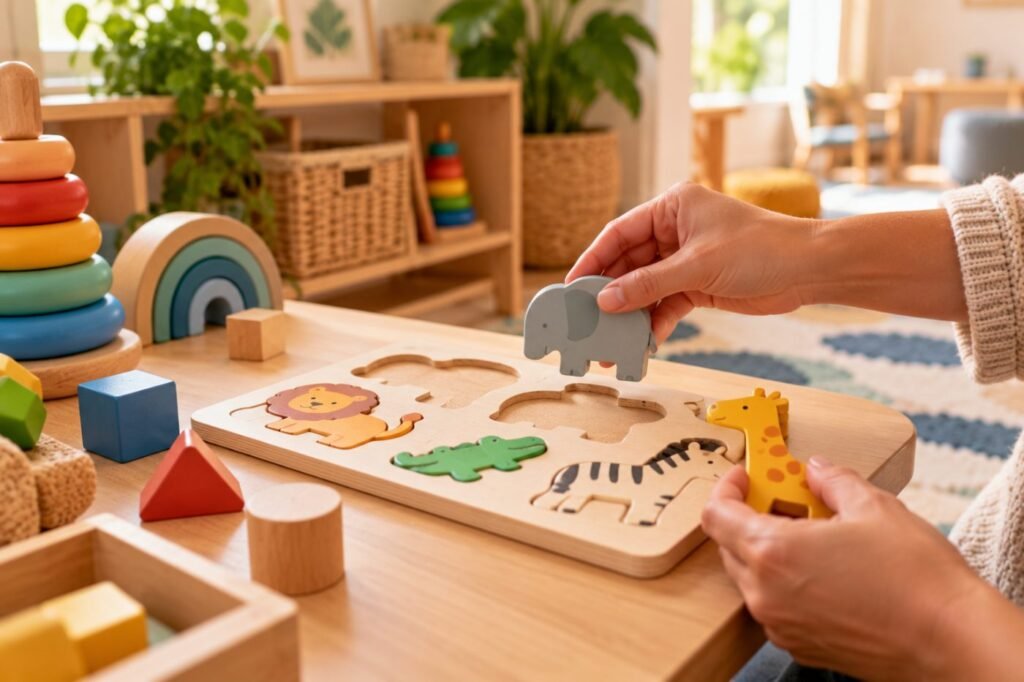
| 7. Puzzles | Keep pieces in your hand so your child asks |
| 8. Pretend play | Feed a doll: “baby eat,” “baby sleep” |
| 9. Sabotage | Give a cup without juice and wait |
| 10. Animal sounds | Easy sounds before words: “moo,” “baa” |
| 11. Clear containers | Toys inside a jar your child cannot open |
| 12. Self-talk | Describe what you do: “I cut, I stir” |
| 13. Parallel talk | Describe what your child does: “You jump!” |
| 14. Signs and gestures | Pair “more,” “all done,” “help” with signs |
| 15. Photo book | Pictures of family and favorite things to name |
A Simple Daily Plan
Five talk moments a day
Expansion examples
Child: “Dog.” You: “Big dog!” Child: “Car go.” You: “Red car go fast!” Child: “Juice.” You: “More juice, please.”
What to Avoid
- Saying “say this” again and again; it creates pressure.
- Asking question after question; comment more than you ask.
- Anticipating every need before your child communicates.
- Background TV during play; it reduces talk.
- Comparing your child with siblings in front of them.
Learn more in speech delay and screen time.
Real-Life Example
Case story
Ethan, 26 months, used 25 words. His parents stopped asking “what’s this?” and began commenting and waiting. They added bubbles and “ready, set, go” games at the same time each day. Within eight weeks, Ethan was combining words like “more bubble” and “daddy go.”
Related: See late talkers and early intervention services.
Speech Therapy at Home FAQ
How long should I practice each day?
Short moments add up: several 5 to 10 minute play times plus daily routines.
Can I do speech therapy at home without a therapist?
You can use these strategies, but an evaluation guides goals and rules out other needs.
Do speech apps help toddlers?
Real interaction teaches more than apps for toddlers.
Should I use baby sign?
Yes. Signs and gestures support, not replace, spoken words.
What if my child does not respond?
Keep modeling without pressure and share this with your therapist.
In short: Speech therapy at home is about responsive moments in everyday life. Observe, wait, listen and add one word. This article is part of our Speech Delay series.
Was this article helpful?
Tap a star to rate
Sources
- The Hanen Centre. Waiting: The Key to Supporting Your Child’s Communication
- ASHA. Childhood Spoken Language Disorders
- ASHA Practice Portal. Late Language Emergence
This article is educational and does not replace professional advice.

