About this assistive technology guide: A complete, practical assistive technology guide for students with disabilities: what counts as AT, how to get it written into the IEP, how assessments work, low-tech and free tools, AT for reading, writing, math and executive function, choosing an AAC device, AT for autism, ADHD and physical disabilities, using AT at home and how to pay for it. Each article includes tables, diagrams, scripts and real-life examples.
What This Assistive Technology Guide Covers
This assistive technology guide brings together everything parents, teachers and therapists need to find, request and use the right tools. Under IDEA, an assistive technology device is any item, piece of equipment or product system used to increase, maintain or improve the functional capabilities of a child with a disability, and schools must consider AT for every student with an IEP (IDEA, 34 CFR 300.105). Federal guidance from 2024 also reminds schools that AT can be low tech or high tech and that it must be provided at no cost to families when the IEP team decides it is needed (OSEP, 2024).
How to Use This Assistive Technology Guide
Start with the basics if you are new to AT: what it is, how it gets written into the IEP and how an assistive technology assessment works. Then jump to the subject or need that matches your student: reading, writing, math, executive function, communication, autism, ADHD or physical access. Finish with the practical articles on free tools, using AT at home and funding, so the right device actually reaches the student and stays in use.
- Parents: read the IEP, assessment and funding articles before your next meeting.
- Teachers: start with low-tech and free tools you can use tomorrow.
- Therapists: use the AAC and physical access articles to guide trials.
- Teens: explore tools that build independence for college and work.
Find the right article
| Level | Examples | Typical cost |
|---|---|---|
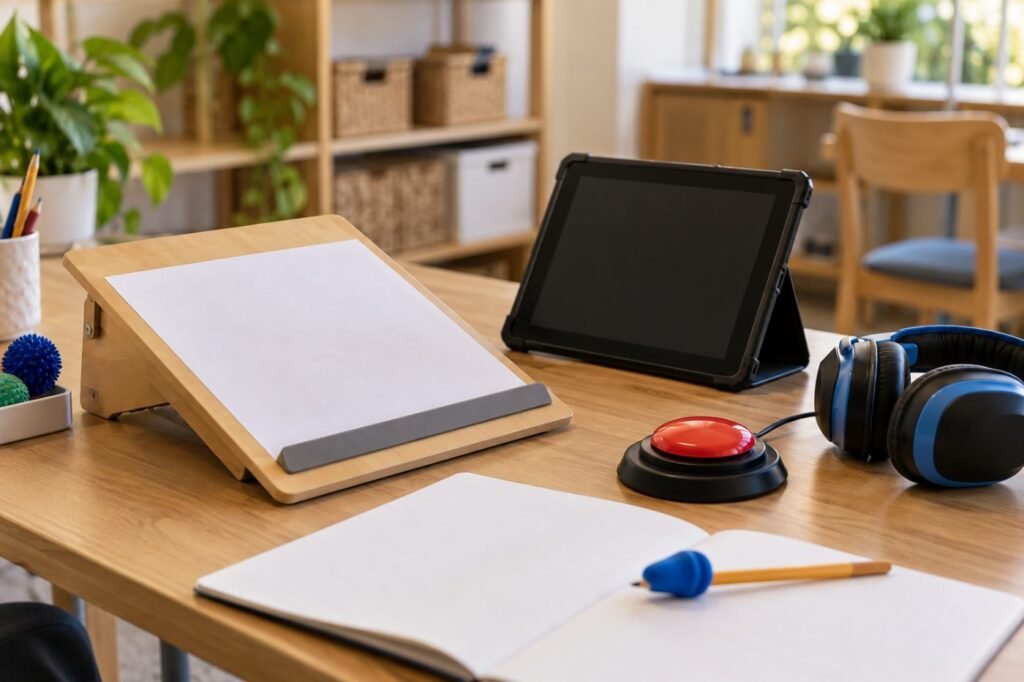
| Low tech | Pencil grips, slant boards, picture schedules, reading guides | Free to low |
| Mid tech | Calculators, reading pens, timers, simple switches | Moderate |
| High tech | Text-to-speech software, speech-generating devices, eye gaze | Higher; often school or Medicaid funded |
| Built-in | Read aloud, voice typing, magnifier, captions | Free on most devices |
All 16 Articles in the Assistive Technology Series
- Assistive Technology in Special Education: The Complete 2026 Guide for Parents and Teachers
Definitions, examples, IDEA rules and how to get AT. - Assistive Technology in the IEP: 7 Essential Steps to Get It Written In (2026)
The special factor, sample wording, AT services and home use. - Assistive Technology Assessment: A Simple 5-Step Guide Using the SETT Framework (2026)
Who evaluates, the SETT framework, trials and data. - Low-Tech Assistive Technology: 25 Proven Tools for the Classroom (2026)
25 simple, affordable tools for every subject. - Assistive Technology for Reading: 9 Powerful Tools for Dyslexia and Struggling Readers (2026)
Text-to-speech, audiobooks, Bookshare and reading pens. - Assistive Technology for Writing: 8 Smart Tools for Dysgraphia (2026)
Speech-to-text, word prediction and adapted tools for dysgraphia. - Assistive Technology for Math: 10 Effective Tools for Dyscalculia (2026)
Manipulatives, calculators and math notation tools. - Assistive Technology for Executive Function: 9 Helpful Tools for Planning (2026)
Timers, planners and reminders for planning and starting work. - Choosing an AAC Device: 7 Essential Questions to Ask (2026)
Types of AAC, feature matching, trials and myths. - AAC in the Classroom
How to support AAC users every day at school. - Assistive Technology for Autism: 10 Proven Tools for School and Home (2026)
Visual supports, AAC, sensory tools and video modeling. - Assistive Technology for ADHD: 10 Practical Tools That Really Work (2026)
Timers, reminders and focus tools that make time visible. - Assistive Technology for Physical Disabilities: 8 Essential Access Tools (2026)
Switches, eye gaze, adapted keyboards and positioning. - Free Assistive Technology Tools: 20 Amazing Options Already on Your Devices (2026)
Built-in read aloud, voice typing, Immersive Reader and free loans. - Assistive Technology at Home: 7 Simple Ways to Keep Tools Working (2026)
Home use rights, family training and daily routines. - Assistive Technology Funding: 7 Proven Ways to Pay for Devices (2026)
School, Medicaid, insurance, VR and state loan programs.
Explore Other IEPfocus Series
- Teaching Strategies guide
- Disabilities Less Covered guide
- Executive Function guide
- Dyslexia guide
- All complete guides
This guide is educational and does not replace professional advice.