Oppositional Defiant Disorder doesn’t end in childhood. Discover the neurological roots, real symptoms, and evidence-based strategies for adults with ODD — plus a recommended visual guide by BERMED.
01 — What Is ODD in Adults?
For decades, Oppositional Defiant Disorder (ODD) was considered a childhood-only condition — a turbulent phase that children simply grow out of. Current clinical research tells a very different story.
The DSM-5-TR defines ODD as a disruptive behavior disorder characterized by a persistent pattern of angry or irritable mood, argumentative or defiant behavior, and vindictiveness, lasting at least six months. This pattern must appear in at least two different settings and involve people other than siblings.
Adult ODD differs from Conduct Disorder in that individuals do not typically show aggression toward strangers, destruction of property, or widespread antisocial behavior. The disturbance is targeted, relational, and emotionally driven — making it easier to miss and harder to diagnose in adulthood.
What the recent scientific literature makes clear is that ODD persists into adulthood for a significant proportion of individuals — and that these adults remain profoundly misunderstood. They are routinely labeled as “difficult,” “toxic,” or “impossible to work with,” when in reality they are living with an unrecognized neurological profile that deserves clinical understanding, not moral judgment.
ODD in adults is not a personality defect. It reflects a specific neurodevelopmental pattern involving disrupted emotional regulation circuits, altered reward and punishment processing, and often a history of adverse early experiences — all of which shape the brain in ways that are measurable and real.
02 — Key Statistics and Prevalence
These figures, drawn from peer-reviewed studies published in PubMed and the Journal of Attention Disorders, dismantle the assumption that ODD is a transient childhood condition. In adults, it represents a clinically significant reality that is frequently masked by other diagnoses or dismissed entirely.
Adults learn to mask their symptoms, manage their reactions in some contexts (the workplace, for example), and rationalize their outbursts. As a result, they typically present to clinicians with depression, anxiety, or relationship problems — never ODD. The disorder slips below the radar of practitioners not trained to recognize its adult presentation.
03 — Adult Symptoms: What It Actually Looks Like
ODD symptoms in adults do not resemble a child having a meltdown. They are subtler, more context-specific, and frequently mistaken for personality traits. Here is how they manifest in everyday life:
Chronic Irritability
Feeling permanently on edge. Reacting disproportionately to minor frustrations — traffic, an offhand comment, an unexpected schedule change.
Resistance to Authority
Deep difficulty accepting rules perceived as arbitrary. A persistent tendency to challenge the instructions of supervisors or authority figures.
Compulsive Arguing
An overwhelming need to have the last word and defend a position until the other person gives up — even on trivial matters with no real stakes.
Vindictive Behavior
Difficulty letting go of perceived offenses. A tendency to keep score and to plan or carry out retaliation, even in passive or subtle ways.
Externalizing Blame
A consistent inability to take responsibility for one’s own mistakes. Others are systematically identified as the source of problems.
Persistent Sense of Injustice
A lasting feeling of being misunderstood, undervalued, or treated unfairly — even when objective evidence contradicts this perception.
“Adults with ODD do not choose to feel angry all the time. They feel misunderstood, hemmed in, and pushed around — and they react to a very real emotional threat, even when their environment does not validate it.”
Integrative clinical perspective, IEPFOCUS.COMWhat is essential to grasp is the gap between what others observe and what the person is actually experiencing. From the outside: defiance, obstruction, aggression. From the inside: intense emotional overload, an unbearable sense of injustice, and an automatic survival response over which they have little conscious control.
04 — The Neurological Basis: It Is Not a Character Flaw
One of the most important advances in ODD research is the identification of its neurobiological substrates. Understanding these mechanisms is essential to dismantling the moral judgment that surrounds this disorder.
Disrupted Punishment Processing
Research published in StatPearls (NCBI, updated October 2024) and confirmed by multiple neuroimaging studies has identified a deficit in the processing of punishment and reward signals in disruptive behavior disorders including ODD. This deficit is mediated by the autonomic nervous system and involves dysregulation of serotonin, norepinephrine, and cortisol pathways.
Individuals with ODD show reduced sensitivity to punishment signals (disrupted fear conditioning), response perseveration (difficulty stopping a behavior even when it produces negative outcomes), and atypically low baseline cortisol levels in males. These are neurobiological characteristics, not moral ones.
Emotional Dysregulation and Prefrontal Circuits
The emotional dysregulation at the core of ODD shares mechanisms with that seen in adult ADHD. Studies published in PLOS ONE (2023) and Frontiers in Psychiatry (2024) show that affected adults use significantly more maladaptive emotion regulation strategies, and that this dysregulation correlates directly with symptom severity and executive functioning deficits.
| Brain Region Involved | Altered Function | Behavioral Manifestation |
|---|---|---|
| Prefrontal cortex | Inhibitory control, decision-making | Impulsive responses, difficulty stopping |
| Amygdala | Threat detection, emotional responses | Hypervigilance, intense emotional reactivity |
| Limbic system | Emotional regulation, experiential memory | Chronic irritability, persistent grudges |
| HPA axis (cortisol) | Stress response, nervous system regulation | Heightened stress reactivity, slow recovery |
These converging findings make one thing clear: ODD is not a matter of willpower or “bad character.” It arises from a specific neurological profile shaped by genetics, environment, and early experience — a profile that deserves clinical recognition, not social condemnation.
05 — ODD and Comorbidities: ADHD, Anxiety, Trauma
Adult ODD rarely appears in isolation. It frequently co-occurs with other conditions, which complicates the clinical picture and often delays appropriate diagnosis for years.
ODD and ADHD: A Very Common Pairing
The ODD-ADHD comorbidity is one of the most documented in adult psychiatry. A major clinical study published in PubMed found that among adults with a confirmed ADHD diagnosis, 69% met ODD criteria at some point in their lives — either in childhood, in adulthood, or both. These individuals showed significantly greater impairment on measures of personality functioning, substance abuse, and treatment response.
Adults combining ADHD and a history of ODD have higher rates of bipolar disorder, multiple anxiety disorders, and substance-related conditions compared to adults with ADHD alone. This profile requires integrated clinical management that addresses both dimensions simultaneously.
The Role of Developmental Trauma
Environmental factors play a considerable role in ODD expression. Physical maltreatment, family instability, inconsistent parenting, and aversive school environments have all been identified as significant risk factors. This is not about assigning blame — it is about recognizing how context shapes the developing brain of a vulnerable child.
In adults, these early experiences often manifest as rigid relational patterns, extreme sensitivity to perceived criticism, and emotional reactivity that can be mistaken — incorrectly — for manipulation or bad faith.
06 — Impact on Work and Relationships
Unrecognized and untreated adult ODD carries deep, measurable consequences for quality of life. A longitudinal study published in the Journal of Attention Disorders (2024), drawing on the Northern Finland Birth Cohort 1986, quantified these impacts with precision.
| Life Domain | Observed Impact | Context |
|---|---|---|
| Employment | Higher unemployment rates, more sick days | Especially marked in males |
| Workplace relationships | Recurring conflicts with supervisors, dismissals | Resistance to authority perceived as arbitrary |
| Romantic relationships | Frequent separations, intense couple conflict | Compulsive arguing, perceived disrespect |
| Social circle | Progressive isolation, negative social labeling | Reputation as “a difficult person,” social avoidance |
| Mental health | Secondary depression, chronic anxiety | Consequence of repeated failures and misunderstanding |
What is particularly painful in these trajectories is the self-reinforcing spiral that unidentified ODD generates: oppositional behaviors provoke negative reactions from the environment, which fuel the sense of injustice, which intensifies the oppositional behaviors. Without intervention, this cycle can drive an entire lifetime of unnecessary suffering.
Understanding the neurological origin of ODD behaviors allows us to shift from a punitive response — which amplifies symptoms — to a therapeutic and understanding one, which is far more effective in the long run for everyone involved.
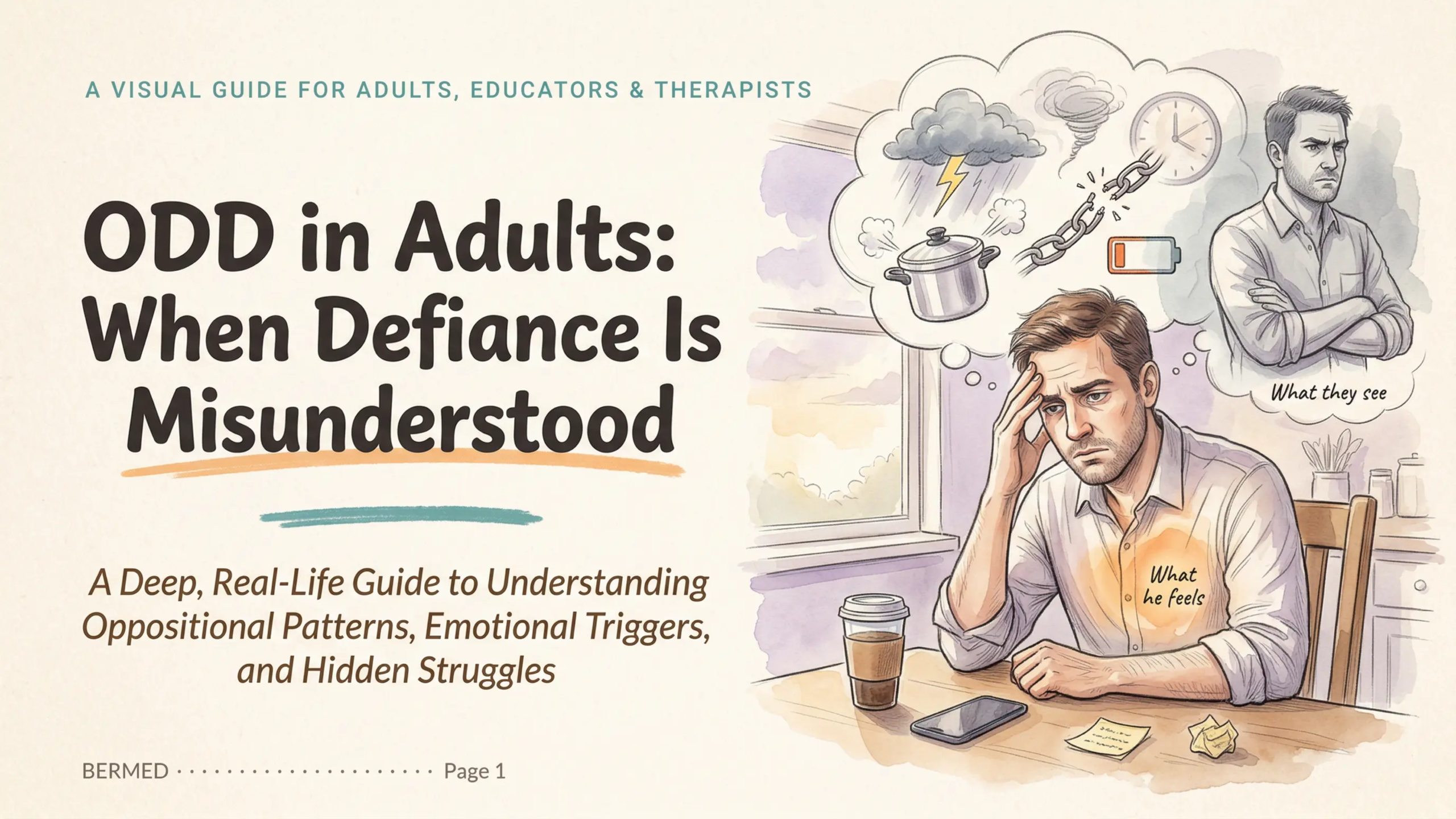
ODD in Adults: When Defiance Is Misunderstood — A 39-page visual guide by BERMED | IEPFOCUS.COM
🎯 Recommended Visual Guide · BERMED
ODD in Adults: When Defiance Is Misunderstood
A deep, 39-page visual guide designed for adults, educators, and therapists. Covers 7 chapters — from understanding adult ODD to inner work and long-term change — with rich neuroaffirmative illustrations and a clinically grounded approach.
Available on TeachersPayTeachers
07 — What Actually Helps: Evidence-Based Strategies
The good news is that adult ODD responds well to targeted interventions — provided those interventions are properly adapted to the neurological profile involved. Current research points to several complementary approaches.
Psychotherapeutic Interventions
-
🧠
Adapted Cognitive Behavioral Therapy (CBT)
CBT focused on emotional regulation shows solid results. It helps identify automatic thought patterns that trigger oppositional responses and develop alternative self-regulation strategies. -
💬
Dialectical Behavior Therapy (DBT)
Particularly effective for profiles with strong emotional dysregulation, DBT teaches distress tolerance, mindfulness, and interpersonal effectiveness skills — tools directly transferable to ODD triggering situations. -
🤝
Schema Therapy
For adults whose ODD is rooted in early traumatic experiences, schema therapy allows identification and modification of early maladaptive schemas that fuel oppositional behavior at a deep structural level. -
🌿
Arousal-Reducing Practices (Mindfulness, Breathing)
Recent meta-analyses confirm that arousal-decreasing activities — deep breathing, meditation, yoga — represent effective interventions for reducing chronic irritability, acting directly on the overactivated autonomic nervous system.
For Family Members and Professionals
-
🚫
Avoid Direct Confrontations and Ultimatums
Escalating into a confrontational dynamic is counterproductive with ODD profiles. Offering genuine choices, reframing in terms of needs rather than demands, and reducing perceived control pressure are all concrete levers. -
🔍
Look for the Cause Behind the Behavior
Behind every oppositional behavior lies an identifiable emotional trigger: sensory overload, a sense of injustice, exhaustion, masked anxiety. Identifying that trigger transforms the environment’s response entirely. -
📚
Build Neuroaffirmative Understanding of ODD
For therapists, educators, and family members, accessing quality visual and clinical resources is the first step. Well-structured guides provide a shared framework for communicating, understanding, and acting consistently.
Pharmacological Considerations
There is no medication specifically approved for ODD. However, when ODD co-occurs with ADHD, appropriate ADHD treatment (including methylphenidate) has been shown in several controlled clinical trials to significantly reduce associated ODD symptoms — offering meaningful relief on both fronts simultaneously.
Exclusively disciplinary approaches based on consequences and punishment have shown limited — and often counterproductive — effectiveness with ODD profiles. They fuel the irritability-confrontation-escalation cycle. The neuroaffirmative approach is both clinically more effective and ethically more sound.
08 — Recommended Resource: The BERMED Visual Guide
Whether you are an adult living with ODD, a therapist, a special education professional, or a family member of someone with this profile, the following resource stands as an essential clinical reference.
📖 Professional Visual Guide · 39 Pages
ODD in Adults: When Defiance Is Misunderstood
This comprehensive guide by BERMED covers 7 essential chapters: understanding adult ODD (pages 3-8), the internal experience (pages 9-14), daily life impact (pages 15-20), what makes it worse (pages 21-25), what helps (pages 26-32), inner work (pages 33-36), and long-term change (pages 37-39). Designed with immersive neuroaffirmative illustrations, it offers both clinical depth and accessibility for non-specialists.
TeachersPayTeachers · BERMED Store
What This Guide Covers
| Chapter | Pages | What You Will Find |
|---|---|---|
| 01 — Understanding Adult ODD | 3-8 | Definition, signs, myths debunked, neurological profile |
| 02 — The Internal Experience | 9-14 | What the person feels from the inside — illustrated and explained |
| 03 — Daily Life Impact | 15-20 | Work, relationships, family life, day-to-day management |
| 04 — What Makes It Worse | 21-25 | Triggers, environments, toxic relational patterns |
| 05 — What Helps | 26-32 | Practical strategies, tools, adapted therapeutic approaches |
| 06 — Inner Work | 33-36 | Self-awareness, deep schemas, emotional reconstruction |
| 07 — Long-Term Change | 37-39 | Long-term perspectives, sustaining progress, grounded hope |
This guide is especially recommended for therapists and psychologists working with neurodivergent adults, special education teachers and school counselors supporting adolescents and young adults with ODD, and adults with ODD and their families who want to understand this reality from the inside out.
Conclusion: Understanding as the First Step
Adult ODD is a real, neurobiologically grounded disorder that remains profoundly misunderstood. What looks like stubbornness, aggression, or bad faith is often the expression of a brain in a state of permanent emotional overload — a brain responding to a perceived threat with the limited tools it has available.
Current scientific research gives us the keys to understand these mechanisms. What we do with that knowledge — as clinicians, educators, family members, and society — determines whether these adults finally find the support they need, or continue to navigate alone through a world that judges them instead of seeing them.
Defiance is not a choice. It is often a distress signal. Changing how we see adult ODD is the first therapeutic act.
Scientific References
- [1] Searight, H.R. et al. (2024). Oppositional Defiant Disorder. StatPearls, NCBI Bookshelf. ncbi.nlm.nih.gov
- [2] Biederman, J. et al. (2007). Is oppositional defiant disorder a meaningful diagnosis in adults? PubMed. pubmed.ncbi.nlm.nih.gov
- [3] Seppä, S. et al. (2024). Associations of Symptoms of ADHD and ODD in Adolescence With Occupational Outcomes. Journal of Attention Disorders. journals.sagepub.com
- [4] Reimherr, F.W. et al. (2011). Oppositional defiant disorder in adults with ADHD. PubMed. pubmed.ncbi.nlm.nih.gov
- [5] Soler-Gutiérrez, A.M. et al. (2023). Evidence of emotion dysregulation as a core symptom of adult ADHD. PLOS ONE. journals.plos.org
- [6] Huang, J. et al. (2024). The impact of emotional dysregulation in adults with ADHD. Frontiers in Psychiatry. frontiersin.org
- [7] Whelan, Y.M. et al. (2025). On the regulation and dysregulation of emotions in child psychopathology. PMC. pmc.ncbi.nlm.nih.gov
- [8] Gnanavel, S. et al. (2017). Oppositional defiant disorder: current insight. PMC. pmc.ncbi.nlm.nih.gov
- [9] Wikipedia contributors. (2026). Oppositional defiant disorder. en.wikipedia.org
- [10] BERMED. (2026). ODD in Adults: When Defiance Is Misunderstood. IEPFOCUS.COM / TeachersPayTeachers. teacherspayteachers.com