
Quick answer: Declarative language for PDA means commenting, wondering, and sharing observations instead of giving direct instructions or asking test questions. “I notice your shoes are by the door” lands very differently from “Put your shoes on.” Speech-language pathologist Linda K. Murphy, author of the Declarative Language Handbook, describes it as commenting rather than commanding. For children with a PDA profile, it lowers the sense of demand, reduces power struggles, and invites them to think and choose.
In this guide
“Brush your teeth.” “Come to dinner.” “Can you tell Grandma thank you?” Most of us speak to children in a steady stream of instructions and questions without noticing. For a child with a PDA profile, each one can feel like pressure, and pressure triggers avoidance. Declarative language for PDA is one of the simplest changes a family can make, and one of the most powerful.

What Is Declarative Language?
Declarative language shares a thought, observation, memory, or feeling. It does not require a specific answer or action. Imperative language does: it tells, asks, or tests.
In an interview with Tilt Parenting, Linda K. Murphy, a speech-language pathologist and author of the Declarative Language Handbook, described it as a thoughtful communication style built on understanding, patience, respect, and kindness. She also points out that questions often hide demands, because the child has to come up with the “right” answer.
Key point: Declarative language does not remove expectations. It changes how they are shared, so the child has space to notice, think, and choose for themselves.
Why Declarative Language Helps Children With PDA
The PDA Society describes PDA as an autism profile driven by anxiety and a need for control, where even enjoyable demands can be avoided. Direct demands can set off fight, flight, or freeze. Declarative language helps because it:
- Lowers the feeling of being controlled
- Leaves room for the child to decide
- Reduces power struggles and meltdowns
- Builds problem solving and independence
- Keeps the relationship warm and collaborative
Read more about the anxiety behind avoidance in PDA and anxiety, and about the profile itself in PDA profile autism.
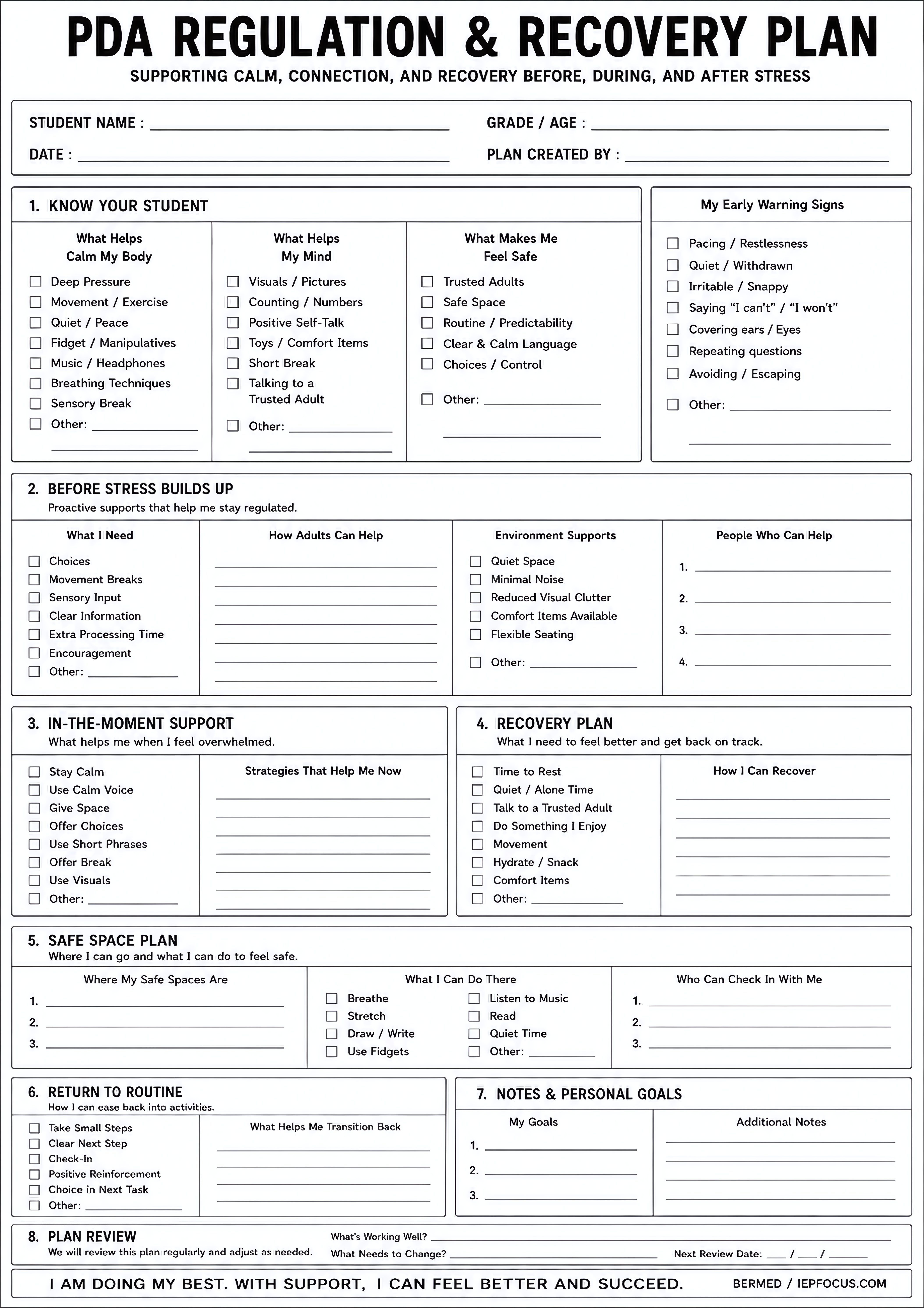
Free resource
PDA Regulation & Recovery Plan
A calm plan for connection, regulation and recovery after hard moments.
Imperative vs Declarative: Everyday Examples
| Imperative (demand) | Declarative (invitation) |
|---|---|
| Put your shoes on. | I see your shoes are waiting by the door. |
| Turn off the TV, it’s dinner time. | Dinner smells ready. I wonder when this episode ends. |
| Clean up your toys. | Those blocks look like they’d fit in this box. |
| What color is this? | I love this blue. It reminds me of the ocean. |
| Say thank you. | Grandma looked so happy when she gave you that. |
| Hurry up, we’re late! | The clock says we have five minutes. I’m grabbing my keys. |

The BERMED Declarative Framework
A simple way to practice declarative language for PDA.
- B: Breathe and pause. Before speaking, notice if you are about to give a command.
- E: Express what you notice. “I notice…” “I see…” “I hear…”
- R: Reflect aloud. “I wonder…” “I’m thinking…” “I remember…”
- M: Model, don’t direct. Start the task yourself and narrate it.
- E: Extend wait time. Silence gives your child space to process and act.
- D: Drop the follow-up demand. If they do not respond, let it be for now.
Using Declarative Language in Daily Routines
Mornings: “I’m putting my coat on. It feels chilly out there today.”
Mealtimes: “I made pasta. There’s extra cheese on the table if anyone wants it.”
Transitions: “I noticed the timer is almost done. I’m going to start the bath.”
Bedtime: “I’m getting sleepy. I wonder which book we’ll read tonight.”
Hard moments: “That was really hard. I’m right here when you’re ready.”

Do
- Use “I” statements and observations
- Narrate what you are doing
- Allow silence and time
- Use humor and playfulness
Avoid
- Questions with a “right” answer
- Turning comments into hidden commands with tone
- Repeating the comment over and over
- Expecting instant results
Tips When It Feels Awkward
Declarative language can feel strange at first. Start with one routine, like mornings. Notice which phrases feel natural to you. Expect your child to test whether the change is real. It pairs well with low demand parenting, and our list of PDA strategies for parents has more ideas.
Teachers can use the same approach at school. Share this guide alongside PDA in the classroom so home and school speak the same language. Find all our PDA guides in the PDA Hub.
Safety first: When safety is at risk, short, clear direct language is still right. Declarative language is for everyday life, not emergencies.
What is declarative language for PDA?
Declarative language for PDA means sharing observations, thoughts, and feelings instead of giving commands or asking test questions, so a child with PDA feels less pressure and more control.
What is the difference between imperative and declarative language?
Imperative language tells, asks, or tests and expects a specific response. Declarative language comments or wonders aloud and leaves room for the child to decide how to respond.
Does declarative language mean no expectations?
No. Expectations still exist, but they are shared indirectly through observations and modeling, which feels less like a demand.
Who created declarative language for autism?
The approach is closely associated with speech-language pathologist Linda K. Murphy, author of the Declarative Language Handbook, and comes from relationship-based approaches like RDI.
Can teachers use declarative language?
Yes. Teachers can comment, wonder aloud, and narrate instead of giving direct instructions, which helps many students with PDA engage in learning.
5 Actions to Take This Week
- Notice how many commands you give in one hour.
- Rewrite your five most common instructions as observations.
- Practice “I notice” and “I wonder” in one routine.
- Add three seconds of wait time after you speak.
- Share the approach with your child’s teacher.
Sources

