Most SPED teachers encounter this situation: a student, often nonverbal, often autistic, is constantly putting unsafe objects in their mouth. Pencils, clothing tags, gravel, toy parts, paper corners. You redirect. You pry. You worry. And the behavior continues, or escalates.
What few classroom guides acknowledge is that non-food mouthing in autism is not a single behavior with a single cause. Before you can support a student effectively, you need to understand what the behavior is doing for them, because the intervention for sensory-seeking looks nothing like the intervention for socially-reinforced behavior.
This guide walks through the full picture: neuroscience, function-based assessment, classroom strategies, family resources, and a clear decision protocol, all grounded in a neuroaffirmative, non-punitive framework.
Why autistic students mouth non-food objects
The mouth is one of the most neurologically rich sensory organs in the human body. For many autistic individuals, oral sensory input, pressure, texture, temperature, vibration, provides a form of proprioceptive regulation that other body parts cannot replicate as efficiently.
Occupational therapists call this oral proprioception: the sense of where the jaw, tongue, and teeth are in space, and the deep pressure feedback generated by chewing, biting, or sucking. For a sensory-seeking nervous system, this input can be organizing and calming in a way that no verbal instruction can override.
The four most common functions of non-food mouthing
Before labeling a behavior as “pica” or “attention-seeking,” it’s essential to consider all possible functions:
- Sensory regulation (automatic positive reinforcement): The input itself is rewarding. The student is not doing it for a social outcome, they are doing it because it feels regulating, stimulating, or soothing. This is the most common function in younger autistic children.
- Communication of distress or unmet need: Mouthing spikes during transitions, noisy environments, or demand-heavy tasks. The behavior communicates “I am overwhelmed” when words or AAC aren’t available or fast enough.
- Social access (attention-seeking): The behavior produces a reliable, intense, and often entertaining adult response, gasping, rushing over, physical contact. For a nonverbal student with limited social interaction, this can become a powerful tool for connection.
- Escape/avoidance: The disruption caused by the behavior reliably ends an unwanted demand. The student learns that mouthing a pencil pauses the worksheet.
When it’s about the reaction: social reinforcement
This is the scenario many teachers find most confusing, and most exhausting. The student is clearly not distressed. They are laughing. They wait until staff are watching, then place the object in their mouth. When staff move to retrieve it, they clamp down, make eye contact, and seem genuinely delighted.
This is textbook socially-maintained behavior, and it is remarkably common in nonverbal autistic students who have learned that their conventional communication attempts (gestures, vocalizations, AAC) produce slow or unpredictable adult responses, but that putting something dangerous in their mouth produces an immediate, guaranteed, high-energy interaction.
The student is not being malicious. They have discovered one of the most efficient social tools available to them. From a behavioral standpoint, every dramatic redirection, however necessary for safety, is a reinforcer. The behavior is being maintained by the very responses designed to stop it.
Why a functional behavior assessment must come first
A Functional Behavior Assessment (FBA) is not optional when a behavior poses safety risks and has persisted across settings and years. It is the foundation of any ethical, effective intervention plan.
An FBA for non-food mouthing should answer:
- When does the behavior occur most (antecedents)?
- What happens immediately after (consequences)?
- Who is present? What activity is occurring?
- Does it occur when the student is alone, or only when staff are present?
- What is the student’s affect during the behavior (distressed vs. regulated vs. playful)?
- Has the behavior changed in frequency, intensity, or form over time?
For the student described in this scenario, laughing, waiting for eye contact, locking jaw, the FBA will almost certainly confirm a social positive reinforcement function. This means the Behavior Intervention Plan (BIP) must include a competing communication pathway (what can they do instead that produces equally reliable, equally intense social connection?) and a deliberate consequence protocol that removes the social payoff without increasing danger.
IN CLASS: What SPED teachers can do
1. Implement a low-arousal response protocol
The single most important change most classrooms need to make is reducing the emotional intensity of their response. This does not mean ignoring safety, it means removing the theatrical element that reinforces the behavior.
Instead of rushing, gasping, or using urgent vocal tones, staff should:
- Approach calmly, without running or raised voice
- Use the least-intrusive safe retrieval method without extended physical engagement
- Avoid extended eye contact or narrating the behavior (“We don’t put that in our mouth”)
- Return to the previous activity immediately, without extended repair or discussion
- Reserve extended, warm interaction for safe, communicative behaviors
2. Build proactive dense reinforcement schedules
If the function is social access, the intervention is to make social connection abundant and non-contingent on unsafe behavior. Staff should proactively engage, eye contact, playful interaction, genuine connection, at high rates throughout the day, before the student has to escalate to get it. This is often called a non-contingent reinforcement (NCR) schedule.
3. Invest in AAC access for social initiation
Most AAC systems in classrooms are heavily loaded with requests (food, break, help) and poorly equipped for social connection (“Watch me,” “Come play,” “That’s funny,” “Let’s do this together”). If the student is using mouthing to initiate social interaction, their communication system needs robust social vocabulary, and staff need to respond enthusiastically every time it is used.
4. Sensory substitution for oral seekers
When sensory regulation is a contributing function (even if not the primary one), providing appropriate oral input reduces the behavior’s intensity and frequency:
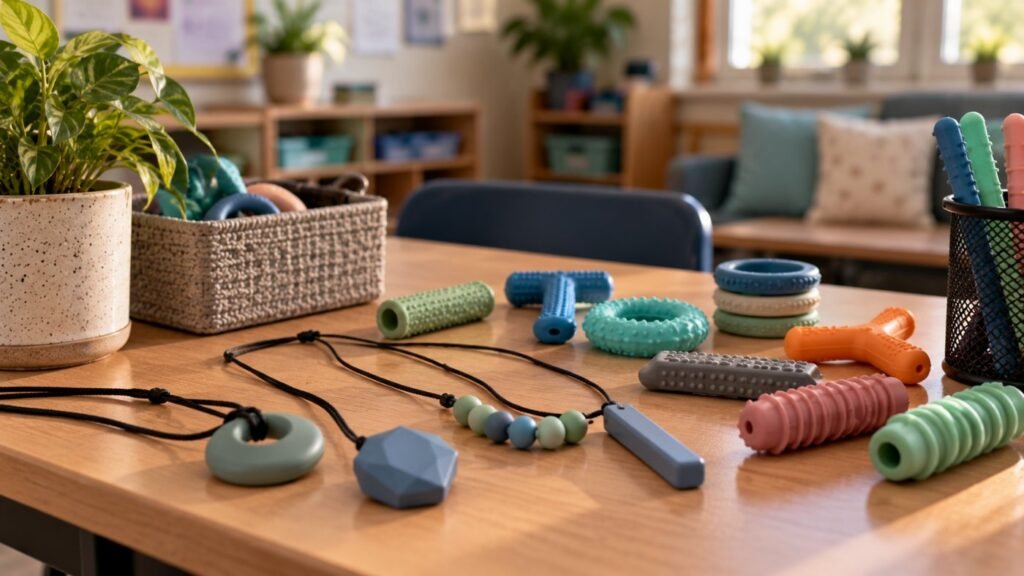
- Chewlery: Must be worn consistently and replaced regularly; introduce it during calm moments, not as a crisis redirect
- Oral motor tools: OT-recommended chewy tubes, vibrating oral tools, resistive drinking through thick straws
- Movement breaks: Heavy work before high-demand periods reduces overall sensory dysregulation
- Environmental audit: Reduce visual and auditory triggers that elevate arousal
5. Environmental modifications
While not a long-term solution, reducing access to high-risk items (loose objects, small parts, paper scraps) reduces immediate danger while the BIP is implemented. This should be a temporary scaffold, not the entire plan.
In Class
Low-arousal response · Dense NCR schedule · Social AAC vocabulary · Oral sensory substitution · Environmental auditAt Home
Consistent response protocol with parents · Safe chewlery at home · OT home program · Communication strategies for familyIn Life
Medical screening (nutritional, GI) · OT eval · SLP for AAC · BCBA for FBA if needed · Occupational safety awarenessAT HOME: Supporting families
Parents are often exhausted, frightened, and have already tried multiple approaches. The most effective family support from the school team involves three things: alignment, resources, and realistic expectations.
Align on the response protocol
If the behavior is socially maintained, inconsistent responses across home and school significantly slow progress. Share the low-arousal protocol with families in writing, with specific, concrete language. Role-play it if possible during a meeting. The goal is that the student receives the same quality of response in both environments.
Resources to share with families
- Understood.org: practical guides for parents navigating behavior support
- American Occupational Therapy Association (AOTA): OT finder and sensory resources
- ASHA (American Speech-Language-Hearing Association): SLP and AAC resources for nonverbal children
- Request a home OT program from the school OT to ensure sensory needs are addressed outside school hours
What to say when families ask about ABA
For families who have tried ABA and experienced regression or increased concerning behaviors, it is important not to dismiss their experience. Acknowledging that ABA is not a universal fit, and that there are effective, evidence-based neuroaffirmative alternatives, is appropriate and honest.
Alternatives worth raising with families include:
- Occupational therapy (sensory integration focus): Directly addresses the sensory regulation piece
- Speech-language therapy with AAC focus: Builds the communication tools that replace dangerous behaviors
- Positive Behavior Support (PBS): Function-based, non-punitive framework aligned with IDEA
- DIR/Floortime: Relationship-based approach that addresses social connection needs
LIFE: Medical and therapeutic pathways
When non-food mouthing is chronic, a medical evaluation is warranted, not because the cause is always medical, but because it should be ruled out before assuming behavioral function alone.
Medical screening checklist
- Iron deficiency anemia: One of the most consistently replicated medical correlates of pica; a simple blood panel can confirm or rule this out
- Zinc deficiency: Associated with pica in several studies
- GI distress or pain: Some students mouth objects to relieve oral/jaw discomfort from reflux or dental pain
- Nutritional evaluation: Especially relevant if the student has significant food selectivity (common in autism)
Requesting a pediatric evaluation that explicitly screens for these factors, and sharing the FBA results with the medical team, creates a more complete picture than either system can provide alone.
The BERMED Low-Arousal Response Protocol
BERMED Framework: Responding to Non-Food Mouthing in Real Time
This protocol is designed for socially-maintained non-food mouthing in nonverbal autistic students. It reduces reinforcement of the unsafe behavior while maintaining safety and dignity.
Step 1: Assess before responding. Before moving, briefly note affect and context. Is the student distressed, or playful and watching you? This shapes your response intensity.
Step 2: Approach calmly. Move without urgency. Neutral face, low tone, no rushing. Say nothing or use one brief, flat phrase (“That’s not safe”), never a lecture, never a question.
Step 3: Safe retrieval, minimal engagement. Retrieve the object using the least intrusive method. Avoid prolonged physical contact. Do not narrate, do not express distress, do not make extended eye contact.
Step 4: Immediate redirect to a preferred safe activity. Do not linger at the mouthing event. Offer an alternative that provides oral input (chewlery) or social connection, briefly and warmly, then move on.
Step 5: Proactive reinforcement within 60 seconds. As soon as the student is engaged appropriately, provide warm, enthusiastic social connection, even briefly. This teaches: safe behavior → social payoff.
Step 6: Log and debrief. Record antecedent, behavior, response, and student affect. Patterns in the data will refine the BIP.
Strategy comparison table
| Strategy | Best for (function) | Evidence base | Caution |
|---|---|---|---|
| Chewlery / oral motor tools | Sensory regulation (automatic) | Moderate (OT literature) | Ineffective as primary intervention for socially-maintained behavior |
| Non-contingent reinforcement (NCR) | Social access / attention | Strong (behavior analytic) | Requires consistent staff implementation across all adults |
| Functional Communication Training (FCT) | Communication / escape | Strong (ASHA/IDEA supported) | AAC must be accessible and staff must honor it immediately |
| Low-arousal response protocol | Social access (extinction component) | Strong (PBS literature) | Extinction burst expected; safety plan must be updated accordingly |
| Token economy | Multiple functions | Moderate | Complex to implement with nonverbal students; requires OT/SLP input |
| Environmental modification | All functions (risk reduction) | Indirect / practical | Not a standalone intervention; temporary scaffold only |
| Social stories / videos | Limited value with nonverbal ASD | Weak for this profile | Typically insufficient without pairing with functional interventions |
| Medical evaluation (iron/zinc) | Physiological pica | Strong for medical pica | Should be ruled out for all chronic cases; easy to overlook |
More Support for Non-Food Mouthing in Autistic Students
Frequently asked questions
Is non-food mouthing always pica?
No. Pica is a diagnosable condition involving persistent eating of non-nutritive, non-food substances. Many autistic students who mouth objects are not ingesting them, they are seeking oral sensory input or using the behavior for social or communicative purposes. The distinction matters because treatment differs significantly. A formal medical or psychiatric evaluation is needed to confirm a pica diagnosis.
What if the student laughs when redirected, isn’t that attention-seeking?
Laughing during redirection is a strong indicator of social reinforcement as the maintaining function, yes. But it is important not to interpret this as the student being manipulative or defiant. A nonverbal student who has learned that one behavior produces reliable, intense human engagement is being resourceful, not malicious. The intervention goal is to give them better, safer tools for getting that same social need met.
Should we use physical intervention to retrieve items from the student’s mouth?
Physical interventions carry significant risks, including escalation, injury, and relationship damage, and should be governed by the student’s safety plan, not improvised. If the team does not have a clear, documented protocol for safe retrieval, this is an IEP team and crisis planning issue that needs to be addressed formally, not in the moment.
What therapies work best when ABA hasn’t been a fit?
For nonverbal autistic students with this profile, the strongest combination is: occupational therapy (sensory integration and oral motor focus) + speech-language therapy (AAC development for social communication) + Positive Behavior Support with a proper FBA. DIR/Floortime can also be a strong complement, particularly for building the social connection the student is seeking through safer means.
How do we communicate urgency to parents without alarming them?
Lead with what you are already doing, describe the specific safety concern clearly and factually, and come with at least two concrete next steps for the family to consider. Avoid catastrophizing language while still being honest about risk. A collaborative tone: “We want to figure this out with you”, builds the partnership needed for home-school consistency.
Sources
- Matson, J. L., & Bamburg, J. W. (1999). A descriptive study of pica behavior in persons with mental retardation. Research in Developmental Disabilities, 20(6), 423–431. ScienceDirect
- American Speech-Language-Hearing Association. (2023). Augmentative and alternative communication (AAC). ASHA.org
- American Occupational Therapy Association. (2020). Occupational therapy practice framework: Domain and process (4th ed.). American Journal of Occupational Therapy, 74(Suppl. 2). AOTA.org
- Carr, E. G., et al. (2002). Positive behavior support: Evolution of an applied science. Journal of Positive Behavior Interventions, 4(1), 4–16.
- Hagopian, L. P., et al. (2011). Toward a signal detection theory of disruptive behavior maintained by negative reinforcement. Journal of Applied Behavior Analysis, 44(4), 779–795.
- National Institute of Mental Health. (2023). Autism spectrum disorder. NIMH.nih.gov