In this guide
- Understanding CP in the Classroom
- The Mistake Most Inclusion Teachers Make
- UDL Framework for CP
- Motor Access & Physical Accommodations
- AAC & Communication Supports
- Assistive Technology for Writing & Academics
- IEP Goals for Students with CP
- The Collaborative Service Delivery Model
- Family–School Partnership
- Action Plan: Today, This Week, Long Term
- FAQ
What Does Cerebral Palsy Actually Look Like in a Classroom?
In seventeen years of observing inclusive settings, the single most consistent pattern is this: students with cerebral palsy are routinely underestimated. A child who takes 40 seconds to produce a sentence with her AAC device is seated at a table where the lesson has already moved on. A student with spastic diplegia has a modified worksheet, but nobody checked whether he can hold a pencil for more than three minutes without pain. The accommodations are present on paper. The environment has not actually changed.
Cerebral palsy is the most common physical disability in childhood, affecting approximately 1 in 323 children in the United States, according to the CDC. It is a group of permanent movement and posture disorders caused by non-progressive disturbances in the developing brain, most occurring before or during birth. The word “permanent” does not mean “static”: function, participation, and quality of life can all improve substantially with the right supports.
What makes educational planning genuinely complex is CP’s extraordinary heterogeneity. Two students with the same diagnosis may share almost no educational profile:
| CP Type | Primary Motor Features | Classroom Implications |
|---|---|---|
| Spastic (most common, ~80%) | Increased muscle tone, stiff movements; diplegia (legs), hemiplegia (one side), quadriplegia (all limbs) | Fatigue from sustained effort, positioning critical, handwriting barriers, possible visual impairment |
| Dyskinetic / Athetoid | Fluctuating tone, involuntary writhing or twisting movements | Access device use inconsistent, drooling may affect social inclusion, dysarthria common |
| Ataxic | Poor balance and coordination, wide gait, tremor | Fine motor tasks and self-care require extra time; handwriting often illegible |
| Mixed | Features of more than one type | Highly individualized profile; requires direct OT/PT assessment before any accommodation plan |
Co-occurring conditions are the rule, not the exception. Research published in Developmental Medicine & Child Neurology (NIH/PMC) found that approximately 50% of children with CP also have intellectual disability, 35% have epilepsy, 28% have autism spectrum features, and roughly one in four has a significant visual impairment. Any educational plan that addresses only the motor dimension is, by definition, incomplete.
What Is the Mistake Most Inclusion Teachers Make with CP?
The most pervasive and damaging error in inclusive classrooms is conflating motor limitation with cognitive limitation. A student who cannot produce legible handwriting, who communicates slowly through an AAC device, who requires assistance to navigate the room, that student is frequently given work that is cognitively simplified when what they need is access support, not reduced expectations.
The second most common error is reactive accommodation: waiting until a student fails or struggles visibly before adjusting the environment. By that point, the student has already spent weeks or months working harder than any peer for worse outcomes, often developing anxiety, learned helplessness, or disengagement as a direct result of systemic under-support.
The BERMED framework for CP education rests on a single orienting question: Is this barrier in the student, or in the environment? Almost always, it is the environment. Removing the barrier, not lowering the expectation, is the professional obligation.
How Does Universal Design for Learning Apply to Students with CP?
Universal Design for Learning (UDL) is the structural backbone of any high-quality educational plan for students with cerebral palsy. Its three principles map directly onto the core challenges CP presents:
| UDL Principle | CP-Specific Application | Concrete Example |
|---|---|---|
| Multiple Means of Representation | Deliver content through visual, auditory, and tactile channels; do not rely on board-reading or spoken-only instruction | Provide digital copies of all materials; use text-to-speech for reading tasks; offer visual schedules |
| Multiple Means of Action & Expression | Accept alternate output modalities; never require handwriting as the only response format | Verbal responses, AAC output, switch-activated choices, voice-to-text, eye-gaze technology |
| Multiple Means of Engagement | Build in choice, reduce unnecessary time pressure, support self-regulation and positioning breaks | Movement breaks every 20–30 min; choice boards for task sequence; flexible seating with postural support |
UDL is not a set of individual accommodations, it is a design philosophy that reduces the need for individual accommodations by building flexibility into the environment from the outset. A classroom designed with UDL principles benefits every student, including those whose needs are not yet identified.
What Physical and Motor Accommodations Does a Student with CP Need?
Motor access is the foundation. No cognitive or communication strategy will function if the student cannot maintain a stable, comfortable, and safe position throughout the school day. Postural support is not a comfort preference, it is a prerequisite for learning. The physical therapist’s positioning recommendations must be implemented with fidelity in every classroom environment, including specials, lunch, and transitions.
Positioning and Seating
The PT assessment should specify the correct seating system for each activity context: floor time, tabletop work, computer use, and group instruction may each require different configurations. Key principles include 90-degree hip-knee-ankle alignment, trunk support sufficient to free the hands for functional tasks, and footrest adjustment to prevent extensor thrust. A student who is fighting to maintain upright posture is not available for learning.
Mobility and Navigation
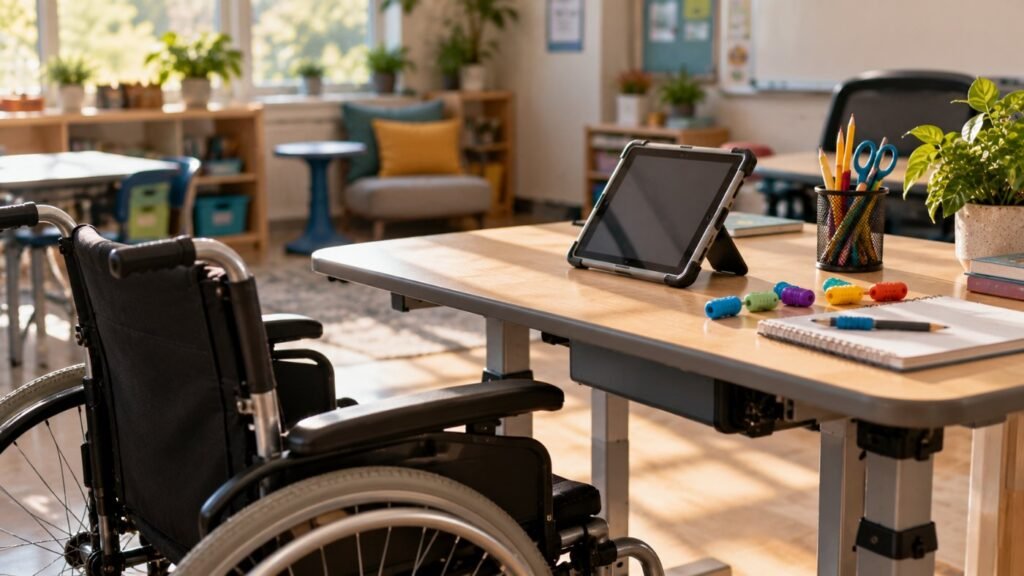
Physical access to the classroom environment means more than a wheelchair-accessible doorway. It means adequate aisle space for power chairs, table height adjustable to the student’s wheelchair tray, a predictable and uncluttered floor plan, and prearranged positions in group settings that include the student rather than park them at the periphery. A physically marginal seat is a socially marginal seat.
Fine Motor Task Adaptations
Fine motor demands are embedded throughout the school day: turning pages, manipulating manipulatives, using scissors, managing fasteners, handling cafeteria trays. OT recommendations for adaptive tools, weighted utensils, adapted scissors, slant boards, pencil grips, mounting hardware for communication devices, must be documented in the IEP and available in every setting where the task occurs. A student should never arrive at an activity and find that the adaptive equipment is in a different room.
| Task | Common Barrier (CP) | Recommended Adaptation |
|---|---|---|
| Handwriting | Spasticity, limited range of motion, fatigue | Slant board + adapted grip; or replace with keyboarding/AAC output entirely |
| Page turning | Unilateral grip difficulty | Page separators (foam dots), single-page presentation, digital materials |
| Scissors | Bilateral coordination | Self-opening adaptive scissors; loop scissors; pre-cut materials |
| Computer mouse | Tremor, limited finger isolation | Trackball, joystick, eye-gaze control, switch scanning |
| Math manipulatives | Dropping, spilling | Tray with raised edges, larger-sized manipulatives, velcro surfaces |
| Self-care (lunch, hygiene) | Motor coordination, fatigue | Adapted utensils, dycem mat, scheduled support staff; privacy respected |
How Do You Support Communication for Students with CP Who Use AAC?
Approximately 25–40% of children with cerebral palsy have speech that is not functional as a primary communication mode, due to dysarthria, apraxia of speech, or co-occurring language disorders. For these students, augmentative and alternative communication (AAC) is not a last resort when speech fails. It is a right-of-first-access communication system that should be introduced as early as possible, long before a student is labeled “not ready.”
The research base on aided language stimulation, the practice of the communication partner modeling AAC use while speaking, is robust. A foundational principle from the American Speech-Language-Hearing Association (ASHA) is that students cannot be expected to use a system that the adults around them never use. Every teacher who works with an AAC user should have access to a communication partner display or light-tech backup that mirrors the student’s device vocabulary.
Classroom AAC Practices
Allow adequate wait time, a minimum of ten seconds after asking a question directed at an AAC user. Ten seconds feels long in a classroom. It is not. Rushing a student who uses scanning or eye-gaze AAC into a faster response mode produces inaccurate output and communicative shutdown. Build wait time into your instructional rhythm by design, not as a reluctant exception.
Ensure that the AAC device is charged, mounted, and accessible at the start of every school day. Device access is not the responsibility of the student. If a communication device arrives without charge, the student has effectively been denied their voice for that day, an outcome that would be recognized as unacceptable if applied to any other disability-related support.
Vocabulary and Participation
Work with the SLP to pre-program vocabulary relevant to upcoming units and social contexts. A student who cannot say “I disagree” or “Can you repeat that?” during a class discussion is communicatively excluded regardless of their physical presence. Core vocabulary (high-frequency, cross-context words) should be consistently available; fringe vocabulary (topic-specific) should be updated proactively in advance of each new unit.
What Assistive Technology Supports Academic Access for Students with CP?
Assistive technology for students with cerebral palsy ranges from no-tech strategies to sophisticated computer access solutions. The AT assessment, conducted by or in consultation with an OT or AT specialist, should identify the appropriate access method for each academic task. “Access method” means: how does this specific student most efficiently produce output, navigate digital environments, and manage the physical demands of academic tasks?
| AT Category | Examples | Best Suited For |
|---|---|---|
| Writing Access | Voice-to-text (Dragon, Google Voice Typing), word prediction (Co:Writer, Snap&Read), adapted keyboard | Students with motor impairment in upper limbs; fatigue-related writing barriers |
| Reading Access | Text-to-speech (Kurzweil, Read&Write, NaturalReader), digital textbooks (Bookshare) | Students with visual impairment, low endurance for physical page management |
| Computer Access | Switch scanning, eye-gaze (Tobii Dynavox), trackball, head mouse, on-screen keyboard | Students with severe upper limb involvement or limited voluntary movement |
| Environmental Control | Smart devices for room controls, switch-adapted materials, power wheelchair interfaces | Students working on autonomy and self-determination goals |
| Organization & Executive Function | Digital calendars, visual timers, apps for assignment tracking, graphic organizer software | Students with co-occurring executive function or cognitive challenges |
One consistent finding in the AT literature: technology that is not embedded into daily instruction is not used. An iPad assigned to a student with CP but kept in a drawer “for special tasks” is not an accommodation, it is a documentation strategy. AT must be integrated into every task where it provides access, and teachers must be trained and supported in facilitating that integration.
What Are Effective IEP Goal Areas for Students with Cerebral Palsy?
IEP goals for students with CP should address the full range of participation, not only fine motor and communication goals, but academic, social, self-determination, and transition objectives. A student whose IEP contains exclusively OT and SLP goals, with no academic goals that reflect grade-aligned content, has been structurally excluded from academic ambition before the school year begins.
Goal Domain Framework
| Domain | Sample SMART Goal Stem |
|---|---|
| Academic Access | Given digital text materials and voice-to-text software, [student] will compose a 3-sentence written response to grade-level reading passages with ≥80% accuracy across 4/5 trials. |
| AAC / Communication | Using her AAC device, [student] will initiate a topic-relevant comment or question in a group discussion setting in 3/5 observed sessions across 8 weeks. |
| Motor / OT Integration | [Student] will independently access his adapted keyboard to complete a 10-word sentence with ≤2 errors in 4/5 trials by [date]. |
| Self-Advocacy | [Student] will verbally or via AAC request a positioning break or AT support from a teacher or aide in 3/4 observed opportunities across a 6-week period. |
| Social Participation | [Student] will initiate a peer interaction (greet, invite to activity, share a comment) in 3 out of 4 unstructured social periods across 6 weeks. |
| Transition / Self-Determination | By [date], [student] will identify 2 personal academic strengths and 2 accommodation preferences and communicate them in a student-led IEP meeting component. |
Baseline data must precede every goal. A goal written without a documented baseline cannot be evaluated, cannot be defended at annual review, and cannot demonstrate growth. Every IEP team member, including the student where age-appropriate, should understand what the baseline shows and what meaningful progress looks like.
How Should the Collaborative Service Delivery Model Work for CP?
Students with cerebral palsy typically receive services from OT, PT, SLP, and special education, and frequently from a vision specialist, AT specialist, and school psychologist as well. The default organizational failure is siloed service delivery: each professional addresses their domain in a pull-out model with limited communication between providers, and the classroom teacher is left to manage the intersections alone.
The gold standard, supported by ASHA, AOTA, and the Council for Exceptional Children, is an integrated, consultative, and collaborative model in which:
Related service providers deliver embedded services within natural classroom routines rather than exclusively in isolated therapy sessions. This means the OT supports handwriting alternatives during writing workshop. The SLP supports AAC use during science lab discussions. The PT supports positioning during carpet time.
A shared communication system, a brief weekly written note, a shared digital log, or a structured team meeting, ensures that every provider knows what is being worked on in other contexts, and that carryover strategies are consistent across environments.
The classroom teacher is treated as a co-implementer, not a passive recipient of service recommendations. This requires that SLP and OT recommendations be written in classroom-actionable language, not clinical jargon, and that training be offered, not assumed.
How Do You Build an Effective Family–School Partnership for a Student with CP?
Families of children with cerebral palsy carry an extraordinary amount of knowledge that the school team does not have: the student’s fatigue patterns across a full day, positioning preferences that work at home, communication strategies that took years to develop, medical history that affects school performance, and a deep understanding of who this person is beyond their disability label. Treating parents as informants, genuine contributors to the educational plan, is both an ethical obligation and a practical necessity.
A realistic family scenario: Marcus is a 10-year-old with spastic quadriplegia and a robust vocabulary. His parents report that he is significantly more alert and communicative between 9 and 11 a.m., and noticeably fatigued by early afternoon. This is not anecdote, it is functional data. A team that schedules Marcus’s most demanding academic work in the afternoon because that is when the inclusion classroom has its reading block has made a scheduling decision that overrides a known biological pattern. The IEP should address scheduling as an accommodation.
Family meetings should include a preview of the student’s current AT setup, a demonstration of AAC vocabulary, and a shared review of goal progress data. Every family member who attends an IEP meeting should leave with a written summary in plain language of what the goals mean, what progress looks like, and what they can do at home to support carryover.
Action Plan: What Can a Teacher Do for a Student with CP Starting Today?
Today
Check that the student’s AAC device is charged and mounted in their primary working position. Identify one handwriting task in today’s schedule and replace it with an equivalent technology-mediated output option. Build in at least two ten-second wait intervals after directing a question to the student.
This Week
Schedule a 30-minute check-in with the student’s OT to review positioning and current AT use. Pull the student’s IEP and identify which accommodations are listed, then audit whether each one is actually implemented daily. Request pre-programmed vocabulary from the SLP for the next curriculum unit.
Long Term
Propose a collaborative service model where at least one related service provider embeds support in the classroom weekly. Develop a student-led component for the next IEP meeting. Build AT use into classroom routines so it is normalized for all students, not marked out as different for one student.
More Resources for Students with Cerebral Palsy
- What is an IEP in education?
- IEP vs 504 plan
- SMART IEP goal examples
- Accommodation cheat sheet for special education
Frequently Asked Questions
Does cerebral palsy always involve intellectual disability?
No. Cerebral palsy is a motor disorder. While co-occurring intellectual disability is present in approximately 50% of individuals with CP, many people with CP have average to above-average cognitive abilities. Motor and speech impairments can cause cognitive abilities to be significantly underestimated if assessment tools rely on verbal or written responses without appropriate access accommodations.
At what age should AAC be introduced for a child with CP?
There is no minimum age, and there is no evidence that introducing AAC delays speech development, in fact, research consistently shows the opposite. AAC should be introduced as soon as a child demonstrates a communication need that exceeds their current motor speech capability, which in many cases of CP is during the toddler years. Early introduction prevents the communication gaps that compound over time.
How do I handle standardized testing accommodations for a student with CP?
Testing accommodations for CP typically include extended time, scribe or speech-to-text for written responses, computer access using the student’s established AT, separate testing location if motor noise is disruptive, and additional breaks. These must be listed explicitly in the IEP and used consistently during instruction, testing-only use of accommodations that are not used in class can be disallowed and is, in any case, poor practice. Coordinate with your district’s assessment office well in advance of standardized testing windows.
What is the difference between a physical therapist’s role and an occupational therapist’s role in CP educational planning?
In school-based practice, the PT focuses primarily on gross motor function, mobility, positioning, and safe navigation of the school environment. The OT focuses on the fine motor, self-care, and AT components that affect participation in educational tasks, handwriting access, feeding, dressing for PE, and computer access. In practice, the roles overlap and require close communication. Neither role is limited to pull-out therapy: both should have a consultative and embedded presence in the classroom.
How do I explain a classmate’s CP to other students?
Use age-appropriate, identity-first language that normalizes difference without dramatizing it. With permission from the student and family, brief classroom conversations can address how the student communicates and what supports they use, framed around access and community, not limitation and pity. Many students with CP are entirely capable of directing this conversation themselves when given the communication access to do so.
Can a student with severe CP participate in general education?
Yes, with appropriate supports, meaningful participation in general education is achievable across the full severity spectrum. “Participation” does not require identical engagement; it requires designed access. A student with severe CP who uses eye-gaze AAC and a specialized seating system can fully participate in a science unit, a literature discussion, or a social studies project when the environment, task design, and communication supports are aligned with their access needs. The question is never whether, it is how.
Related reading:
Part of our complete guide:
- Disabilities Less Covered in School: Complete Guide
- Intellectual Disability in the Classroom
- Developmental Coordination Disorder (Dyspraxia)
Sources
- Centers for Disease Control and Prevention. Cerebral Palsy Data and Statistics. CDC, 2024. cdc.gov/cerebralpalsy
- Novak I, et al. “State of the Evidence Traffic Lights 2019: Systematic Review of Interventions for Preventing and Treating Children with Cerebral Palsy.” Current Neurology and Neuroscience Reports. NIH/PMC, 2020. pmc.ncbi.nlm.nih.gov
- American Speech-Language-Hearing Association. Augmentative and Alternative Communication (AAC): Practice Portal. ASHA, 2024. asha.org
- CAST. Universal Design for Learning Guidelines, Version 2.2. CAST, 2018. udlguidelines.cast.org
- Council for Exceptional Children. High-Leverage Practices in Special Education. CEC, 2017. highleveragepractices.org